Gupta Empire, Founder, Time Period, Rulers, Map, Capital City
How to Use AI for RAS Mains Revision and Note-Making

Get in Touch with RASonly!

Preparing for RAS Mains requires smart revision and well-structured notes. This article explains how aspirants can use AI effectively for RAS Mains revision and note-making. It covers syllabus-based notes, current affairs integration, answer writing support, ethics preparation, and quick revision techniques. When used ethically, AI helps save time, improve clarity, and strengthen conceptual understanding without replacing self-study.

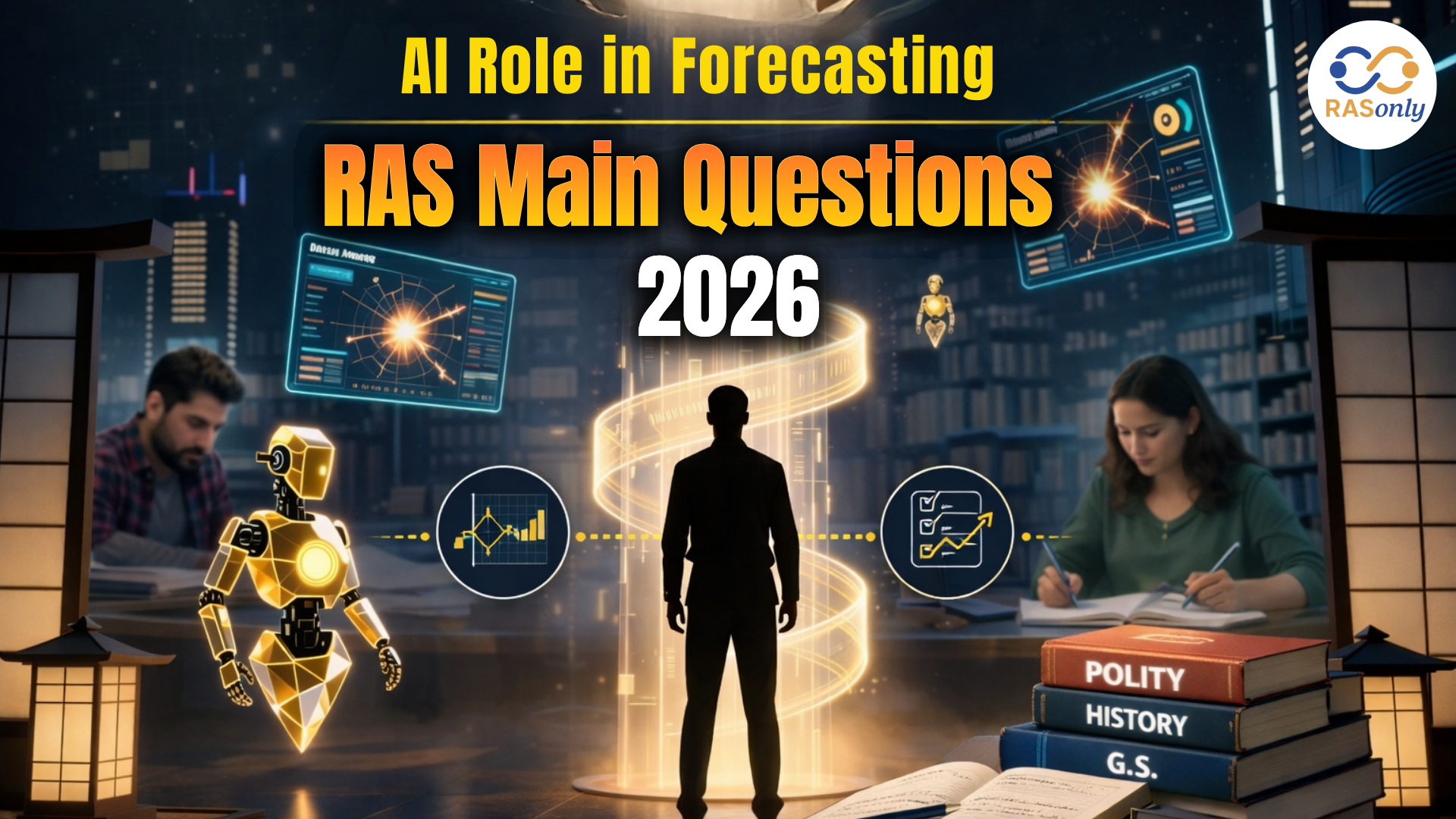
There is a long and arduous process of preparation for the RAS Mains examination. The curriculum is enormous, the test questions are critical and revision can, as a matter of fact, be the greatest problem. It is in this area that AI in RAS Mains revision and AI in RAS Mains note-making can entirely transform the way you study.
When properly applied, AI is not a shortcut. It is an intelligent assistant who helps you revise quicker and arrange superior records and quality of answers. This blog discusses realistic, practical, and ethical how to use AI to prepare for RAS Mains, particularly in revising and making notes.
Why Use AI for RAS Mains Revision and Note-Making?
RAS Mains does not only entail memorization. It needs to be clear, structured, to have interconnection between topics and frequently updated. Conventional ways such as handwritten notes and several books are valuable but they tend to be overpowering.
By revising RAS Mains with AI, you:
- Reduce time in revision cycles.
- Compress voluminous info into sharp notes.
- Improve conceptual clarity
- Write the answer more effectively.
On the same note, AI-based RAS Mains note-making assists in information organization, connection of the unchanging and dynamic subjects, and updating the notes on a regular basis without revising all the information.
Understanding the Role of AI in RAS Mains Preparation
Before using AI, it is important to understand what it can and cannot do.
AI can:
- Summarize content
- Simplify complex topics
- Create structured notes
- Generate revision questions
- Help in answer enrichment
AI cannot:
- Replace your understanding
- Clear the exam on your behalf
- Think critically without your input
When you combine your preparation with AI for RAS Mains note-making, you gain efficiency without losing depth.
Using AI for Syllabus-Based Note-Making
One of the best uses of AI for RAS Mains note-making is syllabus-oriented preparation.
Step-by-step approach:
- Copy one micro-topic from the RAS Mains syllabus
- Ask AI to explain it in simple language
- Ask for points suitable for Mains answers
- Convert them into your own words
This ensures that your notes remain exam-focused. Highlight and internally link topics like RAS Mains syllabus breakdown, subject-wise preparation, and answer writing strategy for later reference.
This method makes AI for RAS Mains revision extremely effective because your notes are already aligned with exam demands.
AI for Condensing Standard Books and Study Material
Most RAS aspirants read multiple standard books. Revising them repeatedly is difficult.
Here is how AI for RAS Mains revision helps:
- Convert chapters into bullet-point notes
- Extract key arguments and examples
- Summarize lengthy explanations
You can paste selected paragraphs and ask AI to:
- Reduce content to 150–200 words
- Highlight important keywords
- Present content in Mains-friendly format
Link these notes internally with static portion, current affairs integration, and concept clarity pages.
Making Current Affairs Notes Using AI
Current affairs are dynamic and need constant updating. AI for RAS Mains note-making works especially well here.
Use AI to:
- Summarize editorials
- Link news with syllabus topics
- Generate pros, cons, and way forward
For example, one current issue can be revised under polity, economy, environment, and ethics. AI helps in creating these multidimensional notes quickly. This approach improves AI for RAS Mains revision by making current affairs easier to revise before the exam.
AI for Value Addition in Notes
RAS Mains answers need value addition like:
- Examples
- Case studies
- Committees
- Constitutional articles
You can use AI for RAS Mains note-making to:
- Generate relevant examples
- Suggest Rajasthan-specific data
- Add ethical dimensions
Internally link such sections with answer enrichment, ethics case studies, and Rajasthan-specific issues.
AI for Smart Revision Before Exams
As the exam approaches, revision becomes the priority. AI for RAS Mains revision can be used for quick and focused revision.
Practical methods:
- Ask AI to create 10 revision questions from a topic
- Generate 5 probable Mains questions
- Create one-page revision sheets
You can also ask AI to prepare:
- 7-day revision plans
- Subject-wise quick revision checklists
- This reduces stress and ensures structured revision.
Using AI for Answer Writing Practice
While AI should not write answers for you, it can help improve them.
Use AI for RAS Mains revision to:
- Check structure of your answers
- Suggest better introductions and conclusions
- Identify missing dimensions
After writing your answer, you can ask AI for feedback on:
- Clarity
- Flow
- Relevance to question
Link this process internally with answer writing practice, GS Mains strategy, and evaluation techniques.
AI for Ethics and Case Study Preparation
Ethics is a scoring paper if prepared well. AI for RAS Mains note-making can simplify ethics concepts.
AI helps in:
- Explaining thinkers in simple language
- Creating real-life examples
- Structuring case study answers
You can also generate multiple perspectives for the same ethical dilemma, which strengthens your analytical ability.
Mistakes to Avoid While Using AI
Although AI in the case of RAS Mains revision is effective, it can be abused to the detriment of preparation.
Avoid:
- Direct file copying of AI material.
- Excessive reliance on AI summaries.
- Ignoring standard books
Always customize the content created by AI. Write down notes to your language. Use AI as a tool, not a crutch.
Best Practices for Using AI Effectively
To achieve the most out of AI to make notes on RAS Mains:
- Use specific prompts
- Combine AI output and textbooks.
- Periodically update AI-written notes.
- Cross-check facts
AI of RAS Mains revision enhances retention and confidence when applied on a regular basis.
Ethical and Responsible Use of AI
RAS is a prestigious service. Even in the preparation, integrity is an issue.
Ethically use AI in eth RAS Mains note-making:
- For learning, not cheating
- To be directed, not to be substituted.
- Not to make improvements, but shortcuts.
The long-term benefits of the exam can be ensured through responsible usage.
Conclusion
AI is not the future. It is the present. Aspirants who study to apply AI to RAS Mains revision and AI to RAS Mains note-making will always have an advantage. AI becomes a potent ally when it comes along with discipline, consistency, and self-study. Begin with small steps, test and develop your strategy. With time, you will find the clarity of the tasks, the revision will be quicker, and the answers will be more confident.
When you are actually passionate about RAS Mains, it is no longer a choice to learn how to work with AI. It is a smart strategic move.
FAQ
No. AI is a support tool that improves efficiency, but textbooks, self-study, and practice remain essential.
AI helps by summarizing topics, creating revision questions, preparing quick notes, and structuring focused revision plans.
Yes, but facts should always be cross-checked with reliable sources like newspapers and official reports.
AI can suggest better structure, introductions, conclusions, and missing dimensions, but answers must be written by you.
Overdependence. Blind copying without understanding can weaken conceptual clarity and exam performance.
BEST SELLER
🏆 PRELIMS
RAS Pass
Prelims focused Hindi & English
₹399
✓
Prelims Topic-Wise Tests
✓
Subject-Wise Tests
✓
Full-Length Prelims Tests
✓
Daily Current Affairs Tests
✓
Prelims PYQs Tests
✓
Detailed Solutions & Analysis
✓
All Rajasthan Ranking
✓
Unlimited Reattempts
✓
Mains Tests
✓
Hindi & English Tests
✓
All Rajasthan Ranking
Trusted by 5,000+ Students
Post Category
- RAS Salary
- Result
- RAS Admit Card
- RAS Job
- RAS Cutoff
- Preparation Tips
- RAS Answer Key
- RAS Exam Analysis
- RAS Syllabus
- RAS Previous Year Papers
- RPSC RAS Exam Pattern
- RAS Interview
- RAS Exam Date
- RAS Vacancy
- RAS Test Series
- RAS Best Books
- RAS Preparation Resources
- RAS Coaching Centre
- History
- Polity
- Geography
- Economics
- Science
- Art and Culture
- RPSC RAS Application Form
- RPSC RAS Notification
- RAS Eligibility Criteria
- UPSC Exam
- RPSC RAS Mains
Visit Our RASonly Offline Center
Our Expert Faculty

Bhunesh Sir
Current Affairs · 13+ Yrs

Aamir Khan Sir
RAS-2017 · IIM Ahm.

Akash Sir
Polity · 8+ Yrs
Free Resources
Official Mobile App

RASOnly App
by OTSAdda · Free
Full Video Lectures
Mock Tests & PYQs
Daily Current Affairs
AI Mock Interview
Free Download · No subscription needed to install
RAS 2024 Toppers — RASonly
Rank 2
Virendra Charan
Rank 9
Bhoopinder Singh
Rank 26
Aanchal Nagpal
Rank 33
Lokendra Singh
Rank 45
Amar Rathore
Rank 46
Manasvini Verma

Join RASonly WhatsApp Community
Get daily current affairs, exam alerts, free study material and tips from expert faculty — right on WhatsApp.
Join for Free →RASonly Interview Guidance Program

Mr. Ashok Jain
Ex-Chief Secretary Govt of Rajasthan
- IAS officer of the 1981 batch, Rajasthan cadre.
- Passionate about mentoring the next generation of RAS officers with real-world insights.
- Got retired in Dec 2017 from the post of Chief Secretary of the state of Rajasthan.

Mr. Guru Charan Rai
Ex-ASP / SP in Jaisalmer
- Guru Charan Rai, IPS (Retd), retired as Inspector General of Police (Security), Rajasthan, Jaipur in 2017.
- Served as ASP and SP in Jaisalmer, Nagaur, Sri Ganganagar, Sawai Madhopur, Dausa, Sikar, and Karauli.
- He also held key positions as DIGP and IGP in the Law and Order division.

Mr. Rakesh Verma
Ex-IAS Officer, B.Tech, MBA, and M.A. (Economics)
- IAS officer of the 1981 batch and retired in Chief Secretary Rank.
- Civil servant of high repute and vast experience.
- Has been teaching UPSC CSE subjects for the last six years.
Related Post
Daily Current Affairs for RAS Exam Preparation 2026

CM Bhajan Lal Sharma Launches Rajasthan Portals
October 08, 2026
Rajasthani Film ‘Omlo’ Selected for Cannes Film Market
October 08, 2026
Rajasthan Initiative to Build India’s First UNESCO Global Geopark
October 07, 2026