Chola Dynasty: Capital, Founder, Kings, Time Period and History
Banking System in India: A Complete Guide

Get in Touch with RASonly!

The Banking System in India forms the backbone of the country’s financial structure, enabling deposit mobilisation, credit flow, payments, and overall economic growth. It includes Scheduled and Non-Scheduled Banks, the RBI as the apex regulator, commercial banks, cooperative banks, RRBs, and specialized institutions. A strong regulatory framework, Basel norms, and ongoing reforms ensure stability, transparency, and financial inclusion across the nation.

The Banking System in India lies in the center of the financial and economic system in the country. It serves as an intermediary between the borrowers and the savers, facilitates the development of businesses, allows payments and remittances, and promotes financial inclusion. Since this system is essential to the mechanisms of modern society, not only to the students of economy and finance but also to any person concerned with the circulation of money in the modern world, it is necessary to understand how it is organized, what kind of banks there are, which organizing bodies are in place, and what reforms have recently been made.
What Is the Banking System in India?
The banking system in India can be defined as the system of institutions that receive deposits and give loans, handle payments, and offer a number of financial
products to individuals, business entities, and the government.
Among other things, banks have a number of vital functions.
- Accepting current deposit and savings.
- Offering loans and advances.
- Enabling online and offline payments.
- Stimulating investment and credit circulation.
- They are financial intermediaries.
- Sustaining economic actions in the sectors.
These institutions are operating in a legal and regulatory environment that is primarily steered by the Reserve Bank of India (RBI) and other banking regulations.
Classification of Banks in India
Banks, forming part of the Banking System in India, can be divided into two categories – Scheduled Banks and Non-Scheduled Banks.
Scheduled Banks
Scheduled Banks under the Banking System in India refer to those financial institutions that are listed in the 2nd Schedule of the Reserve Bank of India Act, 1934. This inclusion signifies that they meet specific criteria set by the RBI and are subject to its stricter regulations.
A bank to be listed in the schedule has to satisfy the following 2 conditions:
- It should have paid-up capital and reserves of not less than 5 lacs, and
- It should satisfy the RBI that their affairs are not being conducted in a manner detrimental to the interest of their depositors.
If any Scheduled Bank violates these conditions, it gets de-listed from the schedule.
A Scheduled Bank gets the following benefits:
- Facility of loans on Bank Rate from RBI.
- Automatic membership of the Clearing House.
- Facility of Re-Discount of first-class exchange bills from RBI.
Non-Scheduled Banks
Non-Scheduled Banks under the Banking System in India refer to those financial institutions that don’t meet the criteria to be included in the 2nd Schedule of the Reserve Bank of India Act, 1934. Being excluded from the schedule means they operate under a different set of regulations as compared to Scheduled Banks.
Difference Between Scheduled Banks and Non-Scheduled Banks
| Basis of Difference | Scheduled Banks | Non-Scheduled Banks |
|---|---|---|
| Meaning | These are banking institutions that appear in the Second Schedule of the Reserve Bank of India Act, 1934. Their inclusion reflects compliance with RBI’s prescribed standards. | These are banks that do not feature in the Second Schedule of the RBI Act, 1934. They operate outside the eligibility criteria set for Scheduled Banks. |
| Criteria |
|
|
| Regulatory Requirements |
|
|
| Rights Available |
|
|
| Risk | Considered more secure and reliable, as they are closely supervised by the RBI and follow stricter norms. | Viewed as comparatively riskier due to limited supervision and smaller operational capacities. |
| Examples | Most banks in India fall under this category—Commercial Banks, Public Sector Banks, Private Banks, and many Cooperative Banks. | Local Area Banks (LABs) and some Urban Cooperative Banks (UCBs). |
Structure of the Banking System in India
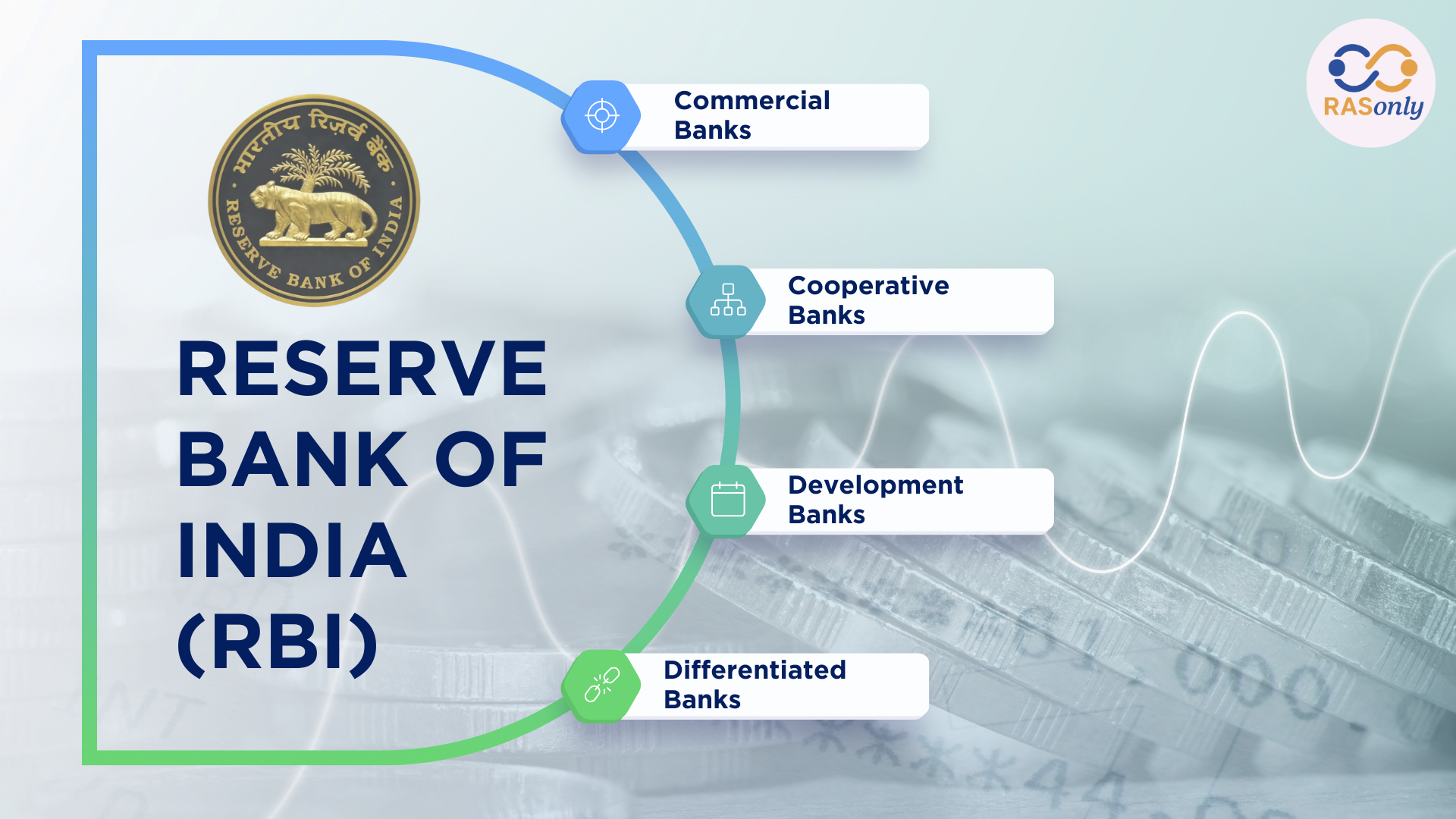
The Indian banking system has a multi-layered structure, with the Reserve Bank of India at the top, followed by commercial banks, cooperative banks, regional rural banks, and specialized institutions.
Overall Structure
| Tier | Category |
|---|---|
| Apex | Reserve Bank of India (RBI) |
| Intermediate | Commercial Banks (Public, Private, Foreign), Regional Rural Banks |
| Local | Cooperative Banks, Local Area Banks, Payments Banks |
| Specialized | Development Banks, Small Finance Banks, NBFCs (Non-Banking Financial Companies) |
The pyramid structure enables the banking system in india to serve diverse economic needs—from national monetary policy to local village banking.
Reserve Bank of India (RBI)
RBI refers to the central bank of India and the ultimate bank and monetary authority of the country. It was founded on April 1, 1935 using the reserve bank of India Act, 1934, which controls the issue, credit and liquidity provisions in the economy. It also regulates banks, controls foreign exchange reserves, and controls payment systems.
Key functions of RBI include:
- Developing monetary policy.
- Bank supervision and control.
- Banker to the government
- Foreign exchange management and reserve management.
- Issuing currency
The RBI also takes significant steps, such as the repo rate, cash reserve ratio (CRR) and statutory liquidity ratio (SLR), which directly affect the credit and lending within the banking system in india.
Types of Banks in India
The Indian banking system includes several types of banks, each designed to serve different segments of the economy:
1. Commercial Banks
Commercial banks are profit-oriented institutions that offer a wide range of financial services including deposits, loans, investment services, and payment processing.
Sub-categories:
| Type | Features | Examples |
|---|---|---|
| Public Sector Banks | Majority government ownership | State Bank of India, Bank of Baroda |
| Private Sector Banks | Majority private ownership | HDFC Bank, Axis Bank |
| Foreign Banks | Headquartered outside India, operate branches locally | Citibank, Standard Chartered |
| Regional Rural Banks (RRBs) | Focus on rural needs | Various RRBs operating under sponsor banks |
2. Cooperative Banks
Cooperative banks are organized according to cooperative principles, with both the customers and the owners being the members. The banks are mainly agricultural-based, small businesses and local customers
Examples: Urban Cooperative Banks, District Central Cooperative Banks
3. Regional Rural Banks (RRBs)
RRBs are meant to serve rural and semi-urban locations, particularly the farmers and small businesses. The government, sponsor banks, and state governments share the joint ownership.
4. Local Area Banks (LABs)
LABs focus on providing the banking services that are based on the needs of the community in a particular geographical area. They are involved in commercial banking, albeit on a limited geographical scope.
5. Differentiated Banks
These are Payment Banks and Small Finance Banks, which were initiated in order to broaden financial inclusion. Payment banks are concerned with simple savings and payments, whereas small finance banks are aimed at the underrepresented groups such as micro and small businesses.
6. Development Banks
Development banks offer investment finance over a long term in projects in areas such as infrastructure, industry, and agriculture. They bridge the gap in cases where the conventional commercial banks could hesitate to lend because of the risk or the mismatch in the duration.
Regulatory and Legal Framework
The Indian banking system operates under several key laws and regulations, including:
Major Banking Laws
- Reserve Bank of India Act, 1934
- Banking Regulation Act, 1949
- Bank Nationalisation Acts (1969, 1980)
- Banking Laws (Amendment) Act, 2025
The recent Banking Laws Amendment Act, 2025 introduced governance enhancements, improved transparency, and strengthened audit and oversight mechanisms for safer banking operations.
These legal instruments empower the RBI to regulate banks, maintain financial stability, and protect depositors.
Basel Norms or Basel Accords
As banking has become increasingly global, the failure of even a single large bank can create widespread disruptions in the international financial system. To reduce this risk, a set of global standards known as the Basel Norms was developed. These norms help improve the way banks manage regulation, supervision, and risk so they can better handle financial and economic pressures.
The Basel standards are created by the Basel Committee on Banking Supervision (BCBS), which functions under the Bank for International Settlements (BIS) in Switzerland. BCBS works closely with the central banks of different countries.
Key Features of Basel Norms
- They apply to both ordinary banks as well as Systemically Important Financial Institutions (SIFIs).
- The norms are implemented and enforced by the central bank of each country.
- Three versions of Basel regulations have been introduced so far: Basel I, Basel II, and Basel III.
Basel I Norms
- Basel I was the first set of guidelines, introduced in 1988.
- It emphasized credit risk and provided a framework for assigning risk weights to different types of assets held by banks.
- Under Basel I, banks were required to maintain a minimum capital adequacy ratio of 8% of their Risk-Weighted Assets (RWA).
Basel II Norms
Basel II, released in 2004, was an expanded and refined version of Basel I
What Basel II introduced
- It covered three categories of risk:
- Operational Risk
- Credit Risk
- Market Risk
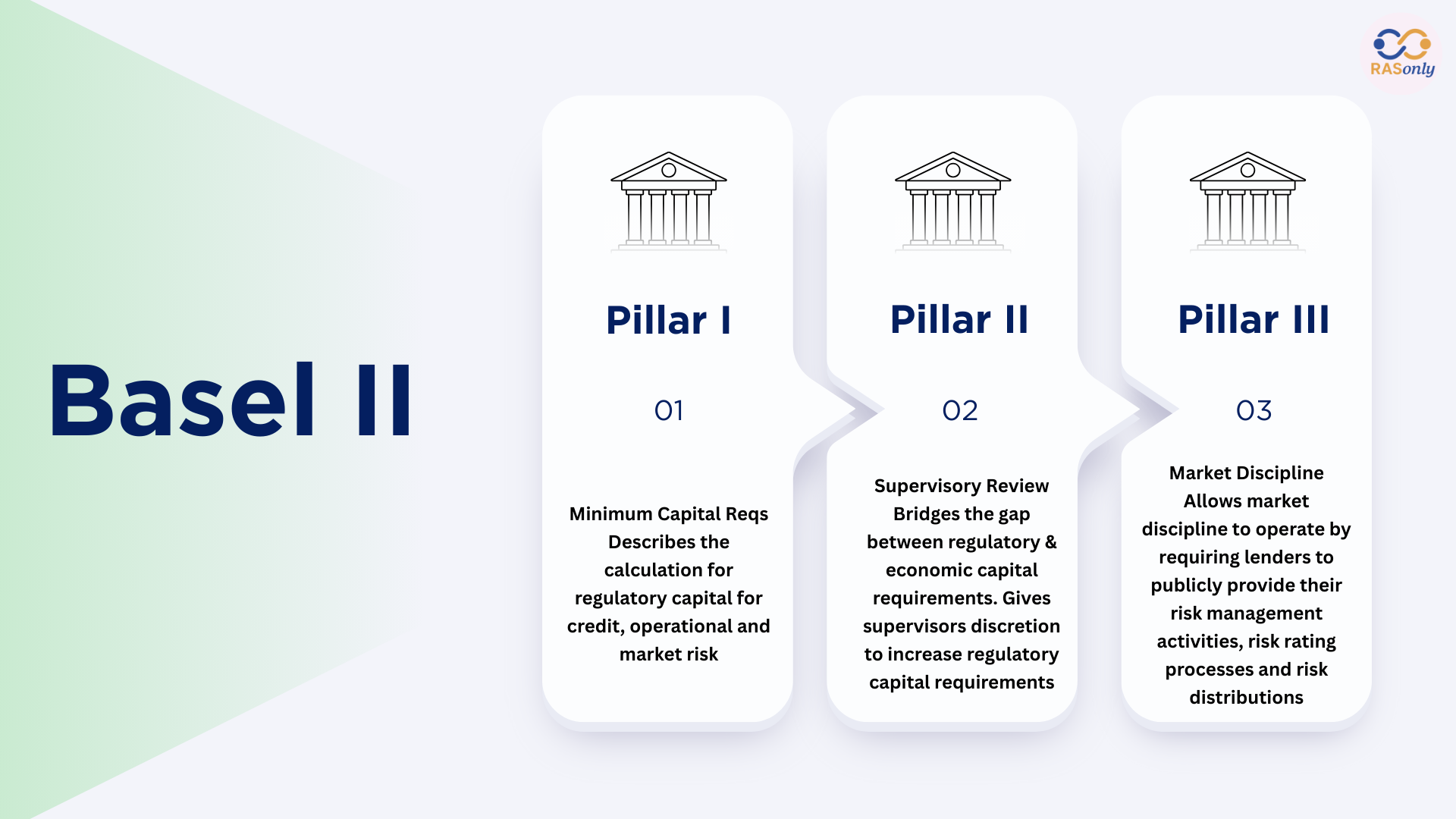
- It was built on three central pillars, which are:
Three Pillars of Basel II
| Pillar | Explanation |
|---|---|
| Pillar I – Minimum Capital Requirements | Defines how banks must calculate the capital required to cover credit, operational, and market risks. |
| Pillar II – Supervisory Review | Seeks to strengthen the relationship between regulatory capital and economic capital, giving supervisors the authority to require banks to hold additional capital if needed. |
| Pillar III – Market Discipline | Promotes transparency by requiring banks to publicly share information about their risk exposure, capital structure, and risk management practices. |
Basel III Norms
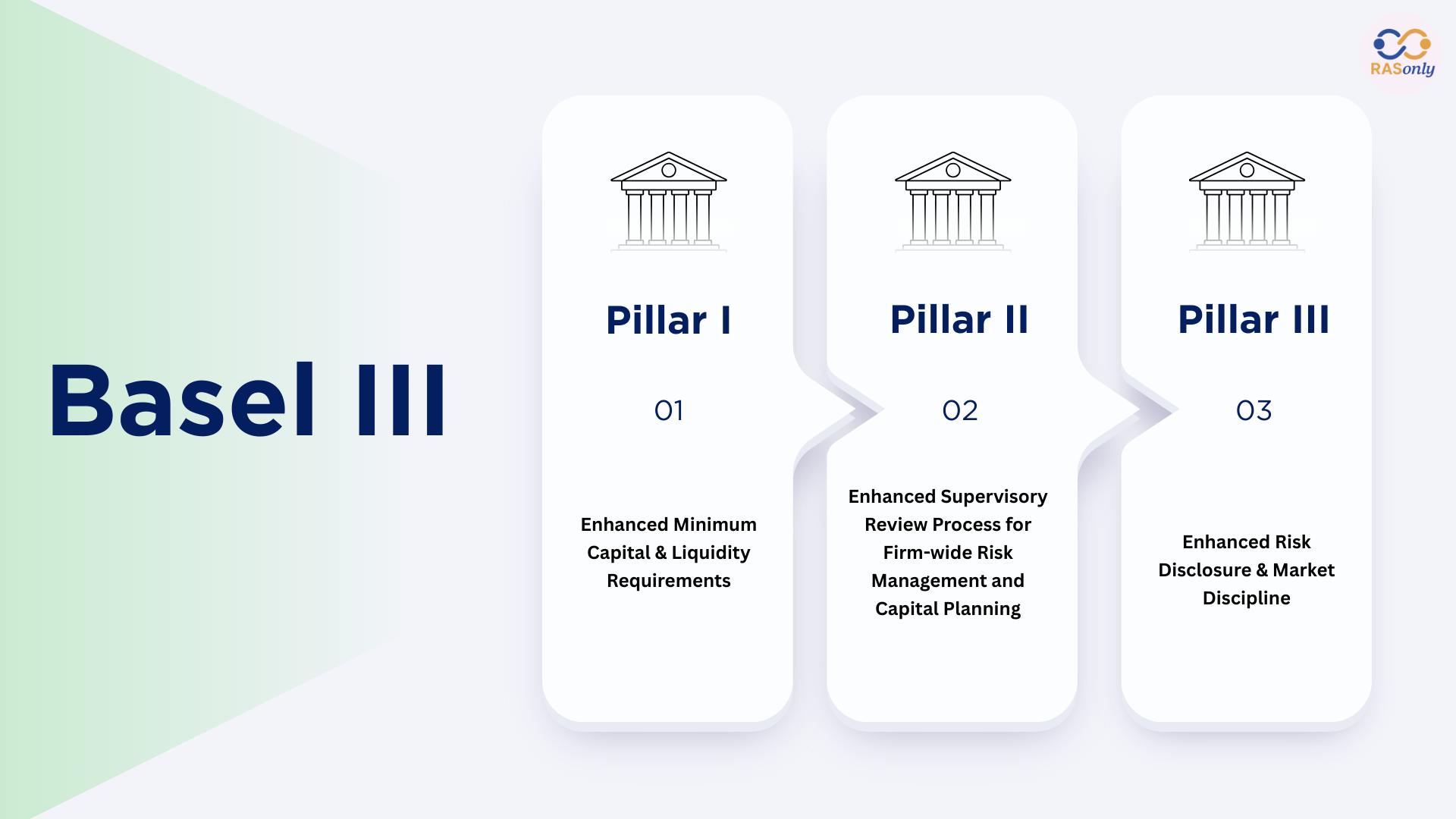
Basel III guidelines were issued in December 2010, following the global financial crisis of 2008.
The objective was to build a stronger and more stable banking system by improving capital quality, leverage controls, funding stability, and liquidity.
The Three Pillars of Basel III
Basel III continues with the same three-pillar structure as Basel II but strengthens the requirements under each pillar to enhance the overall resilience of banks.
Capital-to-Risk Weighted Asset Ratio (CRAR) or Capital Adequacy Ratio (CAR)
The Capital-to-Risk Weighted Asset Ratio (CRAR), also called the Capital Adequacy Ratio (CAR), measures how much capital a bank holds as a percentage of its risk-weighted assets. It shows whether a bank has enough capital to absorb potential losses.
Formula:
CRAR = (Total Capital / Total Risk-Weighted Assets) × 100
Key Points
- Total Risk-Weighted Capital means the weighted value of all assets based on the level of risk they carry.
- CRAR is a requirement under Basel Norms.
- Banks must maintain enough internal capital to cover losses that may arise from bad loans or risky exposures.
- To calculate CRAR, each loan amount is multiplied by the assigned risk percentage of that sector. This gives the Risk-Weighted Assets (RWA).
Example of RWA Calculation
| Purpose of Loan | Loan Amount (₹) | Risk Percentage | Risk-Weighted Assets (₹) |
|---|---|---|---|
| Agriculture | 100 | 20% | 20 |
| Industry | 200 | 17.5% | 35 |
| Government | 100 | 5% | 5 |
| Total | 400 | — | 60 |
Related Concepts
Domestic Systemically Important Banks (D-SIBs).
- D-SIBs are the banks known as Too Big to Fail (TBTF) due to the fact that their collapse can have a great negative effect on the financial system of the country.
- Since such banks are more significant, they tend to have lower borrowing rates and other perks within the financial markets.
- D-SIBs are identified and regulated by the RBI according to some criteria set in 2014.
- Banks that are considered to be systemically important internationally are those whose size is above roughly 2% of national GDP.
- In India, State Bank of India (SBI), ICICI Bank, and HDFC Bank have been classified as D-SIBs.
Neo Banks
- Neo banks are online banking institutions that do not have physical branches.
- They offer an alternative to the traditional banks with the help of technology to offer quicker and cheaper financial services.
- The aim of neo banks is to improve the customer experience through streamlined digital operations.
Types of Neo Bank Models in India
- Neo banks that do not have independent banking licenses and instead partner with regulated banks to deliver services.
- Neo banks that operate using their own banking licenses, offering services independently.
Way Forward
India has the potential to regulate, manage risks, and ensure safer digital infrastructure, which will determine the future of banking there. Banks need to:
- Enhance surveillance and integrity.
- Enhance customer security.
- Cooperate with fintech companies to become innovative.
- Enhance digital security
- Improve employee capabilities, information systems, and customer-oriented services.
In that way, the banking sector will be able to gain trust and drive investment as well as provide long-term economic stability.
Conclusion
India has a banking system that is still developing as the economy expands, technology is improving and the level of customer expectation increases. As regulatory structures are strengthened, as more people go digital, and as more reforms occur, banks are becoming more resilient and inclusive. The sector is where savings mobilization, business support, and financial stability became the main priorities in the country. As India becomes more interconnected and innovation-driven in its financial environment, the reinforcement of risk management, better governance, and better service quality are going to be needed. Strong and future-oriented banking system in india will continue to be one of the pillars in the realization of sustainable economic growth and development of the country.

BEST SELLER
🏆 PRELIMS
RAS Pass
Prelims focused Hindi & English
₹399
✓
Prelims Topic-Wise Tests
✓
Subject-Wise Tests
✓
Full-Length Prelims Tests
✓
Daily Current Affairs Tests
✓
Prelims PYQs Tests
✓
Detailed Solutions & Analysis
✓
All Rajasthan Ranking
✓
Unlimited Reattempts
✓
Mains Tests
✓
Hindi & English Tests
✓
All Rajasthan Ranking
Trusted by 5,000+ Students

Post Category
- RAS Salary
- Result
- RAS Admit Card
- RAS Job
- RAS Cutoff
- Preparation Tips
- RAS Answer Key
- RAS Exam Analysis
- RAS Syllabus
- RAS Previous Year Papers
- RPSC RAS Exam Pattern
- RAS Interview
- RAS Exam Date
- RAS Vacancy
- RAS Test Series
- RAS Best Books
- RAS Preparation Resources
- RAS Coaching Centre
- History
- Polity
- Geography
- Economics
- Science
- Art and Culture
- RPSC RAS Application Form
- RPSC RAS Notification
- RAS Eligibility Criteria
- UPSC Exam
- RPSC RAS Mains
Visit Our RASonly Offline Center
Our Expert Faculty

Bhunesh Sir
Current Affairs · 13+ Yrs

Aamir Khan Sir
RAS-2017 · IIM Ahm.

Akash Sir
Polity · 8+ Yrs
Free Resources
Official Mobile App

RASOnly App
by OTSAdda · Free
Full Video Lectures
Mock Tests & PYQs
Daily Current Affairs
AI Mock Interview
Free Download · No subscription needed to install
RAS 2024 Toppers — RASonly
Rank 2
Virendra Charan
Rank 9
Bhoopinder Singh
Rank 26
Aanchal Nagpal
Rank 33
Lokendra Singh
Rank 45
Amar Rathore
Rank 46
Manasvini Verma

Join RASonly WhatsApp Community
Get daily current affairs, exam alerts, free study material and tips from expert faculty — right on WhatsApp.
Join for Free →RASonly Interview Guidance Program

Mr. Ashok Jain
Ex-Chief Secretary Govt of Rajasthan
- IAS officer of the 1981 batch, Rajasthan cadre.
- Passionate about mentoring the next generation of RAS officers with real-world insights.
- Got retired in Dec 2017 from the post of Chief Secretary of the state of Rajasthan.

Mr. Guru Charan Rai
Ex-ASP / SP in Jaisalmer
- Guru Charan Rai, IPS (Retd), retired as Inspector General of Police (Security), Rajasthan, Jaipur in 2017.
- Served as ASP and SP in Jaisalmer, Nagaur, Sri Ganganagar, Sawai Madhopur, Dausa, Sikar, and Karauli.
- He also held key positions as DIGP and IGP in the Law and Order division.

Mr. Rakesh Verma
Ex-IAS Officer, B.Tech, MBA, and M.A. (Economics)
- IAS officer of the 1981 batch and retired in Chief Secretary Rank.
- Civil servant of high repute and vast experience.
- Has been teaching UPSC CSE subjects for the last six years.
Related Post




Daily Current Affairs for RAS Exam Preparation 2026

Ustad Bismillah Khan Yuva Puraskar
October 24, 2026
Marwar Festival 2026
October 24, 2026
Kundan Art Display in Hong Kong
October 23, 2026