Chola Dynasty: Capital, Founder, Kings, Time Period and History
Classical Dance of India: List of Eight Classical Dances, Spirit of Dance, and Roots

Get in Touch with RASonly!


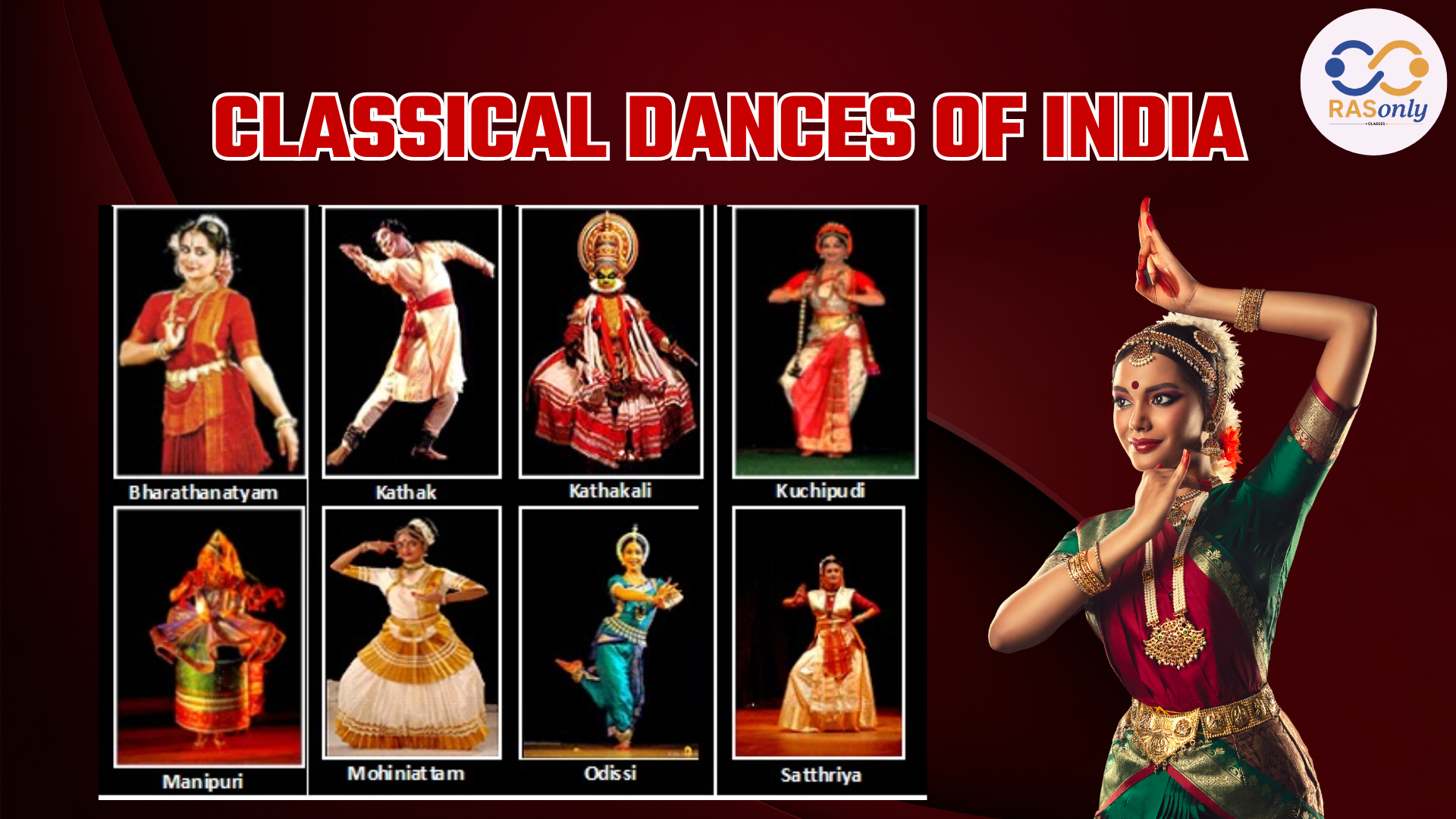
The art has always defined the culture of India, and classical dance is one of the most sophisticated. These dance styles are found on ancient traditions and are based on storytelling, music, and spirituality in addition to providing both artistic and devotional performance. The Ministry of Culture in India has identified nine classical dances: Bharatanatyam, Kathak, Kathakali, Kuchipudi, Manipuri, Mohiniyattam, Odissi, Sattriya and Chhau. Eight of them were already known to the Sangeet Natak Akademi, but the ninth dance form, Chhau, was introduced by the Ministry.
The Roots of Indian Classical Dance
The foundation of India’s classical dances comes from the Natya Shastra, a Sanskrit text written over 2,000 years ago by Bharata Muni. It describes dance (Nritta), expression (Nritya), and dramatic performance (Natya), laying out techniques that are still followed today. These forms developed in temples and royal courts, serving as offerings to the divine and as cultural entertainment.
List of Classical Dances of India
| List of Classical dances in India | State of Origin |
|---|---|
| Bharatanatyam | Tamil Nadu |
| Kathak | Uttar Pradesh |
| Kuchipudi | Andhra Pradesh |
| Odissi | Odisha |
| Kathakali | Kerala |
| Sattriya | Assam |
| Manipuri | Manipur |
| Mohiniyattam | Kerala |
The Eight Classical Dances
India has eight officially recognized styles of classical dances, each having a rhythm, expression and cultural background.
1. Bharatanatyam (Tamil Nadu)
The Bharatanatyam is one of the oldest classical dances and it has a fixed upper torso, bent legs and expressive hand movements (mudras). It frequently narrates tales of devotion and mythology via some complicated motions and facial expressions.
2. Kathak (North India)
Kathak, which is an extension of the story-telling dances of North India, has rapid turns, accurate footsteps, and elegant gestures. It is a mixture of Hindu and Persian which was a result of centuries long cultural fusion of India.
3.Kathakali (Kerala)
Kathakali comes from southwestern India, around the state of Kerala. Like bharatanatyam, kathakali is a religious dance. It draws inspiration from the Ramayana and stories from Shaiva traditions. Kathakali is traditionally performed by boys and men, even for female roles. The costumes and makeup are especially elaborate, with faces made to look like painted masks and enormous headdresses.
4. Kuchipudi (Andhra Pradesh)
Kuchipudi classical dance is a traditional classical dance of Andhra Pradesh with impressive moves, expressive stories and complex footwork. It was formed in the village of Kuchipudi and combines dance, drama, and music that portray stories from Hindu epics. It is done as individuals and in groups and focuses on natya (acting) and rhythmic patterns, making it an exceptional area of cultural heritage.
5. Odissi (Odisha)
Characterized by its fluid body movements and sculpturesque poses, Odissi reflects the temple art of Odisha. The dance often expresses devotion to Lord Jagannath and emphasizes grace and lyricism.
6. Manipuri (Manipur)
Gentle and spiritual, Manipuri focuses on soft movements and devotional themes, often drawn from the stories of Radha and Krishna. The costumes are elaborate yet delicate, enhancing the ethereal quality of the dance.
7. Mohiniyattam (Kerala)
Mohiniyattam is a classical dance form from the state of Kerala in South India. The origin and popularity of this dance form is associated with the great Tamil dance guru Vadivelu, who was one of the members of the Thanjavur Quartet. One of the eight Indian classical dance forms, Mohiniyattam is a visually beautiful dance and is performed solo by women. The word "Mohiniyattam" is derived from the words "Mohini" and "Aattam."
8. Sattriya (Assam)
Introduced by the saint Srimanta Sankardev in the 15th century, Sattriya was originally a monastic ritual dance. It blends devotion with rhythm and storytelling, celebrating themes from Hindu scriptures.
Beyond Performance: Spirit of Dance
Every classical dance is not just choreography it is spiritual experience. The postures (mudras) and expressions (abhinaya) are aimed at developing bhava (emotion) as well as rasa (essence) inviting the audience into a more than a moving experience.
The traditions are still in a constant development but retain their origins. New themes and music are tried by modern performers, but the spirit of devotion and narration is the same.
Conclusion
The classical dances in India are living cultures that relate the past to the present. They narrate those stories about gods, love, and human feelings which are beyond words. As we watch them on a temple stage or on a present-day theatre, we are reminded of the everlasting artistic soul of India.
BEST SELLER
🏆 PRELIMS
RAS Pass
Prelims focused Hindi & English
₹399
✓
Prelims Topic-Wise Tests
✓
Subject-Wise Tests
✓
Full-Length Prelims Tests
✓
Daily Current Affairs Tests
✓
Prelims PYQs Tests
✓
Detailed Solutions & Analysis
✓
All Rajasthan Ranking
✓
Unlimited Reattempts
✓
Mains Tests
✓
Hindi & English Tests
✓
All Rajasthan Ranking
Trusted by 5,000+ Students
Post Category
- RAS Salary
- Result
- RAS Admit Card
- RAS Job
- RAS Cutoff
- Preparation Tips
- RAS Answer Key
- RAS Exam Analysis
- RAS Syllabus
- RAS Previous Year Papers
- RPSC RAS Exam Pattern
- RAS Interview
- RAS Exam Date
- RAS Vacancy
- RAS Test Series
- RAS Best Books
- RAS Preparation Resources
- RAS Coaching Centre
- History
- Polity
- Geography
- Economics
- Science
- Art and Culture
- RPSC RAS Application Form
- RPSC RAS Notification
- RAS Eligibility Criteria
- UPSC Exam
- RPSC RAS Mains
Visit Our RASonly Offline Center
Our Expert Faculty

Bhunesh Sir
Current Affairs · 13+ Yrs

Aamir Khan Sir
RAS-2017 · IIM Ahm.
Akash Sir
Polity · 8+ Yrs
Free Resources
Official Mobile App

RASOnly App
by OTSAdda · Free
Full Video Lectures
Mock Tests & PYQs
Daily Current Affairs
AI Mock Interview
Free Download · No subscription needed to install
RAS 2024 Toppers — RASonly
Rank 2
Virendra Charan
Rank 9
Bhoopinder Singh
Rank 26
Aanchal Nagpal
Rank 33
Lokendra Singh
Rank 45
Amar Rathore
Rank 46
Manasvini Verma

Join RASonly WhatsApp Community
Get daily current affairs, exam alerts, free study material and tips from expert faculty — right on WhatsApp.
Join for Free →RASonly Interview Guidance Program

Mr. Ashok Jain
Ex-Chief Secretary Govt of Rajasthan
- IAS officer of the 1981 batch, Rajasthan cadre.
- Passionate about mentoring the next generation of RAS officers with real-world insights.
- Got retired in Dec 2017 from the post of Chief Secretary of the state of Rajasthan.

Mr. Guru Charan Rai
Ex-ASP / SP in Jaisalmer
- Guru Charan Rai, IPS (Retd), retired as Inspector General of Police (Security), Rajasthan, Jaipur in 2017.
- Served as ASP and SP in Jaisalmer, Nagaur, Sri Ganganagar, Sawai Madhopur, Dausa, Sikar, and Karauli.
- He also held key positions as DIGP and IGP in the Law and Order division.

Mr. Rakesh Verma
Ex-IAS Officer, B.Tech, MBA, and M.A. (Economics)
- IAS officer of the 1981 batch and retired in Chief Secretary Rank.
- Civil servant of high repute and vast experience.
- Has been teaching UPSC CSE subjects for the last six years.
Related Post
Daily Current Affairs for RAS Exam Preparation 2026
Ustad Bismillah Khan Yuva Puraskar
October 24, 2026
Marwar Festival 2026
October 24, 2026
Kundan Art Display in Hong Kong
October 23, 2026