Jainism: Founder, Symbol, Teachings, Beliefs, History & Principles
Migration in Rajasthan 2026: Trends, Causes, Patterns, Impact & Policy Analysis (RAS)

Get in Touch with RASonly!

Migration in Rajasthan reflects a complex mix of economic pressure, environmental challenges, and employment opportunities, making it a key issue in the state’s development. It plays a dual role by supporting rural livelihoods through remittances while also creating challenges like urbanization, labour exploitation, and social imbalance. Understanding migration is essential for analyzing governance, economy, and social issues, especially for RPSC RAS 2026 preparation.

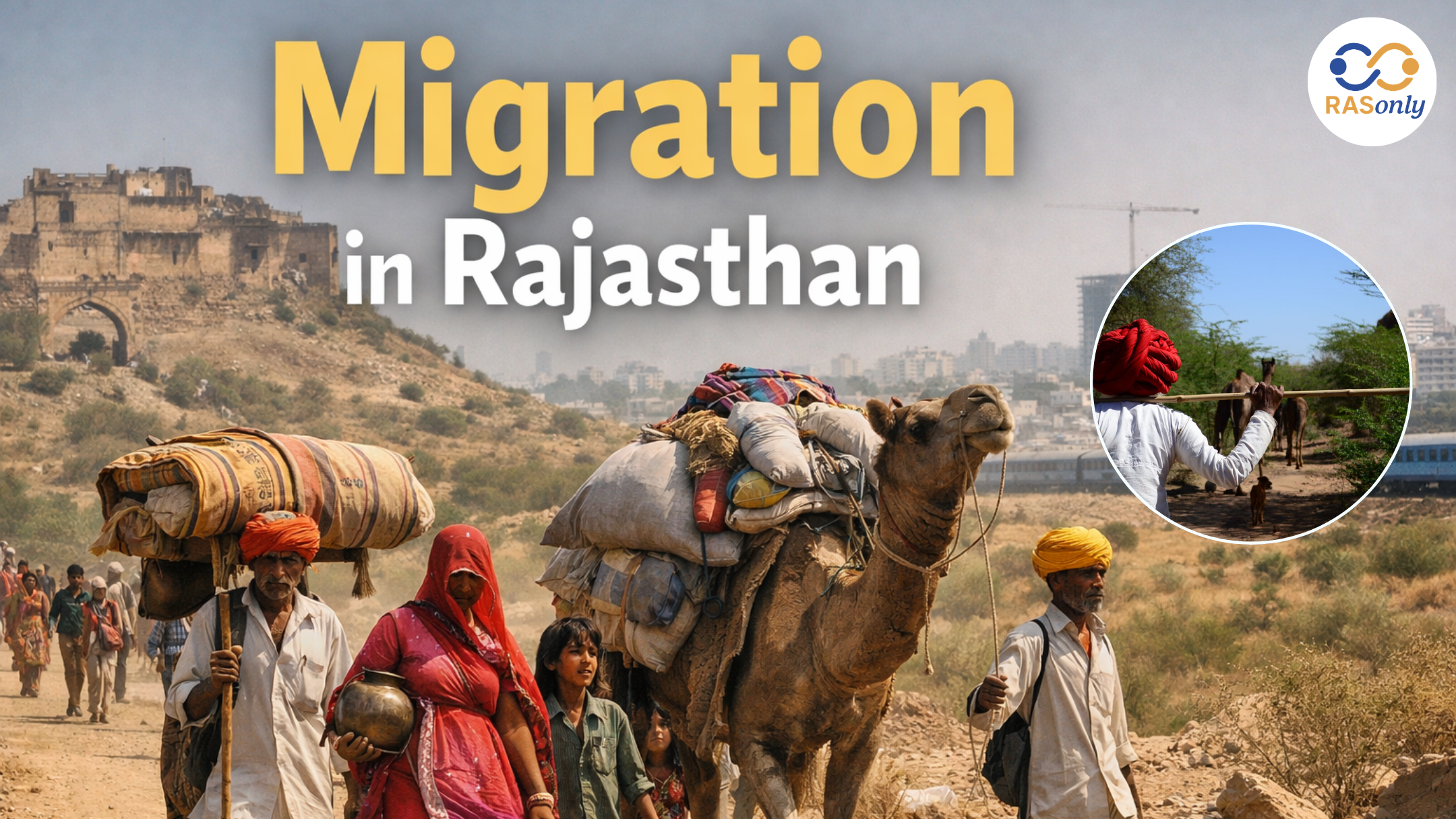
Migration in Rajasthan is a significant socio-economic process that reflects the realities of rural distress, employment patterns, environmental challenges, and regional imbalance. Many of the population, particularly in desert and tribal areas, either seasonally or permanently migrate seeking livelihood, so migration is a fundamental aspect of the state economy and society.
From an exam perspective, migration is highly important for RPSC RAS 2026, Rajasthan GK, Geography, Economy, and Social Issues, as it connects with topics like urbanization, labour markets, poverty, climate change, and governance challenges. Rajasthan shows a distinct pattern where seasonal migration and inter-state labour movement dominate, rather than permanent migration.
Understanding Migration in Rajasthan
Migration in Rajasthan is not only a movement of population, it is also usually a survival measure of economically weaker and economically challenged groups. Migrations occur in most districts, particularly in western and southern Rajasthan, because of scarcity of opportunity in the land, drought, and absence of irrigation.
At the same time, migration also indicates aspiration with people migrating towards cities such as Jaipur or Kota to pursue education, better employment, and better living conditions, displaying the patterns of distress migration as well as opportunity migration.
Types and Nature of Migration
Migration in Rajasthan is varied in nature and is relative to the period, objective, and distance. The preeminence of seasonal and circular movement, particularly among workers, is one of the most significant features.
Unlike permanent migration, many workers move for a few months and then return, creating a cycle of migration linked with agriculture and labour demand.
Major Types
| Type | Description |
|---|---|
| Seasonal Migration | Temporary (4–6 months) for labour work |
| Circular Migration | Repeated movement between the village and the city |
| Rural to Urban | Movement for jobs and education |
| Rural to Rural | Agricultural labour movement |
| Inter-State Migration | Gujarat, Maharashtra, MP |
| Marriage Migration | The major reason for female migration |
Regional Patterns of Migration
The migration in Rajasthan is imbalanced and differs among regions depending on climate, economy, infrastructure availability, etc. There are other regions where the migration is very high because of poor living conditions.
Migration is greatest in the western desert districts and the southern tribal belt, with comparatively lower migration in the eastern regions because of favourable agricultural conditions.
Regional Overview
| Region | Migration Level | Reason |
|---|---|---|
| Western Rajasthan | Very High | Water scarcity, desert conditions |
| Southern Rajasthan | High | Tribal poverty, seasonal work |
| Eastern Rajasthan | Moderate | Agriculture-based stability |
| Urban Areas | In-migration | Jobs, education |
Causes of Migration in Rajasthan
The Rajasthan migration has been primarily triggered by economic pressures, environmental stress factors as well as social factors, in which individuals relocate because of the unavailability of opportunities in their home areas. In most of the rural and drought-stricken regions, migration does not come as an option, but as a compulsion, particularly in terms of livelihood security.
At the same time, better opportunities in cities and other states act as strong attractions, creating a clear push-pull migration pattern that shapes migration trends across Rajasthan.
Push Factors (Forcing Migration)
- Drought and water scarcity in desert regions
- Low agricultural productivity and rain-dependent farming
- Unemployment and low wage levels
- Poverty, debt, and livelihood insecurity
- Lack of infrastructure and basic facilities
Pull Factors (Attracting Migration)
- Better job opportunities in cities and industries
- Higher wages in states like Gujarat and Maharashtra
- Access to education and healthcare
- Improved lifestyle and urban facilities
Demographic Profile of Migrants
Migration trend in Rajasthan consists mainly of individuals whose age is between working age and age of retirement, and thus is very much connected with employment and livelihood. The majority of the migrants are seen to belong to the more economically disadvantaged and marginalized groups, which is a manifestation of regional inequality.
Migration trends also show gender differences, where male migration is mainly work-related, while female migration is largely influenced by marriage and family movement.
Key Features
- Majority age group: 18–35 years (working population)
- Male-dominated labour migration
- Female migration mainly due to marriage
- High participation of SC/ST and tribal communities
- Seasonal migration among unskilled labourers
Impact of Migration
The migration in Rajasthan has a dual impact on the society and economy as a pillar and a problem. Although it enhances the rural income by remittance, it induces problems in education, social stability and urban management. Overall, migration plays a critical role in sustaining rural households but requires proper policy support to minimise its negative effects.
Positive Impact
- Remittances increase household income in rural areas
- Reduction in rural unemployment pressure
- Skill development and exposure to new work environments
- Financial support improves living standards
Negative Impact
- School dropouts among migrant children
- Poor housing and living conditions in cities
- Pressure on urban infrastructure and services
- Social insecurity and labour exploitation
Migration and Urbanization
Migration has been of great concern to the accelerated urbanization in Rajasthan, particularly in cities such as Jaipur, Jodhpur and Kota. The migration of people into major cities in search of employment, education, and improved services causes the growth of cities at a continuous rate.
However, this growth is often unplanned, resulting in slums, overcrowding, unemployment, and pressure on urban infrastructure, which creates major governance challenges.
Migration and Rural Economy
Migration has a mixed impact on the rural economy of Rajasthan. While it reduces the availability of labour in villages, it also brings financial benefits through remittances sent by migrant workers.
This process changes agricultural patterns, family structures, and dependency levels, especially in tribal and drought-prone regions, where migration is a key survival strategy.
Climate Change and Migration
Climate change is also becoming a significant cause of migration in Rajasthan, especially in desert and semi-arid areas. People are compelled to abandon their places due to environmental issues.
Frequent droughts, desertification, and water scarcity are pushing communities toward climate-induced migration, making it an emerging issue in governance and planning.
Government Initiatives and Policy Measures
The Rajasthan government has introduced various initiatives to manage migration and support migrant workers through employment generation, welfare schemes, and digital systems. The focus is on reducing distress migration and improving worker security.
These policies aim to create local opportunities while ensuring that migrant workers receive social protection, fair wages, and access to services.
Key Initiatives
- MGNREGA for rural employment generation
- Labour registration and welfare schemes
- Skill development and training programs
- Social security benefits for workers
- Digital platforms for tracking and grievance redressal
Challenges of Migration
Despite various initiatives, migration in Rajasthan faces several structural and policy challenges that affect both migrants and governance systems. These challenges highlight gaps in planning and implementation. Addressing these issues requires better data management, policy coordination, and awareness among migrants.
Major Challenges
| Issue | Explanation |
|---|---|
| Seasonal Nature | Unstable income and livelihood insecurity |
| Lack of Data | Poor tracking and policy planning |
| Worker Exploitation | Low wages and unsafe conditions |
| Urban Pressure | Slums, overcrowding, and lack of services |
| Social Issues | Family separation and child education impact |
Importance for RPSC RAS 2026
Migration in Rajasthan is a multi-dimensional issue because it connects geography, economy, society, and governance, hence very relevant to conceptual understanding as well as to answer writing. It assists the candidates to gauge practical problems such as rural distress, urbanization, migration of labour and imbalance of regions in Rajasthan.
Exam Relevance
Prelims Focus
- Types of migration (seasonal, rural-urban)
- Causes of migration (push & pull factors)
- Demographic trends and patterns
Mains Focus
- Migration and urbanization issues
- Link with poverty, unemployment, and development
- Impact on rural economy and social structure
- Climate change and migration analysis
Rajasthan GK
- Regional migration patterns (tribal & desert areas)
- Labour migration to Gujarat, Maharashtra
- Government policies and welfare schemes
Answer Writing Advantage
- Helps in case studies and governance answers
- Useful in essays on development and social issues
- Improves analytical and interlinking approach
Conclusion
Migration in Rajasthan is a very critical socio-economic process that has been influenced by economic pressures, environmental forces and regional inequalities. Although it contributes to the rural livelihoods by remittances and job opportunities, it causes problems such as urban pressure, labour exploitation, and social disruption.
There is a necessity to have good policy implementation, creation of local jobs, and improved migrant welfare systems to maintain the balance of development. Understanding migration helps in analyzing real governance challenges, making it highly relevant for RPSC RAS 2026 and modern policy discussions.
FAQ
Migration in Rajasthan refers to the movement of people from one place to another, mainly for employment, education, or marriage, often driven by economic and environmental factors.
The main causes include drought, unemployment, low agricultural productivity, poverty, and better job opportunities in other states.
Western Rajasthan (desert areas) and Southern Rajasthan (tribal regions like Udaipur, Dungarpur) show the highest migration rates.
Seasonal migration refers to temporary migration (4–6 months) for labour work, after which workers return to their villages.
Migration increases rural income through remittances but also creates challenges like labour shortage, urban overcrowding, and social issues.

BEST SELLER
🏆 PRELIMS
RAS Pass
Prelims focused Hindi & English
₹399
✓
Prelims Topic-Wise Tests
✓
Subject-Wise Tests
✓
Full-Length Prelims Tests
✓
Daily Current Affairs Tests
✓
Prelims PYQs Tests
✓
Detailed Solutions & Analysis
✓
All Rajasthan Ranking
✓
Unlimited Reattempts
✓
Mains Tests
✓
Hindi & English Tests
✓
All Rajasthan Ranking
Trusted by 5,000+ Students
Post Category
- RAS Salary
- Result
- RAS Admit Card
- RAS Job
- RAS Cutoff
- Preparation Tips
- RAS Answer Key
- RAS Exam Analysis
- RAS Syllabus
- RAS Previous Year Papers
- RPSC RAS Exam Pattern
- RAS Interview
- RAS Exam Date
- RAS Vacancy
- RAS Test Series
- RAS Best Books
- RAS Preparation Resources
- RAS Coaching Centre
- History
- Polity
- Geography
- Economics
- Science
- Art and Culture
- RPSC RAS Application Form
- RPSC RAS Notification
- RAS Eligibility Criteria
- UPSC Exam
- RPSC RAS Mains
Visit Our RASonly Offline Center
Our Expert Faculty

Bhunesh Sir
Current Affairs · 13+ Yrs

Aamir Khan Sir
RAS-2017 · IIM Ahm.

Akash Sir
Polity · 8+ Yrs
Free Resources
Official Mobile App

RASOnly App
by OTSAdda · Free
Full Video Lectures
Mock Tests & PYQs
Daily Current Affairs
AI Mock Interview
Free Download · No subscription needed to install
RAS 2024 Toppers — RASonly
Rank 2
Virendra Charan
Rank 9
Bhoopinder Singh
Rank 26
Aanchal Nagpal
Rank 33
Lokendra Singh
Rank 45
Amar Rathore
Rank 46
Manasvini Verma

Join RASonly WhatsApp Community
Get daily current affairs, exam alerts, free study material and tips from expert faculty — right on WhatsApp.
Join for Free →RASonly Interview Guidance Program

Mr. Ashok Jain
Ex-Chief Secretary Govt of Rajasthan
- IAS officer of the 1981 batch, Rajasthan cadre.
- Passionate about mentoring the next generation of RAS officers with real-world insights.
- Got retired in Dec 2017 from the post of Chief Secretary of the state of Rajasthan.

Mr. Guru Charan Rai
Ex-ASP / SP in Jaisalmer
- Guru Charan Rai, IPS (Retd), retired as Inspector General of Police (Security), Rajasthan, Jaipur in 2017.
- Served as ASP and SP in Jaisalmer, Nagaur, Sri Ganganagar, Sawai Madhopur, Dausa, Sikar, and Karauli.
- He also held key positions as DIGP and IGP in the Law and Order division.

Mr. Rakesh Verma
Ex-IAS Officer, B.Tech, MBA, and M.A. (Economics)
- IAS officer of the 1981 batch and retired in Chief Secretary Rank.
- Civil servant of high repute and vast experience.
- Has been teaching UPSC CSE subjects for the last six years.
Daily Current Affairs for RAS Exam Preparation 2026

United Nations General Assembly
September 22, 2026
ISSF Junior World Cup Shotgun 2026
September 22, 2026
25th SCO Foreign Trade Ministers' Meeting
September 19, 2026