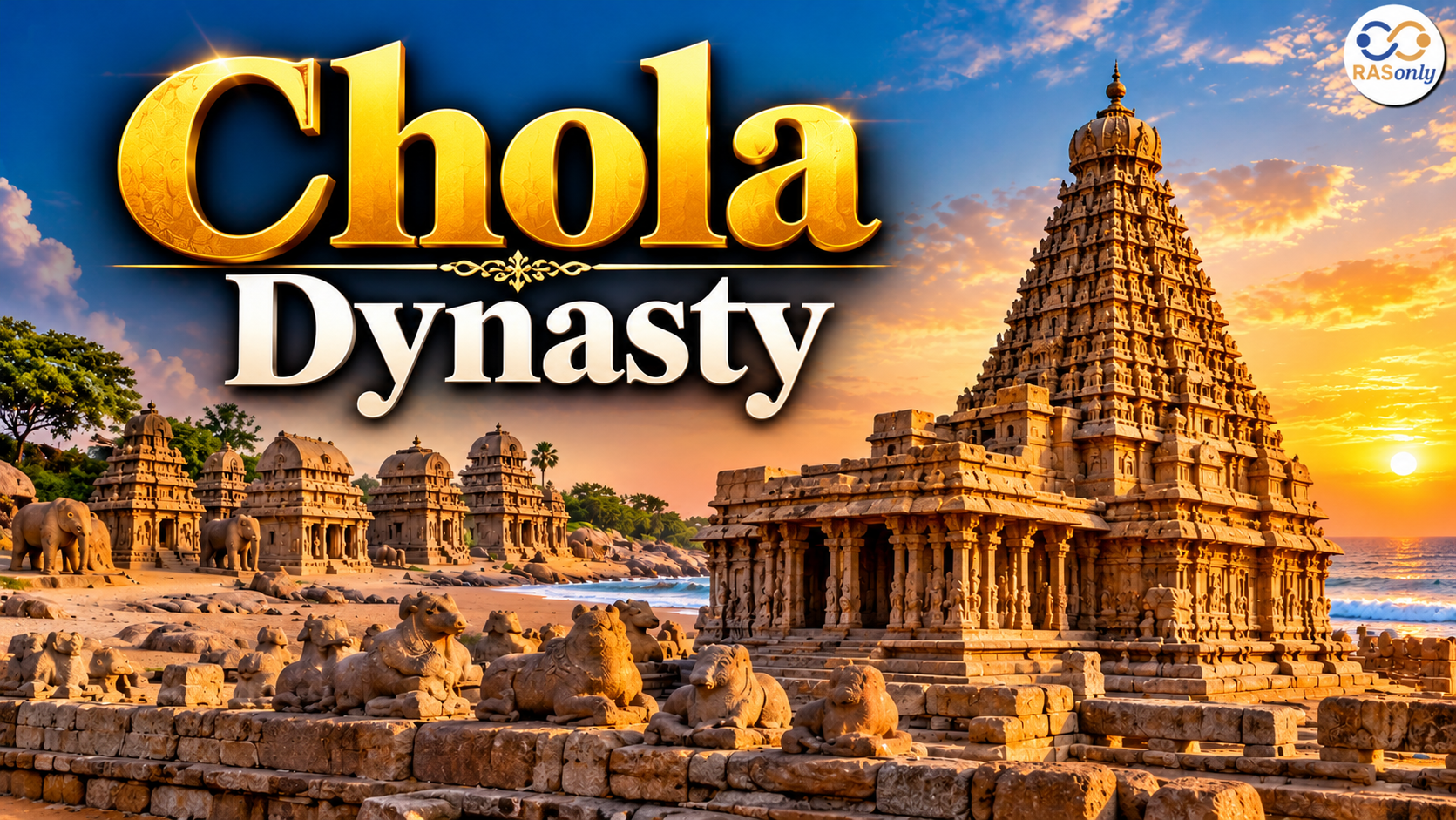
Chola Dynasty: Capital, Founder, Kings, Time Period and History
NITI Aayog: India’s Policy Think Tank

Get in Touch with RASonly!


NITI Aayog, or the National Institution for Transforming India, established on January 1, 2015, is the policy think tank of the Government of India, replacing the Planning Commission. It focuses on inclusive growth, cooperative federalism, and sustainable development. The organization is headed by the Prime Minister and its members include state representatives and experts.
NITI Aayog works on key initiatives such as the Atal Innovation Mission and the Aspirational Districts Programme, promoting innovation and addressing socio-economic inequalities. Despite its advisory role and limitations on resource allocation, it plays a key role in shaping India's policies and governance.
Vision and Purpose
The primary goal of NITI Aayog is to develop a framework that contributes to sustainable and inclusive growth. It promotes the involvement of the states in the national policy-making process and assists in the adjustment of the plans to the local requirements. NITI Aayog is a forum where ideas are debated, progress is being monitored and best practices are being exchanged. It also tracks the performance of India in attaining Sustainable Development Goals (SDGs) and encourages evidence-based governance.
Structure
NITI Aayog is headed by the Prime Minister. It consists of a Vice-Chairperson(Shri Suman Bery), full-time and part-time members and ex-officio members, who are Union Ministers. All Chief Ministers of states and Lieutenant Governors of union territories make up the Governing Council. This non-discriminatory framework makes sure that central and state views are reflected in the national policy-making process.
Functions of NITI Aayog
The following are the detailed functions of Niti Aayog (National Institution for Transforming India):
1. Collaborate with the governments of the states on national development priorities, sectors, and strategies.
- Create a federal system in which national and state governments work in harmony and coordination.
- Implement rural development schemes and initiatives.
- Ensure that economic strategy and policy are in the best interests of national security.
- Encourage partnerships between key stakeholders and like-minded think tanks on a national and international scale, as well as educational and policy research institutions.
- With the assistance of national and international experts, practitioners, and other partners, develop a knowledge, innovation, and entrepreneurial support system.
- Maintain a cutting-edge Resource Center and serve as a research hub for good governance and best practices in sustainable* and equitable* development.
- Actively monitor and evaluate program and initiative implementation, with a focus on technology upgradation and capacity building.
2. National Labor Economics Research and Development Institute (NILERD)
3. Another function of Niti Aayog is to serve as the Planning Commission’s successor.
Challenges
However, NITI Aayog has such limitations as the lack of financial strength, reliance on other ministries to implement it, and the resistance of states at times. But its advisory and research functions are still reinforcing governance in India.
Conclusion
NITI Aayog is the indicator of the change from the centralized planning in India to the joint policy-making. It will make the growth of India sustainable and people-oriented by placing emphasis on evidence, innovation, and inclusivity. It provides the upcoming administrators with the real-life example of how modern governance should be carried out: collaboratively, adaptably, and goal-oriented.
BEST SELLER
🏆 PRELIMS
RAS Pass
Prelims focused Hindi & English
₹399
✓
Prelims Topic-Wise Tests
✓
Subject-Wise Tests
✓
Full-Length Prelims Tests
✓
Daily Current Affairs Tests
✓
Prelims PYQs Tests
✓
Detailed Solutions & Analysis
✓
All Rajasthan Ranking
✓
Unlimited Reattempts
✓
Mains Tests
✓
Hindi & English Tests
✓
All Rajasthan Ranking
Trusted by 5,000+ Students
Post Category
- RAS Salary
- Result
- RAS Admit Card
- RAS Job
- RAS Cutoff
- Preparation Tips
- RAS Answer Key
- RAS Exam Analysis
- RAS Syllabus
- RAS Previous Year Papers
- RPSC RAS Exam Pattern
- RAS Interview
- RAS Exam Date
- RAS Vacancy
- RAS Test Series
- RAS Best Books
- RAS Preparation Resources
- RAS Coaching Centre
- History
- Polity
- Geography
- Economics
- Science
- Art and Culture
- RPSC RAS Application Form
- RPSC RAS Notification
- RAS Eligibility Criteria
- UPSC Exam
- RPSC RAS Mains
Visit Our RASonly Offline Center
Our Expert Faculty

Bhunesh Sir
Current Affairs · 13+ Yrs

Aamir Khan Sir
RAS-2017 · IIM Ahm.

Akash Sir
Polity · 8+ Yrs
Free Resources
Official Mobile App

RASOnly App
by OTSAdda · Free
Full Video Lectures
Mock Tests & PYQs
Daily Current Affairs
AI Mock Interview
Free Download · No subscription needed to install
RAS 2024 Toppers — RASonly
Rank 2
Virendra Charan
Rank 9
Bhoopinder Singh
Rank 26
Aanchal Nagpal
Rank 33
Lokendra Singh
Rank 45
Amar Rathore
Rank 46
Manasvini Verma

Join RASonly WhatsApp Community
Get daily current affairs, exam alerts, free study material and tips from expert faculty — right on WhatsApp.
Join for Free →RASonly Interview Guidance Program

Mr. Ashok Jain
Ex-Chief Secretary Govt of Rajasthan
- IAS officer of the 1981 batch, Rajasthan cadre.
- Passionate about mentoring the next generation of RAS officers with real-world insights.
- Got retired in Dec 2017 from the post of Chief Secretary of the state of Rajasthan.

Mr. Guru Charan Rai
Ex-ASP / SP in Jaisalmer
- Guru Charan Rai, IPS (Retd), retired as Inspector General of Police (Security), Rajasthan, Jaipur in 2017.
- Served as ASP and SP in Jaisalmer, Nagaur, Sri Ganganagar, Sawai Madhopur, Dausa, Sikar, and Karauli.
- He also held key positions as DIGP and IGP in the Law and Order division.

Mr. Rakesh Verma
Ex-IAS Officer, B.Tech, MBA, and M.A. (Economics)
- IAS officer of the 1981 batch and retired in Chief Secretary Rank.
- Civil servant of high repute and vast experience.
- Has been teaching UPSC CSE subjects for the last six years.
Related Post
Daily Current Affairs for RAS Exam Preparation 2026
Ustad Bismillah Khan Yuva Puraskar
October 24, 2026
Marwar Festival 2026
October 24, 2026
Kundan Art Display in Hong Kong
October 23, 2026