Chola Dynasty: Capital, Founder, Kings, Time Period and History
Public Finance in India: A Comprehensive Guide

Get in Touch with RASonly!

Public Finance in India explains how the government raises revenue, manages expenditure, controls debt, and uses fiscal policy to promote economic growth, social welfare, and financial stability. It covers taxation, budgeting, public spending, and reforms that support infrastructure development and inclusive growth.

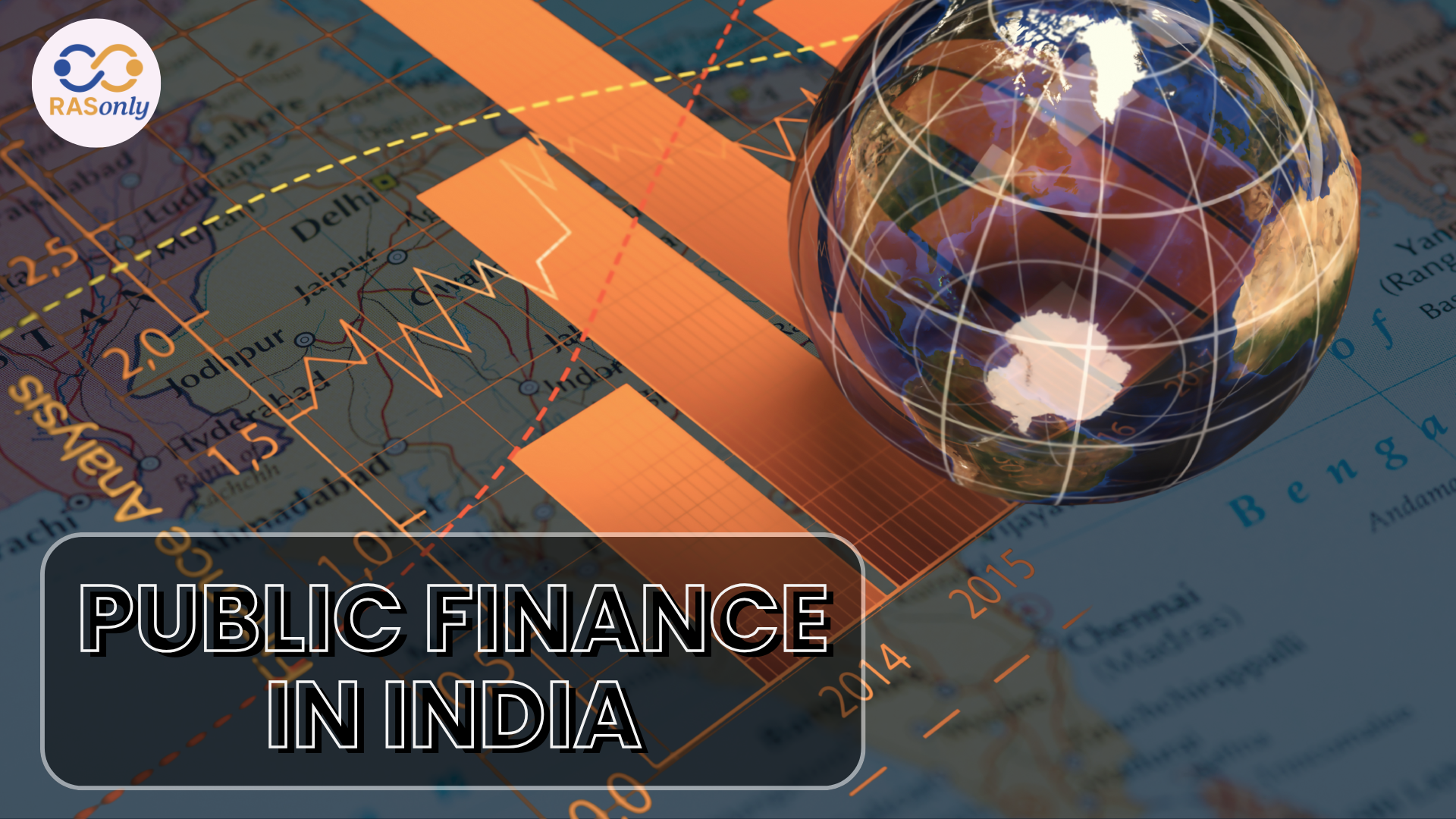
India uses public finance in the core operations of their intervention in the running of the economy, provision of public services and attainment of long-term development objectives. It consists of the actions of the government in terms of increasing revenue, distributing resources, controlling the government spending, and maintaining financial balance. Being one of the fastest-growing economies in the world, India depends more on public finance structure to promote infrastructure, the welfare program, the development of the rural areas, education, health, and national security.
The study of Public Finance in India is a critical area of study for economics students, candidates of competitive examinations, and policymakers and those who desire to know how government money circulates in the economy. This guide describes the structure, elements, obstacles, and reforms connected with public finance, together with a mere table to facilitate the understanding of the main concepts.
What Is Public Finance?
Public finance is the manner in which the governments raise funds, use funds, and utilize funds. It emphasizes the public income, the public spending, budgetary procedures, the government debt, and the fiscal policy. In India, the central government, state governments and local bodies have a common role in the management of public finance.
There are three significant objectives of public finance:
- Effective resource mobilization - Making sure that there is expenditure on basic services such as roads, education and medical services.
- Income redistribution - Underwriting schemes to lessen inequality.
- Economic stability - This is the effort of using taxes, spending, and borrowing to stabilize growth and regulate inflation.
Components of Public Finance in India
The state finance system in India is rather comprehensive. It entails the finances of the Central Government, State finances and local government finances.
Here are the five main components:
- Public Revenue
- Public Expenditure
- Public Debt
- Budgeting System
- Fiscal Policy
Let’s look at each in detail.
1. Public Revenue
The income taxed by the government through various sources is called public revenue. It is broadly classified as tax and non-tax revenue.
Tax Revenue
The Indian government is heavily relying on taxes as a source of revenue.
Major types include:
- Direct Taxes – Income tax, corporate tax.
- Indirect Taxes – GST (Goods and Services Tax), customs duties, excise duties (on specific items).
Since the implementation of GST, many of the indirect taxes have come under a single system. GST revenue has emerged as a key pointer to the economic well-being in India.
Non-Tax Revenue
This includes:
- Fees and fines
- Dividends from public sector enterprises
- Interest receipts
- Profits from RBI transfers
Tax and non-tax revenue are very essential to finance the services and development programs of the government.
2. Public Expenditure
Public expenditure refers to how the government uses its financial resources. Over the years, India’s spending has shifted toward development-related activities.
Two main categories:
Revenue Expenditure
Money spent on daily operations such as:
- Salaries
- Subsidies
- Interest payments
- Pensions
This type of expenditure does not create assets, but it is essential for running the administration.
Capital Expenditure
This includes long-term investments that create assets:
- Roads, railways, bridges
- Schools and hospitals
- Irrigation projects
- Digital infrastructure
Higher capital expenditure supports economic growth by building productive assets.
3. Public Debt
Public debt refers to the money the government borrows when its expenditure exceeds revenue. Borrowing is a normal part of public finance, as long as it is sustainable.
Types of Public Debt
- Internal Debt – Borrowed within the country (government bonds, treasury bills).
- External Debt – Borrowed from international institutions (World Bank, ADB) or foreign governments.
Borrowing helps bridge fiscal gaps but must be managed carefully to avoid excessive burden on future budgets.
4. Government Budget
Every year, the central government presents the Union Budget, which outlines estimated revenues and expenditures for the upcoming financial year. States also prepare their own budgets.
Major Components of the Budget
- Revenue Budget – Revenue receipts and expenditure.
- Capital Budget – Capital receipts (borrowings, asset sales) and capital expenditure.
The budget reflects government priorities, such as infrastructure development, welfare schemes, rural employment, and digital transformation.
5. Fiscal Policy
Fiscal policy is the use of taxation and expenditure to influence the economy.
Objectives of Fiscal Policy in India
- Promote economic growth
- Control inflation
- Reduce unemployment
- Stabilize the economy
- Reduce income inequality
In difficult periods, such as the pandemic, fiscal policy plays a crucial role in boosting demand and supporting businesses.
Structure of Public Finance in India
Public finance in India operates at three levels:
| Level of Government | Responsibilities | Sources of Revenue |
|---|---|---|
| Central Government | Defence, foreign affairs, railways, major infrastructure, national schemes | Income tax, corporate tax, GST share, excise duties, customs, dividends |
| State Governments | Health, education, agriculture, police, transport | State GST, excise duty, stamp duty, electricity duty, grants from Centre |
| Local Bodies (Urban & Rural) | Sanitation, water supply, roads, local welfare schemes | Property tax, user fees, grants from Centre & State |
This multi-level structure ensures efficient distribution of responsibilities across the nation.
Public Finance Management System in India
India’s public finance system is driven by strong institutions:
- Ministry of Finance – Overall fiscal policy and budgeting.
- Reserve Bank of India (RBI) – Manages public debt and banking structure.
- Finance Commission – Recommends tax-sharing between Centre and states.
- CAG (Comptroller and Auditor General) – Audits government accounts.
These institutions ensure accountability and transparency in public spending.
Challenges in Public Finance in India
In spite of the fact that India has a well-developed financial structure, the country has a number of challenges that influence the fiscal stability.
1. High Fiscal Deficit: A Deficit increases when the government expenditure is higher than the revenue. Large fiscal deficits raise the debt of the population and restrict its expenditures in the future.
2. Rising Subsidy Burden: India has a huge expenditure on food, fuel, fertilizers, and welfare scheme subsidies. Though subsidies play an important role, overindulgence in subsidies will lead to less money to be used in development.
3. Limited Tax Base: The number of Indians who pay income tax is very low. Expansion of the tax base is a requirement towards revenue growth.
4. Federal Fiscal Imbalance: The relations of the centers of state are strained in some cases with regard to compensation and distribution of revenues in GST.
5. Governmental Agency Unproductiveness: There are certain enterprises in the sector of the state that are not profitable and need governmental support.
Reforms in Public Finance in India
Over the years, the government has introduced several reforms to modernize the financial system.
Major Reforms Include:
- GST Reform (2017) - Tax Reform.
- FRBM Act (Fiscal Responsibility and Budget Management Act) - Establish fiscal deficit targets in order to ensure financial discipline.
- Direct Benefit Transfer (DBT) - Less leakages in welfare programs.
- Disinvestment Policy - Less intervention of government in non-core sectors.
- Digital Public Finance System - Online Payments, e-tender, PFMS (Public Financial Management System).
These reforms are meant to transform the public finance in India into being more transparent, efficient and growth-oriented.
Importance of Public Finance in Developing India
Public finance ensures:
- Stabilization of the economy using fiscal policies.
- Greater transparency of budgeting.
- Social welfare through subsidies and plans.
- Capital investment in the infrastructure.
- The balanced regional development.
An inclusive growth and a healthy long-term economy depend on a strong public finance system.
Conclusion
In India, the economic development and the government rely on the public finance. It instructs the government on how to raise and spend money, handle deficit matters, invest in the infrastructure, and institute welfare programs. As the country is being reformed and digitalized, the state finance system is becoming more open and effective. Fiscal deficits, increases in subsidies, and poor tax bases are, however, challenges that require attention. Having a well-designed strategy of public finance is critical in ensuring sustainable growth and an enhanced standard of living among all the citizens.

BEST SELLER
🏆 PRELIMS
RAS Pass
Prelims focused Hindi & English
₹399
✓
Prelims Topic-Wise Tests
✓
Subject-Wise Tests
✓
Full-Length Prelims Tests
✓
Daily Current Affairs Tests
✓
Prelims PYQs Tests
✓
Detailed Solutions & Analysis
✓
All Rajasthan Ranking
✓
Unlimited Reattempts
✓
Mains Tests
✓
Hindi & English Tests
✓
All Rajasthan Ranking
Trusted by 5,000+ Students
Post Category
- RAS Salary
- Result
- RAS Admit Card
- RAS Job
- RAS Cutoff
- Preparation Tips
- RAS Answer Key
- RAS Exam Analysis
- RAS Syllabus
- RAS Previous Year Papers
- RPSC RAS Exam Pattern
- RAS Interview
- RAS Exam Date
- RAS Vacancy
- RAS Test Series
- RAS Best Books
- RAS Preparation Resources
- RAS Coaching Centre
- History
- Polity
- Geography
- Economics
- Science
- Art and Culture
- RPSC RAS Application Form
- RPSC RAS Notification
- RAS Eligibility Criteria
- UPSC Exam
- RPSC RAS Mains
Visit Our RASonly Offline Center
Our Expert Faculty

Bhunesh Sir
Current Affairs · 13+ Yrs

Aamir Khan Sir
RAS-2017 · IIM Ahm.

Akash Sir
Polity · 8+ Yrs
Free Resources
Official Mobile App

RASOnly App
by OTSAdda · Free
Full Video Lectures
Mock Tests & PYQs
Daily Current Affairs
AI Mock Interview
Free Download · No subscription needed to install
RAS 2024 Toppers — RASonly
Rank 2
Virendra Charan
Rank 9
Bhoopinder Singh
Rank 26
Aanchal Nagpal
Rank 33
Lokendra Singh
Rank 45
Amar Rathore
Rank 46
Manasvini Verma

Join RASonly WhatsApp Community
Get daily current affairs, exam alerts, free study material and tips from expert faculty — right on WhatsApp.
Join for Free →RASonly Interview Guidance Program

Mr. Ashok Jain
Ex-Chief Secretary Govt of Rajasthan
- IAS officer of the 1981 batch, Rajasthan cadre.
- Passionate about mentoring the next generation of RAS officers with real-world insights.
- Got retired in Dec 2017 from the post of Chief Secretary of the state of Rajasthan.

Mr. Guru Charan Rai
Ex-ASP / SP in Jaisalmer
- Guru Charan Rai, IPS (Retd), retired as Inspector General of Police (Security), Rajasthan, Jaipur in 2017.
- Served as ASP and SP in Jaisalmer, Nagaur, Sri Ganganagar, Sawai Madhopur, Dausa, Sikar, and Karauli.
- He also held key positions as DIGP and IGP in the Law and Order division.

Mr. Rakesh Verma
Ex-IAS Officer, B.Tech, MBA, and M.A. (Economics)
- IAS officer of the 1981 batch and retired in Chief Secretary Rank.
- Civil servant of high repute and vast experience.
- Has been teaching UPSC CSE subjects for the last six years.
Related Post




Daily Current Affairs for RAS Exam Preparation 2026

Ustad Bismillah Khan Yuva Puraskar
October 24, 2026
Marwar Festival 2026
October 24, 2026
Kundan Art Display in Hong Kong
October 23, 2026