Chola Dynasty: Capital, Founder, Kings, Time Period and History
RAS Subject-wise Weightage, Marks Analysis 2026 (Prelims & Mains Complete Guide)

Get in Touch with RASonly!

Understand RAS subject-wise weightage 2026 with complete Prelims and Mains analysis. Focus on high-weightage subjects, improve your strategy, and boost your score with smart preparation. This guide helps you plan effectively and succeed in the RAS exam.

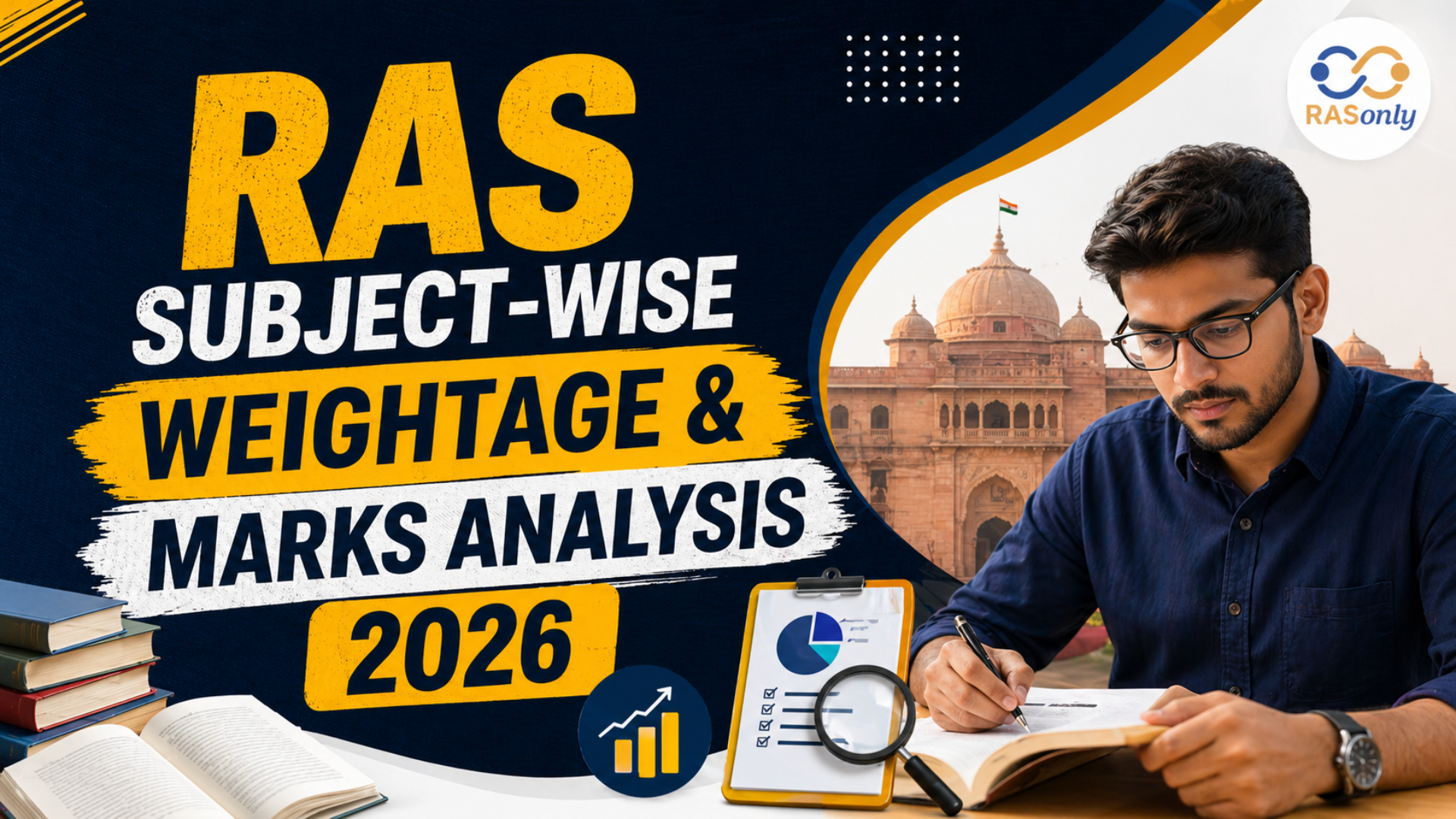
One of the best strategies to prepare for the RAS exam is to know the RAS subject-wise weightage for 2026. By understanding the question distribution, you can prioritise preparation for scoring and high-weightage subjects, rather than spending equal time on all subjects. This not only enhances your Prelims performance but also makes better use of your time in preparation.
The RAS exam pattern 2026 is a combination of conceptual, Rajasthan-specific, and current affairs knowledge. Analysing the past trends and weightage of different subjects will give you a clear idea of which topics you should focus more on, and how. A weightage-based approach helps you plan and prepare in an efficient, focused, and productive manner.
Why Subject-wise Weightage is Important for RAS 2026
Before starting preparation, it is important to understand where to invest your effort. Many aspirants study randomly, but the exam does not follow an equal distribution across subjects. Some areas consistently carry higher weightage and are easier to score with proper preparation.
Key Benefits of Weightage Analysis
- Helps in smart study planning for RAS 2026
- Focus on high-weightage and scoring subjects
- Improves accuracy and reduces confusion
- Saves time by avoiding low-priority topics
A clear understanding of RAS subject-wise weightage gives you a strong competitive advantage.
RAS Prelims Subject-wise Weightage 2026 (Expected Trend)
Understanding the RAS Prelims subject-wise weightage 2026 helps you prepare in a focused and strategic way instead of studying everything randomly. The Prelims paper covers questions from different subjects, and understanding the weightage helps you focus on the main ones, such as Rajasthan GK, History, Geography, and Current Affairs. This strategic approach not only helps you improve accuracy and speed but also enhances your chances of qualifying for RAS Prelims 2026.
RAS Prelims Weightage Table 2026
| Subject | Expected Questions | Weightage Level |
|---|---|---|
| Rajasthan GK (History, Culture, Geography) | 30–40 | Very High |
| Indian History | 15–20 | High |
| Geography (India + World) | 15–20 | High |
| Current Affairs (2025–26) | 15–20 | High |
| Polity | 10–15 | Medium |
| Economy | 10–15 | Medium |
| Science & Technology | 10–15 | Medium |
Prelims Weightage Analysis (Key Insights)
A closer look at the RAS Prelims weightage analysis 2026 shows clear patterns that can help you prepare more effectively:
- Rajasthan GK carries the highest weightage in RAS Prelims
- History and Geography together form a major portion of the paper
- Current Affairs is consistently important every year
- Polity, Economy, and Science are scoring with strong basics
Focusing on these high-weightage areas can significantly boost your score in RAS Prelims 2026.
RAS Mains Subject-wise Weightage 2026 (Paper-wise Breakdown)
RAS Mains exam subject-wise weightage 2026 is crucial to strategically prepare your answers and content. The Mains is a descriptive exam, so subject knowledge and structuring your answers are essential. The GS papers cover various subjects, and knowing their focus will help you plan your preparation for RAS Mains 2026 accordingly.
GS Paper 1 (History, Culture & Geography)
| Section | Focus Areas |
|---|---|
| Indian History | Ancient, Medieval, Modern |
| Rajasthan History & Culture | High priority |
| Geography | India + Rajasthan |
This paper is high-scoring if your facts and basic concepts are clear, especially from Rajasthan topics.
GS Paper 2 (Polity, Governance & International Relations)
| Section | Focus Areas |
|---|---|
| Indian Polity | Constitution, governance |
| Rajasthan Administration | State-specific topics |
| International Relations | Basic understanding |
Focus on concept clarity, examples, and real-life applications to score well in this paper.
GS Paper 3 (Economy, Science & Environment)
| Section | Focus Areas |
|---|---|
| Economy | Budget, policies, growth |
| Science & Technology | Basics + current |
| Environment | Climate change, ecology |
This paper has a strong link with current affairs, so regular updates are important for RAS 2026.
GS Paper 4 (Ethics & Integrity)
| Section | Focus Areas |
|---|---|
| Ethics | Values, integrity |
| Case Studies | Practical scenarios |
Requires answer writing practice, clarity of thought, and ethical understanding to score high.
RAS Exam Trend Analysis 2026 (Based on Previous Years)
It is important to understand the RAS exam trend analysis to know what kind of questions are asked and what topics are important. Looking at past papers, you can easily understand the changing pattern of the exam and the topics that are important. This helps you prepare smartly instead of studying everything randomly for RAS 2026.
Important Trends in RAS Exam
- Increasing focus on Rajasthan-specific topics
- Shift towards concept-based questions over direct facts
- Strong integration of current affairs with static subjects
- Repetition of core topics across multiple years
These trends clearly show that concept clarity, regular revision, and consistent practice are the key to success in RAS.
Most Important Subjects for RAS 2026 (Priority List)
When preparing for RAS 2026, it is crucial to categorise subjects according to their significance. This allows you to prioritise scoring subjects and time management.
High Priority Subjects
- Rajasthan GK
- History
- Geography
- Current Affairs
Medium Priority Subjects
- Polity
- Economy
- Science & Technology
Mains-Focused Subjects
- Ethics
- Governance
- Answer Writing Practice
Prioritising subjects based on weightage improves both your accuracy and overall score.
Smart Preparation Strategy for RAS 2026 (Based on Weightage)
An effective plan based on RAS subject-wise weightage 2026 allows you to study smarter and not harder. Rather than studying all topics, prioritising key topics helps you achieve better results in less time.
Follow This Smart Strategy
- Start with high-weightage subjects first
- Build strong basics in Polity, Economy, and Science
- Integrate current affairs with static subjects
- Practice RAS MCQs regularly for Prelims
- Focus on answer writing for Mains preparation
Prelims vs Mains Strategy (Quick Comparison Table)
| Aspect | Prelims | Mains |
|---|---|---|
| Type | Objective (MCQs) | Descriptive |
| Focus | Speed + accuracy | Depth + analysis |
| Preparation | Facts + concepts | Writing + structure |
Understanding this difference helps you prepare effectively for both stages of the RAS exam 2026.
Minimum Safe Attempt Strategy for RAS Prelims 2026
Knowing how many questions to attempt is just as important as preparation. A smart attempt strategy based on accuracy can significantly improve your chances of clearing the cutoff.
Recommended Approach
- Attempt around 70–80 questions with high accuracy
- Avoid blind guessing and unnecessary risks
- Focus on strong and well-prepared subjects
Remember, accuracy matters more than the number of attempts in RAS Prelims.
Final Strategy for RAS 2026
Preparing for RAS 2026 becomes much easier when you follow a structured and focused approach. Instead of studying everything equally, prioritise high-weightage subjects, revise regularly, and practice consistently.
With the right combination of concept clarity, revision, MCQ practice, and answer writing, you can improve your performance in both Prelims and Mains. A smart and disciplined strategy will help you maximise your score and increase your chances of final selection.
Conclusion
Knowing RAS subject-wise weightage 2026 helps you to plan your preparation and avoid confusion. Rather than wasting time on all subjects, you can prioritise the high-weightage subjects and key topics to study and score well in the exam. By having a clear understanding of concepts, revising, practising MCQs, and writing answers, you can boost your Prelims and Mains scores. With regularity and discipline, you can easily crack RAS 2026.
Also Read
| RAS History | RAS Polity |
| RAS Economics | RAS Geography |
| Rajasthan current affairs | RAS Art & Culture |
RAS Subject Wise Weightage 2026 - FAQ
Rajasthan GK is the most important subject as it carries the highest weightage, followed by History, Geography, and Current Affairs.
A safe attempt is around 70–80 questions with good accuracy, as accuracy matters more than the number of attempts.
Yes, RAS Mains is more challenging because it requires descriptive answers, a deeper understanding, and strong answer-writing skills.
Start with high-weightage subjects, build strong basics, integrate current affairs, and practice regularly for both Prelims and Mains.
Yes, current affairs is very important as it is directly asked in Prelims and also linked with many topics in Mains.
BEST SELLER
🏆 PRELIMS
RAS Pass
Prelims focused Hindi & English
₹399
✓
Prelims Topic-Wise Tests
✓
Subject-Wise Tests
✓
Full-Length Prelims Tests
✓
Daily Current Affairs Tests
✓
Prelims PYQs Tests
✓
Detailed Solutions & Analysis
✓
All Rajasthan Ranking
✓
Unlimited Reattempts
✓
Mains Tests
✓
Hindi & English Tests
✓
All Rajasthan Ranking
Trusted by 5,000+ Students
Post Category
- RAS Salary
- Result
- RAS Admit Card
- RAS Job
- RAS Cutoff
- Preparation Tips
- RAS Answer Key
- RAS Exam Analysis
- RAS Syllabus
- RAS Previous Year Papers
- RPSC RAS Exam Pattern
- RAS Interview
- RAS Exam Date
- RAS Vacancy
- RAS Test Series
- RAS Best Books
- RAS Preparation Resources
- RAS Coaching Centre
- History
- Polity
- Geography
- Economics
- Science
- Art and Culture
- RPSC RAS Application Form
- RPSC RAS Notification
- RAS Eligibility Criteria
- UPSC Exam
- RPSC RAS Mains
Visit Our RASonly Offline Center
Our Expert Faculty

Bhunesh Sir
Current Affairs · 13+ Yrs

Aamir Khan Sir
RAS-2017 · IIM Ahm.

Akash Sir
Polity · 8+ Yrs
Free Resources
Official Mobile App

RASOnly App
by OTSAdda · Free
Full Video Lectures
Mock Tests & PYQs
Daily Current Affairs
AI Mock Interview
Free Download · No subscription needed to install
RAS 2024 Toppers — RASonly
Rank 2
Virendra Charan
Rank 9
Bhoopinder Singh
Rank 26
Aanchal Nagpal
Rank 33
Lokendra Singh
Rank 45
Amar Rathore
Rank 46
Manasvini Verma

Join RASonly WhatsApp Community
Get daily current affairs, exam alerts, free study material and tips from expert faculty — right on WhatsApp.
Join for Free →RASonly Interview Guidance Program

Mr. Ashok Jain
Ex-Chief Secretary Govt of Rajasthan
- IAS officer of the 1981 batch, Rajasthan cadre.
- Passionate about mentoring the next generation of RAS officers with real-world insights.
- Got retired in Dec 2017 from the post of Chief Secretary of the state of Rajasthan.

Mr. Guru Charan Rai
Ex-ASP / SP in Jaisalmer
- Guru Charan Rai, IPS (Retd), retired as Inspector General of Police (Security), Rajasthan, Jaipur in 2017.
- Served as ASP and SP in Jaisalmer, Nagaur, Sri Ganganagar, Sawai Madhopur, Dausa, Sikar, and Karauli.
- He also held key positions as DIGP and IGP in the Law and Order division.

Mr. Rakesh Verma
Ex-IAS Officer, B.Tech, MBA, and M.A. (Economics)
- IAS officer of the 1981 batch and retired in Chief Secretary Rank.
- Civil servant of high repute and vast experience.
- Has been teaching UPSC CSE subjects for the last six years.
Related Post



Daily Current Affairs for RAS Exam Preparation 2026

Ustad Bismillah Khan Yuva Puraskar
October 24, 2026
Marwar Festival 2026
October 24, 2026
Kundan Art Display in Hong Kong
October 23, 2026