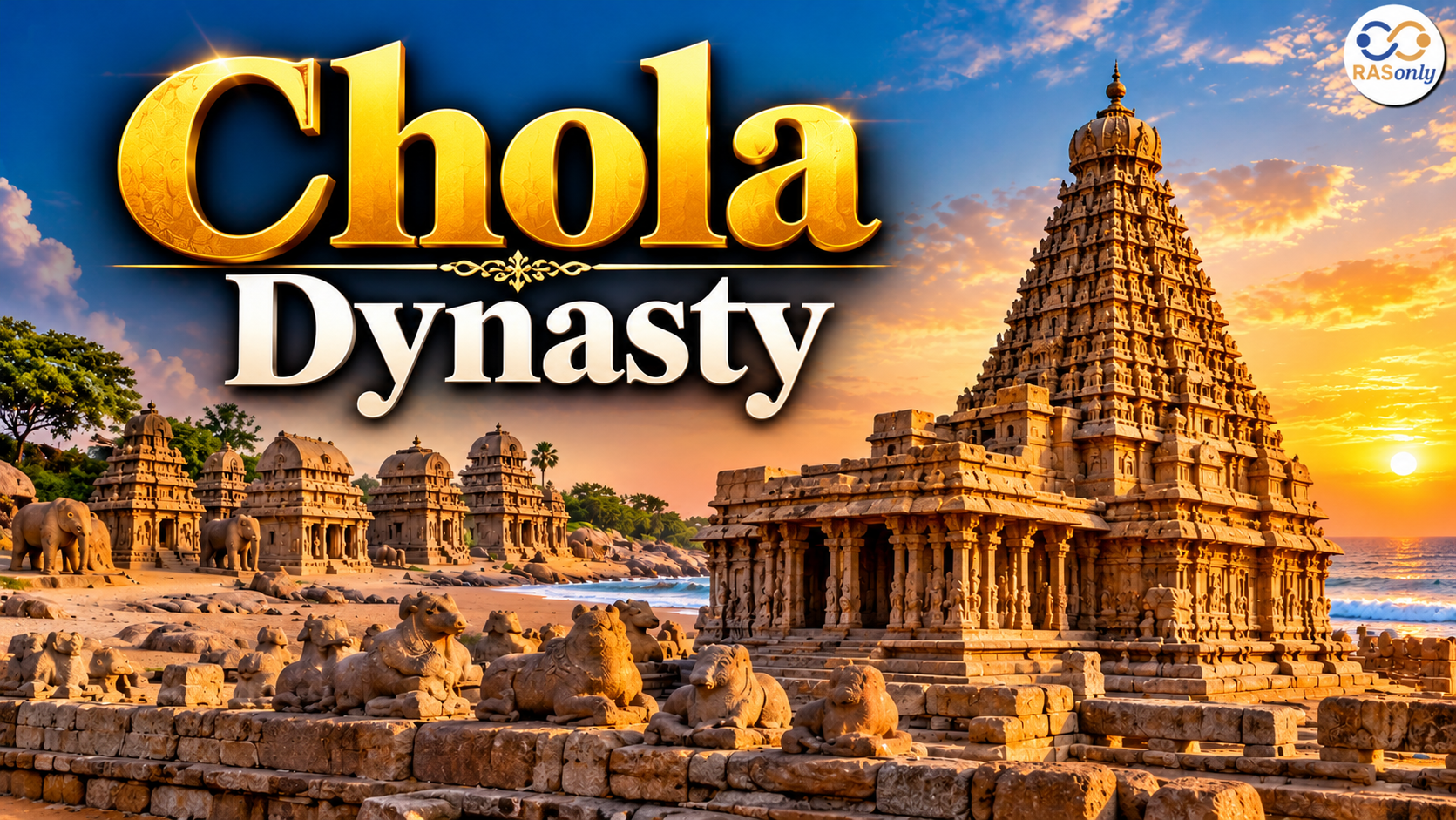
Chola Dynasty: Capital, Founder, Kings, Time Period and History
RAS Prelims 2023 History & Culture Analysis: India, Rajasthan, and Art & Culture Breakdown

Get in Touch with RASonly!

The RAS Prelims 2023 History and Culture analysis highlights the importance of syllabus-aligned preparation. With 22 questions carrying nearly 30 marks, History and Culture played a decisive role in the exam. Rajasthan Culture emerged as the most dominant area, followed by Modern Indian History. This analysis explains topic-wise weightage, exam trends, and a smart preparation strategy based on official RPSC patterns.

One of the most significant issues of serious RAS preparation is learning of exam tendencies. As evidently stated in the formal RPSC RAS syllabus and RPSC RAS Notification, the RAS Prelims test is aimed not only at gauging factual knowledge but also at gauging how a candidate comprehends the state-specific Indian and Rajasthan history and culture.
The Rajasthan Administrative Services (RAS) Prelims examination is a structured examination that takes place every year. In this structure, however, some subjects always have greater weightage. History and Culture are permanent areas of scoring amongst them, as they have been in the syllabus, as well as the real question papers published by RPSC.
One of the most obvious distributions of questions on Indian History, Rajasthan History, and Art and Culture was also presented in the RAS Prelims 2023 paper. A paper study using images confirms that RPSC was keen on balancing national history and Rajasthan-based content and placed high emphasis on cultural issues and primarily, Rajasthan Culture.
In this blog, we provide a complete and factual breakdown of History and Culture questions in RAS Prelims 2023, explain what this trend means for aspirants, and outline a practical preparation strategy aligned with the official RPSC framework.
Overview of History & Culture in RAS Prelims 2023 (As per Paper Analysis)
According to the paper analysis based on the official RAS Prelims 2023 question paper, History and Culture together contributed 22 questions, carrying approximately 29.33 marks.
This means nearly one-third of the Prelims paper was influenced by History- and Culture-related topics, all of which are clearly mentioned in the RPSC-
prescribed syllabus under:
- History of India
- History of Rajasthan
- Art, Culture, Literature, Tradition, and Heritage of Rajasthan
For aspirants, this is not just statistical data. It is a clear indication of where focused and syllabus-aligned preparation can deliver maximum returns.
RAS Prelims 2023 History & Culture Question Weightage
| Sub-topic | Number of Questions | Approx. Marks |
|---|---|---|
| Indian History – Ancient | 2 | 2.67 |
| Indian History – Medieval | 2 | 2.67 |
| Indian History – Modern | 5 | 6.67 |
| Indian Art & Culture | 3 | 4.00 |
| Rajasthan History | 3 | 4.00 |
| Rajasthan Culture | 7 | 9.33 |
| World History | 0 / Not Reported | — |
| Total (History + Culture) | 22 Questions | ≈ 29.33 Marks |
Key Insight: Clear Split Between India and Rajasthan
One of the most striking features of RAS Prelims 2023 is the clear division of questions, exactly in line with the official syllabus structure:
- Indian History
- Rajasthan History
- Art & Culture (with Rajasthan Culture dominating)
This proves that random questions are not being asked by RPSC. The commission has a very clear and syllabus-based structure, with aspirants expected to offer a balance between national-level historical knowledge and knowledge of the heritage of Rajasthan.
Indian History in RAS Prelims 2023
Ancient Indian History (2 Questions)
Ancient History still remains to be presented with small yet stable figures, in line with the syllabus section dealing with ancient Indian civilization and culture.
Common focus areas include:
- Indus Valley Civilization
- Vedic culture
- Buddhism and Jainism
- Art, architecture, and philosophy
The emphasis is on conceptual clarity, not memorization. RPSC prefers direct, fundamental questions rooted in standard sources mentioned implicitly through the syllabus.
Medieval Indian History (2 Questions)
Medieval History carried similar weightage to Ancient History. Questions were aligned with themes such as:
- Delhi Sultanate
- Mughal administration
- Bhakti and Sufi movements
- Cultural developments
Instead of being overloaded with facts, which is called factual overload, RPSC tests themes, reforms, and cultural influence, which is also descriptive by the nature of the syllabus.
Modern Indian History (5 Questions)
Modern History emerged as the most important segment within Indian History, carrying approximately 6.67 marks.
This reflects a long-standing RPSC trend, with focus on:
- Indian freedom struggle
- British administration
- Socio-religious reform movements
- National movements
Modern History is a scoring area because:
- Sources are limited and standard
- Questions align closely with syllabus wording
- Conceptual understanding leads to high accuracy
Indian Art & Culture: A Consistent Area
3 questions (4 marks) were provided by Indian Art & Culture. This part is in line with the syllabus focus on the Indian cultural heritage.
Key areas include:
- Classical and folk dances
- Architecture and sculpture
- Paintings
- UNESCO heritage sites
- Cultural traditions
This section overlaps naturally with Ancient and Medieval History, making integrated preparation highly effective, especially for Prelims.
Rajasthan History: Focused and Syllabus-Oriented
Rajasthan History contributed 3 questions (4 marks) in RAS Prelims 2023.
Important focus areas generally include:
- Major dynasties of Rajasthan
- Administrative systems
- Battles, treaties, and political evolution
RPSC avoids unnecessary depth and strictly follows core historical themes mentioned in the official syllabus.
Rajasthan Culture: The Decisive Factor
The most important highlight of RAS Prelims 2023 was Rajasthan Culture.
- 7 questions
- Approximately 9.33 marks
- Highest weightage among all sub-topics
This clearly shows that Rajasthan Culture is no longer optional. It is now a decisive component for clearing Prelims.
Commonly asked areas include:
- Folk dances and music
- Fairs and festivals
- Traditions and customs
- Handicrafts
- Paintings and art forms
- Religious and cultural practices
All these areas are explicitly mentioned in the official RPSC syllabus, making syllabus-based preparation absolutely essential.
What About World History?
World History was not separately reported in RAS Prelims 2023. While it still exists marginally in the broader syllabus context, its priority remains very low.
For aspirants, this means:
- Avoid overinvesting time
- Maintain only basic awareness
- Focus primarily on India and Rajasthan
What This Trend Means for Future RAS Aspirants
The RAS Prelims 2023 analysis sends a clear, syllabus-backed message:
- Rajasthan-focused content is increasing
- Culture is gaining more weight than political history
- Balanced, syllabus-aligned preparation is essential
- English-medium aspirants benefit from structured, topic-wise study
Ignoring any one of these areas significantly reduces selection chances.
Smart Preparation Strategy Based on Official Trends
1. Prioritize Rajasthan Culture
- Daily revision
- Visual tools like tables and charts
- Repeated MCQ practice from syllabus topics
2. Build Strong Foundation in Modern History
- NCERTs and standard books
- Timeline-based preparation
- Integration with PYQs
3. Integrated Art & Culture Preparation
- Link culture with historical periods
- Focus on recurring syllabus themes
4. Data-Driven Revision
- Analyze past 10–15 years PYQs
- Identify repeating syllabus areas
- Revise accordingly
Why This Analysis Matters More Than Just Reading the Syllabus
Most candidates study the syllabus and disregard the actual implementation by RPSC in exams. RAS Prelims 2023 proves that:
- RPSC strictly follows patterns
- Trends are predictable
- Data-backed preparation provides a clear advantage
Aspirants who align their study with official syllabus + actual paper trends save time, improve accuracy, and gain confidence.
Conclusion
It is obvious that it is no longer about reading everything, as the RAS Prelims 2023 History and Culture Analysis clearly indicates. It consists of reading just what is requested by RPSC in the correct proportions.
With 22 questions and nearly 30 marks, History and Culture played a decisive role in the exam. Among them, Rajasthan Culture emerged as the most dominant area, followed by Modern Indian History.
For serious RAS aspirants, this analysis should act as a preparation roadmap grounded in official facts, not just general information. Understanding trends, respecting the syllabus, and revising smartly is the real key to clearing RAS Prelims.
FAQ
History & Culture together contributed 22 questions (~29.33 marks), making it one of the highest-weightage areas in RAS Prelims 2023.
Rajasthan Culture had the highest weightage with 7 questions (~9.33 marks), making it the most decisive sub-topic.
Modern Indian History was the most important, contributing 5 questions (~6.67 marks), mainly from the freedom struggle and reform movements.
No. World History was not reported separately, indicating very low priority compared to Indian and Rajasthan history and culture.
Aspirants should prioritize Rajasthan Culture, build a strong base in Modern Indian History, and follow syllabus-aligned, PYQ-based preparation for maximum scoring.
BEST SELLER
🏆 PRELIMS
RAS Pass
Prelims focused Hindi & English
₹399
✓
Prelims Topic-Wise Tests
✓
Subject-Wise Tests
✓
Full-Length Prelims Tests
✓
Daily Current Affairs Tests
✓
Prelims PYQs Tests
✓
Detailed Solutions & Analysis
✓
All Rajasthan Ranking
✓
Unlimited Reattempts
✓
Mains Tests
✓
Hindi & English Tests
✓
All Rajasthan Ranking
Trusted by 5,000+ Students
Post Category
- RAS Salary
- Result
- RAS Admit Card
- RAS Job
- RAS Cutoff
- Preparation Tips
- RAS Answer Key
- RAS Exam Analysis
- RAS Syllabus
- RAS Previous Year Papers
- RPSC RAS Exam Pattern
- RAS Interview
- RAS Exam Date
- RAS Vacancy
- RAS Test Series
- RAS Best Books
- RAS Preparation Resources
- RAS Coaching Centre
- History
- Polity
- Geography
- Economics
- Science
- Art and Culture
- RPSC RAS Application Form
- RPSC RAS Notification
- RAS Eligibility Criteria
- UPSC Exam
- RPSC RAS Mains
Visit Our RASonly Offline Center
Our Expert Faculty

Bhunesh Sir
Current Affairs · 13+ Yrs

Aamir Khan Sir
RAS-2017 · IIM Ahm.

Akash Sir
Polity · 8+ Yrs
Free Resources
Official Mobile App

RASOnly App
by OTSAdda · Free
Full Video Lectures
Mock Tests & PYQs
Daily Current Affairs
AI Mock Interview
Free Download · No subscription needed to install
RAS 2024 Toppers — RASonly
Rank 2
Virendra Charan
Rank 9
Bhoopinder Singh
Rank 26
Aanchal Nagpal
Rank 33
Lokendra Singh
Rank 45
Amar Rathore
Rank 46
Manasvini Verma

Join RASonly WhatsApp Community
Get daily current affairs, exam alerts, free study material and tips from expert faculty — right on WhatsApp.
Join for Free →RASonly Interview Guidance Program

Mr. Ashok Jain
Ex-Chief Secretary Govt of Rajasthan
- IAS officer of the 1981 batch, Rajasthan cadre.
- Passionate about mentoring the next generation of RAS officers with real-world insights.
- Got retired in Dec 2017 from the post of Chief Secretary of the state of Rajasthan.

Mr. Guru Charan Rai
Ex-ASP / SP in Jaisalmer
- Guru Charan Rai, IPS (Retd), retired as Inspector General of Police (Security), Rajasthan, Jaipur in 2017.
- Served as ASP and SP in Jaisalmer, Nagaur, Sri Ganganagar, Sawai Madhopur, Dausa, Sikar, and Karauli.
- He also held key positions as DIGP and IGP in the Law and Order division.

Mr. Rakesh Verma
Ex-IAS Officer, B.Tech, MBA, and M.A. (Economics)
- IAS officer of the 1981 batch and retired in Chief Secretary Rank.
- Civil servant of high repute and vast experience.
- Has been teaching UPSC CSE subjects for the last six years.
Related Post
Daily Current Affairs for RAS Exam Preparation 2026
Ustad Bismillah Khan Yuva Puraskar
October 24, 2026
Marwar Festival 2026
October 24, 2026
Kundan Art Display in Hong Kong
October 23, 2026