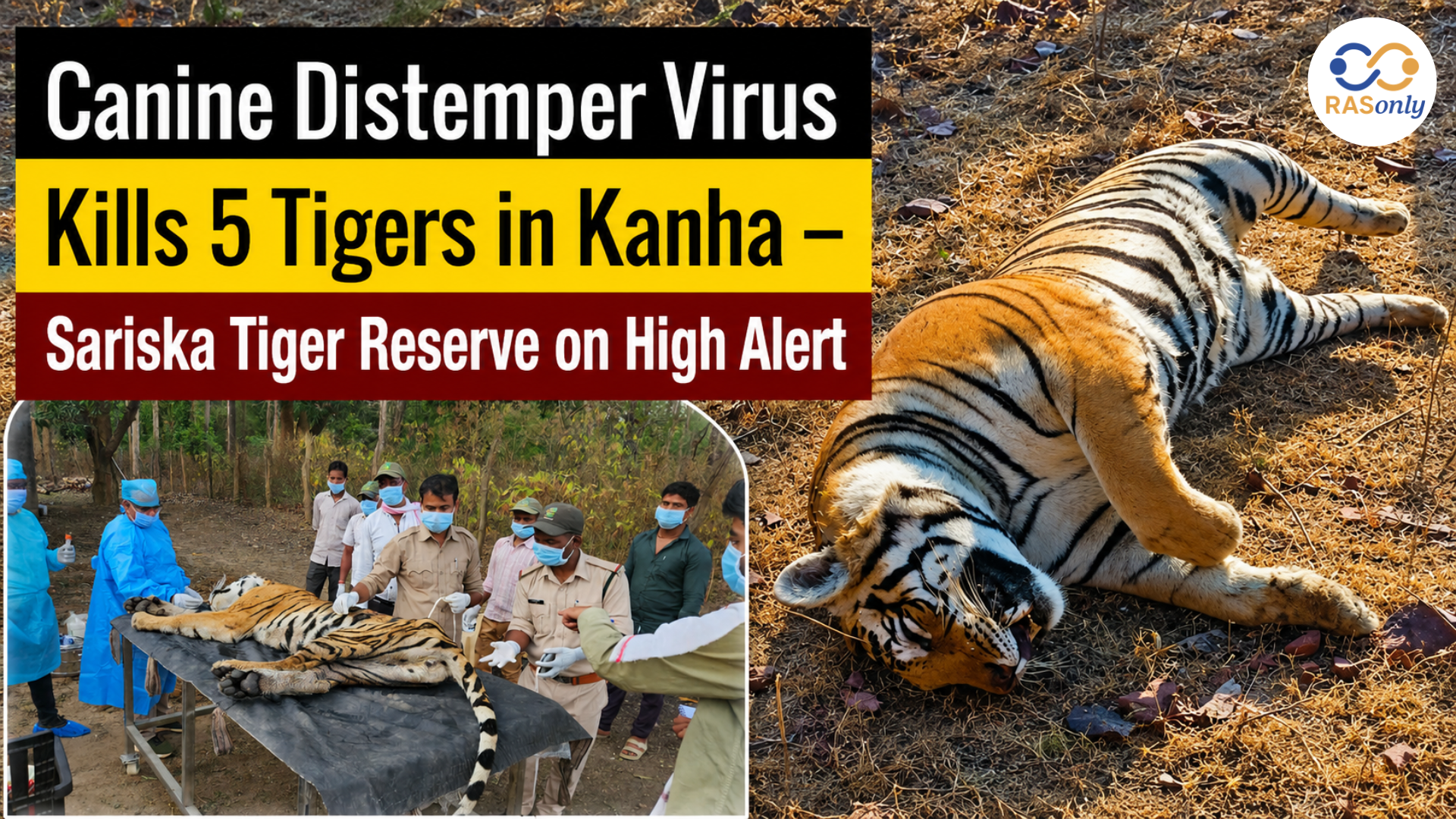
Five tigers have died in Madhya Pradesh's Kanha Tiger Reserve due to the Canine Distemper Virus (CDV), sending shockwaves through wildlife conservation circles across the country. The incident has placed Rajasthan's Sariska Tiger Reserve — home to 52 hard-won tigers — on immediate alert. With around 16,000 stray dogs living in approximately 80 villages surrounding Sariska, experts warn that if urgent vaccination and monitoring measures are not taken, the consequences could be devastating for one of Rajasthan's most celebrated wildlife habitats.
Key Highlights
- Five tigers have died in Kanha Tiger Reserve (Madhya Pradesh) due to Canine Distemper Virus.
- Sariska Tiger Reserve in Alwar, Rajasthan has been placed on high alert following the Kanha deaths.
- Sariska currently has 52 tigers, restored over 16 years of conservation efforts.
- Around 80 villages surround Sariska, with an estimated 16,000+ stray dogs — the primary transmission risk.
- CDV spreads mainly through infected stray dogs that enter the forest or whose meat is consumed by wild animals.
- The Supreme Court mandates vaccination of all dogs near tiger reserves — this work remains incomplete at Sariska.
- Sariska Field Director Sangram Singh Katiyar confirmed: no CDV case has been reported at Sariska so far, but teams are on full alert.
- Experts recommend forming a high-level monitoring committee for round-the-clock surveillance.
What is Canine Distemper Virus?
Canine Distemper Virus is being described in wildlife circles as the "wildlife's coronavirus" — and with good reason. It is a highly contagious viral disease that primarily attacks the respiratory system, directly targeting the lungs of big cats. As the infection progresses, it destroys the body's immune defenses and spreads to other organs, leaving the animal severely weakened before eventually proving fatal.
The key symptoms to watch for include:
- Difficulty breathing
- Discharge from eyes and nose
- High fever
- Muscle tremors and seizures
The virus does not spread through direct predator-prey contact alone. If an infected stray dog enters the forest and partially feeds on a carcass, any wild animal that later feeds on the same carcass can contract the virus. Even more directly, tigers and leopards frequently prey on stray dogs near village boundaries — bringing them into immediate contact with the pathogen.
The Stray Dog Problem Around Sariska
Sariska Tiger Reserve spreads across approximately 1,213 square kilometres. Along its entire periphery sit around 80 villages, and these villages are estimated to have over 16,000 stray dogs. These dogs routinely wander into forest-fringe areas in search of food, creating repeated points of contact with the wildlife inside.
Former Sariska Field Director R.S. Shekhawat explains that the chain of infection often begins quietly — an infected dog scavenges, a tiger or leopard comes into contact with the carcass or the dog itself, and the virus finds a new host. Given that tigers are apex predators that regularly encounter dogs near village edges, the risk is structural, not incidental.
The Supreme Court has issued clear guidelines making vaccination of all dogs in tiger reserve buffer zones mandatory. However, at Sariska, this vaccination programme is yet to be completed — a gap that demands urgent attention.
Sariska's Conservation History and What Is at Stake
Sariska has a sobering history with wildlife disease. Back in 1972, outbreaks of Rinderpest and Anthrax caused mass mortality among sambar deer in the reserve. The lessons of that era were hard-learned, and conservationists fear the same complacency could cost Sariska dearly today.
The 52 tigers currently living in Sariska represent 16 years of painstaking conservation work — tigers were completely wiped out from the reserve in 2004 due to poaching and were reintroduced starting 2008. Losing even a handful to a preventable viral outbreak would be a serious blow to one of India's most watched wildlife recovery stories.
Experts are clear: this cannot be left to the Animal Husbandry Department alone. A dedicated, high-level inter-departmental committee with the authority to enforce vaccination drives and run 24-hour monitoring is what the situation demands.
What Sariska Administration Is Doing
Field Director Sangram Singh Katiyar has stated that the entire Sariska team is on standby. The administration is prioritising stray dog vaccination in surrounding villages and maintaining continuous monitoring across the reserve. No CDV case has been detected at Sariska as of now, but the administration is taking no chances given the Kanha incident.
Importance for the RAS Exam
- Relevant for Rajasthan Current Affairs, wildlife conservation, and tiger reserve management.
- Canine Distemper Virus is an important topic for environment and ecology sections.
- Tests awareness of Sariska Tiger Reserve — its location (Alwar), area (1,213 sq km), tiger population (52), and reintroduction history.
- The role of Supreme Court guidelines in wildlife buffer zone management is important for polity and governance.
- Historical reference to 1972 Rinderpest and Anthrax outbreaks in Sariska is useful for environment history questions.
- Connects to broader themes of human-wildlife conflict, stray animal management, and One Health approach.
Conclusion
The deaths of five tigers at Kanha Tiger Reserve due to Canine Distemper Virus are a stark reminder of how quickly a viral outbreak can undo decades of conservation work. For Sariska, where 52 tigers stand as proof of what sustained effort can achieve, the threat demands more than routine vigilance. Completing the pending vaccination of stray dogs in surrounding villages, establishing a high-level monitoring committee, and ensuring forest-fringe communities are engaged in early detection are the immediate priorities. The line between a timely response and a tragedy can be very thin — and Sariska cannot afford to find out the hard way.
MCQs
1. Which virus was responsible for the deaths of five tigers in Kanha Tiger Reserve, Madhya Pradesh?
a. Feline Parvovirus
b. Canine Distemper Virus
c. Bovine Herpesvirus
d. Nipah Virus
Answer: b
Explanation: Five tigers in Kanha Tiger Reserve died due to Canine Distemper Virus (CDV). This highly contagious virus primarily attacks the respiratory and immune systems of big cats and can spread through infected stray dogs that enter forest areas or through consumption of contaminated carcasses. Following these deaths, Rajasthan's Sariska Tiger Reserve was placed on high alert due to similar risk factors present around it.
2. Approximately how many stray dogs are estimated to live in the villages surrounding Sariska Tiger Reserve?
a. 6,000
b. 10,000
c. 16,000
d. 22,000
Answer: c
Explanation: Around 80 villages surround Sariska Tiger Reserve, and these villages are estimated to have over 16,000 stray dogs. These dogs frequently move into forest-fringe areas and are the primary transmission risk for Canine Distemper Virus to tigers. The Supreme Court has mandated vaccination of all such dogs near tiger reserves, but this work remains incomplete at Sariska.
3. In which year were large numbers of sambar deer lost in Sariska due to disease outbreaks, and which diseases were responsible?
a. 1965 — Foot and Mouth Disease and Tuberculosis
b. 1972 — Rinderpest and Anthrax
c. 1980 — Canine Distemper and Rabies
d. 1995 — Avian Influenza and Parvovirus
Answer: b
Explanation: In 1972, outbreaks of Rinderpest and Anthrax caused large-scale mortality among sambar deer in Sariska. This historical episode is a reminder of how vulnerable wildlife populations are to infectious disease outbreaks. Today, with Canine Distemper Virus posing a similar threat to Sariska's 52 tigers — restored over 16 years of conservation work — the administration is under pressure to act swiftly and prevent history from repeating itself.
बाघों पर मंडराया कैनाइन डिस्टेंपर वायरस का खतरा — कान्हा में 5 मौतों के बाद सरिस्का हाई अलर्ट पर
मध्यप्रदेश के कान्हा टाइगर रिजर्व में कैनाइन डिस्टेंपर वायरस के कारण पांच बाघों की मौत ने देशभर के वन्यजीव संरक्षण जगत को हिलाकर रख दिया है। इस घटना के बाद राजस्थान के अलवर स्थित सरिस्का टाइगर रिजर्व को तत्काल हाई अलर्ट पर रखा गया है। सरिस्का में 52 बाघ हैं जिन्हें 16 वर्षों की अथक मेहनत से संरक्षित किया गया है। रिजर्व के चारों ओर बसे करीब 80 गांवों में अनुमानित 16,000 से अधिक आवारा कुत्ते इस वायरस के सबसे बड़े वाहक बन सकते हैं। विशेषज्ञों का मानना है कि यदि तत्काल टीकाकरण और निगरानी के कदम नहीं उठाए गए तो परिणाम अत्यंत गंभीर हो सकते हैं।
प्रमुख बिंदु
- मध्यप्रदेश के कान्हा टाइगर रिजर्व में कैनाइन डिस्टेंपर वायरस से पांच बाघों की मौत हो चुकी है।
- राजस्थान के सरिस्का टाइगर रिजर्व (अलवर) को तत्काल हाई अलर्ट पर रखा गया है।
- सरिस्का में वर्तमान में 52 बाघ हैं, जो 16 वर्षों के संरक्षण प्रयासों का परिणाम हैं।
- सरिस्का के आसपास 80 गांव और अनुमानित 16,000 से अधिक आवारा कुत्ते — यही सबसे बड़ा खतरा है।
- वायरस मुख्यतः संक्रमित आवारा कुत्तों के जरिए फैलता है जो जंगल में घुसते हैं या जिनका मांस वन्यजीव खाते हैं।
- सुप्रीम कोर्ट के निर्देशों के अनुसार टाइगर रिजर्व के आसपास सभी कुत्तों का टीकाकरण अनिवार्य है — सरिस्का में यह काम अभी अधूरा है।
- क्षेत्र निदेशक संग्राम सिंह कटियार के अनुसार सरिस्का में अभी तक कोई मामला नहीं आया है, लेकिन पूरी टीम सतर्क है।
- विशेषज्ञों ने उच्च स्तरीय कमेटी गठित कर चौबीसों घंटे निगरानी की मांग की है।
कैनाइन डिस्टेंपर वायरस क्या है?
इस वायरस को वन्यजीव विशेषज्ञ "वन्यजीवों का कोरोना" कह रहे हैं और इसकी वजह भी स्पष्ट है। यह अत्यंत संक्रामक वायरल बीमारी है जो सीधे बड़े वन्यजीवों के फेफड़ों पर हमला करती है। धीरे-धीरे यह शरीर की प्रतिरोधक क्षमता को नष्ट करती है और अन्य अंगों को भी प्रभावित करती जाती है — जिससे जानवर बेहद कमजोर होकर अंततः मर जाता है।
मुख्य लक्षण:
- सांस लेने में तकलीफ
- आंखों और नाक से पानी गिरना
- तेज बुखार
- शरीर में झटके आना
वायरस केवल सीधे शिकार से नहीं फैलता। यदि कोई संक्रमित आवारा कुत्ता जंगल में जाकर किसी मृत जानवर का मांस खाता है और उसी मांस को बाद में कोई वन्यजीव खाए, तो संक्रमण का चक्र शुरू हो जाता है। इससे भी बड़ा खतरा यह है कि बाघ और तेंदुए अक्सर गांवों के किनारे आवारा कुत्तों का शिकार करते हैं — जिससे सीधा संपर्क होता है।
सरिस्का के इर्द-गिर्द आवारा कुत्तों की समस्या
सरिस्का टाइगर रिजर्व लगभग 1,213 वर्ग किलोमीटर में फैला है। इसकी परिधि में बसे करीब 80 गांवों में 16,000 से अधिक आवारा कुत्ते हैं जो भोजन की तलाश में जंगल की सीमा तक पहुंच जाते हैं।
सरिस्का के पूर्व क्षेत्रीय निदेशक आर.एस. शेखावत बताते हैं कि संक्रमण अक्सर चुपचाप शुरू होता है — एक संक्रमित कुत्ता मांस खाता है, बाघ उसी कुत्ते का शिकार करता है या उसी मांस को खाता है, और वायरस को नया मेजबान मिल जाता है। सुप्रीम कोर्ट के स्पष्ट निर्देशों के बावजूद सरिस्का में यह टीकाकरण अधूरा है — यह एक गंभीर खामी है जिसे तत्काल दूर करना होगा।
सरिस्का की संरक्षण विरासत और दांव पर क्या है
सरिस्का का इतिहास वन्यजीव रोगों से पहले भी टकरा चुका है। 1972 में रिंडरपेस्ट और एंथ्रेक्स जैसी बीमारियों ने यहां बड़ी संख्या में सांभर को खत्म कर दिया था। उस त्रासदी से सीखे गए सबक आज भी प्रासंगिक हैं।
2004 में अवैध शिकार के कारण सरिस्का से बाघ पूरी तरह समाप्त हो गए थे और 2008 से पुनः बाघों को यहां लाया गया। आज के 52 बाघ उन 16 वर्षों की कड़ी मेहनत का नतीजा हैं। किसी रोकी जा सकने वाली बीमारी से इनका नुकसान होना संरक्षण की दृष्टि से अक्षम्य होगा।
विशेषज्ञों का स्पष्ट मत है कि यह जिम्मेदारी केवल पशुपालन विभाग पर नहीं छोड़ी जा सकती। एक उच्च स्तरीय अंतरविभागीय कमेटी के जरिए चौबीसों घंटे निगरानी और टीकाकरण अभियान की जरूरत है।
सरिस्का प्रशासन की तैयारी
क्षेत्र निदेशक संग्राम सिंह कटियार ने स्पष्ट किया है कि पूरी टीम मुस्तैद है। आसपास के गांवों में आवारा कुत्तों के टीकाकरण पर जोर दिया जा रहा है और रिजर्व में लगातार निगरानी जारी है। अभी तक सरिस्का में कैनाइन डिस्टेंपर का कोई मामला सामने नहीं आया है — लेकिन कान्हा की घटना को देखते हुए प्रशासन कोई जोखिम नहीं उठाना चाहता।
RAS परीक्षा के लिए महत्व
- राजस्थान समसामयिकी, वन्यजीव संरक्षण और टाइगर रिजर्व प्रबंधन के लिए प्रासंगिक।
- कैनाइन डिस्टेंपर वायरस पर्यावरण और पारिस्थितिकी खंड के लिए महत्वपूर्ण विषय।
- सरिस्का टाइगर रिजर्व की स्थिति (अलवर), क्षेत्रफल (1,213 वर्ग किमी), बाघ संख्या (52) और पुनः प्रवेश इतिहास परीक्षा में उपयोगी।
- बफर जोन प्रबंधन में सुप्रीम कोर्ट के दिशानिर्देशों की भूमिका राजव्यवस्था और शासन के लिए महत्वपूर्ण।
- 1972 में रिंडरपेस्ट और एंथ्रेक्स का ऐतिहासिक संदर्भ पर्यावरण इतिहास के प्रश्नों के लिए उपयोगी।
- मानव-वन्यजीव संघर्ष, आवारा पशु प्रबंधन और 'वन हेल्थ' दृष्टिकोण से जुड़े व्यापक विषयों से संबद्ध।
निष्कर्ष
कान्हा टाइगर रिजर्व में कैनाइन डिस्टेंपर वायरस से पांच बाघों की मौत इस बात की कड़ी याद दिलाती है कि एक वायरल संक्रमण दशकों की संरक्षण मेहनत को कितनी तेजी से नष्ट कर सकता है। सरिस्का के लिए — जहां 52 बाघ 16 वर्षों के अथक प्रयास की जीती-जागती मिसाल हैं — यह खतरा केवल सतर्कता से नहीं, बल्कि ठोस कार्रवाई से टालना होगा। आसपास के गांवों में लंबित टीकाकरण को पूरा करना, उच्च स्तरीय निगरानी समिति का गठन और वन सीमा पर बसे समुदायों को शुरुआती चेतावनी तंत्र से जोड़ना — ये तीन कदम अभी सबसे जरूरी हैं।
बहुविकल्पीय प्रश्न
1. किस वायरस के कारण कान्हा टाइगर रिजर्व, मध्यप्रदेश में पांच बाघों की मौत हुई?
a. फेलाइन पार्वोवायरस
b. कैनाइन डिस्टेंपर वायरस
c. बोवाइन हर्पीसवायरस
d. निपाह वायरस
उत्तर: b
व्याख्या: कान्हा टाइगर रिजर्व में पांच बाघों की मौत कैनाइन डिस्टेंपर वायरस (CDV) के कारण हुई। यह अत्यंत संक्रामक वायरस बड़े वन्यजीवों की श्वसन और प्रतिरक्षा प्रणाली पर हमला करता है और मुख्यतः संक्रमित आवारा कुत्तों के जरिए फैलता है। इन मौतों के बाद सरिस्का टाइगर रिजर्व को हाई अलर्ट पर रखा गया क्योंकि वहां भी इसी प्रकार के जोखिम कारक मौजूद हैं।
2. सरिस्का टाइगर रिजर्व के आसपास के गांवों में अनुमानित कितने आवारा कुत्ते हैं?
a. 6,000
b. 10,000
c. 16,000 से अधिक
d. 22,000 से अधिक
उत्तर: c
व्याख्या: सरिस्का टाइगर रिजर्व के आसपास करीब 80 गांव हैं जिनमें 16,000 से अधिक आवारा कुत्ते अनुमानित हैं। ये कुत्ते अक्सर जंगल की सीमा में प्रवेश कर जाते हैं और कैनाइन डिस्टेंपर वायरस के सबसे बड़े वाहक बन सकते हैं। सुप्रीम कोर्ट के निर्देशों के तहत इन सभी कुत्तों का टीकाकरण अनिवार्य है, लेकिन सरिस्का में यह काम अभी अधूरा है।
3. 1972 में सरिस्का में सांभरों की बड़े पैमाने पर मृत्यु के लिए कौन-सी दो बीमारियां जिम्मेदार थीं?
a. फुट एंड माउथ डिजीज और तपेदिक
b. रिंडरपेस्ट और एंथ्रेक्स
c. कैनाइन डिस्टेंपर और रेबीज
d. एवियन इन्फ्लुएंजा और पार्वोवायरस
उत्तर: b
व्याख्या: 1972 में रिंडरपेस्ट और एंथ्रेक्स जैसी बीमारियों के कारण सरिस्का में बड़ी संख्या में सांभर समाप्त हो गए थे। यह ऐतिहासिक घटना इस बात की याद दिलाती है कि संक्रामक रोग कितनी तेजी से वन्यजीव आबादी को नुकसान पहुंचा सकते हैं। आज सरिस्का के 52 बाघ — जो 2008 से शुरू हुए पुनः प्रवेश अभियान और 16 वर्षों के संरक्षण प्रयासों का परिणाम हैं — इसी तरह के खतरे का सामना कर रहे हैं, इसलिए त्वरित कार्रवाई अनिवार्य है।