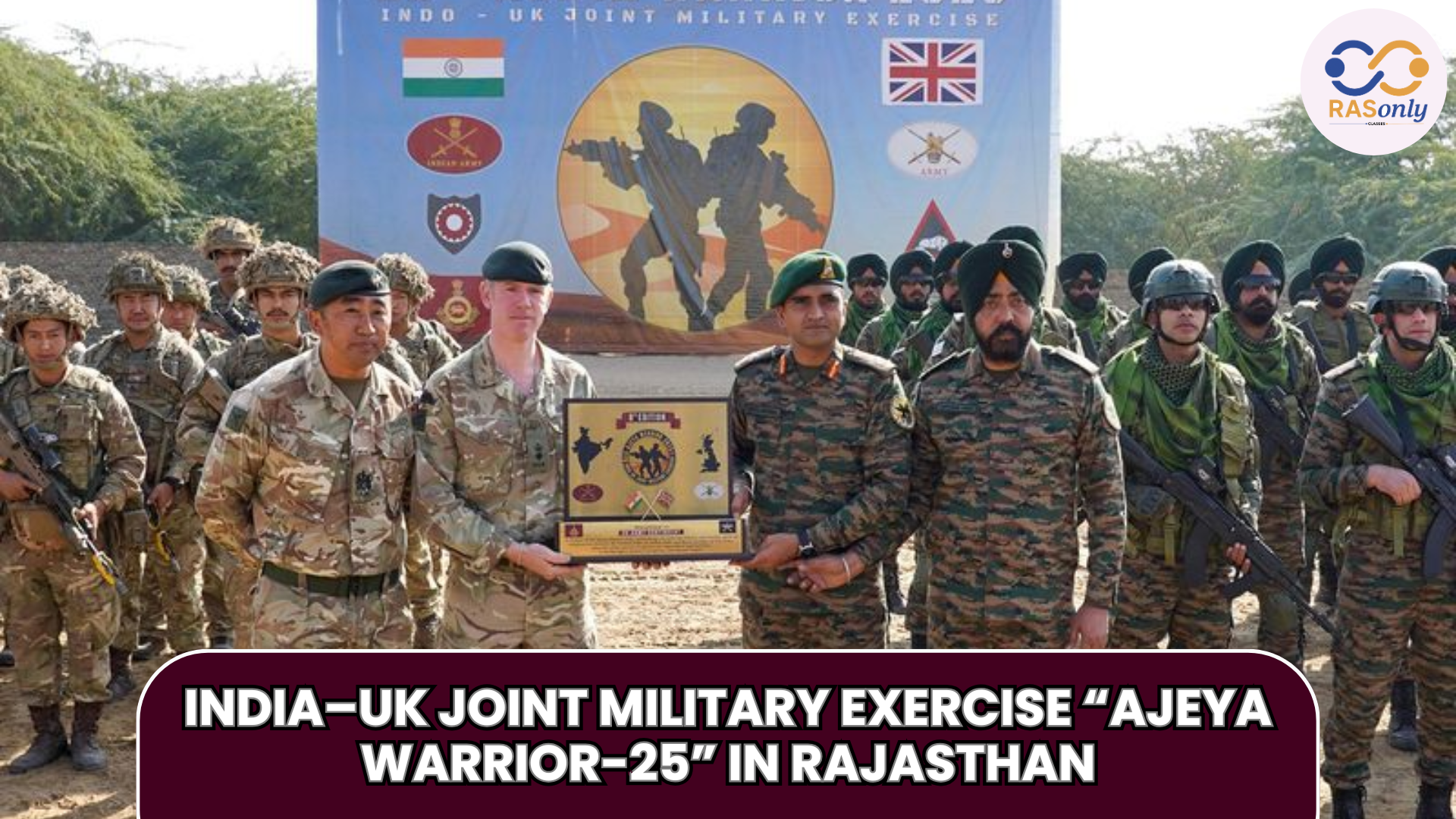
India and the UK have completed a 14-day joint military exercise, Ajeya Warrior-25, at the Mahajan Field Firing Range in the western sector of Rajasthan. The drill emphasised future multi-domain operations, hybrid warfare, anti-terrorism exercises, and coordinated fighting in urban and semi-desert areas. Soldiers from the Indian Army's Sikh Light Infantry and the British Army's Royal Gorkha Rifles participated. Advanced technologies such as DRDO’s mule robotic system, tactical drones, and integrated battlefield platforms were used. The exercise aimed to enhance interoperability, tactical coordination, and joint response for counter-terror and high-mobility missions. Approximately 240 soldiers from the two countries participated, strengthening bilateral defence cooperation.
Key Features of Ajeya Warrior-25
Multi-Domain and Hybrid Warfare Training
• Focus on coordinated land–air–tech integrated operations.
• Execution of counter-terror and high-mobility battlefield actions.
• Joint mission planning in semi-desert terrain.
Advanced Technology Demonstrations
• DRDO’s robotic mule system for load-carrying and reconnaissance.
• Use of mini tactical drones for surveillance and target marking.
• Training in helicopter mobility and insertion–extraction operations.
Participating Units
• India: Sikh Light Infantry Regiment.
• UK: Royal Gorkha Rifles.
• Total personnel: Approximately 240 troops.
Strategic Importance (RAS-Oriented)
Military Objectives
• Improve compatibility between the two armies.
• Strengthen joint counter-terrorism and sub-conventional warfare capabilities.
• Develop shared SOPs for hybrid conflict scenarios.
Defence Diplomacy Significance
• Reinforces the India–UK strategic defence partnership.
• Enhances preparedness for joint multinational operations.
• Highlights India’s expertise in desert warfare on global platforms.
Conclusion
The India–UK military exercise "Ajeya Warrior-25" showcases the growing depth of their defence partnership and the evolution of modern joint combat practices. The use of robotics, drones, and high-tech mobility platforms signals a major shift toward future warfare standards. Conducted in the challenging desert terrain of Rajasthan, the exercise significantly strengthened interoperability, tactical readiness, and shared security capabilities between the two armies.
MCQs (English )
1. What was the primary focus of the India–UK military exercise ‘Ajeya Warrior-25’?
A. Maritime border protection
B. Hybrid warfare and multi-domain operations
C. Mountain warfare training
D. Nuclear posture readiness
Answer: B. Hybrid warfare and multi-domain operations
Explanation:
Ajeya Warrior-25 was primarily designed to train both armies in hybrid warfare, combining conventional, sub-conventional, cyber, and technology-driven combat. The exercise incorporated multi-domain operations using land forces, air mobility assets, drones, and robotics. This reflects the nature of modern warfare, where coordinated action across multiple theatres is essential for operational success.
2. Which advanced system developed by DRDO was demonstrated during Ajeya Warrior-25?
A. Arjun Mk-II tank
B. Agni-V missile
C. Robotic mule system
D. Pinaka rocket launcher
Answer: C. Robotic mule system
Explanation:
The DRDO-developed robotic mule system showcased autonomous load-carrying, reconnaissance, and mobility support in high-risk environments. This unmanned ground vehicle assists soldiers with surveillance and logistical functions, particularly in complex terrain. Its demonstration highlights India's drive to integrate robotics and AI-enabled systems into battlefield operations.
3. Which regiments participated in the exercise from India and the UK respectively?
A. Rajput Regiment and Scots Guards
B. Sikh Light Infantry and Royal Gorkha Rifles
C. Jat Regiment and Irish Guards
D. Assam Regiment and Welsh Guards
Answer: B. Sikh Light Infantry and Royal Gorkha Rifles
Explanation:
India was represented by the Sikh Light Infantry, known for its expertise in desert operations and counter-insurgency. The UK participated through the Royal Gorkha Rifles, a regiment with significant experience in hybrid and high-intensity conflict. Their collaboration improved interoperability, mutual trust, and the tactical strength of the exercise.
राजस्थान में आयोजित भारत–ब्रिटेन संयुक्त सैन्य अभ्यास ‘अजेय वॉरियर-25’
भारत और ब्रिटेन ने राजस्थान के पश्चिमी सेक्टर स्थित महाजन फील्ड फायरिंग रेंज में 14 दिन लंबे संयुक्त सैन्य अभ्यास ‘अजेय वॉरियर-25’ को पूरा किया। इस अभ्यास में भविष्य के मल्टी-डोमेन ऑपरेशंस, हाइब्रिड युद्ध, आतंकवाद-रोधी अभ्यास, तथा शहरी और अर्ध-रेगिस्तानी क्षेत्रों में समन्वित युद्धक क्षमता पर विशेष जोर दिया गया। भारतीय सेना की सिख लाइट इन्फेंट्री और ब्रिटिश सेना की रॉयल गोरखा राइफल्स ने इसमें भाग लिया। DRDO के म्यूल रोबोटिक सिस्टम, टैक्टिकल ड्रोन और इंटीग्रेटेड बैटलफील्ड प्लेटफॉर्म जैसी उन्नत तकनीकों का प्रदर्शन किया गया। अभ्यास का उद्देश्य इंटरऑपरेबिलिटी, सामरिक समन्वय, और उच्च-गतिशीलता व आतंकवाद-रोधी अभियानों में संयुक्त प्रतिक्रिया क्षमता को बढ़ाना था। लगभग 240 सैनिकों ने भाग लेकर द्विपक्षीय रक्षा सहयोग को मजबूत किया।
अजेय वॉरियर-25 की प्रमुख विशेषताएं
मल्टी-डोमेन और हाइब्रिड वारफेयर प्रशिक्षण
• भूमि–वायु–प्रौद्योगिकी आधारित समन्वित अभियानों पर फोकस।
• आतंकवाद-रोधी और उच्च गतिशीलता वाले युद्धाभ्यासों का संचालन।
• अर्ध-रेगिस्तानी क्षेत्र में संयुक्त मिशन योजनाओं का अभ्यास।
उन्नत तकनीक का प्रदर्शन
• DRDO का रोबोटिक म्यूल सिस्टम—भार ढोने और टोही मिशनों के लिए।
• मिनी टैक्टिकल ड्रोन—निगरानी और लक्ष्य चिह्नित करने के लिए।
• हेलिकॉप्टर मोबिलिटी एवं इनसर्शन–एक्सट्रैक्शन तकनीकों का प्रशिक्षण।
भाग लेने वाली इकाइयाँ
• भारत: सिख लाइट इन्फेंट्री रेजिमेंट
• यूके: रॉयल गोरखा राइफल्स
• कुल प्रतिभागी: लगभग 240 सैनिक
रणनीतिक महत्व (RAS उन्मुख विश्लेषण)
सैन्य उद्देश्य
• दोनों सेनाओं के बीच सामरिक संगतता को बढ़ाना।
• संयुक्त आतंकवाद-रोधी और उप-पारंपरिक युद्धक क्षमताओं को मजबूत करना।
• हाइब्रिड संघर्ष परिदृश्यों के लिए साझा SOPs का विकास।
रक्षा कूटनीति महत्व
• भारत–यूके रणनीतिक रक्षा साझेदारी को सुदृढ़ करता है।
• दोनों सेनाओं को बहुराष्ट्रीय संयुक्त अभियानों के लिए बेहतर तैयार करता है।
• भारत की रेगिस्तानी युद्धक विशेषज्ञता को वैश्विक स्तर पर प्रदर्शित करता है।
निष्कर्ष
भारत–ब्रिटेन का संयुक्त सैन्य अभ्यास "अजेय वॉरियर-25" दोनों देशों की गहरी होती रक्षा साझेदारी और आधुनिक संयुक्त युद्धक क्षमताओं के विकास को दर्शाता है। रोबोटिक्स, ड्रोन और हाई-टेक मोबिलिटी प्लेटफॉर्म का उपयोग भविष्य के युद्ध मानकों की ओर एक महत्वपूर्ण परिवर्तन है। राजस्थान के चुनौतीपूर्ण रेगिस्तानी क्षेत्र में आयोजित इस अभ्यास ने इंटरऑपरेबिलिटी, सामरिक तैयारी और साझा सुरक्षा क्षमताओं को उल्लेखनीय रूप से मजबूत किया।
MCQs (हिंदी)
1. भारत–ब्रिटेन संयुक्त सैन्य अभ्यास ‘अजेय वॉरियर-25’ का मुख्य फोकस क्या था?
A. समुद्री सीमा सुरक्षा
B. हाइब्रिड युद्ध और मल्टी-डोमेन ऑपरेशंस
C. पर्वतीय युद्ध प्रशिक्षण
D. परमाणु स्थिति तैयारियां
उत्तर: B. हाइब्रिड युद्ध और मल्टी-डोमेन ऑपरेशंस
व्याख्या:
अजेय वॉरियर-25 का उद्देश्य दोनों सेनाओं को हाइब्रिड युद्ध की परिस्थितियों में प्रशिक्षित करना था, जिसमें पारंपरिक, उप-पारंपरिक, साइबर और तकनीकी आधारित युद्ध तत्व शामिल हैं। अभ्यास में भूमि सेना, वायु गतिशीलता साधनों, ड्रोन और रोबोटिक्स का उपयोग करके मल्टी-डोमेन ऑपरेशंस का प्रदर्शन किया गया। यह आधुनिक युद्ध की वास्तविकताओं को दर्शाता है, जहाँ कई मोर्चों पर समन्वित कार्रवाई आवश्यक है।
2. अजेय वॉरियर-25 के दौरान DRDO की कौन-सी उन्नत प्रणाली प्रदर्शित की गई?
A. अर्जुन Mk-II टैंक
B. अग्नि-V मिसाइल
C. रोबोटिक म्यूल सिस्टम
D. पिनाका रॉकेट लॉन्चर
उत्तर: C. रोबोटिक म्यूल सिस्टम
व्याख्या:
DRDO द्वारा विकसित रोबोटिक म्यूल सिस्टम को स्वायत्त भार ढुलाई, टोही और जोखिमपूर्ण क्षेत्रों में गतिशील सहायता प्रदर्शित करने के लिए दिखाया गया। यह मानव रहित ग्राउंड वाहन जटिल भूभाग में सैनिकों की निगरानी और लॉजिस्टिक आवश्यकताओं में मदद करता है। इसका प्रदर्शन भारत की युद्धक्षेत्र संचालन में रोबोटिक्स और AI-आधारित प्रणालियों को शामिल करने की दिशा को दर्शाता है।
3. इस अभ्यास में भारत और ब्रिटेन की ओर से क्रमशः कौन-सी रेजिमेंट शामिल हुईं?
A. राजपूत रेजिमेंट और स्कॉट्स गार्ड
B. सिख लाइट इन्फेंट्री और रॉयल गोरखा राइफल्स
C. जाट रेजिमेंट और आयरिश गार्ड
D. असम रेजिमेंट और वेल्श गार्ड
उत्तर: B. सिख लाइट इन्फेंट्री और रॉयल गोरखा राइफल्स
व्याख्या:
भारत की ओर से सिख लाइट इन्फेंट्री ने भाग लिया, जो रेगिस्तानी और काउंटर-इंसर्जेंसी ऑपरेशन्स में अपनी विशेषज्ञता के लिए जानी जाती है। ब्रिटिश सेना की ओर से रॉयल गोरखा राइफल्स ने हिस्सा लिया, जो हाइब्रिड और उच्च-तीव्रता वाले संघर्षों में व्यापक अनुभव रखती है। इस सहयोग ने इंटरऑपरेबिलिटी, पारस्परिक विश्वास और सामरिक गहराई को बढ़ाया