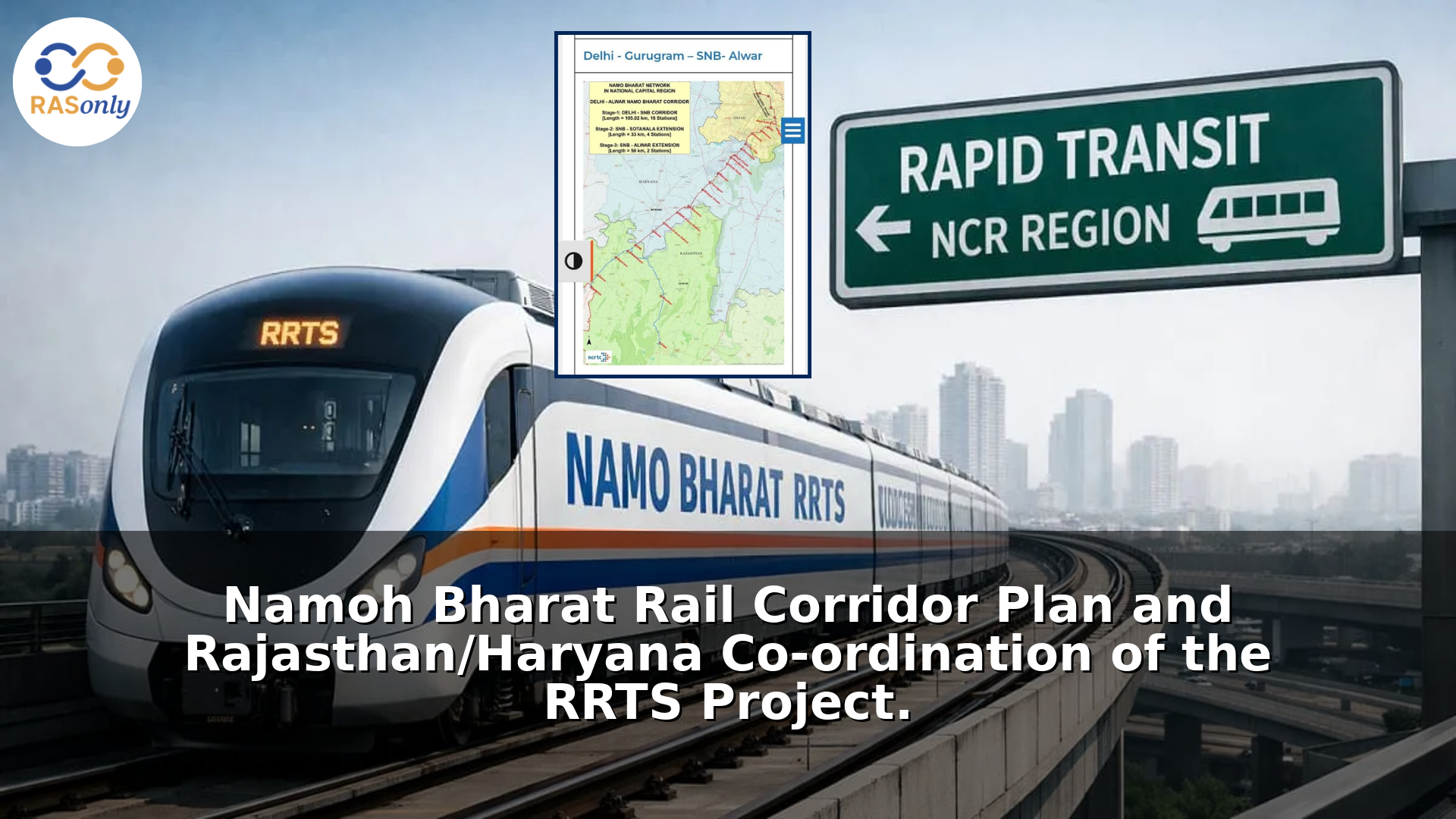
On 5 March, a major video conference was conducted between Rajasthan Chief Secretary V. Srinivas and Haryana Chief Secretary Anurag Rastogi between the Namoh Bharat Rail Corridor plan as part of the Regional Rapid Transit System (RRTS) project. At the meeting, Rajasthan said that it had already resolved to take up the first phase of the project on the terms of the revised DPR. Nonetheless, one of the major cost-sharing problems cropped up when Haryana agreed to contribute the project cost up to Babal. Rajasthan has asked Haryana to change its mind about this stance because the high-speed rail connectivity will have a direct impact on big industrialist regions like Shahjahanpur, Ghiloth, Neemrana and Behror.
The meeting consists of important developments which are outlined below.
- The session was convened using video conference in the Secretariat.
- Chief Secretary Rajasthan V. Srinivas brought out issues of the renegotiated project cost-sharing with Haryana.
- He had told the Haryana that Rajasthan was already willing to take the financial burden of the first phase as per the revised DPR.
- Rajasthan asked Haryana to rethink its move to cap the cost responsibility up to Babal only.
- Haryana Chief Secretary, Anurag Rastogi promised that a decision would be made shortly.
The Project has the following financial problem.
The Revised Cost Burden of Rajasthan.
- Under new DPR, in Rajasthan, the track development will be done on 1.13 kilometres.
- Cost was up by 103 crore by 124.26 crore.
- According to Rajasthan, when Haryana pays up to Babal, then another financial burden of 510 crore will be placed on Rajasthan.
Cost-sharing concern of the MoU.
- The participating states were supposed to contribute 20 percent of the individual share of the project cost according to the MoU.
- Rajasthan has made an objection that the current ruling upsets the agreed system of participation in finance.
Ancient Economic and Connectivity Benefits to be Expected.
Industrial Growth
- Industrial regions that will be directly benefited by the project will include Shahjahanpur, Ghiloth, Neemrana and Behror.
- Another benefit of the project will be the proposed KBNIR township.
High-Speed Connectivity
- These localities will have direct connectivity with high-speed rail to Delhi and Gurugram.
- The passageway project is likely to create a significant shift in transport, travel, and accessibility of the area.
Regional Development
- The project will most probably boost the economic growth in the region.
- There can be enhanced transport connectivity that will enhance industrial growth and investment potential.
Members of the official body attending the meeting were as follows:
The meeting was attended by:
- Shikhar Agrawal, additional Chief Secretary, Industries and Commerce.
- Vaibhav Galaria, Principal Secretary, Finance.
- Urban Development Principal Secretary Urban Development, Devashish Prushti.
- Shivangi Swarnkar is the RIICO Managing Director.
- Akash Tomar is the Executive Director of RIICO.
- Ajay Gupta is the topmost RIICO officer.
Conclusion
The Namoh Bharat Rail Corridor debate narrates the strategic worth and the economic intricacy of the rapid transit projects in the region. In the case of Rajasthan, the project will not only make transport connectivity essential but also the growth of industries in the major areas around Delhi-NCR. Examination wise, the significance of this development is that inter-state coordination, infrastructure financing, industrial development and regional economic integration is linked.
MCQS (RAS Prelims )
1. What was the main issue that was discussed during the meeting between the Chief Secretaries of Rajasthan and Haryana about the Namoh Bharat Rail Corridor plan?
(a) Station naming in Delhi and Gurugram: Finalisation of station names.
(b) KBNIR township acquisition of land only.
(c) Financing and expense sharing in the RRTS project.
(d) Sealing of industrial estates in Neemrana and Behror.
Answer: (c)
Explanation: The financial burden and cost-sharing arrangement of the RRTS project was the primary issue discussed during the meeting. As per the revised DPR, Rajasthan claimed that it had already committed to shoulder the financial cost of the 1st phase. The move by Haryana however to accept the cost as far as Babal would be would add extra burden of Rs 510 crore to Rajasthan which sought revisions.
2. What were the specific industrial regions that were identified as receiving direct high-speed rail connections under the proposed project?
(a) Kota, Bundi, Baran and Jhalawar.
(b) Shahjahanpur, Ghiloth, Neemrana, and Behror.
(c) Udaipur, Chittorgarh, Rajsamand and Bhilwara.
(d) Sikar, Jhunjhunu, Churu, and Hanumangarh district.
Answer: (b)
Explanation: The industrial belt that includes Shahjahanpur, Ghiloth, Neemrana, and Behror is likely to directly be positively impacted by the project. The proposed KBNIR township, as well as these areas, is likely to be directly connected to high-speed rail with Delhi and Gurugram. This is important as a better transport accessibility will be able to facilitate industrial development, labor movement, and broader regional economic growth.
3. Based on how Rajasthan had been placed at the meeting, what was the impression of the participating states under the MoU?
(a) The full cost of the project would be incurred by each state in its territory.
(b) Participating states would have 20 percent of their share in the project cost.
(c) The Union Government would cover the whole cost of the project
(d) Haryana would only fund the entire corridor to the industrial areas of Rajasthan.
Answer: (b)
Explanation In the MoU, Rajasthan indicated that the cost of the project was supposed to be divided between the participating states in 20 percent of their respective share. Rajasthan protested against Haryana decision to only limit its cost liability to Babal since this will deficit a more heavy burden on Rajasthan. This causes the problem to be a significant model of inter-state coordination of infrastructure financing.
नमो भारत रेल गलियारा योजना तथा आरआरटीएस परियोजना में राजस्थान-हरियाणा समन्वय।
5 मार्च को नमो भारत रेल गलियारा योजना के संबंध में, जो क्षेत्रीय तीव्र परिवहन प्रणाली (आरआरटीएस) परियोजना का हिस्सा है, राजस्थान के मुख्य सचिव वी. श्रीनिवास और हरियाणा के मुख्य सचिव अनुराग रस्तोगी के बीच एक महत्वपूर्ण वीडियो कॉन्फ्रेंस आयोजित की गई। बैठक में राजस्थान ने कहा कि उसने पहले ही संशोधित विस्तृत परियोजना प्रतिवेदन (डीपीआर) की शर्तों के अनुसार परियोजना के प्रथम चरण का वित्तीय भार वहन करने का निर्णय ले लिया है। इसके बावजूद, एक प्रमुख लागत-साझेदारी समस्या तब सामने आई जब हरियाणा ने केवल बाबल तक परियोजना लागत वहन करने पर सहमति दी। राजस्थान ने हरियाणा से इस रुख पर पुनर्विचार करने का आग्रह किया, क्योंकि यह उच्चगति रेल संपर्क शाहजहांपुर, घीलोठ, नीमराणा और बहरोड़ जैसे बड़े औद्योगिक क्षेत्रों को प्रत्यक्ष लाभ पहुंचाएगा।
बैठक के मुख्य बिंदु
बैठक के दौरान निम्नलिखित महत्वपूर्ण बातें सामने आईं:
- बैठक शासन सचिवालय में वीडियो कॉन्फ्रेंस के माध्यम से आयोजित की गई।
- राजस्थान के मुख्य सचिव वी. श्रीनिवास ने हरियाणा के साथ संशोधित परियोजना लागत-साझेदारी का मुद्दा उठाया।
- उन्होंने हरियाणा को बताया कि राजस्थान पहले ही संशोधित डीपीआर के अनुसार प्रथम चरण का वित्तीय भार वहन करने के लिए तैयार है।
- राजस्थान ने हरियाणा से यह आग्रह किया कि वह अपनी लागत जिम्मेदारी केवल बाबल तक सीमित रखने के निर्णय पर पुनर्विचार करे।
- हरियाणा के मुख्य सचिव अनुराग रस्तोगी ने आश्वासन दिया कि शीघ्र ही निर्णय से अवगत कराया जाएगा।
परियोजना से जुड़ा वित्तीय प्रश्न
राजस्थान पर संशोधित लागत भार
- नए डीपीआर के अनुसार राजस्थान में 1.13 किलोमीटर ट्रैक का विकास किया जाएगा।
- लागत 103 करोड़ रुपये से बढ़कर 124.26 करोड़ रुपये हो गई।
- राजस्थान के अनुसार, यदि हरियाणा केवल बाबल तक लागत वहन करता है, तो राजस्थान पर अतिरिक्त 510 करोड़ रुपये का वित्तीय भार आएगा।
समझौता ज्ञापन से जुड़ी लागत-साझेदारी चिंता
- समझौता ज्ञापन के अनुसार, सहभागी राज्यों को परियोजना लागत में अपने-अपने हिस्से का 20 प्रतिशत वहन करना था।
- राजस्थान ने आपत्ति जताई कि वर्तमान निर्णय वित्तीय सहभागिता की सहमति-आधारित व्यवस्था को प्रभावित करता है।
संभावित आर्थिक और संपर्क लाभ
औद्योगिक विकास
- इस परियोजना से शाहजहांपुर, घीलोठ, नीमराणा और बहरोड़ जैसे औद्योगिक क्षेत्र सीधे लाभान्वित होंगे।
- प्रस्तावित केबीएनआईआर टाउनशिप को भी इस परियोजना से लाभ मिलेगा।
उच्चगति संपर्क
- इन क्षेत्रों को दिल्ली और गुरुग्राम से सीधे उच्चगति रेल संपर्क मिलेगा।
- यह गलियारा परिवहन, आवागमन और क्षेत्रीय पहुंच में महत्वपूर्ण परिवर्तन ला सकता है।
क्षेत्रीय विकास
- यह परियोजना क्षेत्र के आर्थिक विकास को तेज कर सकती है।
- बेहतर परिवहन संपर्क से औद्योगिक विस्तार और निवेश की संभावनाएं बढ़ सकती हैं।
बैठक में उपस्थित अधिकारी
बैठक में निम्नलिखित अधिकारी उपस्थित रहे:
- अतिरिक्त मुख्य सचिव, उद्योग एवं वाणिज्य, शिखर अग्रवाल
- प्रमुख शासन सचिव, वित्त, वैभव गालरिया
- प्रमुख शासन सचिव, नगरीय विकास, देवाशीष पृष्ठि
- रीको की प्रबंध निदेशक, शिवांगी स्वर्णकार
- रीको के अधिशासी निदेशक, आकाश तोमर
- रीको के वरिष्ठ अधिकारी, अजय गुप्ता
निष्कर्ष
नमो भारत रेल गलियारा पर हुई चर्चा क्षेत्रीय तीव्र परिवहन परियोजनाओं के रणनीतिक महत्व और उनकी वित्तीय जटिलता दोनों को सामने लाती है। राजस्थान के लिए यह परियोजना केवल परिवहन संपर्क का प्रश्न नहीं है, बल्कि दिल्ली-एनसीआर के निकट स्थित प्रमुख औद्योगिक क्षेत्रों के विकास से भी जुड़ी हुई है। परीक्षा की दृष्टि से यह विकास महत्वपूर्ण है, क्योंकि इसमें अंतर्राज्यीय समन्वय, अवसंरचना वित्तपोषण, औद्योगिक विकास और क्षेत्रीय आर्थिक एकीकरण जैसे विषय एक साथ जुड़े हुए हैं।
1. नमो भारत रेल गलियारा योजना के संबंध में राजस्थान और हरियाणा के मुख्य सचिवों के बीच हुई बैठक में मुख्य मुद्दा क्या था?
(a ) दिल्ली और गुरुग्राम में स्टेशनों के नामों का अंतिम निर्धारण
(b )केवल केबीएनआईआर टाउनशिप के लिए भूमि अधिग्रहण
(c )आरआरटीएस परियोजना में वित्तपोषण और लागत-साझेदारी
(d )नीमराणा और बहरोड़ के औद्योगिक क्षेत्रों को बंद करना
उत्तर: (c )
व्याख्या: बैठक का मुख्य मुद्दा आरआरटीएस परियोजना के अंतर्गत वित्तीय भार और लागत-साझेदारी की व्यवस्था था। राजस्थान ने कहा कि संशोधित डीपीआर के अनुसार वह पहले ही प्रथम चरण का वित्तीय भार वहन करने के लिए तैयार है। लेकिन हरियाणा द्वारा केवल बाबल तक लागत वहन करने का निर्णय लेने से राजस्थान पर 510 करोड़ रुपये का अतिरिक्त भार आएगा, इसलिए राजस्थान ने पुनर्विचार की मांग की।
2. प्रस्तावित परियोजना के अंतर्गत किन औद्योगिक क्षेत्रों को प्रत्यक्ष उच्चगति रेल संपर्क मिलने की बात कही गई थी?
(a ) कोटा, बूंदी, बारां और झालावाड़
(b )शाहजहांपुर, घीलोठ, नीमराणा और बहरोड़
(c )उदयपुर, चित्तौड़गढ़, राजसमंद और भीलवाड़ा
(d )सीकर, झुंझुनूं, चूरू और हनुमानगढ़
उत्तर: (b )
व्याख्या: इस परियोजना से शाहजहांपुर, घीलोठ, नीमराणा और बहरोड़ वाला औद्योगिक पट्टा सीधे लाभान्वित होने वाला है। इन क्षेत्रों के साथ प्रस्तावित केबीएनआईआर टाउनशिप को भी दिल्ली और गुरुग्राम से उच्चगति रेल संपर्क मिलने की संभावना है। यह महत्वपूर्ण है क्योंकि बेहतर परिवहन संपर्क औद्योगिक विकास, श्रमिकों की आवाजाही और व्यापक क्षेत्रीय आर्थिक वृद्धि को गति दे सकता है।
3. बैठक में राजस्थान के पक्ष के अनुसार, समझौता ज्ञापन के अंतर्गत सहभागी राज्यों के लिए क्या व्यवस्था थी?
(a ) प्रत्येक राज्य अपने क्षेत्र में परियोजना की पूरी लागत वहन करेगा
(b )सहभागी राज्य परियोजना लागत में अपने-अपने हिस्से का 20 प्रतिशत वहन करेंगे
(c )संपूर्ण परियोजना लागत का वहन केंद्र सरकार करेगी
(d )हरियाणा अकेले राजस्थान के औद्योगिक क्षेत्रों तक पूरे गलियारे की लागत वहन करेगा
उत्तर: (b )
व्याख्या: राजस्थान ने स्पष्ट किया कि समझौता ज्ञापन के अनुसार सहभागी राज्यों को परियोजना लागत में अपने-अपने हिस्से का 20 प्रतिशत वहन करना था। राजस्थान ने हरियाणा के उस निर्णय पर आपत्ति जताई जिसमें उसकी लागत जिम्मेदारी को केवल बाबल तक सीमित किया गया, क्योंकि इससे राजस्थान पर अधिक वित्तीय भार पड़ता। इस कारण यह मामला अवसंरचना वित्तपोषण में अंतर्राज्यीय समन्वय का महत्वपूर्ण उदाहरण बन जाता है