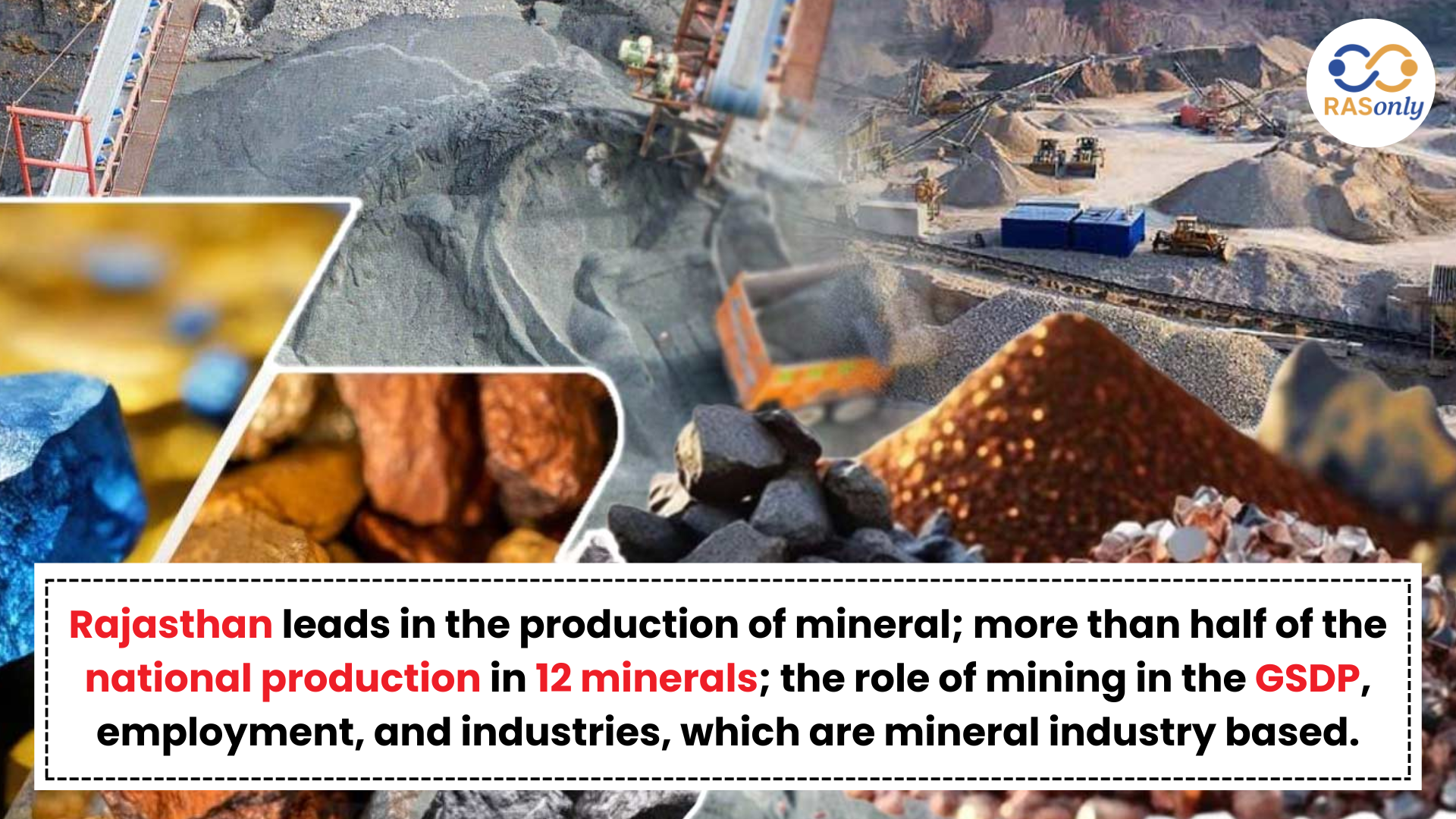
The Rajasthan mineral production has become a national leader also as indicated in the Rajasthan Economic Review 2024-25. The review observes that India has many major and minor mines in Rajasthan region and the state leads in the country in terms of mineral productivity. The mineral production is particularly robust in the production of gypsum, lead-zinc, wollastonite, silica sand, rock phosphate, marble, and limestone as seen in Rajasthan. The state contributes approximately 90 per cent or more of the total gypsum. It is a large national producer of lead-zinc. Rajasthan produces also the dimensional stones like marble and granite and these have reinforced the cement, ceramics, fertiliser and metal industries of India
Among the most significant discoveries on the mineral strength of Rajasthan is presented below.
- Rajasthan contains many of the India major and minor minerals.
The state is the national leader in the production of:
- Gypsum, lead-zinc, wollastonite, silica sand, rock phosphate, marble and limestone.
- Rajasthan also provides more of the total production of gypsum in India; that is, approximately 90 percent.
- Rajasthan produces a significant quantity of dimensional stones in the country, including marble and granite.
Share in India (More than 50 percent in 12 minerals) Rajasthan.
|
|
|
|
|
|
|
|
|
|
|
|
|
|
|
|
|
|
|
|
|
|
|
|
|
|
|
|
|
|
|
|
|
|
|
|
Status Only Producer Highlighted.
Rajasthan is displayed as the sole manufacturer in India of:
- Calcite
- Silver
- Natural gypsum
- Zinc ore
- Selenite
- Wollastonite
The contribution of Mining Sector to the GSDP and industrial base.
- The mining industry contributes significantly to the Rajasthan GSDP that earns the state revenue.
- It offers both direct and indirect working to lakhs of individuals.
Mineral based industries are strong because of the inputs related to mining such as:
- Cement
- Ceramics
- Fertilisers
- Metal industry
- The geological structure of Rajasthan and mineral diversity are seen by experts to form a foundation of a mineral hub identity.
- More value addition and downstream industry should be promoted to boost the contribution of Rajasthan towards the national economy.
Objectives and Benefits
Objectives
- Enhance the mineral hub potential in Rajasthan via enhanced value addition.
- Develop, endorsing the related minerals industries to increase the economy.
- Favour the development of mineral dependency manufacturing industries that rely on local mineral supply.
Benefits
- An increase in state revenue levels due to long-term mining-based output.
- Increased job creation by way of direct and indirect mining-based livelihoods.
- Enhanced industrial belt in cement, ceramics, fertilisers as well as metals based on dependable mineral feeds.
Conclusion
The state of Rajasthan occupies one of the leading national positions in terms of mineral production because it has more than half of the share in 12 minerals, and it has outstanding shares in some of the significant outputs. The mining industry contributes to GSDP, provides lakhs of people with jobs, and enhances mineral-related industries, including cement and metals. As the mineral economy of Rajasthan increases its value addition and downstream industrial development, then the economy will increase its contribution to the total economic activity in India.
MCQs (English)
1. What is the share of the total gypsum production in India by Rajasthan?
a) About 25%
b) About 50%
c) About 75%
d) About 90% or more
Answer: d
2. What is the highest Rajasthan share of all the minerals listed in India?
a) Gypsum (82%)
b) Potash (94%)
c) Feldspar (66%)
d) Marble (63%)
Answer: b
3. Of the following sets, Rajasthan is indicated to be the sole producer in India?
a) Calcite, Silver, Natural gypsum, Zinc ore, Selenite, Wollastonite.
b) Limestone, Granite, Dolomite, Feldspar, Bentonite, Fuller Earth.
c) Potash, Gypsum, Marble, Asbestos, Red ochre, Dolomite.
d) Silica sand, Rock phosphate, Limestone, Cement, Ceramics, Fertilisers.
Answer: a
खनिज उत्पादन में राजस्थान की अग्रणी स्थिति; 12 खनिजों में देश के कुल उत्पादन का 50% से अधिक योगदान; GSDP, रोजगार और खनिज-आधारित उद्योगों में खनन क्षेत्र की भूमिका
राजस्थान आर्थिक समीक्षा 2024–25 के अनुसार राजस्थान का खनिज उत्पादन राष्ट्रीय स्तर पर अग्रणी बनकर उभरा है। समीक्षा में बताया गया है कि भारत के अनेक प्रमुख एवं गौण खनिज राजस्थान क्षेत्र में पाए जाते हैं और खनिज उत्पादन की दृष्टि से राज्य देश में अग्रणी है। राजस्थान में विशेष रूप से जिप्सम, सीसा-जस्ता, वोलास्टोनाइट, सिलिका सैंड, रॉक फॉस्फेट, मार्बल और लाइमस्टोन का उत्पादन अत्यंत मजबूत है। राज्य देश में कुल जिप्सम उत्पादन का लगभग 90% या उससे अधिक योगदान देता है और सीसा-जस्ता का भी बड़ा राष्ट्रीय उत्पादक है। राजस्थान मार्बल और ग्रेनाइट जैसे डाइमेंशनल स्टोन्स का भी प्रमुख उत्पादक है, जिससे भारत के सीमेंट, सिरेमिक्स, उर्वरक और धातु उद्योग को मजबूती मिली है।
राजस्थान की खनिज-शक्ति से जुड़े प्रमुख निष्कर्ष निम्न हैं—
राजस्थान में भारत के अनेक प्रमुख एवं गौण खनिज पाए जाते हैं।
- राज्य निम्न खनिजों के उत्पादन में राष्ट्रीय स्तर पर अग्रणी है—
जिप्सम, सीसा-जस्ता, वोलास्टोनाइट, सिलिका सैंड, रॉक फॉस्फेट, मार्बल और लाइमस्टोन।
राजस्थान भारत के कुल जिप्सम उत्पादन का लगभग 90% योगदान करता है।
राजस्थान देश में मार्बल और ग्रेनाइट जैसे डाइमेंशनल स्टोन्स का भी बड़ा उत्पादक है।
12 खनिजों में भारत के कुल उत्पादन में राजस्थान की हिस्सेदारी (50% से अधिक)
|
|
|
|
|
|
|
|
|
|
|
|
|
|
|
|
|
|
|
|
|
|
|
|
|
|
|
|
|
|
|
|
|
|
|
|
“एकमात्र उत्पादक” (Only Producer) स्थिति
राजस्थान को भारत में निम्न खनिजों का एकमात्र उत्पादक दर्शाया गया है—
- कैल्साइट
- चांदी
- प्राकृतिक जिप्सम
- जिंक अयस्क (Zinc ore)
- सेलेनाइट
- वोलास्टोनाइट
GSDP और औद्योगिक आधार में खनन क्षेत्र का योगदान
खनन क्षेत्र राजस्थान की GSDP में महत्वपूर्ण योगदान देता है और राज्य के लिए राजस्व अर्जित करता है।
यह प्रत्यक्ष एवं अप्रत्यक्ष रूप से लाखों लोगों को रोजगार उपलब्ध कराता है।
खनन से मिलने वाले कच्चे माल/इनपुट के कारण खनिज-आधारित उद्योग मजबूत होते हैं, जैसे—
- सीमेंट
- सिरेमिक्स
- उर्वरक
- धातु उद्योग
विशेषज्ञ राजस्थान की भू-वैज्ञानिक संरचना और खनिज विविधता को “मिनरल हब” की पहचान का आधार मानते हैं।
राजस्थान के राष्ट्रीय अर्थव्यवस्था में योगदान को बढ़ाने के लिए वैल्यू एडिशन और डाउनस्ट्रीम उद्योगों को अधिक प्रोत्साहित करने की आवश्यकता बताई गई है।
उद्देश्य और लाभ
उद्देश्य
- बेहतर वैल्यू एडिशन के माध्यम से राजस्थान की “मिनरल हब” क्षमता को बढ़ाना।
- खनिजों से जुड़े उद्योगों को विकसित/प्रोत्साहित करके आर्थिक गतिविधि का विस्तार करना।
- स्थानीय खनिज आपूर्ति पर निर्भर विनिर्माण उद्योगों के विकास को समर्थन देना।
लाभ
- दीर्घकालीन खनन-आधारित उत्पादन से राज्य राजस्व में वृद्धि।
- प्रत्यक्ष और अप्रत्यक्ष खनन-आधारित आजीविका के माध्यम से रोजगार सृजन में वृद्धि।
- खनिज-आधारित उद्योगों—सीमेंट, सिरेमिक्स, उर्वरक और धातु—के लिए विश्वसनीय इनपुट से औद्योगिक तंत्र मजबूत होना।
निष्कर्ष
राजस्थान खनिज उत्पादन में राष्ट्रीय स्तर पर अग्रणी राज्य है, क्योंकि 12 खनिजों में इसका देश के कुल उत्पादन में 50% से अधिक योगदान है और कई महत्वपूर्ण खनिजों में इसकी हिस्सेदारी अत्यधिक है। खनन क्षेत्र GSDP में योगदान देता है, लाखों लोगों को रोजगार उपलब्ध कराता है और सीमेंट व धातु जैसे खनिज-आधारित उद्योगों को मजबूती देता है। यदि राजस्थान वैल्यू एडिशन और डाउनस्ट्रीम औद्योगिक विकास को बढ़ाता है, तो इसकी खनिज अर्थव्यवस्था भारत की समग्र आर्थिक गतिविधि में अपना योगदान और अधिक बढ़ा सकती है।
MCQs (हिंदी)
1. भारत के कुल जिप्सम उत्पादन में राजस्थान की हिस्सेदारी लगभग कितनी बताई गई है?
a) लगभग 25%
b) लगभग 50%
c) लगभग 75%
d) लगभग 90% या उससे अधिक
उत्तर: d
2. सूचीबद्ध खनिजों में भारत में राजस्थान की सर्वाधिक हिस्सेदारी किसमें है?
a) जिप्सम (82%)
b) पोटाश (94%)
c) फेल्डस्पार (66%)
d) मार्बल (63%)
उत्तर: b
3. निम्नलिखित में से कौन-सा समूह भारत में राजस्थान को “एकमात्र उत्पादक” के रूप में दर्शाता है?
a) कैल्साइट, चांदी, प्राकृतिक जिप्सम, जिंक अयस्क, सेलेनाइट, वोलास्टोनाइट
b) लाइमस्टोन, ग्रेनाइट, डोलोमाइट, फेल्डस्पार, बेंटोनाइट, फुलर्स अर्थ
c) पोटाश, जिप्सम, मार्बल, एस्बेस्टस, गेरू, डोलोमाइट
d) सिलिका सैंड, रॉक फॉस्फेट, लाइमस्टोन, सीमेंट, सिरेमिक्स, उर्वरक
उत्तर: a