Chola Dynasty: Capital, Founder, Kings, Time Period and History
How to Read Current Affairs for Interview: A Complete Strategy Guide

Get in Touch with RASonly!

Current affairs are crucial for interview success, but they must be studied differently from exams. This guide explains how to read current affairs for interviews with the right sources, analytical mindset, opinion-building techniques, and revision strategy to help aspirants answer confidently and logically in UPSC, RPSC RAS, and other competitive interviews.

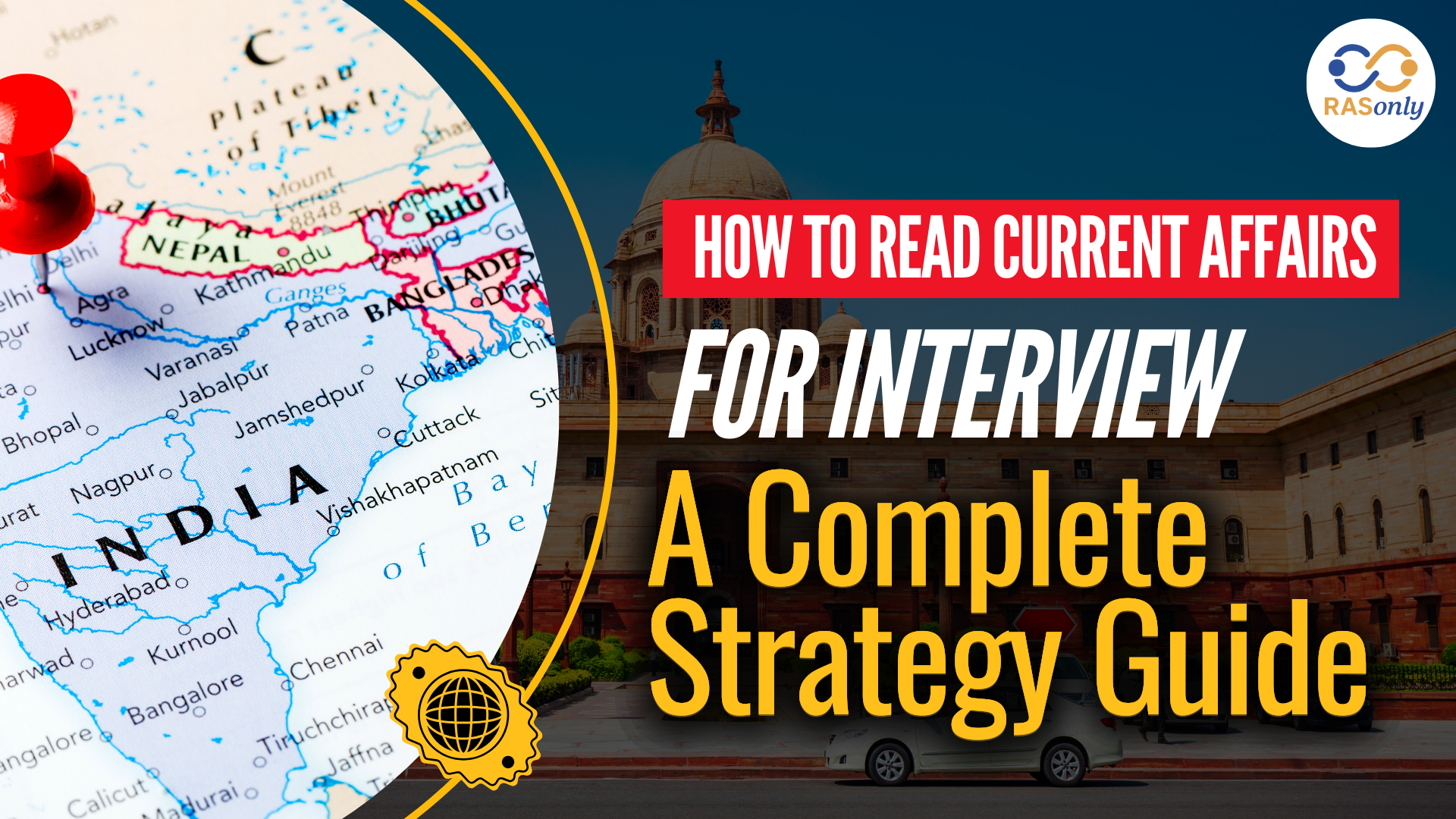
Current affairs play a decisive role in almost every competitive exam interview, whether it is UPSC, RPSC RAS, SSC, Banking, Defence, or State PCS. Many candidates read newspapers daily but still fail to answer interview questions confidently. The problem is not lack of reading, but lack of direction. This guide explains how to read current affairs for interview in a focused, analytical, and interview-oriented manner.
Unlike written exams, interviews test your awareness, clarity of thought, opinion-building, and communication skills. Therefore, your approach to current affairs must be different. Let us understand how to read current affairs for interview the right way.
Why Current Affairs Matter in Interviews
Factual dumping is not what the interview panels are seeking. They want to see:
- Taking national and international concerns into consideration.
- Capacity to relate events with your past.
- Rational thoughts and fair judgments.
- Communication competence and confidence.
This is the reason it is essential to learn up-to-date affairs to interview. Current affairs assist interviewers to determine how mature, capable, and fit to serve in the position of leadership or any other positions that serve the community the candidate is.
Difference Between Exam-Oriented and Interview-Oriented Current Affairs
Understanding this difference is the first step in learning how to read current affairs for interview.
| Exam-Oriented | Interview-Oriented |
|---|---|
| Focus on facts | Focus on opinions |
| One-line answers | Analytical answers |
| Static preparation | Dynamic discussion |
| Objective questions | Open-ended questions |
In interviews, questions often start with:
- What do you think about…
- Why is this issue important?
- How does this affect India or your state?
So, your preparation must go beyond memorization.
Step 1: Choose the Right Sources
One of the biggest mistakes candidates make is following too many sources. To master how to read current affairs for interview, quality matters more than quantity.
Recommended Sources
- One national newspaper (The Hindu or Indian Express)
- Monthly current affairs magazine
- Government websites (PIB, ministries)
- Economic Survey and Budget highlights
- State-specific current affairs (for state exams)
Avoid reading multiple newspapers. One is enough if read properly.
Step 2: Read with an Interview Mindset
When learning how to read current affairs for interview, always ask yourself:
- Why is this in the news?
- What is the background of this issue?
- What are its advantages and challenges?
- How does it affect common people?
For example, if you read about climate change:
- Causes
- Impact on India
- Government initiatives
- Your personal opinion
This habit builds depth in your answers.
Step 3: Interviews: Target Areas
All news items are not all interview-relevant. The key areas to focus on in order to know how to read current affairs to interview are:
1. National Issues
- Government schemes
- Social justice
- Education, health, poverty
- Federal relations
2. International Relations
- The relations of India with neighbors.
- Global organizations
- India’s global role
3. Economy
- Inflation, growth, and employment.
- Budget highlights
- Economic reforms
4. Science and Technology
- Space missions
- AI, digital governance
- Renewable energy
5. Ethics and Governance
- Transparency
- Corruption
- Role of civil servants
Step 4: Link Current Affairs with Your Background
One of the most important aspects of how to read current affairs for interview is personalization.
Interviewers often ask questions related to:
- Your hometown
- Your graduation subject
- Your work experience
- Your hobbies
For example:
- Engineers may be asked about infrastructure or technology
- Commerce graduates may face economic questions
- Candidates from Rajasthan may be asked state-specific issues
Always prepare current affairs related to your profile.
Step 5: Prepare Opinion-Based Answers
Interview panels are interested in how you think, not what you think. While learning how to read current affairs for interview, develop balanced opinions.
A good answer should include:
- Brief introduction
- Both positive and negative aspects
- Logical conclusion
Avoid extreme opinions. Be neutral, practical, and solution-oriented.
Step 6: Maintain Short Notes for Revision
You cannot revise newspapers before the interview. This is where smart note-making helps in mastering how to read current affairs for interview.
How to Make Notes
- Topic-wise (Economy, Polity, Environment)
- Bullet points
- Add keywords and data
- Update monthly
Digital notes are preferable as they are easy to revise.
Step 7: Learn to Speak, Not to read.
There are a lot of candidates who are known to have answers but do not articulate them. To actually know how to read the current affairs to interview, practice speaking.
Ways to Practice
- Speak in front of a mirror
- Record your answers
- Taking part in mock interviews.
- Discuss topics with friends
Practice of speaking enhances confidence and articulateness.
Step 8: Prepar Current Affairs of the previous year.
The interview questions tend to be based on:
- Last 6 to 12 months
- Ongoing issues
- Major policy changes
Do not go too far back. Focus on relevance. This is one of the essential rules in reading current affairs to be able to interview.
Step 9: Be Honest and Calm in the Interview
Even after proper preparation, you may face questions you do not know. Interviewers appreciate honesty.
If you do not know an answer:
- Admit politely
- Show willingness to learn
This attitude reflects maturity, an essential trait assessed through how to read current affairs for interview.
Common Mistakes to Avoid
During the process of learning to read current affairs for interview, avoid the following errors:
- Mugging up facts
- Providing biased responses politically.
- Using complex language
- Interrupting the panel
- Showing overconfidence
Last-Minute Preparation Checklist
Revise before your interview:
- Big national and international events.
- Government schemes
- State-specific issues
- Your profile-linked topics
- Ethical and opinion-based questions.
This checklist fills your strategy on how to read current affairs for interview.
Conclusion
Learning to read current affairs to interview has nothing to do with reading a lot but reading smart. The interview-based approach is based on the desire to comprehend the problem, develop a moderate position, and be able to express it. As long as you have the right sources, revise it regularly, and practice speaking, current affairs will be your strongest point. You should prepare early, maintain consistency and make sure that your preparation is aligned to your personality and background. It will not only make you pass the interview, but you will also be molded into an informed and confident person.
BEST SELLER
🏆 PRELIMS
RAS Pass
Prelims focused Hindi & English
₹399
✓
Prelims Topic-Wise Tests
✓
Subject-Wise Tests
✓
Full-Length Prelims Tests
✓
Daily Current Affairs Tests
✓
Prelims PYQs Tests
✓
Detailed Solutions & Analysis
✓
All Rajasthan Ranking
✓
Unlimited Reattempts
✓
Mains Tests
✓
Hindi & English Tests
✓
All Rajasthan Ranking
Trusted by 5,000+ Students
Post Category
- RAS Salary
- Result
- RAS Admit Card
- RAS Job
- RAS Cutoff
- Preparation Tips
- RAS Answer Key
- RAS Exam Analysis
- RAS Syllabus
- RAS Previous Year Papers
- RPSC RAS Exam Pattern
- RAS Interview
- RAS Exam Date
- RAS Vacancy
- RAS Test Series
- RAS Best Books
- RAS Preparation Resources
- RAS Coaching Centre
- History
- Polity
- Geography
- Economics
- Science
- Art and Culture
- RPSC RAS Application Form
- RPSC RAS Notification
- RAS Eligibility Criteria
- UPSC Exam
- RPSC RAS Mains
Visit Our RASonly Offline Center
Our Expert Faculty

Bhunesh Sir
Current Affairs · 13+ Yrs

Aamir Khan Sir
RAS-2017 · IIM Ahm.

Akash Sir
Polity · 8+ Yrs
Free Resources
Official Mobile App

RASOnly App
by OTSAdda · Free
Full Video Lectures
Mock Tests & PYQs
Daily Current Affairs
AI Mock Interview
Free Download · No subscription needed to install
RAS 2024 Toppers — RASonly
Rank 2
Virendra Charan
Rank 9
Bhoopinder Singh
Rank 26
Aanchal Nagpal
Rank 33
Lokendra Singh
Rank 45
Amar Rathore
Rank 46
Manasvini Verma

Join RASonly WhatsApp Community
Get daily current affairs, exam alerts, free study material and tips from expert faculty — right on WhatsApp.
Join for Free →RASonly Interview Guidance Program

Mr. Ashok Jain
Ex-Chief Secretary Govt of Rajasthan
- IAS officer of the 1981 batch, Rajasthan cadre.
- Passionate about mentoring the next generation of RAS officers with real-world insights.
- Got retired in Dec 2017 from the post of Chief Secretary of the state of Rajasthan.

Mr. Guru Charan Rai
Ex-ASP / SP in Jaisalmer
- Guru Charan Rai, IPS (Retd), retired as Inspector General of Police (Security), Rajasthan, Jaipur in 2017.
- Served as ASP and SP in Jaisalmer, Nagaur, Sri Ganganagar, Sawai Madhopur, Dausa, Sikar, and Karauli.
- He also held key positions as DIGP and IGP in the Law and Order division.

Mr. Rakesh Verma
Ex-IAS Officer, B.Tech, MBA, and M.A. (Economics)
- IAS officer of the 1981 batch and retired in Chief Secretary Rank.
- Civil servant of high repute and vast experience.
- Has been teaching UPSC CSE subjects for the last six years.
Related Post



Daily Current Affairs for RAS Exam Preparation 2026

Ustad Bismillah Khan Yuva Puraskar
October 24, 2026
Marwar Festival 2026
October 24, 2026
Kundan Art Display in Hong Kong
October 23, 2026