RAS 2026 vs RAS 2027: Overlap Guide for Aspirants
Inland Drainage System of India and Rajasthan: A Complete Guide for RAS Aspirants

Get in Touch with RASonly!

The Inland Drainage System of Rajasthan includes rivers like Luni and Ghaggar that do not reach the sea and instead end in inland basins or salt lakes. It is mainly found in the Thar Desert region due to low rainfall and high evaporation. This topic is highly important for RPSC RAS 2026, Rajasthan GK, and Geography preparation.

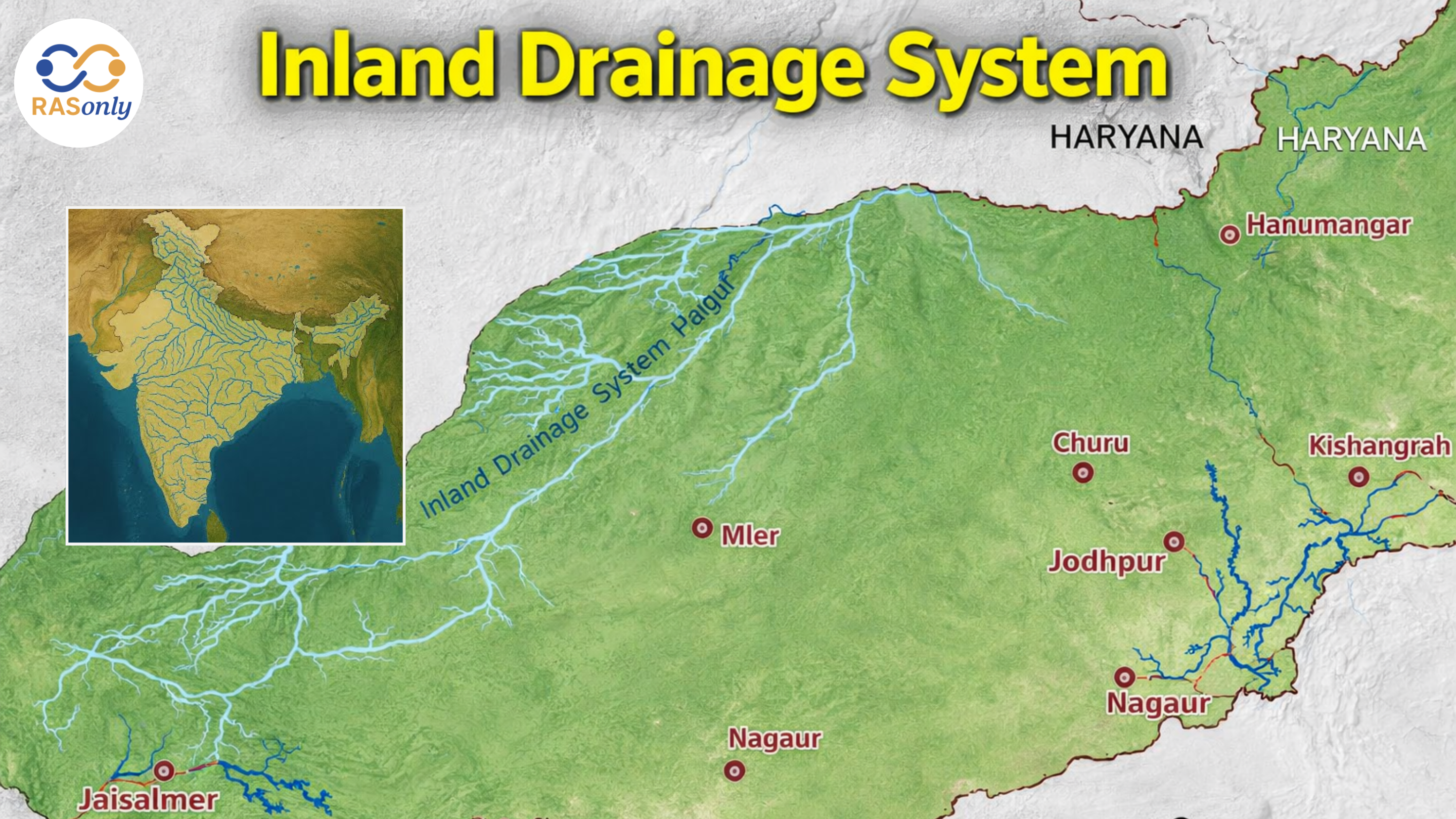
An endorheic drainage system, or an inland drainage system, is one of the most interesting and exam-relevant topics in Indian geography, which you might have seen when viewing a map if you ever wondered why some rivers just seem to "disappear" without ever reaching a sea. This topic is not only about Rajasthan, as there are broader All India aspects as well, and the examiner may ask you to contextualize the rivers of Rajasthan in the bigger picture of India.
In this article we will elucidate the concept at the India level and then zoom in to the state of Rajasthan, where this drainage pattern can be best observed.
What is an Inland Drainage System?
In simple terms, an inland drainage system refers to rivers and streams that do not flow into any ocean or sea. Instead, they either terminate in an inland lake, a marsh, or simply evaporate and vanish into the sand of a desert region. This phenomenon is scientifically termed "areic drainage" or a "closed basin system," because the water is "closed" within a landlocked region rather than draining out to the open sea.
This is different from both the Himalayan drainage system (perennial, snow-fed, flows into Bay of Bengal or Arabian Sea) and the Peninsular drainage system (rain-fed, mostly flows into the seas around the peninsula). The inland drainage system is a smaller, unique category found only in specific arid and high-altitude pockets of the country.
Inland Drainage System: The India-Level Picture
Most students only associate this topic with Rajasthan, but for a complete RAS-level answer, you need to know that India's inland drainage is spread across three major regions:
| Region | Nature of Terrain | Examples |
|---|---|---|
| Ladakh region (Trans-Himalaya) | Cold desert, high-altitude lakes | Pangong Tso, Tso Moriri, Tso Kar |
| Kutch region (Gujarat) | Salt marsh, seasonal streams | Rann of Kutch drainage |
| Rajasthan (Thar Desert belt) | Hot desert, seasonal rivers | Ghaggar, Kantli, Sabi, Sota, Mendha |
- In the Ladakh region, high-altitude lakes like Pangong Tso and Tso Moriri collect glacial meltwater but have no outlet to the sea, making this a classic case of inland drainage in a cold desert setting.
- The Kutch region in Gujarat, especially the Great and Little Rann of Kutch, receives seasonal streams that end in salt marshes rather than reaching the sea directly during most of the year.
- Rajasthan remains the most exam-emphasized region because of the sheer number of rivers involved and their historical and economic significance.
This national perspective is important because RAS Mains answers that only mention Rajasthan (while ignoring Ladakh and Kutch) are considered incomplete for a question specifically framed around "India's inland drainage system."
Rajasthan's Drainage Pattern: The Aravalli Divide
Now let's narrow our focus to Rajasthan, where this topic carries maximum weightage. The Aravalli range acts as a major watershed line dividing Rajasthan's drainage into two broad zones:
- Eastward flowing rivers - These eventually join the Bay of Bengal system (like Chambal and Banas).
- Westward and north-westward flowing rivers - These either join the Arabian Sea system (like Luni) or simply get lost in the desert - forming the inland drainage system.
Classification of Rajasthan's Drainage System
| Type of Drainage | Description | Example Rivers |
|---|---|---|
| Bangar/Chambal System | Eastward, joins Bay of Bengal basin | Chambal, Banas, Kali Sindh |
| Aravalli/Banas System | Rises from Aravalli, joins eastern rivers | Banas, Berach |
| Luni or Arabian Sea System | Flows west, ends in Rann of Kutch | Luni, Jawai |
| Inland Drainage System | Rivers ending in lakes/desert, no sea outlet | Ghaggar, Kantli, Sabi, Sota, Mendha |
This four-fold classification is a must-remember table, as it forms the backbone of most objective-type questions on this topic.
Major Rivers of Rajasthan's Inland Drainage System
These are the actual stars of this topic - the non-perennial rivers that make up Rajasthan's inland drainage system. Most of these are seasonal, meaning they flow only during the monsoon and dry up for the rest of the year.
1. Ghaggar River
The Ghaggar River is easily the most important river in this category, both geographically and historically. It originates from the Shivalik hills in Himachal Pradesh and enters Rajasthan through the Hanumangarh district, eventually losing itself in the sands of the Thar Desert near the India-Pakistan border.
What makes the Ghaggar particularly interesting for Mains answer-writing is its connection with the Vedic Saraswati river. Many historians and geologists believe that the Ghaggar's ancient course once matched that of the mythical Saraswati river mentioned in the Rigveda, making it a topic that bridges geography with ancient history and culture.
2. Kantli (or Kantali) River
The Kantli River rises near the Khandela hills in the Sikar district and flows through Jhunjhunu before disappearing into the sandy plains. It is one of the few rivers in this system that has some local irrigation significance despite being seasonal.
3. Sabi River
The Sabi River originates in the Jaipur district (near the border with Haryana) and generally flows in a north-easterly direction. In years of heavy rainfall, the Sabi has been known to reach as far as the Najafgarh Jheel in Delhi, though this is not a regular occurrence.
4. Sota and Mendha Rivers
Both the Sota River and Mendha River are smaller streams that also belong to this inland system. They flow through parts of eastern Rajasthan before merging with the broader Ghaggar-Sabi drainage network or simply drying up in the plains.
5. Ruparel and Katli Rivers
Lesser known but still exam-relevant, the Ruparel River and Katli River flow through the Alwar-Jaipur belt and eventually lose themselves before reaching any major water body, a textbook example of endorheic behavior.
The Terminal Points: Salt Lakes of Rajasthan
An inland river has to end somewhere, and in Rajasthan's case, this is often a salt lake or a playa lake (locally called Bhawartal). These terminal basins are not just geographical curiosities; they hold immense economic value too.
| Lake Name | District | Significance |
|---|---|---|
| Sambhar Lake | Jaipur/Nagaur | Largest inland salt lake in India; major salt production centre; RAMSAR wetland site |
| Didwana Lake | Nagaur | Second largest salt lake; historical salt trade center |
| Pachpadra Lake | Barmer | Known for salt production since ancient times |
| Lunkaransar Lake | Bikaner | Seasonal salt lake in arid zone |
Among these, the Sambhar Lake deserves special attention. It is not only the largest inland saltwater lake in India but also holds the status of a RAMSAR site, making it relevant for both the geography and environment sections of the RAS syllabus. Its salt production industry, ecological importance as a habitat for migratory flamingos, and recent environmental concerns (like mass bird deaths reported in past years) make it a rich topic for current affairs linkage in Mains answers.
Why This Topic Matters for RAS Exam
This topic is almost entirely fact-based, which means it is highly scoring if you prepare it systematically. Let's look at why:
- Prelims relevance: Direct factual questions like "Which river is associated with the Vedic Saraswati?" or "Sambhar Lake is located in which district?" are common.
- Mains relevance: Questions asking you to compare the Inland drainage vs. peninsular vs Himalayan drainage patterns, or to discuss the economic significance of salt lakes, require deeper conceptual understanding and mentioning the Ladakh and Kutch examples alongside Rajasthan shows a well-rounded national perspective.
- Interview relevance: Since many RAS aspirants are from Rajasthan itself, interview panels often ask location-specific questions about rivers and lakes near the candidate's hometown.
Recommended Study Strategy
Based on how this topic is typically tested, here is a practical approach to master it:
- Build the foundation first - Understand the basic definition and terminology (endorheic, areic, closed basin) before memorizing names.
- Learn the India-level picture - Keep the three regions (Ladakh, Kutch, Rajasthan) in mind so your answers reflect the full national scope, not just Rajasthan.
- Use the four-fold classification as your anchor point for Rajasthan - every river you learn should be mentally slotted into one of the four drainage systems.
- Map-based revision - Physically trace each river (Ghaggar, Kantli, Sabi, Sota) on a Rajasthan map, and also locate Pangong Tso and the Rann of Kutch on the India map. Visual memory works far better than rote learning for this topic.
- Solve previous year papers - Go through at least the last 8-10 years of RAS Prelims and Mains papers to identify the exact pattern and depth of questions asked.
- Link static facts with current affairs - Especially for Sambhar Lake, keep an eye on recent news related to salt industry policies or environmental issues.
- Create quick-revision flash notes - A simple format like River/Lake name → Region → Origin → Termination point works wonders for last-minute revision.
Conclusion
The Inland Drainage System might seem like a niche topic at first glance, but it is one of those high-yield areas that consistently appears across RAS Prelims, Mains, and even interviews. While the cold deserts of Ladakh and the salt marshes of Kutch give this topic a national dimension, it is Rajasthan with the historically rich Ghaggar River and the economically vital Sambhar Lake that carries the maximum exam weightage. With a clear understanding of the India-level classification, Rajasthan's four-fold drainage system, consistent map practice, and regular revision, this topic can become one of your strongest scoring areas rather than something to fear.
FAQs
An inland drainage system refers to rivers that do not flow into a sea or ocean. Instead, they end in an inland lake, marsh, or simply evaporate in a desert region. This is also called an endorheic or areic drainage system.
India's inland drainage is mainly found in three regions: the Ladakh region (Pangong Tso, Tso Moriri), the Kutch region of Gujarat (Rann of Kutch), and the Rajasthan (Thar Desert) belt.
The major rivers include the Ghaggar, Kantli, Sabi, Sota, Mendha, Ruparel, and Katli rivers. Most of these are seasonal and dry up outside the monsoon season.
Sambhar Lake is the largest inland saltwater lake in India, an important salt production centre, and a RAMSAR-recognised wetland. It is relevant for Geography, Economy, and Environment sections of the syllabus.
Many historians and geologists believe the ancient course of the Ghaggar River overlaps with the mythical Vedic Saraswati river, making it an important topic linking Geography with Ancient Indian History.
While the inland drainage system's rivers terminate in desert regions or salt lakes with no outlet to the sea, the Luni system eventually drains into the Rann of Kutch, which is connected to the Arabian Sea.

BEST SELLER
🏆 PRELIMS
RAS Pass
Prelims focused Hindi & English
₹399
✓
Prelims Topic-Wise Tests
✓
Subject-Wise Tests
✓
Full-Length Prelims Tests
✓
Daily Current Affairs Tests
✓
Prelims PYQs Tests
✓
Detailed Solutions & Analysis
✓
All Rajasthan Ranking
✓
Unlimited Reattempts
✓
Mains Tests
✓
Hindi & English Tests
✓
All Rajasthan Ranking
Trusted by 5,000+ Students
Post Category
- RAS Salary
- Result
- RAS Admit Card
- RAS Job
- RAS Cutoff
- Preparation Tips
- RAS Answer Key
- RAS Exam Analysis
- RAS Syllabus
- RAS Previous Year Papers
- RPSC RAS Exam Pattern
- RAS Interview
- RAS Exam Date
- RAS Vacancy
- RAS Test Series
- RAS Best Books
- RAS Preparation Resources
- RAS Coaching Centre
- History
- Polity
- Geography
- Economics
- Science
- Art and Culture
- RPSC RAS Application Form
- RPSC RAS Notification
- RAS Eligibility Criteria
- UPSC Exam
- RPSC RAS Mains
Visit Our RASonly Offline Center
Our Expert Faculty

Bhunesh Sir
Current Affairs · 13+ Yrs

Aamir Khan Sir
RAS-2017 · IIM Ahm.

Akash Sir
Polity · 8+ Yrs
Free Resources
Official Mobile App

RASOnly App
by OTSAdda · Free
Full Video Lectures
Mock Tests & PYQs
Daily Current Affairs
AI Mock Interview
Free Download · No subscription needed to install
RAS 2024 Toppers — RASonly
Rank 2
Virendra Charan
Rank 9
Bhoopinder Singh
Rank 26
Aanchal Nagpal
Rank 33
Lokendra Singh
Rank 45
Amar Rathore
Rank 46
Manasvini Verma

Join RASonly WhatsApp Community
Get daily current affairs, exam alerts, free study material and tips from expert faculty — right on WhatsApp.
Join for Free →RASonly Interview Guidance Program

Mr. Ashok Jain
Ex-Chief Secretary Govt of Rajasthan
- IAS officer of the 1981 batch, Rajasthan cadre.
- Passionate about mentoring the next generation of RAS officers with real-world insights.
- Got retired in Dec 2017 from the post of Chief Secretary of the state of Rajasthan.

Mr. Guru Charan Rai
Ex-ASP / SP in Jaisalmer
- Guru Charan Rai, IPS (Retd), retired as Inspector General of Police (Security), Rajasthan, Jaipur in 2017.
- Served as ASP and SP in Jaisalmer, Nagaur, Sri Ganganagar, Sawai Madhopur, Dausa, Sikar, and Karauli.
- He also held key positions as DIGP and IGP in the Law and Order division.

Mr. Rakesh Verma
Ex-IAS Officer, B.Tech, MBA, and M.A. (Economics)
- IAS officer of the 1981 batch and retired in Chief Secretary Rank.
- Civil servant of high repute and vast experience.
- Has been teaching UPSC CSE subjects for the last six years.

Daily Current Affairs for RAS Exam Preparation 2026
Rajasthan Ranks First in Mission Karmayogi
September 16, 2026
CAR-T Cell Therapy
September 16, 2026
Swami Vivekananda Government Model Schools Rajasthan
September 15, 2026