Chola Dynasty: Capital, Founder, Kings, Time Period and History
RAS Notes Making Strategy 2026 (How to Make Short, Smart & Revision-Friendly Notes for Prelims & Mains)

Get in Touch with RASonly!

Master the RAS notes-making strategy 2026 with simple and effective techniques for Prelims and Mains. Learn how to create short, structured, and revision-friendly notes. Improve your preparation, save time, and boost your exam performance.

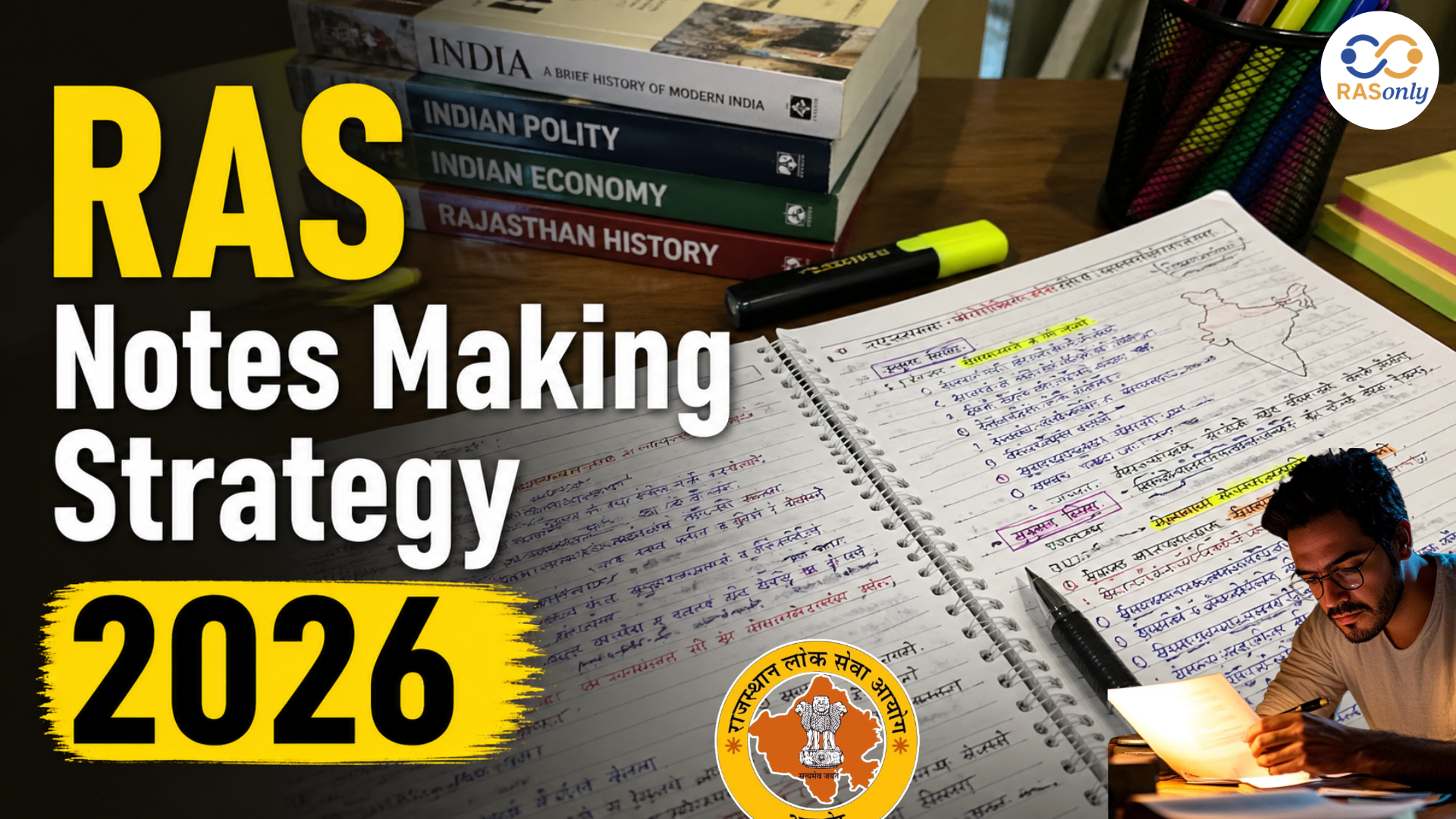
Preparing for RAS 2026 is not just about studying more—it is about studying smartly. One of the biggest differences between average and top-performing candidates is how effectively they make and use notes. Many aspirants read multiple books and sources, but without proper notes, revision becomes difficult and time-consuming.
A well-planned RAS notes-making strategy 2026 helps you convert scattered information into a structured format that is easy to revise and recall. The RAS exam has Prelims (objective) and Mains (descriptive), so your notes should be formatted to encourage both: quick revision during Prelims and structured answers during Mains. When you have clear, concise, and constantly updated notes, they may be your ultimate weapon in the process of preparation.
Why Notes Making is Crucial for RAS 2026 Preparation
Notes making is a key part of RAS 2026 preparation because it helps you organize important information in a simple and revision-friendly format. Instead of revisiting multiple books, properly prepared notes enable you to revise ideas very fast, relate the things taught in books with what is happening in the world, and retain the information to face Prelims and Mains.
Key Benefits of Effective Note-Making
- Makes revision faster and more efficient, especially before the exam
- Improves long-term retention and conceptual clarity
- Helps in linking the static syllabus with current affairs topics
- Reduces dependency on multiple books and sources
- Supports both MCQs in RAS Prelims and answer writing in RAS Mains
Types of Notes You Should Make for RAS 2026
To prepare for the RAS 2026, it is necessary to use more than one type of note. The notes needed at each step of preparation (beginning with elementary knowledge up to the final revision) are of different types. The smart RAS notes-making strategy is to make a combination of concept-based, short, and revision notes such that you are able to study effectively and revise easily before the exam.
Types of Notes (Complete Comparison)
| Type of Notes | Purpose | Best For |
|---|---|---|
| Concept Notes | Understanding basic concepts | Early preparation |
| Short Notes | Quick revision of key points | Prelims |
| Mains Notes | Structured and analytical content | Mains |
| Current Affairs Notes | Linking static with current | Both |
| Revision Notes | Fast final revision | Last stage |
Handwritten vs Digital Notes (Best Strategy for RAS 2026)
Your RAS notes-making strategy 2026 includes choosing the right format of notes. Most of the applicants become confused between handwritten and digital notes, yet the fact is that both are beneficial. The trick is to apply them in a wise manner, depending on your preparation requirements, handwritten notes to increase comprehension and memorization, and digital notes to be more flexible and updated.
Comparison Table: Handwritten vs Digital Notes
| Feature | Handwritten Notes | Digital Notes |
|---|---|---|
| Retention | High (better memory recall) | Moderate |
| Editing | Difficult to update | Easy to edit and modify |
| Portability | Limited | High (accessible anywhere) |
| Revision | Fast and focused | Very fast and searchable |
Best Strategy for RAS Preparation 2026
- Use handwritten notes for building strong concepts and understanding subjects like Polity, History, and Geography
- Use digital notes for current affairs, updates, and quick revisions
- Combine both formats to create a balanced and efficient RAS preparation system
How to Make Effective Notes for RAS 2026 (Step-by-Step Strategy)
Preparation of RAS 2026 notes is not about writing much but the correct things in the correct manner. Good notes must assist you to revise fast, grasp ideas, and remembering in the exam with ease. In case your notes are disorganized, they are too long, or will not be beneficial when revising. The idea is to make them straightforward, succinct, and exam-oriented.
Step-by-Step Notes Making Strategy
1. Understand First, Then Write
- Never write notes without understanding the topic
- Read once, then write in your own words
- Clear concepts = better retention
2. Keep Notes Short and Structured
- Use bullet points instead of paragraphs
- Keep sentences short and simple
- Focus on keywords and main ideas only
3. Write Only Exam-Relevant Content
- Avoid unnecessary details in books
- Focus on important and frequently asked topics
- Keep notes aligned with the RAS syllabus
4. Use Visual Tools (Boost Memory)
- Use flowcharts, diagrams, and tables
- Convert complex topics into simple visuals
- Highlight important points
5. Regularly Update Your Notes
- Add current affairs related to topics
- Update notes after mock tests
- Improve based on mistakes
Subject-wise Notes Making Strategy for RAS 2026
Each subject in RAS Prelims and Mains requires a slightly different approach while making notes. Understanding this helps you create more effective and exam-oriented notes.
History
- Use timelines and flowcharts for better understanding
- Focus on causes, events, and impact
- Highlight important dates and personalities
Polity
- Write definitions and important articles clearly
- Focus on concept clarity and structure
- Use headings and subheadings
Geography
- Use maps, diagrams, and visuals
- Focus on concepts along with locations
- Practice map-based understanding
Economy
- Focus on basic concepts (GDP, inflation, budget, etc.)
- Link topics with current affairs and real examples
- Keep notes simple and practical
Science & Technology
- Stick to basic NCERT-level concepts
- Focus on application-based understanding
- Avoid unnecessary technical details
How to Make Short Notes for RAS Prelims 2026
The short notes are very important in the preparation of RAS Prelims 2026, particularly in the final revision stage. Since the Prelims is an objective exam, you require a fast recollection of facts and concepts. Properly written RAS short notes assist you in revising big portions of the syllabus within a small period of time and increase the accuracy in MCQs.
Tips for Making Short Notes
- Limit each topic to 1–2 pages maximum
- Use keywords, abbreviations, and bullet points
- Highlight important facts, dates, and concepts
- Avoid unnecessary explanations
Your short notes should be quick to revise and easy to recall just before the exam.
How to Make Notes for RAS Mains 2026
Unlike Prelims, RAS Mains 2026 requires descriptive and analytical answers. Your notes should help you structure answers clearly and present them effectively in the exam. A good RAS Mains notes strategy focuses on clarity, examples, and answer-writing support.
Tips for Mains Notes
- Include definitions, examples, and case studies
- Prepare content in Intro–Body–Conclusion (IBC) format
- Add points for causes, effects, and solutions
- Focus on content that can be directly used in answers
Your notes should help you write structured and high-scoring answers quickly.
Common Mistakes in Notes Making (Avoid These)
Many aspirants make mistakes while preparing notes, which reduces their effectiveness during revision. Being aware of these mistakes can help you improve your RAS notes-making strategy for 2026.
Avoid These Errors
- Making very lengthy and detailed notes
- Copying content directly from books
- Not revising notes regularly
- Ignoring current affairs updates
- Making notes without proper understanding
Revision Strategy Using Notes
Notes are most valuable during the revision stage, especially in the last few months before the exam. A proper RAS revision strategy using notes helps you retain information and improve performance.
Effective Revision Plan
- Revise your notes multiple times
- Focus more on weak and important topics
- Use short notes for last-minute revision
- Link static notes with current affairs
Advanced Tips for RAS Notes Making (Topper Approach)
Top-performing candidates follow simple but effective methods to make their notes more useful. These small improvements can make a big difference in your preparation.
Pro Tips
- Use one notebook per subject for better organization
- Maintain a separate mistake notebook
- Highlight important keywords and concepts
- Revise and update notes after every mock test
Final Strategy for RAS Notes Making 2026
A well-planned RAS notes making strategy 2026 can simplify your entire preparation and make revision much faster. Instead of collecting too many resources, focus on creating your own notes that are concise, clear, and aligned with the exam pattern.
Stay consistent, keep updating your notes with current affairs, and revise them regularly. When your notes are well-organized and exam-focused, they become your strongest tool for scoring well in both RAS Prelims and Mains 2026.
Conclusion
With a properly designed RAS notes making strategy 2026 can streamline all of your preparation, making it both quicker and more efficient. You need to learn to take only a few resources instead of many and create short, clear, and exam-oriented notes that you can go through several times. By continually revising your notes with the latest affairs and using them to prepare not only Prelims but also Mains, you will have the best weapon to be more accurate, save time, and score higher in the RAS exam.
FAQ
Focus on understanding first, then write short and structured notes using keywords, bullet points, and diagrams for easy revision.
Use handwritten notes for concept clarity and digital notes for current affairs and updates. A combination of both works best.
Notes should be short and concise. Ideally, each topic should be covered within 1–2 pages for easy revision.
Yes, short notes are very important for quick revision before the exam and help improve accuracy in MCQs.
You should revise your notes regularly, especially after completing topics and during the final revision phase.

BEST SELLER
🏆 PRELIMS
RAS Pass
Prelims focused Hindi & English
₹399
✓
Prelims Topic-Wise Tests
✓
Subject-Wise Tests
✓
Full-Length Prelims Tests
✓
Daily Current Affairs Tests
✓
Prelims PYQs Tests
✓
Detailed Solutions & Analysis
✓
All Rajasthan Ranking
✓
Unlimited Reattempts
✓
Mains Tests
✓
Hindi & English Tests
✓
All Rajasthan Ranking
Trusted by 5,000+ Students
Post Category
- RAS Salary
- Result
- RAS Admit Card
- RAS Job
- RAS Cutoff
- Preparation Tips
- RAS Answer Key
- RAS Exam Analysis
- RAS Syllabus
- RAS Previous Year Papers
- RPSC RAS Exam Pattern
- RAS Interview
- RAS Exam Date
- RAS Vacancy
- RAS Test Series
- RAS Best Books
- RAS Preparation Resources
- RAS Coaching Centre
- History
- Polity
- Geography
- Economics
- Science
- Art and Culture
- RPSC RAS Application Form
- RPSC RAS Notification
- RAS Eligibility Criteria
- UPSC Exam
- RPSC RAS Mains
Visit Our RASonly Offline Center
Our Expert Faculty

Bhunesh Sir
Current Affairs · 13+ Yrs

Aamir Khan Sir
RAS-2017 · IIM Ahm.

Akash Sir
Polity · 8+ Yrs
Free Resources
Official Mobile App

RASOnly App
by OTSAdda · Free
Full Video Lectures
Mock Tests & PYQs
Daily Current Affairs
AI Mock Interview
Free Download · No subscription needed to install
RAS 2024 Toppers — RASonly
Rank 2
Virendra Charan
Rank 9
Bhoopinder Singh
Rank 26
Aanchal Nagpal
Rank 33
Lokendra Singh
Rank 45
Amar Rathore
Rank 46
Manasvini Verma

Join RASonly WhatsApp Community
Get daily current affairs, exam alerts, free study material and tips from expert faculty — right on WhatsApp.
Join for Free →RASonly Interview Guidance Program

Mr. Ashok Jain
Ex-Chief Secretary Govt of Rajasthan
- IAS officer of the 1981 batch, Rajasthan cadre.
- Passionate about mentoring the next generation of RAS officers with real-world insights.
- Got retired in Dec 2017 from the post of Chief Secretary of the state of Rajasthan.

Mr. Guru Charan Rai
Ex-ASP / SP in Jaisalmer
- Guru Charan Rai, IPS (Retd), retired as Inspector General of Police (Security), Rajasthan, Jaipur in 2017.
- Served as ASP and SP in Jaisalmer, Nagaur, Sri Ganganagar, Sawai Madhopur, Dausa, Sikar, and Karauli.
- He also held key positions as DIGP and IGP in the Law and Order division.

Mr. Rakesh Verma
Ex-IAS Officer, B.Tech, MBA, and M.A. (Economics)
- IAS officer of the 1981 batch and retired in Chief Secretary Rank.
- Civil servant of high repute and vast experience.
- Has been teaching UPSC CSE subjects for the last six years.
Related Post




Daily Current Affairs for RAS Exam Preparation 2026

Rajasthan AVGC-XR Summit on International Animation Day
October 26, 2026
Inauguration of the Khet Bachao Abhiyan 2026
October 26, 2026
Ustad Bismillah Khan Yuva Puraskar
October 24, 2026