Gupta Empire, Founder, Time Period, Rulers, Map, Capital City
Land Degradation & Soil Erosion in Rajasthan: Preparation Strategy for RAS Prelims 2026

Get in Touch with RASonly!

Land Degradation & Soil Erosion are among the most important Rajasthan Geography and Environment topics for RAS 2026 preparation. Aspirants should focus on desertification, wind erosion, Chambal ravines, soil conservation methods, watershed management, and climate-change linkage through maps, current affairs, and MCQ practice. Strong conceptual clarity in land degradation can significantly improve scoring potential in Geography, Environment, Agriculture, and Rajasthan GK sections.

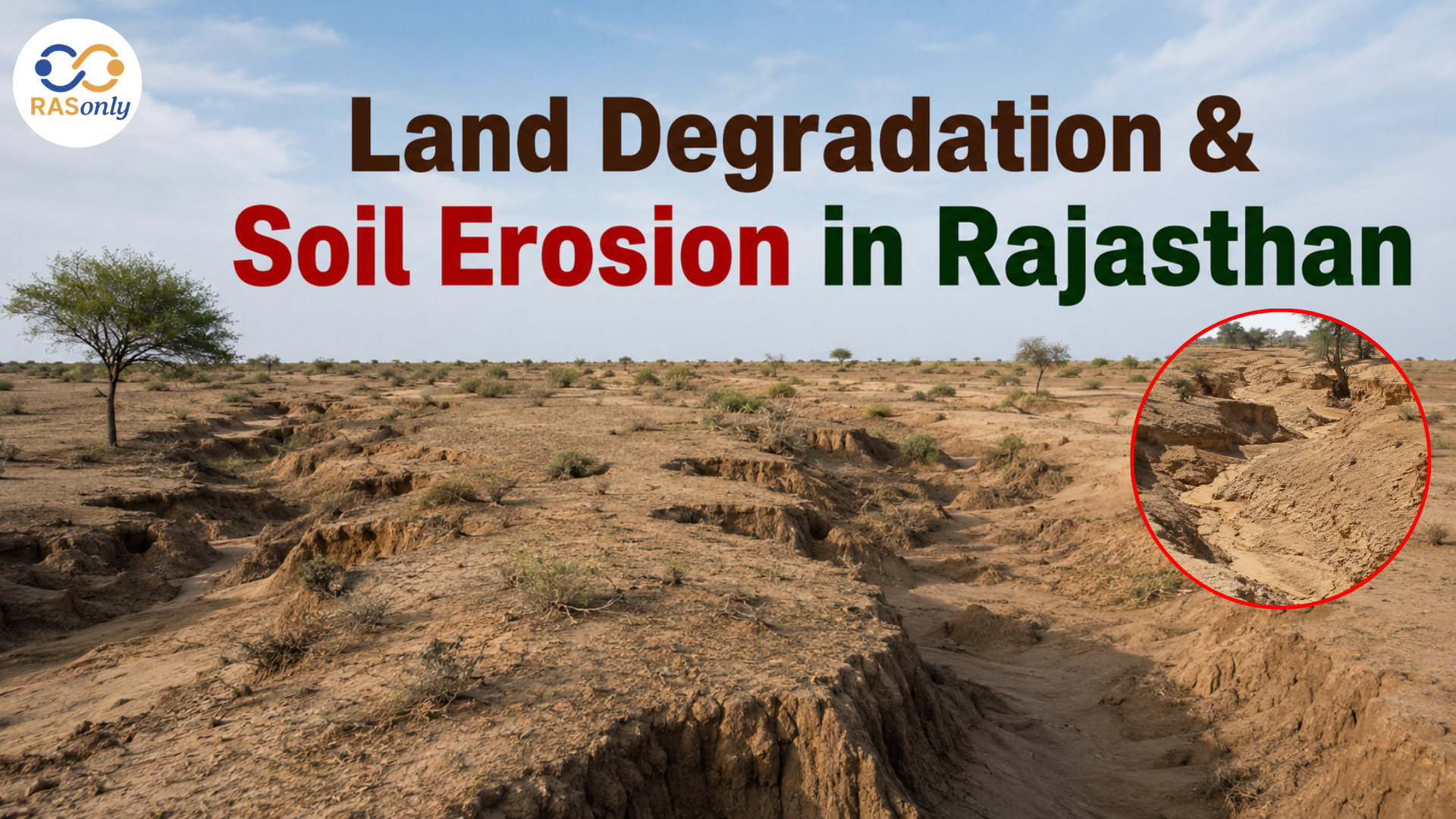
Land Degradation & Soil Erosion in Rajasthan have become one of the most important topics of Geography, Environment, Agriculture & Climate Change in RAS Prelims 2026 due to the frequent appearance of questions on desertification, soil erosion, drought, causes of land degradation, soil erosion control measures, watershed management, afforestation, sustainable agriculture, and environmental issues in Rajasthan. Over the last few years, RAS has given a lot of emphasis on the topics of Environment, Ecology, Climate Change, Sustainable Development, Geography of Rajasthan and topics related to disaster management, making land degradation an extremely important area for preparation of serious aspirants.
Rajasthan is highly vulnerable to land degradation because of desert climate, low rainfall, wind erosion, overgrazing, deforestation, groundwater depletion, salinity, mining activities, and unsustainable agricultural practices. Desertification and soil erosion issues are being experienced in large areas of western Rajasthan and reduction in soil fertility and ecological imbalance in semi-arid regions. Thus, the government of Rajasthan and the central government have initiated several soil conservation, watershed management, afforestation and drought control schemes to improve soil productivity and environmental sustainability. The aspirants should study this topic based on conceptual clarity, map practice of Rajasthan, climate association, with the help of current affairs and revising the MCQ's repeatedly.
Why Land Degradation & Soil Erosion are Important for RAS 2026
Land degradation directly relates to the Geography of Rajasthan, Agriculture, Environment, Climate Change, Water Conservation, disaster management, and Sustainable Development. The questions are often conceptual and factual on desertification, types of soil erosion, methods of soil conservation, drought-prone areas and environmental management programmes frequently asked by RAS.
Benefits of Strong Preparation
- Improves Rajasthan Geography preparation
- Helps in Environment & Ecology topics
- Useful for Agriculture & Climate Change linkage
- Important for current affairs integration
- Helpful in both Prelims and Mains
- Scoring with proper map practice and revision
What is Land Degradation?
Land Degradation is the process of loss of quality, fertility, vegetation cover and productive capacity of the land as a result of natural and anthropogenic processes. It has a negative impact on agriculture, biodiversity, recharge of the groundwater and environmental sustainability.
Major Causes of Land Degradation
- Deforestation
- Overgrazing
- Mining activities
- Unsustainable agriculture
- Wind erosion
- Water erosion
- Salinity & waterlogging
- Urbanization
- Climate change
Soil Erosion Strategy for RAS 2026
Soil erosion is one of the most paramount Geography and Environment concepts which influences agriculture, fertility, biodiversity and desertification directly.
Soil erosion is loss of top fertile soil due to natural forces like wind and water. Rajasthan is very susceptible to wind erosion and water erosion due to low vegetational cover, desert climatic conditions, drought and erratic rainfall.
Types of Soil Erosion
| Type | Main Cause |
|---|---|
| Wind Erosion | Desert winds |
| Water Erosion | Rainfall & runoff |
| Sheet Erosion | Surface runoff |
| Gully Erosion | Running water channels |
| Ravine Formation | River erosion |
Smart Strategy
- Learn erosion types conceptually
- Compare wind vs water erosion
- Focus on Rajasthan examples
- Practice statement-based MCQs
Desertification in Rajasthan Strategy
Rajasthan Environment is one of the highest weightage topics in the Rajasthan Sub-Ordinate Service Exam in terms of the occurrence of desertification in western Rajasthan and the ecological degradation of the region.
Desertification is the process whereby productive areas turn into deserts because of climatic changes and human action. The dry land and semi-arid areas of Rajasthan are very prone to vulnerability due to low rainfall, overgrazing, deforestation, mining and excessive withdrawal of ground water.
Major Causes of Desertification
- Low rainfall
- Overgrazing
- Deforestation
- Wind erosion
- Mining activities
- Groundwater depletion
Important Affected Areas
- Jaisalmer
- Barmer
- Bikaner
- Jodhpur
- Nagaur
Smart Strategy
- Focus on western Rajasthan
- Link desertification with climate change
- Practice Rajasthan map-based questions
- Revise environmental impacts carefully
Wind Erosion in Rajasthan Strategy
The importance of wind erosion is very high as the region of desert is greatly affected by sand movement and topsoil loss in Rajasthan. High winds in the desert strip the soil of good topsoil, and contribute to the formation of mobile sand dunes, thus lowering productivity and land degradation. Due to less vegetation and dry climatic conditions, the wind erosion is particularly high in western Rajasthan.
Important Features
- Sand dune formation
- Topsoil removal
- Reduced soil fertility
- Desert expansion
Important Regions
- Thar Desert
- Western Rajasthan
- Arid districts
Smart Strategy
- Learn desert geography carefully
- Focus on sand dune concepts
- Practice map-based MCQs
- Link with desertification
Water Erosion & Ravines Strategy
Water erosion is important in eastern and southeastern Rajasthan where runoff water carries off fertile soil thus forming gullies and ravines. Many areas of river basins in Rajasthan suffer from soil erosion and land degradation due to heavy rainfall, surface runoff and deforestation. Chambal ravines are one of the most important examples frequently asked in RAS exams.
Important Features
- Surface runoff erosion
- Gully formation
- Ravine development
- Fertile soil loss
Important Regions
- Chambal Basin
- Kota region
- Southeastern Rajasthan
Smart Strategy
- Focus on Chambal ravines
- Compare water vs wind erosion
- Practice river-basin mapping
- Revise soil conservation methods
Mining & Land Degradation Linkage
Rajasthan is one of the areas of the country with a large amount of mineral extraction and mining is one of the main causes of land degradation in the state. Soil degradation, deforestation, pollution of the ground water, land instability and ecological imbalance are the effects of mining. The connection of mining and the environment with questions is growing.
Important Mining Impacts
- Land degradation
- Soil erosion
- Water pollution
- Vegetation loss
- Dust pollution
Important Mining Areas
- Udaipur
- Bhilwara
- Jodhpur
- Makrana
- Zawar region
Smart Strategy
- Link mining with the environment
- Focus on sustainable mining
- Practice environment-based MCQs
- Revise the Rajasthan mineral geography
Salinity & Waterlogging Strategy
Salinity and waterlogging are significant land degradation problems, particularly in the canal-irrigated areas. Over irrigation and poor drainage enhance the amount of salt in soil, which leads to soil infertility and low productivity. Canal command areas of the state of Rajasthan are especially vulnerable.
Important Causes
- Excess irrigation
- Poor drainage
- Groundwater rise
- Canal seepage
Important Regions
- Indira Gandhi Canal areas
- Northern Rajasthan
Smart Strategy
- Learn salinity concepts carefully
- Link irrigation with land degradation
- Practice agriculture-based MCQs
- Revise canal irrigation linkage
Soil Conservation Methods Strategy for RAS 2026
Sustainable agriculture and environmental management are frequently addressed by RAS and hence, soil conservation is a major consideration. Soil conservation is the term that is used to describe practices that help keep soil from eroding, enhance soil fertility, conserve moisture, and keep the land productive.
Important Soil Conservation Methods
- Afforestation
- Shelter belts
- Contour ploughing
- Check dams
- Watershed management
- Crop rotation
- Terrace farming
Smart Strategy
- Compare conservation methods visually
- Focus on Rajasthan adaptation
- Link with sustainability
- Practice statement-based MCQs
Afforestation & Social Forestry Strategy
Afforestation and social forestry are important as it helps in reducing desertification and ecological imbalance. Tree planting enhances vegetation cover, soil fertility, groundwater recharge and helps to manage wind erosion. Rajasthan has adopted various afforestation plans in the desert and semi-arid regions.
Important Benefits
- Reduces wind erosion
- Improves biodiversity
- Controls desertification
- Enhances groundwater recharge
Smart Strategy
- Focus on desert afforestation
- Link forestry with soil conservation
- Practice environment MCQs
- Revise the sustainability linkage
Watershed Management Strategy
One of the major environmental and Geography topics is Watershed Management as it helps in better recharge of groundwater, soil conservation, and drought management. Watershed programmes are developed to conserve rainwater, reduce runoff erosion, optimise irrigation and boost the productivity of land with integrated resource management.
Important Components
- Check dams
- Farm ponds
- Contour trenches
- Rainwater harvesting
- Afforestation
Smart Strategy
- Learn watershed concepts visually
- Link with drought management
- Practice map-based MCQs
- Focus on groundwater recharge
Climate Change & Land Degradation Linkage
The climatic change is exacerbating drought, heatwaves, desertification, climatic variability and ecological stress in the state of Rajasthan.
Climate change contributes to the risk of land degradation by affecting the amount of vegetation cover, soil erosion and water availability. There is growing connection of questions to climate adaptation and sustainable land management.
Important Climate Concerns
- Heatwaves
- Drought frequency
- Rainfall variability
- Desert expansion
- Soil moisture loss
Smart Strategy
- Link climate change with desertification
- Focus on sustainability concepts
- Practice climate-based MCQs
- Revise adaptation measures
Important Organizations & Institutions
Different government departments and environmental agencies are engaged in soil conservation and watershed management, afforestation and desertification control in Rajasthan.
| Organization | Main Role |
|---|---|
| Rajasthan Forest Department | Afforestation |
| Watershed Development Department | Soil & water conservation |
| Central Arid Zone Research Institute (CAZRI) | Desert research |
| Ministry of Environment, Forest and Climate Change | Environmental policy |
| Rajasthan Agriculture Department | Soil management |
Understanding institutional roles improves conceptual clarity in Environment and Geography-related MCQs.
Rajasthan & Desert Ecology Linkage
The desert ecology of Rajasthan has an immense significance as Thar is one of the most sensitive ecological regions in India. The questions of desert vegetation, sand dunes, adaptation to drought, arid agriculture, and ecological conservation are repeatedly asked in western Rajasthan.
Important Desert Ecology Concepts
- Sand dunes
- Xerophytic vegetation
- Desert agriculture
- Drought adaptation
- Arid ecosystem
Smart Strategy
- Focus on Thar Desert concepts
- Practice Rajasthan map revision
- Link ecology with climate change
- Practice statement-based MCQs
Map Practice Strategy for Land Degradation & Soil Erosion
Many of the RAS Geography and Environment questions are directly map-based and location-oriented which makes Map practice very important. Desertification zones, ravine regions, districts of soil erosion and watershed projects are demarcated and regularly revised visually.
Important Areas to Practice
- Desertification regions
- Chambal ravines
- Those Desert districts
- Mining regions
- Watershed development areas
- Canal-irrigated zones
Smart Map Practice Tips
- Practice blank Rajasthan maps regularly
- Mark erosion-prone areas repeatedly
- Revise the desert regions visually
- Link rivers with ravines
Land Degradation & Soil Erosion MCQ Practice Strategy
MCQ practice is very important as questions are conceptual, factual, map-related and current affairs-linked.
Important Focus Areas
- Desertification
- Wind erosion
- Water erosion
- Soil conservation methods
- Watershed management
- Afforestation
- Mining impacts
Smart MCQ Strategy
- Solve topic-wise MCQs daily
- Practice Rajasthan Geography PYQs
- Analyse wrong answers carefully
- Revise map-based concepts repeatedly
Most Important Land Degradation Topics for RAS 2026
There are topics related to land degradation which are repeatedly asked in RAS due to their direct association with Rajasthan Geography, Environment, Agriculture and Climate change.
High-Weightage Topics
- Desertification
- Wind erosion
- Soil conservation methods
- Chambal ravines
- Watershed management
- Afforestation
- Mining & land degradation
| Topic | Importance Level |
|---|---|
| Desertification | Very High |
| Wind Erosion | Very High |
| Soil Conservation | High |
| Chambal Ravines | High |
| Watershed Management | High |
Conclusion
Land Degradation & Soil Erosion in Rajasthan have become one of the most important Rajasthan-specific Environment and Geography topics for RAS 2026 because they are directly linked with desertification, drought, climate change, sustainable agriculture, watershed management, and environmental conservation. Topics such as wind erosion, Chambal ravines, afforestation, soil conservation methods, and desert ecology are highly important from both Prelims and Mains perspectives.
Aspirants should prepare this topic through conceptual clarity, Rajasthan map practice, climate linkage, conservation-method comparison, current affairs integration, and repeated MCQ revision instead of rote memorization. Strong preparation of land degradation and soil erosion topics can significantly improve scoring potential in Geography, Environment, Agriculture, and Rajasthan GK sections.
FAQ
Land degradation is important because RAS frequently asks questions from desertification, soil erosion, climate change, watershed management, and Rajasthan environmental challenges.
Wind erosion is the most common type in western Rajasthan because of desert climate, sparse vegetation, and strong winds, while water erosion is important in Chambal and southeastern regions.
Desertification refers to the degradation of productive land into desert-like conditions due to low rainfall, overgrazing, deforestation, mining, and climate stress.
Chambal ravines are important because they are a major example of water erosion and land degradation frequently asked in Rajasthan Geography and Environment sections.
Aspirants should focus on conceptual understanding, Rajasthan map practice, conservation methods, climate linkage, PYQs, and repeated MCQ revision for effective preparation.

BEST SELLER
🏆 PRELIMS
RAS Pass
Prelims focused Hindi & English
₹399
✓
Prelims Topic-Wise Tests
✓
Subject-Wise Tests
✓
Full-Length Prelims Tests
✓
Daily Current Affairs Tests
✓
Prelims PYQs Tests
✓
Detailed Solutions & Analysis
✓
All Rajasthan Ranking
✓
Unlimited Reattempts
✓
Mains Tests
✓
Hindi & English Tests
✓
All Rajasthan Ranking
Trusted by 5,000+ Students
Post Category
- RAS Salary
- Result
- RAS Admit Card
- RAS Job
- RAS Cutoff
- Preparation Tips
- RAS Answer Key
- RAS Exam Analysis
- RAS Syllabus
- RAS Previous Year Papers
- RPSC RAS Exam Pattern
- RAS Interview
- RAS Exam Date
- RAS Vacancy
- RAS Test Series
- RAS Best Books
- RAS Preparation Resources
- RAS Coaching Centre
- History
- Polity
- Geography
- Economics
- Science
- Art and Culture
- RPSC RAS Application Form
- RPSC RAS Notification
- RAS Eligibility Criteria
- UPSC Exam
- RPSC RAS Mains
Visit Our RASonly Offline Center
Our Expert Faculty

Bhunesh Sir
Current Affairs · 13+ Yrs

Aamir Khan Sir
RAS-2017 · IIM Ahm.

Akash Sir
Polity · 8+ Yrs
Free Resources
Official Mobile App

RASOnly App
by OTSAdda · Free
Full Video Lectures
Mock Tests & PYQs
Daily Current Affairs
AI Mock Interview
Free Download · No subscription needed to install
RAS 2024 Toppers — RASonly
Rank 2
Virendra Charan
Rank 9
Bhoopinder Singh
Rank 26
Aanchal Nagpal
Rank 33
Lokendra Singh
Rank 45
Amar Rathore
Rank 46
Manasvini Verma

Join RASonly WhatsApp Community
Get daily current affairs, exam alerts, free study material and tips from expert faculty — right on WhatsApp.
Join for Free →RASonly Interview Guidance Program

Mr. Ashok Jain
Ex-Chief Secretary Govt of Rajasthan
- IAS officer of the 1981 batch, Rajasthan cadre.
- Passionate about mentoring the next generation of RAS officers with real-world insights.
- Got retired in Dec 2017 from the post of Chief Secretary of the state of Rajasthan.

Mr. Guru Charan Rai
Ex-ASP / SP in Jaisalmer
- Guru Charan Rai, IPS (Retd), retired as Inspector General of Police (Security), Rajasthan, Jaipur in 2017.
- Served as ASP and SP in Jaisalmer, Nagaur, Sri Ganganagar, Sawai Madhopur, Dausa, Sikar, and Karauli.
- He also held key positions as DIGP and IGP in the Law and Order division.

Mr. Rakesh Verma
Ex-IAS Officer, B.Tech, MBA, and M.A. (Economics)
- IAS officer of the 1981 batch and retired in Chief Secretary Rank.
- Civil servant of high repute and vast experience.
- Has been teaching UPSC CSE subjects for the last six years.
Related Post

Daily Current Affairs for RAS Exam Preparation 2026

CM Bhajan Lal Sharma Launches Rajasthan Portals
October 08, 2026
Rajasthani Film ‘Omlo’ Selected for Cannes Film Market
October 08, 2026
Rajasthan Initiative to Build India’s First UNESCO Global Geopark
October 07, 2026