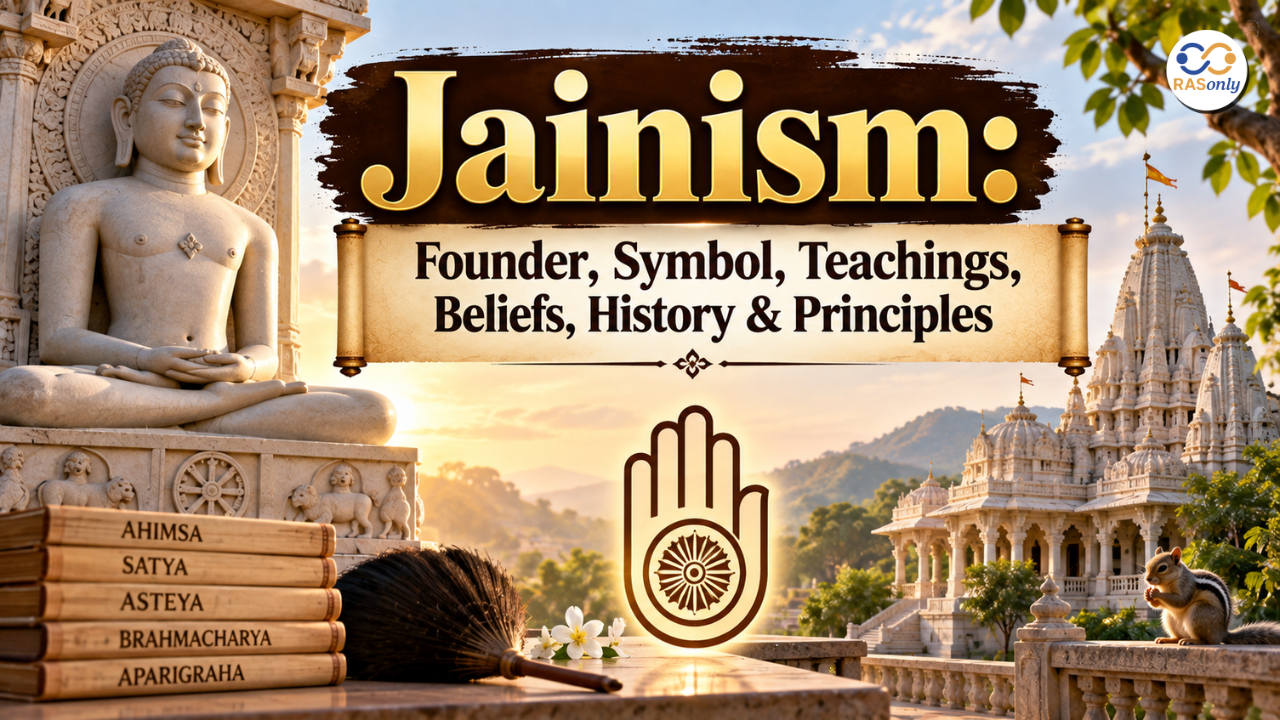
Jainism: Founder, Symbol, Teachings, Beliefs, History & Principles
Local Self-Government in India

Get in Touch with RASonly!

Local self-government in India empowers communities to participate directly in governance through Panchayati Raj and Urban Local Bodies. Rooted in ancient village systems and strengthened by the 73rd and 74th Amendments, it forms the foundation of grassroots democracy and local development.


Local self-government in India is the system where the communities manage themselves with elected leaders at the local level. It is a Government level that falls below the Union and State level and serves to foster democratic participation, decentralized decision-making and responsiveness to the local. In the year 1992 the Constitutional foundation of the local self-government was greatly reinforced in the form of the 73rd and 74th Constitutional Amendment Acts. Through these amendments, the rural and urban systems of local government were formally acknowledged and their powers, composition and duties were established.
What is the historical background and evolution of Local Self-Governments in India?
Pre-Independence Period
- Local self-governance in India has roots that stretch back to ancient village communities. These early institutions, commonly called panchayats, handled everyday administration and helped maintain order in rural areas long before modern government structures existed.
- These community bodies settled disputes, managed shared resources, and acted as spaces for collective decision-making at the village level. Leadership usually rested with respected village elders, who guided discussions and ensured that decisions reflected the needs of the community.
- Former forms of local governance were replaced by more formal forms of local governance, which were brought about in the 19th century by the British rule. Local governments and district boards started to emerge and this was an early manifestation of what would later on be the Panchayati Raj system. Although these institutions were narrow, they provided the basis of the centralized local governments that later formed the rural governance in independent India.
Mahatma Gandhi’s View on Local Self-Governments
- Decentralized Government: Gandhi considered local self-government as the base of the democratic system in India. He was of the opinion that true democracy would only be possible when the power of making decisions was distributed with communities and not at a higher government.
- Village Self-Rule: To Gandhi, village self-government was the key to having strong local government. The reason he presented is that these institutions had to have sufficient authority and resources to run their own affairs as well as to provide development to the community.
- The Partaking of people: Gandhi considered the local governments as important arenas where people can participate in making decisions that affect their lives. In his opinion, engaging people in the governance process would enhance democracy and make the citizens more accountable.
- Accountability and Transparency: Gandhi also asserted that Panchayati Raj Institutions must also be accountable to the people whom they represent. His view was that they ought to operate freely and in a responsible manner with a high degree of concern in regard to serving the society.
Post-Independence Period (Table Format)
Major Milestones in the Evolution of Local Self-Governments After Independence
| Year | Development / Event |
|---|---|
| 1951 | Community Development Programme launched to promote rural development. |
| 1953 | First Panchayati Raj elections held in Rajasthan. |
| 1957 | Rajasthan passes the Panchayati Raj Act, creating a legal framework for PRIs. |
| 1962 | Central Government establishes the Ministry of Community Development and Cooperation. |
| 1992 | National Panchayati Raj Day introduced to recognise the role of PRIs. |
| 1993 | 73rd Constitutional Amendment comes into effect, giving legal status to PRIs across India. |
| 1996 | PESA Act passed, granting tribal areas stronger control and local self-governance. |
| 2000 | National Gram Swaraj Abhiyan launched to strengthen decentralised governance. |
| 2011 | National Rural Livelihoods Mission launched to support women and vulnerable groups through PRIs. |
Important Committees and Working Groups on Panchayati Raj
Panchayati Raj & Local Self Government in India has not been a one-step process. Committees and Working Groups worked on rural development; others were in charge of decentralisation and responsibilities for district planning and the functioning of Panchayati Raj Institutions (PRIs). Over time, their recommendations steadily helped in constitutionalising local self-government with the advent of the 73rd Constitutional Amendment Act, 1992.
Balwant Rai Mehta Committee: 1957
- In 1957, the Balwant Rai Mehta Committee was set up to review the functioning of the Community Development Programme and the National Extension Service.
- The report was submitted in November 1957 by Balwant Rai Mehta. Back then, Jawaharlal Nehru was the Prime Minister of India.
- It published its report, “Report of the team for study of community projects and national extension service.”
Major Recommendations
- Introduction of democratic decentralisation.
- Three-tier Panchayati Raj system is implemented.
- Gram Panchayat at the village level
- Panchayat Samiti at the Block level
- Zila Parishad at the District level
- Decentralising sufficient powers and functions to local bodies
- Adequate financial resources to be allocated to Panchayati Raj Institutions.
Ashok Mehta Committee: 1977
- The Janata Government formed the Ashok Mehta Committee in December 1977 to evaluate how Panchayati Raj Institutions have been functioning.
- It was chaired by Ashok Mehta and presented its report in August 1978. The Prime Minister then was Morarji Desai.
- Commonly known as the "Report on Panchayati Raj."
Major Recommendations
- Introduction of a two-tier system instead of the three-tier system.
- District Level: Zila Parishad
- Mandal Panchayat at the sub-district level.
- District should be the first principle of decentralisation.
- Enhanced Financial and Administrative Powers for PRIs.
- Political parties contesting Panchayati Raj elections.
- Constitutional Status to Panchayati Raj Institutions
M.L. Dantwala Working Group: 1977–78
- In November 1977, the Planning Commission constituted the Working Group on Block-Level Planning
- The team handed in its report in 1978. Its primary role was to create protocols for planning at the block level.
- While the Ashok Mehta Committee was broad in nature, dealing with the institutional structure of Panchayati Raj, the Dantwala Working Group was specific, dealing with decentralised 2 planning and block-level planning.
Major Recommendations
- Formulation of plans at the block level.
- Proper assessment of local resources.
- Assessment and preparation of the development projects.
- Building district-level machinery for planning.
- Formation of Panchayat Samitis to perform several planning functions at the block level.
- Coordination between block officials, Panchayati Raj Institutions and voluntary organisations
- Focus on monitoring, evaluation, and budgets.
C.H. Hanumantha Rao Working Group: 1982-84
- In September 1982, the Planning Commission constituted a Working Group on District Planning under the Chairmanship of Dr C.H. Hanumantha Rao. Its activity is commonly linked to the 1983–84 era.
- The study investigated the approach to planning at the district level and involvement of local institutions in development planning.
- Its recommendations emphasised that decentralised planning should have a strong district-level institutional mechanism, with greater involvement of local representatives and Panchayati Raj Institutions.
Major Recommendations
- Decentralised planning should be available up to the district level.
- District planning should include an active role for local representatives.
- The preparation part must have an adequate share of Panchayati Raj Institutions.
- There needs to be more independence and autonomy of district planning systems.
- Planning must resonate with local realities and available resources.
G.V.K. Rao Committee: 1985
- In 1985, the G.V.K. Rao Committee was set up to look into the administrative structure for rural development and poverty alleviation programmes.
- It was chaired by G.V.K. Rao. Rajiv Gandhi was then the Prime Minister of India.
- The committee ruled that Panchayati Raj Institutions must not be seen merely as instruments in implementing Government schemes, but as broadening out the ambit of rural development.
Major Recommendations
- Strengthening Panchayati Raj Institutions.
- District as an important unit of planning and development.
- Reorganising decentralised planning and entrusting extensive powers over development programmes at the district level to the Zila Parishad.
- Making bureaucracy work with elected representatives in a better manner.
- Strengthening district-level planning.
- More role for local institutions in rural development
L.M. Singhvi Committee: 1986
- The L.M. Singhvi Committee was set up in 1986 to look into the revamping of Panchayati Raj Institutions.
- This was headed by Dr L.M.Singhvi. At that time, Rajiv Gandhi was the Prime Minister.
- This committee was in favour of constitutional status for the Panchayati Raj Institutions.
Major Recommendations
- Panchayati Raj Institutions should be recommended to be recognised constitutionally.
- Strengthening of the Gram Sabha.
- Greater autonomy for Panchayats.
- Panchayati Raj Institutions: regular elections.
- An abundance of local bodies financially capable.
- Institutional arrangement of dispute redressal concerning Panchayati Raj.
The Panchayati Raj system was an informal system for decades until the 73rd Amendment Act gave it constitutional recognition. This Act has led to a three-level structure that consists of
- Village Panchayats: The lowest tier, responsible for development and administration at the village level.
- Intermediate Panchayats: The middle tier, overseeing a group of villages and coordinating block-level planning.
- District Panchayats: The highest tier in rural governance, managing district-wide development and administration.
Urban Local Bodies (ULBs) – Note Table Format
| ULB Type | Meaning / Purpose | Key Features |
|---|---|---|
| Municipal Corporation (Nagar Nigam) | Governs large cities with high population and complex civic needs. | • Highest urban local body • Constitutional status via 74th Amendment • Handles major urban services: planning, water, sanitation, public health |
| Municipality (Municipal Council / Nagar Panchayat) | Governs smaller towns and semi-urban areas. | • Municipal Council = small towns • Nagar Panchayat = transitioning rural-urban areas • Responsible for routine urban administration |
| Notified Area Committee (NAC) | Formed in fast-developing areas that are not yet municipalities. | • Created by state government notification • Members fully nominated • Used where urbanisation is emerging |
| Town Area Committee (TAC) | Manages small towns requiring limited administrative functions. | • Set up through state legislation • May be elected, nominated, or mixed membership |
| Cantonment Board | Administers civilian areas inside military cantonments. | • Functions under Cantonments Act, 2006 • Works under Defence Ministry • Provides civic services to residents in cantonments |
15th Finance Commission Recommendations for Strengthening Local Government Finances
- Comparison with the 14th Finance Commission:
The 15th Finance Commission extended grant eligibility to all tiers of rural panchayats, including those in Scheduled Areas. This is different from the 14th Finance Commission, which only covered village panchayats and left out Scheduled Area village panchayats.
- Grants to Local Bodies:
The Commission recommended allocating ₹4.36 lakh crore from the divisible tax pool to local governments—both rural and urban—for the period 2021–26.
- State Finance Commissions Requirement:
No funds will be released to a state’s local bodies after March 2024 if the state fails to set up its State Finance Commission and take action on its recommendations.
- Grant Criteria:
Except for health-related grants, all other local body grants will be distributed among states based on two factors:
- Population – 90% weightage
- Geographical area – 10% weightage
Conclusion
Indian-Local Self - Government is in the central position to enhance democracy and enhance governance at the grassroots. Having developed since ancient times and village panchayats constituted to be constitutionally recognized institutions under the 73rd and 74th Amendments, they enable the citizens to participate in decisions that impact their daily lives. The Urban Local Bodies and Panchayati Raj Institutions deal with key services and development support and enhance accountability. Reforms, committees and financial assistance, particularly by the 15th Finance Commission, have added to their ability. Due to the growth and urbanization of India, the local governments in this country are crucial towards inclusive development, efficient service delivery, and responsive governance.
BEST SELLER
🏆 PRELIMS
RAS Pass
Prelims focused Hindi & English
₹399
✓
Prelims Topic-Wise Tests
✓
Subject-Wise Tests
✓
Full-Length Prelims Tests
✓
Daily Current Affairs Tests
✓
Prelims PYQs Tests
✓
Detailed Solutions & Analysis
✓
All Rajasthan Ranking
✓
Unlimited Reattempts
✓
Mains Tests
✓
Hindi & English Tests
✓
All Rajasthan Ranking
Trusted by 5,000+ Students
Post Category
- RAS Salary
- Result
- RAS Admit Card
- RAS Job
- RAS Cutoff
- Preparation Tips
- RAS Answer Key
- RAS Exam Analysis
- RAS Syllabus
- RAS Previous Year Papers
- RPSC RAS Exam Pattern
- RAS Interview
- RAS Exam Date
- RAS Vacancy
- RAS Test Series
- RAS Best Books
- RAS Preparation Resources
- RAS Coaching Centre
- History
- Polity
- Geography
- Economics
- Science
- Art and Culture
- RPSC RAS Application Form
- RPSC RAS Notification
- RAS Eligibility Criteria
- UPSC Exam
- RPSC RAS Mains
Visit Our RASonly Offline Center
Our Expert Faculty

Bhunesh Sir
Current Affairs · 13+ Yrs

Aamir Khan Sir
RAS-2017 · IIM Ahm.
Akash Sir
Polity · 8+ Yrs
Free Resources
Official Mobile App

RASOnly App
by OTSAdda · Free
Full Video Lectures
Mock Tests & PYQs
Daily Current Affairs
AI Mock Interview
Free Download · No subscription needed to install
RAS 2024 Toppers — RASonly
Rank 2
Virendra Charan
Rank 9
Bhoopinder Singh
Rank 26
Aanchal Nagpal
Rank 33
Lokendra Singh
Rank 45
Amar Rathore
Rank 46
Manasvini Verma

Join RASonly WhatsApp Community
Get daily current affairs, exam alerts, free study material and tips from expert faculty — right on WhatsApp.
Join for Free →RASonly Interview Guidance Program

Mr. Ashok Jain
Ex-Chief Secretary Govt of Rajasthan
- IAS officer of the 1981 batch, Rajasthan cadre.
- Passionate about mentoring the next generation of RAS officers with real-world insights.
- Got retired in Dec 2017 from the post of Chief Secretary of the state of Rajasthan.

Mr. Guru Charan Rai
Ex-ASP / SP in Jaisalmer
- Guru Charan Rai, IPS (Retd), retired as Inspector General of Police (Security), Rajasthan, Jaipur in 2017.
- Served as ASP and SP in Jaisalmer, Nagaur, Sri Ganganagar, Sawai Madhopur, Dausa, Sikar, and Karauli.
- He also held key positions as DIGP and IGP in the Law and Order division.

Mr. Rakesh Verma
Ex-IAS Officer, B.Tech, MBA, and M.A. (Economics)
- IAS officer of the 1981 batch and retired in Chief Secretary Rank.
- Civil servant of high repute and vast experience.
- Has been teaching UPSC CSE subjects for the last six years.
Daily Current Affairs for RAS Exam Preparation 2026
25th SCO Foreign Trade Ministers' Meeting
September 19, 2026
India’s flag bearer at the opening ceremony of the...
September 19, 2026
PM-YASASVI Scheme Update 2026
September 18, 2026