Jainism: Founder, Symbol, Teachings, Beliefs, History & Principles
Major Ports of India: Snapshot of Locations, Capacity & Trade Importance

Get in Touch with RASonly!


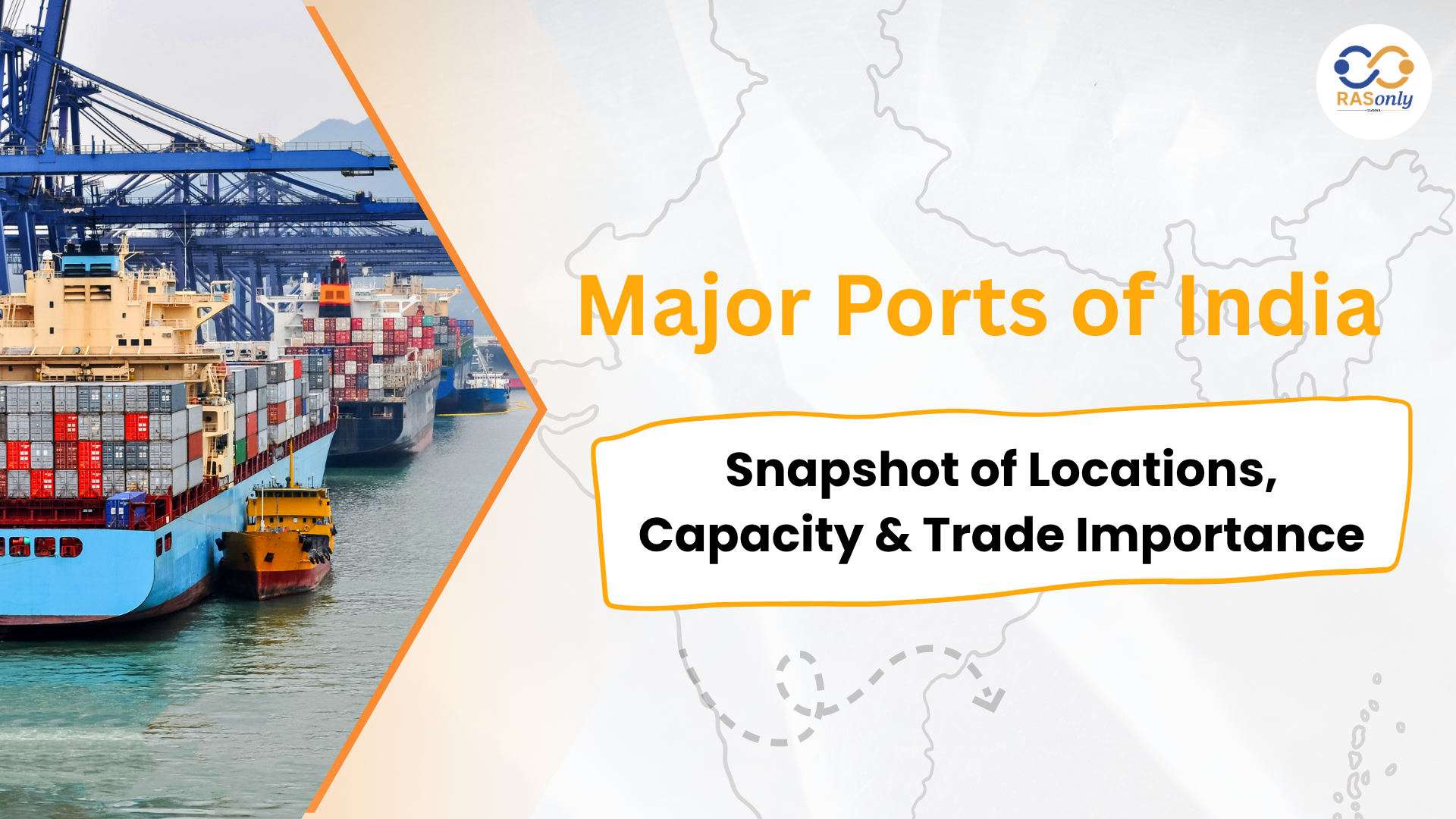
The backbone of the maritime trade in India is its major ports, which facilitate and ensure that there is much interaction between the Indian economy and the rest of the world. India has a coastline of about 7,500 kilometers with an extensive 13 major ports, which are strategically located along the east and west coasts. The ports process about 95 per cent of the total Indian trade in terms of volume and about 70 per cent in terms of value; thus, they are critical in terms of national development, trade, and regional connectivity.
How Many Major Ports of India and Who Manages Them
India has 13 major ports, which are under the control of the central government through the Ministry of Ports, Shipping, and Waterways. The ports are under the control of the Major Port Authorities Act, 2021, and are not in line with minor ports, which are managed by various state governments.
| Port Name | State | Coast | Type |
|---|---|---|---|
| Kandla (Deendayal Port) | Gujarat | West | Tidal |
| Mumbai Port | Maharashtra | West | Natural |
| Jawaharlal Nehru Port (JNPT) | Maharashtra | West | Artificial |
| Mormugao Port | Goa | West | Natural |
| New Mangalore Port | Karnataka | West | All-weather |
| Cochin Port | Kerala | West | Natural |
| Paradip Port | Odisha | East | Artificial |
| Visakhapatnam Port | Andhra Pradesh | East | Natural |
| Chennai Port | Tamil Nadu | East | Artificial |
| Ennore Port (Kamarajar) | Tamil Nadu | East | Artificial |
| Tuticorin Port (V.O.C. Port) | Tamil Nadu | East | Artificial |
| Kolkata Port | West Bengal | East | Riverine |
| Haldia Dock Complex | West Bengal | East | Riverine |
Geographical Spread of Major Ports of India
The biggest ports of India are positioned properly on the east and west coasts in order to maximize seaside availability and local reach with aerodrome complete performance. Their location is such that it makes the economic activity along the coast balanced, benefiting those inland states with trade routes to the international market. The West Coast has deeper natural harbors, whereas deep-draft ports fit large vessels, and exporting minerals can be found on the East Coast.
| Coast | Ports Located |
|---|---|
| West Coast | Kandla (Gujarat), Mumbai (Maharashtra), JNPT (Maharashtra), Mormugao (Goa), New Mangalore (Karnataka), Cochin (Kerala) |
| East Coast | Paradip (Odisha), Visakhapatnam (Andhra Pradesh), Chennai (Tamil Nadu), Ennore/Kamarajar (Tamil Nadu), Tuticorin (Tamil Nadu), Kolkata & Haldia (West Bengal) |
Snapshot Table: Major Ports of India at a Glance
| Port Name | Coast & State | Highlights |
|---|---|---|
| Jawaharlal Nehru Port (JNPT) | West, Maharashtra | India’s largest container port (~5.8 M TEUs), a major carrier's hub |
| Mundra Port | West, Gujarat | India’s largest commercial & private port (155 MT cargo) |
| Kandla/Deendayal Port | West, Gujarat | Largest by cargo volume (~132 MT) |
| Chennai Port | East, Tamil Nadu | One of the oldest (since 1881), handles autos, containers (~1.6 M TEUs) |
| Visakhapatnam Port | East, Andhra Pradesh | East Coast’s largest cargo (~81 MT), deep-draft operations |
| Kolkata (Haldia) | East, West Bengal | The only major riverine port serves NE states (~66 MT) |
Conclusion
Major Ports of India are of key interest to trade, economic development, and strategic connectivity. These ports are transforming into international maritime ports with modernization and expansion of the same. They are crucial to the national logistics and export industry, and training to be in competition. The location and capacity to handle cargo make them ideal.
FAQs
There are 13 major ports of India, managed by the central government.
Kandla (Deendayal Port) in Gujarat handles the highest cargo volume.
They handle large-scale import and export of goods, supporting trade and industry.
Jawaharlal Nehru Port (JNPT) near Mumbai is the largest container port.
Major ports are centrally governed; minor ports are under state control and handle smaller traffic.
BEST SELLER
🏆 PRELIMS
RAS Pass
Prelims focused Hindi & English
₹399
✓
Prelims Topic-Wise Tests
✓
Subject-Wise Tests
✓
Full-Length Prelims Tests
✓
Daily Current Affairs Tests
✓
Prelims PYQs Tests
✓
Detailed Solutions & Analysis
✓
All Rajasthan Ranking
✓
Unlimited Reattempts
✓
Mains Tests
✓
Hindi & English Tests
✓
All Rajasthan Ranking
Trusted by 5,000+ Students
Post Category
- RAS Salary
- Result
- RAS Admit Card
- RAS Job
- RAS Cutoff
- Preparation Tips
- RAS Answer Key
- RAS Exam Analysis
- RAS Syllabus
- RAS Previous Year Papers
- RPSC RAS Exam Pattern
- RAS Interview
- RAS Exam Date
- RAS Vacancy
- RAS Test Series
- RAS Best Books
- RAS Preparation Resources
- RAS Coaching Centre
- History
- Polity
- Geography
- Economics
- Science
- Art and Culture
- RPSC RAS Application Form
- RPSC RAS Notification
- RAS Eligibility Criteria
- UPSC Exam
- RPSC RAS Mains
Visit Our RASonly Offline Center
Our Expert Faculty

Bhunesh Sir
Current Affairs · 13+ Yrs

Aamir Khan Sir
RAS-2017 · IIM Ahm.
Akash Sir
Polity · 8+ Yrs
Free Resources
Official Mobile App

RASOnly App
by OTSAdda · Free
Full Video Lectures
Mock Tests & PYQs
Daily Current Affairs
AI Mock Interview
Free Download · No subscription needed to install
RAS 2024 Toppers — RASonly
Rank 2
Virendra Charan
Rank 9
Bhoopinder Singh
Rank 26
Aanchal Nagpal
Rank 33
Lokendra Singh
Rank 45
Amar Rathore
Rank 46
Manasvini Verma

Join RASonly WhatsApp Community
Get daily current affairs, exam alerts, free study material and tips from expert faculty — right on WhatsApp.
Join for Free →RASonly Interview Guidance Program

Mr. Ashok Jain
Ex-Chief Secretary Govt of Rajasthan
- IAS officer of the 1981 batch, Rajasthan cadre.
- Passionate about mentoring the next generation of RAS officers with real-world insights.
- Got retired in Dec 2017 from the post of Chief Secretary of the state of Rajasthan.

Mr. Guru Charan Rai
Ex-ASP / SP in Jaisalmer
- Guru Charan Rai, IPS (Retd), retired as Inspector General of Police (Security), Rajasthan, Jaipur in 2017.
- Served as ASP and SP in Jaisalmer, Nagaur, Sri Ganganagar, Sawai Madhopur, Dausa, Sikar, and Karauli.
- He also held key positions as DIGP and IGP in the Law and Order division.

Mr. Rakesh Verma
Ex-IAS Officer, B.Tech, MBA, and M.A. (Economics)
- IAS officer of the 1981 batch and retired in Chief Secretary Rank.
- Civil servant of high repute and vast experience.
- Has been teaching UPSC CSE subjects for the last six years.

Daily Current Affairs for RAS Exam Preparation 2026
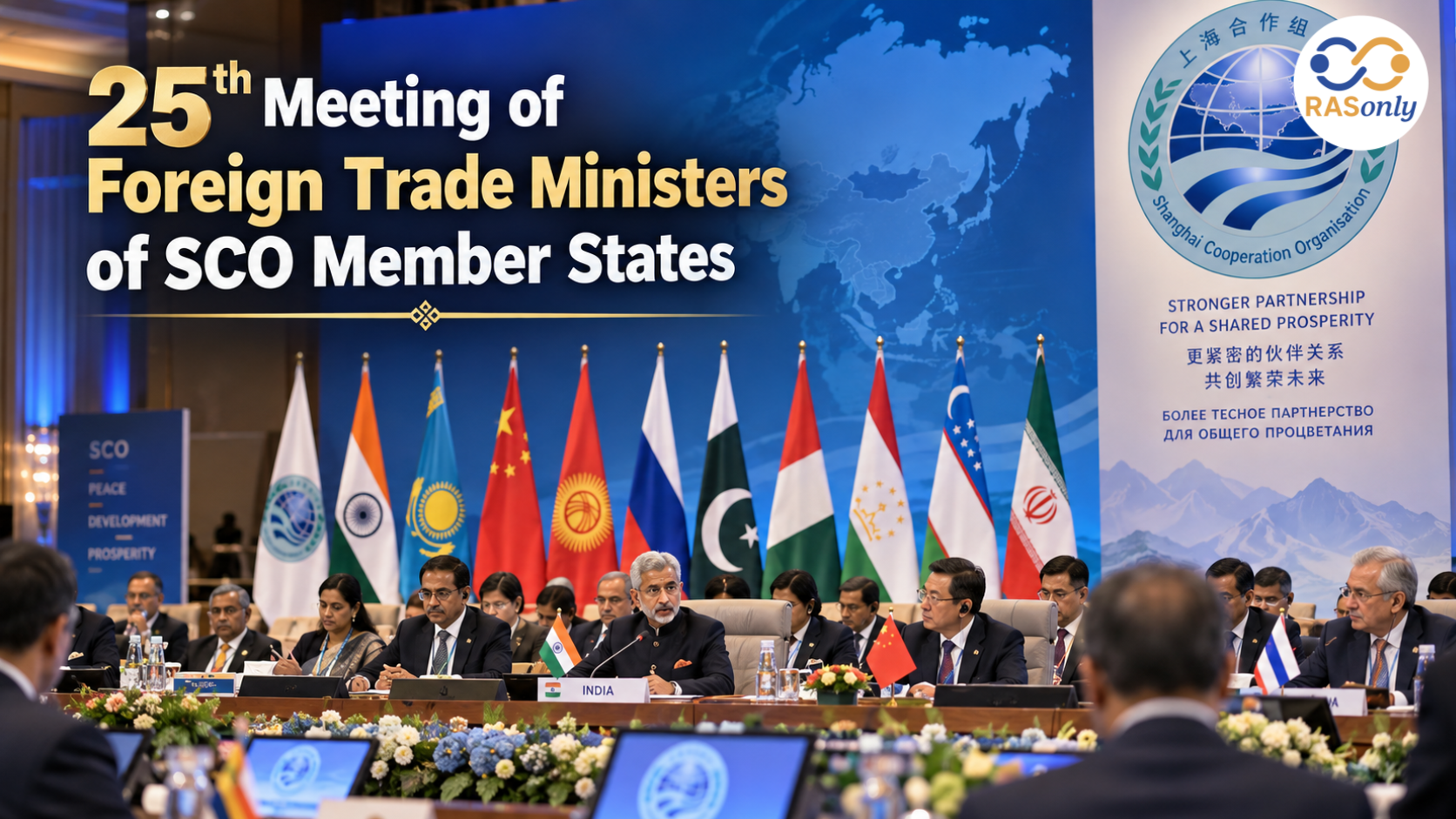
25th SCO Foreign Trade Ministers' Meeting
September 19, 2026
India’s flag bearer at the opening ceremony of the...
September 19, 2026
PM-YASASVI Scheme Update 2026
September 18, 2026