Jainism: Founder, Symbol, Teachings, Beliefs, History & Principles
RAS Eligibility: Age Limit, Attempts, and Key Rules (2026 Guide)

Get in Touch with RASonly!

The RAS Eligibility Criteria 2026 defines the complete requirements to apply for the RPSC RAS Exam, including RAS age limit 2026, educational qualification, nationality, domicile rules, age relaxation, and number of attempts. Every candidate aspiring to join the Rajasthan Administrative Service (RAS) must carefully understand the RAS eligibility conditions before submitting the application form.
This detailed guide explains RAS eligibility, RAS eligibility criteria 2026, RAS criteria for age, RAS qualification requirements, RAS attempt limit, and category-wise age relaxation as per the latest RPSC rules. Understanding these rules early helps candidates plan their preparation strategy effectively.

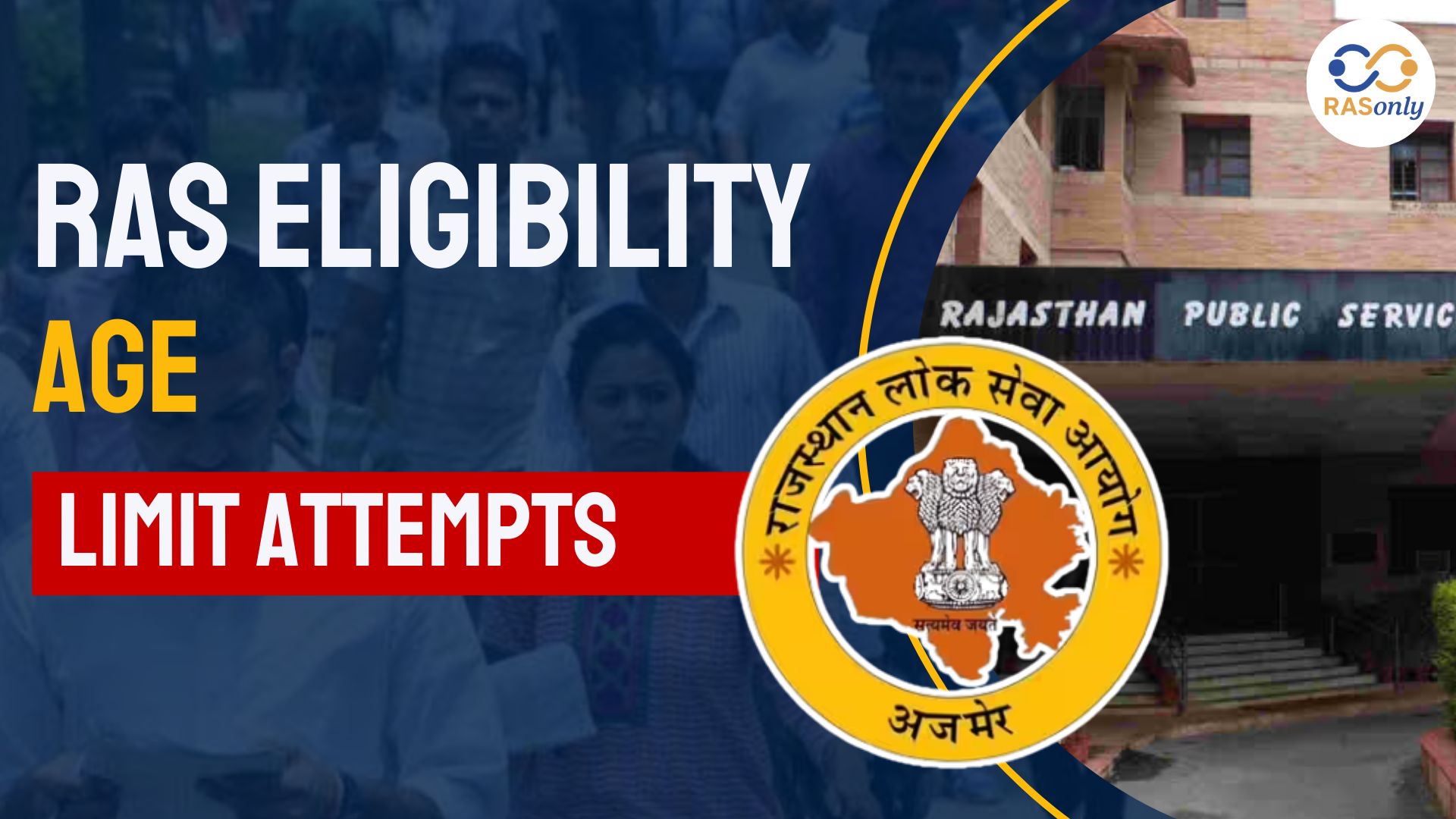
Becoming an officer through the Rajasthan Administrative Service (RAS) is a popular ambition for many young graduates in Rajasthan and across India. Before beginning serious preparation, one of the most important steps is to clearly understand the RAS eligibility criteria 2026. Among all eligibility conditions, the RAS age limit and number of attempts are the areas where aspirants usually have the most questions.
In this guide, we break down the RAS eligibility criteria in detail, including the RAS age limit 2026, category-wise age relaxation, educational qualification, domicile rules, and RAS attempt limit. Tables, bullet points, and structured explanations are provided to make the information easy to understand. The information provided here is based on official RPSC notifications and standard eligibility guidelines.
RAS Eligibility Criteria 2026: Complete Overview
The RAS eligibility criteria 2026 include age limit, educational qualification, nationality, domicile requirements, and number of attempts. Candidates must satisfy all RPSC RAS eligibility conditions to apply successfully.
To be eligible for the RPSC RAS exam, a candidate must meet all of the following general requirements:
- The candidate must be an Indian citizen.
- The applicant should possess a Bachelor’s degree from a recognized university.
- The age of the candidate must fall within the prescribed age limits (explained next).
- There is no minimum percentage requirement in the degree for the exam.
- Final-year students in graduation can apply provisionally, subject to providing proof of passing before the mains exam.
RAS Educational Qualification Eligibility
To be eligible for the RPSC RAS examination, a candidate must possess a Bachelor’s degree from a recognized university or institution. There is no minimum percentage requirement for appearing in the RAS exam.
Candidates who are in the final year of graduation can also apply for the RAS Prelims exam provisionally. However, they must submit proof of passing the degree examination before the RAS Mains stage.
RAS Age Limit 2026 (Minimum & Maximum Age Criteria)
The RAS age limit 2026 specifies the minimum and maximum age required to apply for the Rajasthan Administrative Service examination. RPSC prescribes these limits to ensure administrative maturity and fair competition among candidates. Applicants must satisfy both lower and upper age criteria as mentioned in the official RPSC RAS notification.
Basic Age Range
| Eligibility Component | Details |
|---|---|
| Minimum Age | 21 years |
| Maximum Age (General Category) | 40 years |
This means a candidate must be at least 21 years old by the cutoff date specified in the RPSC RAS Notification and must not have exceeded the upper age limit for their category.
Why 21 years?
This requirement ensures candidates have completed their graduation before entering the service or are close to finishing it.
Age Relaxation and Category-Wise Age Limits
One of the key advantages of competitive exams in India is that age concessions are available for certain categories to promote equal opportunity. RPSC follows category-wise relaxations in the upper age limit.
Category-Wise Age Limit Summary
| Category | Base Upper Limit | Age Relaxation | Final Max Age |
|---|---|---|---|
| General (Unreserved) – Male | 40 | No relaxation | 40 |
| General (Unreserved) – Female | 40 | +5 years | 45 |
| OBC / MBC – Male | 40 | +5 years | 45 |
| OBC / MBC – Female | 40 | +10 years | 50 |
| SC / ST – Male | 40 | +5 years | 45 |
| SC / ST – Female | 40 | +10 years | 50 |
| EWS – Male | 40 | +5 years | 45 |
| EWS – Female | 40 | +10 years | 50 |
| Persons With Disabilities (PwD) | 40 | 5–15 years | 50–55 |
| Widow / Divorced Women | 40 | No upper age limit | Unlimited |
| Ex-Servicemen | 40 | +10 years | 50 |
*For PwD candidates, the exact relaxation depends on the subcategory (General, OBC, SC/ST) and applicable rules.
Key Points on Age Relaxation
- General category female candidates get an additional 5 years.
- OBC and SC/ST female candidates typically receive a 10-year relaxation, increasing the limit to 50.
- Persons with disabilities receive extended age relaxation based on their base category.
- Widowed and divorced women are not restricted by any upper age limit, and therefore, they can make an appearance irrespective of their age, provided that they qualify in terms of the education requirements.
- Ex-servicemen who keep records of their services might find relaxation (which is often up to 50).
These relaxations ensure that the RAS exam is open to a large pool of candidates and should be able to accept the value of inclusion and equity in recruitment to the public service.
RAS Eligibility 2026: Category-Wise Summary
To better understand the RAS eligibility criteria 2026, here is a clear category-wise summary based on the RAS age limit 2026 and applicable age relaxation rules prescribed by RPSC. This breakdown helps candidates quickly verify their eligibility for the Rajasthan Administrative Service (RAS) examination.
RAS Eligibility for General Category
- Minimum Age: 21 years
- Maximum Age (Male): 40 years
- Maximum Age (Female): 45 years (5-year relaxation)
General category candidates do not receive additional reservation benefits unless specified under special conditions such as PwD or Ex-servicemen status.
RAS Eligibility for OBC / MBC Candidates
- Maximum Age (Male): 45 years
- Maximum Age (Female): 50 years
OBC and MBC candidates belonging to Rajasthan domicile are eligible for age relaxation as per RPSC RAS eligibility rules. Valid caste certificate is mandatory to claim relaxation benefits.
RAS Eligibility for SC / ST Candidates
- Maximum Age (Male): 45 years
- Maximum Age (Female): 50 years
SC and ST candidates of Rajasthan domicile receive upper age relaxation under RAS eligibility 2026 guidelines. Proper category documentation is required at the time of verification.
RAS Eligibility for EWS Category
EWS candidates are eligible for upper age relaxation similar to OBC category candidates, subject to submission of a valid Economically Weaker Section (EWS) certificate issued by the competent Rajasthan authority.
RAS Eligibility for Female Candidates
Female candidates receive additional age relaxation depending on their category:
- General Female: +5 years
- OBC / SC / ST Female: Up to +10 years
This provision ensures wider participation of women in the Rajasthan Administrative Service.
RAS Eligibility for Persons with Disabilities (PwD)
Candidates under the PwD category are eligible for extended upper age relaxation ranging from 5 to 15 years, depending on their base category (General, OBC, SC/ST). A valid medical disability certificate is mandatory.
RAS Eligibility for Ex-Servicemen
Ex-servicemen are entitled to upper age relaxation, generally up to 10 years, as per the Rajasthan Government rules. Service records and discharge certificates must be verified to claim this benefit.
RAS Eligibility for Rajasthan Government Employees
Under the RAS eligibility criteria 2026, certain age relaxation benefits are also available for Rajasthan State Government employees as per RPSC rules.
Age Relaxation for Non-Gazetted Employees
Non-gazetted employees working under the Government of Rajasthan may receive upper age relaxation, subject to service conditions and applicable recruitment rules mentioned in the official RPSC RAS notification.
The exact upper age extension for Rajasthan Government employees is subject to the latest RPSC notification and applicable service rules.
Service Proof Requirement
To claim RAS eligibility benefits as a government employee, candidates must:
- Provide a valid service certificate issued by the competent authority
- Fulfill minimum service duration (if specified in notification)
- Meet all other RAS eligibility conditions, including educational qualification
Important Clarification
- Relaxation benefits apply only to eligible Rajasthan Government employees.
- Employees must ensure they satisfy both general RAS eligibility and service-related conditions.
- Exact upper age extension is subject to the latest RPSC notification.
RAS Nationality and Domicile Eligibility
As per RPSC guidelines, a candidate applying for the RAS exam must be an Indian citizen. Certain age relaxation benefits are applicable only to candidates who fulfill Rajasthan domicile requirements under the reserved categories.
Physical and Medical Standards
Physical standards are required for certain posts, especially those involving field duty or uniformed services under the state government.
| Criteria | Standard |
|---|---|
| Height (Male) | 168 cm |
| Height (Female) | 152 cm |
| Chest (Male) | Minimum 84–89 cm (with expansion) |
| Vision | Normal Vision (no severe defects) |
Medical rules:
- Candidates must be physically and medically fit.
- Vision, hearing, and other physical fitness standards are checked during medical examination.
- Certain defects like color blindness or major physical deformities, can affect eligibility for specific posts.
Understanding Age Limit Cutoff Dates
Whenever RPSC notifies the exam, it does state the reference date against age calculation. This typically falls on the 1st of the year of the exam or some predetermined date that is indicated in the notification.
Suppose that the notification was of RAS 2026 on the cutoff date, January 1, 2026:
- On the lower side, a candidate who attains the age of 21 years on or before January 1, 2026, is eligible.
- The candidate who is not older than the category's upper age on January 1, 2026, may apply.
It is important to make sure you look at the official RPSC announcement because the cutoff can be different in different cycles.
Number of Attempts as per RAS Eligibility Criteria
A common question is whether there is a cap on how many times a candidate can sit for the RAS exam.
Attempt Rules
- There is no fixed limit on the number of attempts prescribed by RPSC.
- A candidate can attempt the exam repeatedly as long as they remain within the age limit for their category.
- Once a candidate crosses the upper age limit, they can no longer appear for the exam.
This means efforts are only constrained by age, not by a fixed attempt cap such as seen in some other exams. As long as you keep meeting age eligibility, you can keep applying.
Tips for Candidates on Age and Attempts
The following are some effective suggestions for aspirants on their way to RAS:
Plan Early: Prepare early, particularly where you are either near the lower or upper age ranges. The sooner the better; the more years you have to take the exam in case you have to.
Track Changes in Rules: RPSC reviews the RAS eligibility criteria periodically. Check official notifications on the latest cutoff dates, relaxations and any change of age requirements.
Use Age Relaxation Wisely: When you are in one of those categories that have age relaxations, you need to strategize your efforts. You can have more additional time than general category candidates.
Document Domicile and Category Proof: Age relaxation often applies only if you meet domicile and category requirements. Make sure you have valid evidence if you are claiming reserved category benefits.
Conclusion
Understanding the RAS eligibility criteria 2026 is the first and most important step for candidates preparing for the Rajasthan Administrative Service exam. The RAS age limit, educational qualification, domicile rules, and number of attempts directly determine whether a candidate can apply for the RPSC RAS examination. Since there is no fixed attempt limit and age relaxation is available for reserved categories, aspirants should carefully verify their eligibility before starting serious preparation.
Staying updated with official RPSC notifications ensures that you meet all RAS eligibility conditions and avoid disqualification at later stages.
| RPSC RAS New Exam Pattern 2026 | RPSC RAS Cut-off | RAS Mains Exam Pattern |
| RAS Interview Pattern & Marks | RPSC RAS Notification | RAS Exam Stage-Wise Selection Process |
RAS GK & GS Subject-Wise Preparation Links
RAS Courses, Test Series & Practice Resources
RAS Mains & Interview Guidance
| RAS Mains Preparation Strategy | AI Mock Interview | RAS Interview Guidance Program |
| RAS Interview Preparation Tips | RAS Interview Questions | RAS Offline Center |
FAQs
Yes, if they belong to a category eligible for age relaxation, they may apply up to their respective relaxed upper age limit.
Yes, candidates must be at least 21 years old by the reference date specified in the exam notification.
Since RPSC does not have a fixed limit on attempts and it’s tied to age eligibility, just appearing while within age makes it valid. Always check official terms.
No, there is no minimum percentage requirement. A bachelor’s degree from a recognized university is sufficient.
Yes, candidates from other states can apply under the general category but may not receive Rajasthan-specific reservation benefits.
BEST SELLER
🏆 PRELIMS
RAS Pass
Prelims focused Hindi & English
₹399
✓
Prelims Topic-Wise Tests
✓
Subject-Wise Tests
✓
Full-Length Prelims Tests
✓
Daily Current Affairs Tests
✓
Prelims PYQs Tests
✓
Detailed Solutions & Analysis
✓
All Rajasthan Ranking
✓
Unlimited Reattempts
✓
Mains Tests
✓
Hindi & English Tests
✓
All Rajasthan Ranking
Trusted by 5,000+ Students
Post Category
- RAS Salary
- Result
- RAS Admit Card
- RAS Job
- RAS Cutoff
- Preparation Tips
- RAS Answer Key
- RAS Exam Analysis
- RAS Syllabus
- RAS Previous Year Papers
- RPSC RAS Exam Pattern
- RAS Interview
- RAS Exam Date
- RAS Vacancy
- RAS Test Series
- RAS Best Books
- RAS Preparation Resources
- RAS Coaching Centre
- History
- Polity
- Geography
- Economics
- Science
- Art and Culture
- RPSC RAS Application Form
- RPSC RAS Notification
- RAS Eligibility Criteria
- UPSC Exam
- RPSC RAS Mains
Visit Our RASonly Offline Center
Our Expert Faculty

Bhunesh Sir
Current Affairs · 13+ Yrs

Aamir Khan Sir
RAS-2017 · IIM Ahm.

Akash Sir
Polity · 8+ Yrs
Free Resources
Official Mobile App

RASOnly App
by OTSAdda · Free
Full Video Lectures
Mock Tests & PYQs
Daily Current Affairs
AI Mock Interview
Free Download · No subscription needed to install
RAS 2024 Toppers — RASonly
Rank 2
Virendra Charan
Rank 9
Bhoopinder Singh
Rank 26
Aanchal Nagpal
Rank 33
Lokendra Singh
Rank 45
Amar Rathore
Rank 46
Manasvini Verma

Join RASonly WhatsApp Community
Get daily current affairs, exam alerts, free study material and tips from expert faculty — right on WhatsApp.
Join for Free →RASonly Interview Guidance Program

Mr. Ashok Jain
Ex-Chief Secretary Govt of Rajasthan
- IAS officer of the 1981 batch, Rajasthan cadre.
- Passionate about mentoring the next generation of RAS officers with real-world insights.
- Got retired in Dec 2017 from the post of Chief Secretary of the state of Rajasthan.

Mr. Guru Charan Rai
Ex-ASP / SP in Jaisalmer
- Guru Charan Rai, IPS (Retd), retired as Inspector General of Police (Security), Rajasthan, Jaipur in 2017.
- Served as ASP and SP in Jaisalmer, Nagaur, Sri Ganganagar, Sawai Madhopur, Dausa, Sikar, and Karauli.
- He also held key positions as DIGP and IGP in the Law and Order division.

Mr. Rakesh Verma
Ex-IAS Officer, B.Tech, MBA, and M.A. (Economics)
- IAS officer of the 1981 batch and retired in Chief Secretary Rank.
- Civil servant of high repute and vast experience.
- Has been teaching UPSC CSE subjects for the last six years.



Daily Current Affairs for RAS Exam Preparation 2026

Women’s Cricket Team Wins Gold Medal
September 23, 2026
9th India International Water Week 2026
September 23, 2026
United Nations General Assembly
September 22, 2026