Common DAF Mistakes That Invite Tough Questions
Rainfall Distribution in Rajasthan: Complete Pattern, Regional Variation, Monsoon Analysis & Factors (RAS 2026)

Get in Touch with RASonly!

Rainfall in Rajasthan is highly uneven, decreasing from the humid south-east to the arid north-west desert region. The Aravalli Range, monsoon winds, and distance from sea are the main controlling factors. This topic is crucial for understanding agriculture, water scarcity, and climate patterns in RAS 2026.

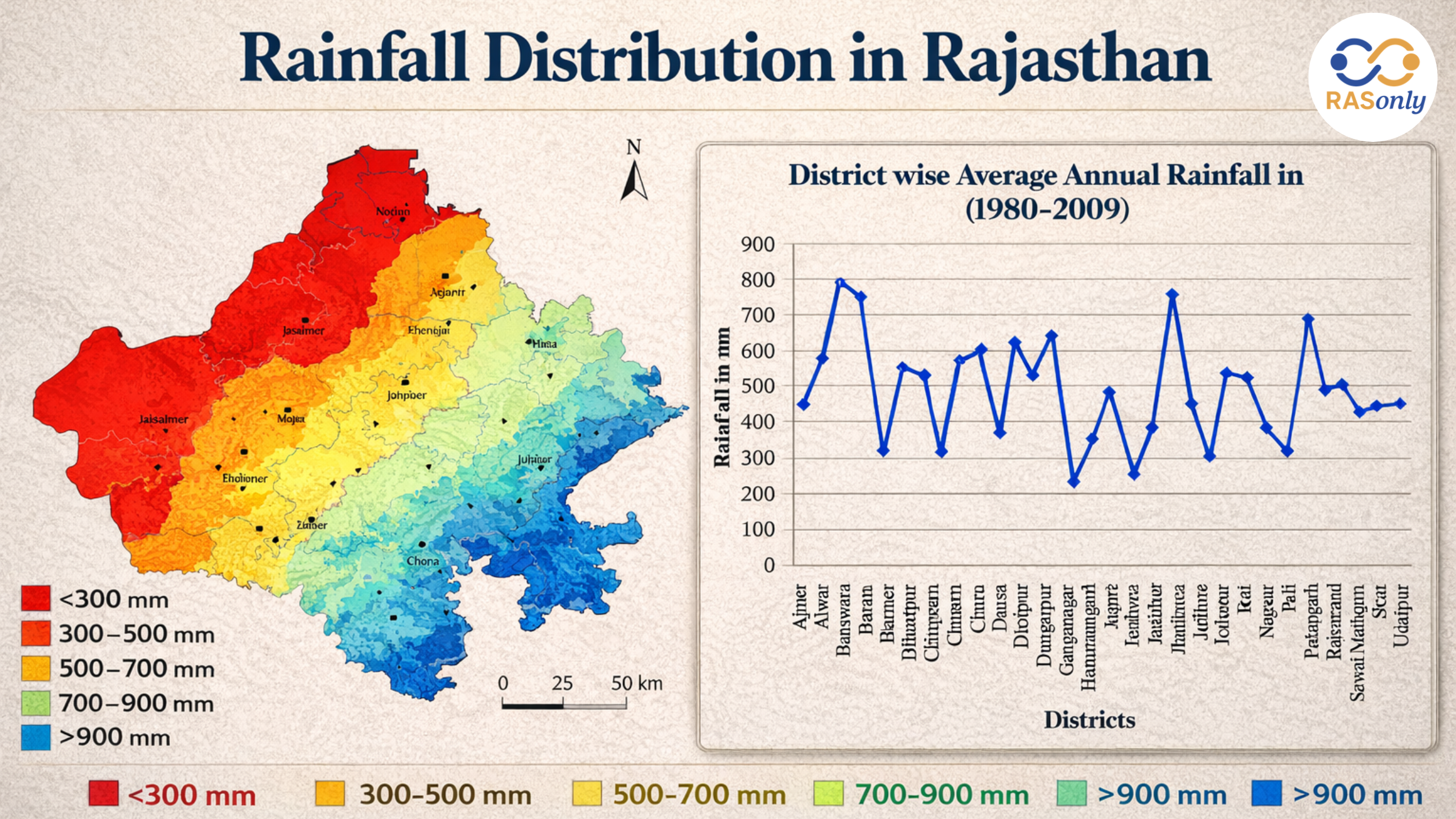
The Rainfall Distribution in Rajasthan is one of the most important topics in Rajasthan Geography, Climatology, Environment, and RPSC RAS 2026 preparation. Rajasthan, being the largest state of India, experiences extreme variation in rainfall due to its geographical location, desert conditions, monsoon system, and the Aravalli Range.
Rainfall distribution is important in order to comprehend the patterns of agriculture, water resources, drought, desertification, irrigation systems, and economic development of regions. A good example of uneven distribution of rainfall in India is in Rajasthan in which south-eastern areas receive very high rainfall in contrast to north-western desert areas which receive very low rainfall.
Overview of Rainfall in Rajasthan
The South-West Monsoon is the main rain carrier of Rajasthan with an annual rainfall contributing most of the annual precipitation. Rainfall, however, is highly uneven over the state because of climatic and geographical reasons.
Key Facts (RAS 2026 Important)
- Average annual rainfall: ~500–600 mm (varies regionally)
- Over 90–91% rainfall received during South-West Monsoon
- Rainfall decreases from South-East → North-West direction
- July and August are the rainiest months
- East Rajasthan: ~64.9 cm rainfall
- West Rajasthan: ~32.7 cm rainfall
Exam Insight: Rajasthan rainfall = Highly uneven + monsoon dependent + desert influenced
Regional Distribution of Rainfall in Rajasthan
The regional distribution of rainfall in Rajasthan shows a clear geographical pattern, decreasing from south-east to north-west. This variation is mainly controlled by the Aravalli Range, monsoon winds, and distance from the sea, making Rajasthan one of the best examples of uneven rainfall distribution in India.
RPSC RAS 2026, Rajasthan Geography, and Climatology are extremely related to this topic, as it assists in comprehending the aspects of agriculture, water resources, drought situations, and in the regional developmental patterns.
Rainfall Zones (Detailed Classification)
| Rainfall Zone | Rainfall Range | Regions/Districts |
|---|---|---|
| Very High Rainfall | > 90 cm | Banswara, Jhalawar |
| High Rainfall | 60–90 cm | Kota, Udaipur, Dungarpur |
| Moderate Rainfall | 40–60 cm | Jaipur, Ajmer, Alwar |
| Low Rainfall | 20–40 cm | Jodhpur, Nagaur, Barmer |
| Very Low Rainfall | < 20 cm | Jaisalmer, Bikaner |
Key Facts (Exam Important):
- Western Rajasthan = Arid desert region (low rainfall)
- Eastern Rajasthan = Semi-humid region (agriculture zone)
- Extreme variation: Jaisalmer (<100 mm) vs Banswara (>900 mm)
Rainfall Distribution Map (Important for RAS)
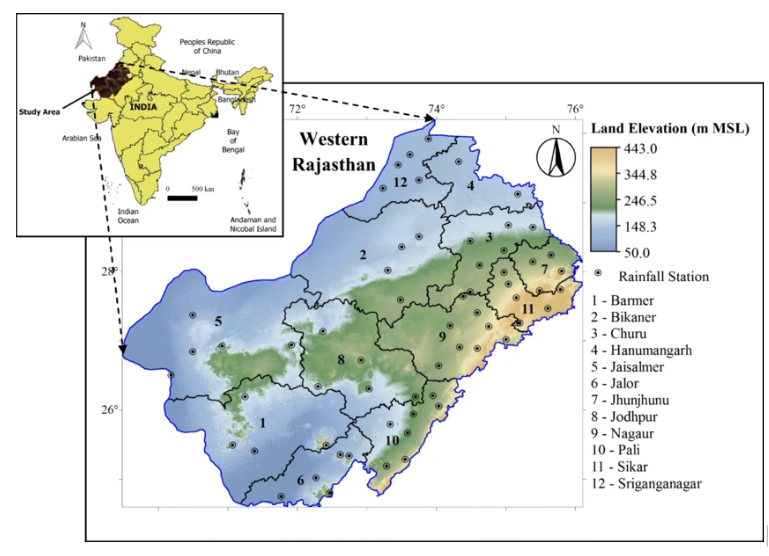
The Rainfall Distribution Map of Rajasthan helps in visualizing rainfall zones, isohyets, and regional variation across the state. It is very useful for solving map-based questions in RAS Prelims and Mains.
Seasonal Distribution of Rainfall in Rajasthan
Rainfall distribution in Rajasthan is extremely uneven and rainfall controlled by the South-West Monsoon. The heavy rainfall is experienced in a limited time and this leads to other issues such as droughts and water shortage.
Seasonal Rainfall Pattern
| Season | Contribution |
|---|---|
| South-West Monsoon (June–Sept) | ~90–91% |
| Winter Rainfall (Jan–Feb) | ~2–3% |
| Pre-Monsoon | ~3% |
| Post-Monsoon | ~4% |
Detailed Explanation
- Monsoon onset: Mid-June (Eastern Rajasthan)
- Covers entire state: Early July
- Withdrawal: Mid-September
Important Facts:
- July & August = Peak rainfall months (~34% each)
- Winter rainfall due to Western Disturbances, especially in northern Rajasthan
Factors Affecting Rainfall Distribution in Rajasthan
Factors influencing the rainfall distribution in Rajasthan are also important in the generation of uneven rainfall within the state with south-eastern parts of the state receiving high rainfall whilst the desert areas of north-west experience dryness. These subjects matter in the knowledge of the Rajasthan climate, monsoon performance, desert environment, and water shortage and would therefore be very relevant to RPSC RAS 2026, Geography, and Environment.
1. Aravalli Range (Most Important Factor)
Aravalli Range is the biggest aspect that regulates rainfall distribution in Rajasthan. It serves as a natural climatic division that goes through the state and divides it into eastern and western parts. It however does not effectively block the monsoon winds because it is parallel to monsoon winds and thus, causes low rainfall in western Rajasthan.
Key Points
- Extends from South-West to North-East
- Acts as a climatic divide of Rajasthan
- Fails to obstruct monsoon winds effectively
- Causes arid conditions in western Rajasthan
Exam Insight: Aravalli = Main reason for uneven rainfall in Rajasthan
2. Distance from Sea
The distance from the Arabian Sea significantly affects rainfall in Rajasthan. The western part of the state is far from the sea, which reduces the availability of moisture carried by monsoon winds.
Key Points
- Western Rajasthan = far from sea → less moisture
- Leads to low rainfall and dry climate
- Creates continental climatic conditions
3. Direction of Monsoon Winds
The direction and strength of South-West Monsoon winds determine rainfall distribution across Rajasthan. Different branches of monsoon behave differently in the region.
Key Points
- Arabian Sea branch weakens over Rajasthan
- Bay of Bengal branch brings more rainfall to eastern regions
- Eastern Rajasthan receives relatively higher rainfall
4. Relief and Topography
The relief and physical features of Rajasthan play an important role in rainfall distribution. Elevated and plateau regions receive more rainfall compared to flat desert areas.
Key Points
- South-eastern plateau → higher rainfall
- Western desert → low rainfall
- Topography influences rainfall intensity and distribution
5. Temperature and Evaporation
The high temperature in Rajasthan leads to high evaporation rates, which reduces the effectiveness of rainfall. This is one of the major reasons for water scarcity in desert regions.
Key Points
- High temperature → high evaporation
- Reduces effective rainfall availability
- Increases aridity and desertification
Isohyet Concept (Very Important for Exams)
The Isohyet concept in Rajasthan is essential for understanding rainfall distribution and is frequently asked in RAS Prelims and Geography exams. Isohyets are imaginary lines joining places of equal rainfall.
25 cm Isohyet Line:
This line divides Rajasthan into two major climatic regions:
- Western Rajasthan (<25 cm rainfall) → Arid desert region
- Eastern Rajasthan (>25 cm rainfall) → Semi-arid region
This boundary clearly shows the transition from desert climate to semi-humid climate
Impact of Rainfall Distribution
The impact of rainfall distribution in Rajasthan is clearly visible in agriculture, water availability, and economic development. Uneven rainfall creates regional imbalances and affects livelihoods.
Major Impacts
- Determines cropping patterns (rain-fed agriculture)
- Causes water scarcity in western Rajasthan
- Leads to frequent drought conditions
- Affects groundwater recharge
- Promotes desertification and land degradation
District-wise Rainfall Pattern
The district-wise rainfall pattern in Rajasthan helps in understanding regional variations and is important for RAS GK and Prelims questions.
| Region | Rainfall Nature |
|---|---|
| Jaisalmer, Bikaner | Extremely low rainfall |
| Barmer, Jodhpur | Low rainfall |
| Jaipur, Ajmer | Moderate rainfall |
| Udaipur, Kota | High rainfall |
| Banswara, Jhalawar | Very high rainfall |
Important Fact: Rainfall increases from North-West → South-East direction
Monsoon Behavior in Rajasthan
Rajasthan monsoon behavior plays an important role in comprehending monsoon and its pattern or seasonal fluctuation and climate. It has a direct impact on water resources and agriculture.
Key Features
- Entry: Eastern Rajasthan (Mid-June)
- Spread: Entire state by early July
- Withdrawal: Western Rajasthan first (September)
Result:
- Eastern Rajasthan → Flood conditions (high rainfall)
- Western Rajasthan → Drought conditions (low rainfall)
Importance for RPSC RAS 2026
The topic Rainfall Distribution of Rajasthan is a high-weightage area in RPSC RAS 2026, Rajasthan GK, Geography, and Environment. It helps in understanding both factual and analytical aspects of climate and development.
Exam Relevance
Prelims:
- Direct MCQs on rainfall zones, isohyets, districts
Mains:
- Analytical questions on drought, agriculture, climate change
Rajasthan GK:
- Static + conceptual understanding
Important Focus Areas:
- Aravalli Range and rainfall
- Rainfall zones of Rajasthan
- Monsoon pattern
- East vs West rainfall comparison
Conclusion
The distribution of rainfall in Rajasthan strongly indicates the peculiarity of the geographical and climatic conditions in this state in which Aravalli Range, the monsoon winds, and desert conditions form severe regional differences. South-eastern Rajasthan is very rainy and supports agriculture whereas the north-western desert area is very dry with a severe water shortage and drought.
Understanding this uneven rainfall pattern is essential for analyzing agriculture, water resources, climate, and regional development, making it a highly important topic for RPSC RAS 2026, Rajasthan GK, and Geography. A clear grasp of rainfall zones, monsoon behavior, and controlling factors helps in solving both objective and analytical questions effectively.
FAQ
Rainfall is uneven due to the Aravalli Range, distance from sea, monsoon wind direction, and desert climate, causing high rainfall in the southeast and low rainfall in the northwest.
The south-eastern districts like Banswara and Jhalawar receive the highest rainfall (above 90 cm).
The north-western desert region (Jaisalmer, Bikaner) receives the lowest rainfall (less than 20 cm).
The Aravalli Range acts as a climatic divide but runs parallel to monsoon winds, so it fails to block them effectively, leading to low rainfall in western Rajasthan.
The 25 cm isohyet line divides Rajasthan into:
- Arid region (West)
- Semi-arid region (East) It is a frequently asked concept in RAS exams.

BEST SELLER
🏆 PRELIMS
RAS Pass
Prelims focused Hindi & English
₹399
✓
Prelims Topic-Wise Tests
✓
Subject-Wise Tests
✓
Full-Length Prelims Tests
✓
Daily Current Affairs Tests
✓
Prelims PYQs Tests
✓
Detailed Solutions & Analysis
✓
All Rajasthan Ranking
✓
Unlimited Reattempts
✓
Mains Tests
✓
Hindi & English Tests
✓
All Rajasthan Ranking
Trusted by 5,000+ Students

Post Category
- RAS Salary
- Result
- RAS Admit Card
- RAS Job
- RAS Cutoff
- Preparation Tips
- RAS Answer Key
- RAS Exam Analysis
- RAS Syllabus
- RAS Previous Year Papers
- RPSC RAS Exam Pattern
- RAS Interview
- RAS Exam Date
- RAS Vacancy
- RAS Test Series
- RAS Best Books
- RAS Preparation Resources
- RAS Coaching Centre
- History
- Polity
- Geography
- Economics
- Science
- Art and Culture
- RPSC RAS Application Form
- RPSC RAS Notification
- RAS Eligibility Criteria
- UPSC Exam
- RPSC RAS Mains
Visit Our RASonly Offline Center
Our Expert Faculty

Bhunesh Sir
Current Affairs · 13+ Yrs

Aamir Khan Sir
RAS-2017 · IIM Ahm.

Akash Sir
Polity · 8+ Yrs
Free Resources
Official Mobile App

RASOnly App
by OTSAdda · Free
Full Video Lectures
Mock Tests & PYQs
Daily Current Affairs
AI Mock Interview
Free Download · No subscription needed to install
RAS 2024 Toppers — RASonly
Rank 2
Virendra Charan
Rank 9
Bhoopinder Singh
Rank 26
Aanchal Nagpal
Rank 33
Lokendra Singh
Rank 45
Amar Rathore
Rank 46
Manasvini Verma

Join RASonly WhatsApp Community
Get daily current affairs, exam alerts, free study material and tips from expert faculty — right on WhatsApp.
Join for Free →RASonly Interview Guidance Program

Mr. Ashok Jain
Ex-Chief Secretary Govt of Rajasthan
- IAS officer of the 1981 batch, Rajasthan cadre.
- Passionate about mentoring the next generation of RAS officers with real-world insights.
- Got retired in Dec 2017 from the post of Chief Secretary of the state of Rajasthan.

Mr. Guru Charan Rai
Ex-ASP / SP in Jaisalmer
- Guru Charan Rai, IPS (Retd), retired as Inspector General of Police (Security), Rajasthan, Jaipur in 2017.
- Served as ASP and SP in Jaisalmer, Nagaur, Sri Ganganagar, Sawai Madhopur, Dausa, Sikar, and Karauli.
- He also held key positions as DIGP and IGP in the Law and Order division.

Mr. Rakesh Verma
Ex-IAS Officer, B.Tech, MBA, and M.A. (Economics)
- IAS officer of the 1981 batch and retired in Chief Secretary Rank.
- Civil servant of high repute and vast experience.
- Has been teaching UPSC CSE subjects for the last six years.



Daily Current Affairs for RAS Exam Preparation 2026

India-US Yudh Abhyas 2026
September 17, 2026
Western Region Official Language Conference 2026
September 17, 2026
Rajasthan Ranks First in Mission Karmayogi
September 16, 2026