RAS 2026 vs RAS 2027: Overlap Guide for Aspirants
Ramsar Sites in India 2026: Complete List, State-wise Distribution, Largest, Smallest, Oldest & Latest Updates

Get in Touch with RASonly!

India’s 98 Ramsar Sites reflect its strong commitment to wetland conservation and environmental sustainability. These wetlands play a vital role in protecting biodiversity, supporting livelihoods, and maintaining ecological balance. For competitive exam aspirants, this topic offers high scoring potential due to its relevance in both static and current affairs.

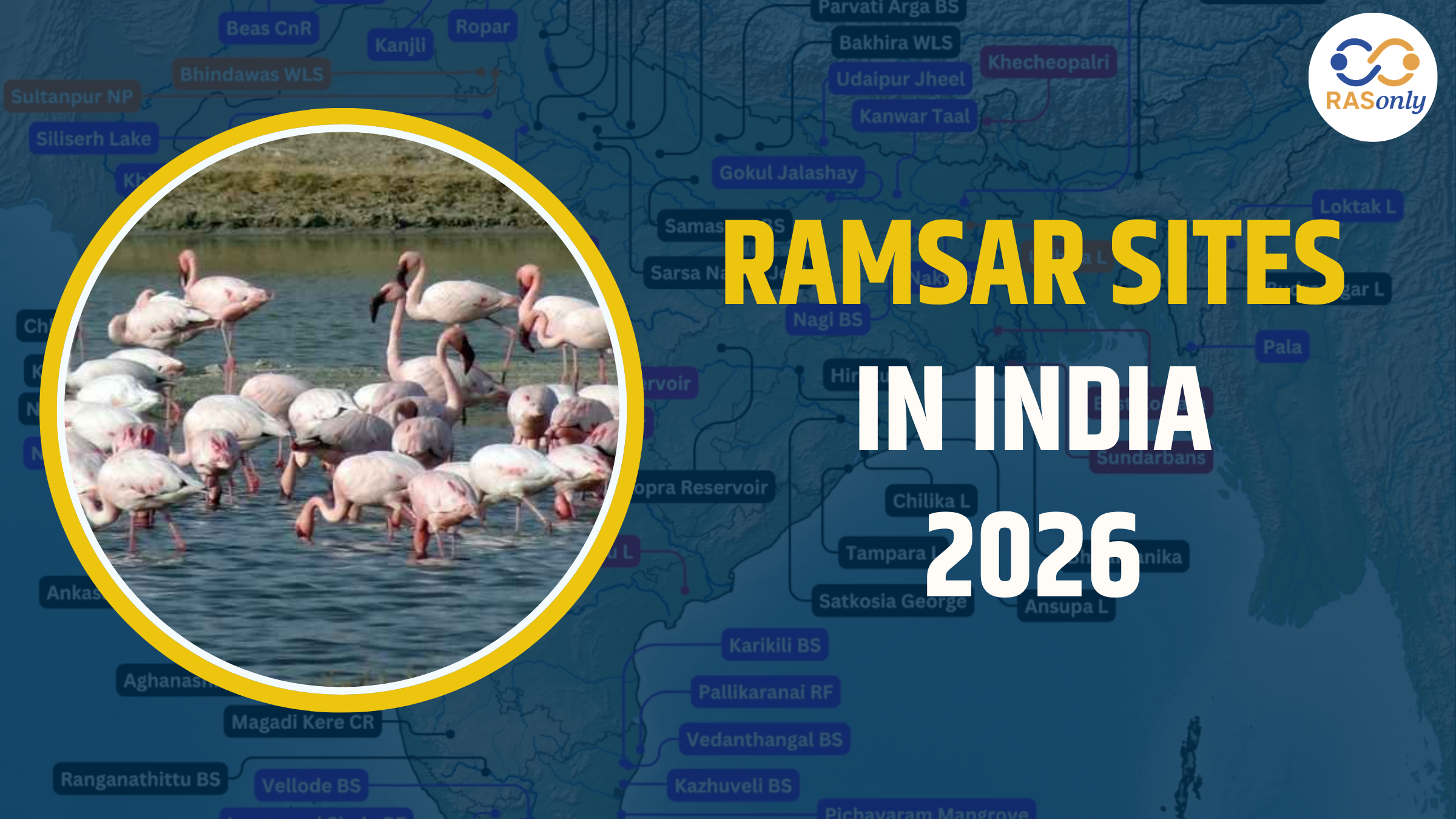
Ramsar Sites in India 2026 are wetlands of international importance designated under the Ramsar Convention on Wetlands (1971). These wetlands are vital in the ecological balance, the biodiversity conservation, and migration birds, as well as water security. India has been able to build a high number of Ramsar Sites in the recent years and hence it has become one of the most proactive countries in conserving wetlands worldwide. By the year 2026, there are 98 Ramsar Sites in India, an outcome of the country great concern on environmental protection, sustainable development and climate change mitigation.
The importance of Ramsar Sites in India goes beyond conservation, as these wetlands support millions of livelihoods through fisheries, agriculture, and eco-tourism. They also act as natural buffers against floods, help in groundwater recharge, and function as carbon sinks that reduce the impact of global warming. For competitive exams like RAS, UPSC, and State PCS, Ramsar Sites are a highly important topic, covering both static knowledge and current affairs. Understanding the state-wise distribution of Ramsar Sites in India, latest additions (2025–2026), largest and smallest wetlands, and key facts is essential for scoring well in exams.
What is Ramsar Convention?
The Ramsar Convention is an international treaty adopted in 1971 at Ramsar, Iran, with the primary objective of conserving wetlands and promoting their sustainable use.
The convention emphasizes maintaining the ecological character of wetlands and encourages countries to develop national policies for wetland conservation. It introduces the concept of “wise use”, which means using wetlands in a sustainable manner without degrading their ecosystem.
Key Features of Ramsar Convention
One of the most notable international environmental agreements is the Ramsar Convention on Wetlands which is put in place to conserve and use wetlands sustainably. It offers a well-organized scheme of global collaboration, domestic policy making, and scientific management of wetland ecosystems throughout the globe.
- Adopted: 2 February 1971
- Location: Ramsar, Iran
- Enforcement: 1975
- Nature: Legally binding treaty
- Total Countries: 170+
- Global Ramsar Sites: 2500+
- World Wetlands Day: 2 February
The convention is supported by organizations like IUCN, WWF, and Wetlands International, which provide scientific research, technical guidance, and policy support for effective wetland conservation worldwide.
Ramsar Sites in India: Key Highlights (2026)
Ramsar Sites in India 2026 represent the country’s growing commitment towards wetland conservation, biodiversity protection, and sustainable environmental management. India joined the Ramsar Convention in 1982 and has significantly expanded its network of protected wetlands, especially in the last decade.
- Total Ramsar Sites: 98
- First Sites: Chilika Lake & Keoladeo National Park (1981)
- Largest Site: Sundarban Wetland (West Bengal)
- Smallest Site: Renuka Lake (Himachal Pradesh)
- State with Highest Sites: Tamil Nadu (20)
- Total Area Covered: ~13.6 lakh hectares
India ranks among the top countries globally in terms of Ramsar Sites, particularly in South Asia, highlighting its leadership role in wetland conservation and environmental sustainability.
Latest Ramsar Sites in India (2025–2026)
India has been keen on conserving the important wetland ecosystems and this has seen the addition of new Ramsar Sites in the past years. This part is very crucial to the present day affairs, RAS, UPSC, and State PCS examinations.
- Patna Bird Sanctuary (Uttar Pradesh) – 2026
- Chhari-Dhand Wetland (Gujarat) – 2026
- Siliserh Lake (Rajasthan) – 2025
- Kopra Reservoir (Chhattisgarh) – 2025
- Gogabeel Lake (Bihar) – 2025
These new additions strengthen India’s wetland ecosystem protection, biodiversity conservation, climate change mitigation, and ecological resilience, making the Ramsar network more robust and comprehensive.
Complete List of Ramsar Sites in India (2026)
The following table provides the complete list of all 98 Ramsar Sites in India (2026) along with their respective states and year of designation. This is extremely important for RAS, UPSC, and other state exams.
Full Table: Ramsar Sites in India (2026)
| S.No | Ramsar Site | State | Year |
|---|---|---|---|
| 1 | Kolleru Lake | Andhra Pradesh | 2002 |
| 2 | Deepor Beel | Assam | 2002 |
| 3 | Kanwar Taal | Bihar | 2020 |
| 4 | Nanda Lake | Goa | 2022 |
| 5 | Thol Lake | Gujarat | 2021 |
| 6 | Wadhvana Wetland | Gujarat | 2021 |
| 7 | Khijadiya Bird Sanctuary | Gujarat | 2021 |
| 8 | Nalsarovar Bird Sanctuary | Gujarat | 2012 |
| 9 | Sultanpur National Park | Haryana | 2021 |
| 10 | Bhindawas Wildlife Sanctuary | Haryana | 2021 |
| 11 | Pong Dam Lake | Himachal Pradesh | 2002 |
| 12 | Chandra Taal | Himachal Pradesh | 2005 |
| 13 | Renuka Lake | Himachal Pradesh | 2005 |
| 14 | Ashtamudi Wetland | Kerala | 2002 |
| 15 | Loktak Lake | Manipur | 1990 |
| 16 | East Kolkata Wetlands | West Bengal | 2002 |
| 17 | Nandur Madhameshwar | Maharashtra | 2019 |
| 18 | Nangal Wildlife Sanctuary | Punjab | 2019 |
| 19 | Nawabganj Bird Sanctuary | Uttar Pradesh | 2019 |
| 20 | Parvati Arga Bird Sanctuary | Uttar Pradesh | 2019 |
| 21 | Point Calimere Sanctuary | Tamil Nadu | 2002 |
| 22 | Keshopur-Miani Reserve | Punjab | 2019 |
| 23 | Keoladeo National Park | Rajasthan | 1981 |
| 24 | Ropar Wetland | Punjab | 2002 |
| 25 | Rudrasagar Lake | Tripura | 2005 |
| 26 | Saman Bird Sanctuary | Uttar Pradesh | 2019 |
| 27 | Samaspur Bird Sanctuary | Uttar Pradesh | 2019 |
| 28 | Sambhar Lake | Rajasthan | 1990 |
| 29 | Sandi Bird Sanctuary | Uttar Pradesh | 2019 |
| 30 | Sarsai Nawar Jheel | Uttar Pradesh | 2019 |
| 97 | Patna Bird Sanctuary | Uttar Pradesh | 2026 |
| 98 | Chhari-Dhand Wetland | Gujarat | 2026 |
State-wise Ramsar Sites in India
Ramsar Sites distribution in India (2026) is uneven on a state-wise basis and it shows the ecological diversity, availability of wetlands and conservation efforts of the wetlands in various regions. The southern and northern states take the leading positions in the list as they have coastal ecosystems, river systems, floodplains, and man-made wetlands. This distribution is of great importance in RAS, UPSC and State PCS exam.
- Tamil Nadu – 20 sites
- Uttar Pradesh – 11 sites
- Punjab – 6 sites
- Odisha – 6 sites
- Gujarat – 5 sites
- Rajasthan – 5 sites
Tamil Nadu is the leading state in Ramsar Site conservation, with the highest number of wetlands in India. This is frequently asked in exams and is a key factual point.
Largest Ramsar Sites in India
India has the largest Ramsar Sites with a wide geographical range and is essential in ensuring the ecological balance, ensuring that the biodiversity is not affected and controlling the climate. These wetlands encompass mangroves, lagoons and big freshwater systems that are crucial in protecting the coasts and stability of the ecosystems.
- Sundarban Wetland (West Bengal)
- Vembanad-Kol Wetland (Kerala)
- Chilika Lake (Odisha)
- Satkosia Gorge (Odisha)
- Kolleru Lake (Andhra Pradesh)
These wetlands are extremely important for coastal protection, carbon sequestration, flood control, and marine biodiversity conservation, making them ecologically and economically significant.
Smallest Ramsar Sites in India
Although small in size, the smallest Ramsar Sites in India are ecologically very important. These wetlands act as micro-habitats and support specific species, especially migratory birds and aquatic organisms.
- Renuka Lake (Himachal Pradesh)
- Vembannur Wetland Complex (Tamil Nadu)
- Therthangal Bird Sanctuary (Tamil Nadu)
- Vedanthangal Bird Sanctuary (Tamil Nadu)
These sites serve as critical stopover and breeding grounds for migratory birds, especially along major flyways like the Central Asian Flyway.
Oldest Ramsar Sites in India
The oldest Ramsar Sites in India represent the beginning of India’s journey in wetland conservation and international environmental cooperation. These sites were the first to be recognized under the Ramsar Convention.
- Chilika Lake (Odisha) – 1981
- Keoladeo National Park (Rajasthan) – 1981
These are the first Ramsar Sites of India, and they are extremely important from an exam perspective as they are frequently asked in prelims.
Ramsar Sites in Montreux Record
The Montreux Record is a register of Ramsar Sites where ecological changes have occurred or are likely to occur due to human activities such as pollution, urbanization, or developmental projects. It highlights wetlands that require urgent conservation attention.
India currently has two Ramsar Sites in the Montreux Record:
- Keoladeo National Park (Rajasthan)
- Loktak Lake (Manipur)
These sites require priority conservation, monitoring, and restoration efforts, making them highly important for both environmental studies and competitive exams.
Importance of Ramsar Sites in India
The importance of Ramsar Sites in India extends beyond environmental conservation, as they play a crucial role in supporting human life, economic activities, and ecological sustainability.
Biodiversity Conservation
Wetlands provide habitat to a wide variety of species, including migratory birds, endangered animals, fish species, and aquatic plants, making them biodiversity hotspots.
Climate Change Control
Ramsar wetlands act as carbon sinks, helping to absorb carbon dioxide and regulate global temperatures, thereby mitigating climate change impacts.
Flood & Drought Management
Wetlands function as natural sponges, absorbing excess rainwater during floods and releasing it during dry periods, thus maintaining hydrological balance.
Livelihood Support
Millions of people depend on wetlands for fishing, agriculture, tourism, and other economic activities, making them vital for rural and local economies.
Water Purification
Wetlands naturally filter pollutants, sediments, and toxins, improving water quality and acting as natural water treatment systems.
Important Facts for RAS Exam
The following facts are extremely important for RAS, UPSC, and State PCS exams and should be revised regularly:
- Total Ramsar Sites in India (2026): 98
- First Ramsar Sites: Chilika Lake & Keoladeo National Park
- Largest Ramsar Site: Sundarban Wetland
- State with Highest Sites: Tamil Nadu
- Latest Additions: 2026 (2 sites)
- Ramsar Convention Year: 1971
These facts are highly probable for direct questions in prelims exams, so they should be memorized properly.
Conclusion
Ramsar Sites in India 2026 highlight the country’s strong commitment to wetland conservation, biodiversity protection, and sustainable development. With 98 designated wetlands, India has emerged as a global leader in preserving critical ecosystems that support both nature and human livelihoods. These sites play a vital role in climate regulation, water security, and ecological balance.
For students preparing for RAS, UPSC, and other competitive exams, Ramsar Sites remain a high-weightage topic combining static knowledge with current affairs. Understanding their distribution, key facts, and recent additions can significantly improve exam performance. Overall, Ramsar Sites are not just environmental assets but essential pillars of India’s ecological and economic sustainability.
FAQ
Ramsar Sites are wetlands of international importance recognised under the Ramsar Convention (1971). They are crucial for biodiversity conservation, water purification, flood control, and supporting livelihoods like fishing and agriculture.
As of 2026, India has 98 Ramsar Sites, reflecting its growing commitment to environmental conservation and sustainable ecosystem management.
Tamil Nadu leads with 20 Ramsar Sites, making it the top state in wetland conservation in India.
The largest is Sundarban Wetland (West Bengal), while the smallest is Renuka Lake (Himachal Pradesh).
Ramsar Sites are frequently asked in exams like UPSC, RAS, and State PCS because they combine static GK with current affairs, especially recent additions and key facts.

BEST SELLER
🏆 PRELIMS
RAS Pass
Prelims focused Hindi & English
₹399
✓
Prelims Topic-Wise Tests
✓
Subject-Wise Tests
✓
Full-Length Prelims Tests
✓
Daily Current Affairs Tests
✓
Prelims PYQs Tests
✓
Detailed Solutions & Analysis
✓
All Rajasthan Ranking
✓
Unlimited Reattempts
✓
Mains Tests
✓
Hindi & English Tests
✓
All Rajasthan Ranking
Trusted by 5,000+ Students

Post Category
- RAS Salary
- Result
- RAS Admit Card
- RAS Job
- RAS Cutoff
- Preparation Tips
- RAS Answer Key
- RAS Exam Analysis
- RAS Syllabus
- RAS Previous Year Papers
- RPSC RAS Exam Pattern
- RAS Interview
- RAS Exam Date
- RAS Vacancy
- RAS Test Series
- RAS Best Books
- RAS Preparation Resources
- RAS Coaching Centre
- History
- Polity
- Geography
- Economics
- Science
- Art and Culture
- RPSC RAS Application Form
- RPSC RAS Notification
- RAS Eligibility Criteria
- UPSC Exam
- RPSC RAS Mains
Visit Our RASonly Offline Center
Our Expert Faculty

Bhunesh Sir
Current Affairs · 13+ Yrs

Aamir Khan Sir
RAS-2017 · IIM Ahm.

Akash Sir
Polity · 8+ Yrs
Free Resources
Official Mobile App

RASOnly App
by OTSAdda · Free
Full Video Lectures
Mock Tests & PYQs
Daily Current Affairs
AI Mock Interview
Free Download · No subscription needed to install
RAS 2024 Toppers — RASonly
Rank 2
Virendra Charan
Rank 9
Bhoopinder Singh
Rank 26
Aanchal Nagpal
Rank 33
Lokendra Singh
Rank 45
Amar Rathore
Rank 46
Manasvini Verma

Join RASonly WhatsApp Community
Get daily current affairs, exam alerts, free study material and tips from expert faculty — right on WhatsApp.
Join for Free →RASonly Interview Guidance Program

Mr. Ashok Jain
Ex-Chief Secretary Govt of Rajasthan
- IAS officer of the 1981 batch, Rajasthan cadre.
- Passionate about mentoring the next generation of RAS officers with real-world insights.
- Got retired in Dec 2017 from the post of Chief Secretary of the state of Rajasthan.

Mr. Guru Charan Rai
Ex-ASP / SP in Jaisalmer
- Guru Charan Rai, IPS (Retd), retired as Inspector General of Police (Security), Rajasthan, Jaipur in 2017.
- Served as ASP and SP in Jaisalmer, Nagaur, Sri Ganganagar, Sawai Madhopur, Dausa, Sikar, and Karauli.
- He also held key positions as DIGP and IGP in the Law and Order division.

Mr. Rakesh Verma
Ex-IAS Officer, B.Tech, MBA, and M.A. (Economics)
- IAS officer of the 1981 batch and retired in Chief Secretary Rank.
- Civil servant of high repute and vast experience.
- Has been teaching UPSC CSE subjects for the last six years.



Daily Current Affairs for RAS Exam Preparation 2026
Rajasthan Ranks First in Mission Karmayogi
September 16, 2026
CAR-T Cell Therapy
September 16, 2026
Swami Vivekananda Government Model Schools Rajasthan
September 15, 2026