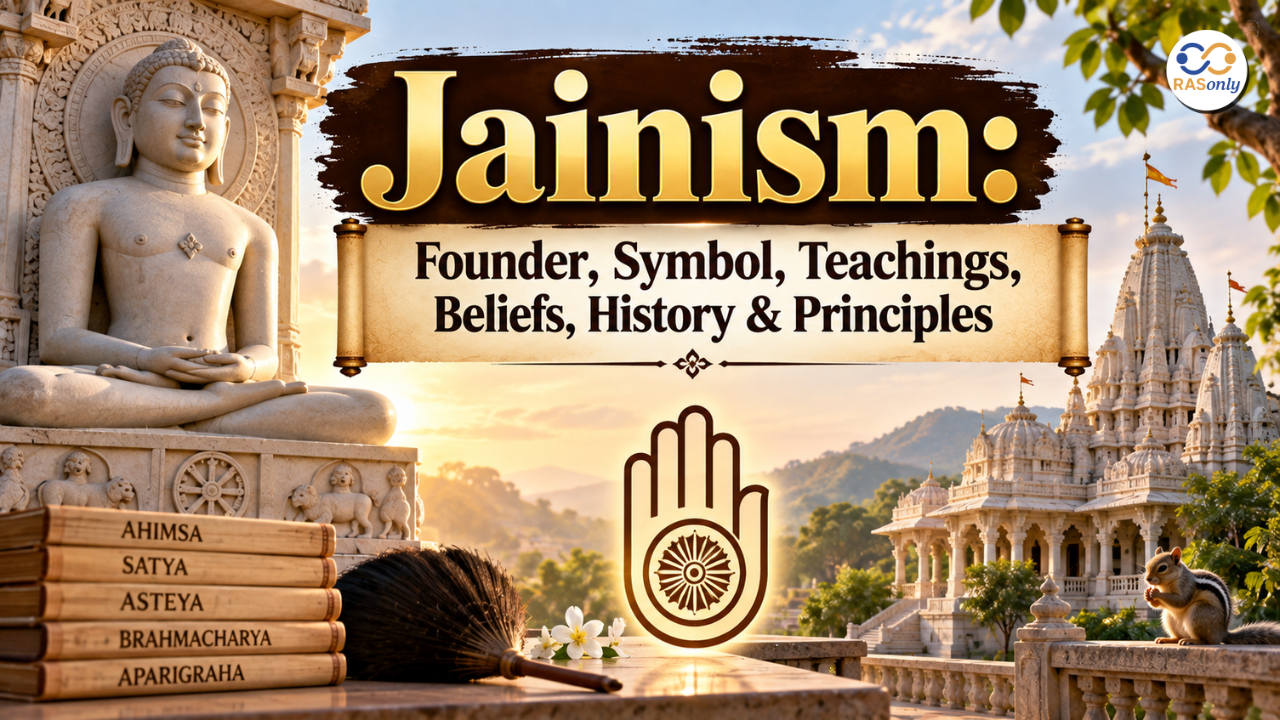
Jainism: Founder, Symbol, Teachings, Beliefs, History & Principles
RPSC RAS Mains Exam Syllabus 2026: Download Subject-wise Syllabus PDF

Get in Touch with RASonly!

The RPSC RAS Mains New Pattern 2026 introduces a more structured and transparent examination system with a clearly defined RAS exam new syllabus. Unit-wise topics, fixed word limits, and an administrative-oriented approach demand focused preparation. Understanding the RAS mains new syllabus and aligning study strategy with the RAS exam new pattern will help aspirants improve answer quality, time management, and overall scoring potential in the RAS Mains exam.


RPSC RAS Mains Syllabus 2026 will be very crucial to the candidates who are training to take the Rajasthan Administrative Services (RAS) examination under the RAS Mains New Pattern. The New Syllabus of the RAS Exam makes it easier to understand the nature of the new and more organized exam structure announced on 9 January 2026 to new aspirants.
According to the RAS Mains New Syllabus, the Mains examination is separated into several papers (General Studies (Paper I, II, III), General Hindi and General English (Paper IV)). It is a well-covered subject on Rajasthan-specific history, culture, economy and governance, the Indian polity, science and technology, ethics, law and current affairs. This moderation is what makes it regional but also national.
The RAS Exam New Pattern emphasizes more on the division of the syllabus into units, structured writing of the answers and clearly demarcated word limits and therefore the candidate has no choice but to prepare in a strategic and focused way. The candidates can also hear of the RAS Prelims New Syllabus along with the Mains syllabus because it is the entrance gateway to the Mains stage.
To be a good planner, candidates are advised to carefully read the RPSC RAS Notification 2026 as well as the detailed RAS Exam Syllabus 2026 released by the Rajasthan Public Service Commission. Study the RAS Mains subjects and match your studies with the new evaluation strategy. The RAS Syllabus 2026 PDF is also very user-friendly and provides essential information about each unit and topic included in the new scheme. For better performance, candidates can consult a well-designed RPSC RAS Mains Preparation Guide, which explains how to approach the RAS Mains new pattern, manage time, write answers within the word limit, and address each section with confidence. A thorough understanding of the RAS exam new syllabus and pattern will significantly improve accuracy, presentation, and overall scoring potential.
RPSC RAS Mains New Syllabus 2026: Overview
The RPSC RAS Mains Exam Syllabus 2026 is crucial for candidates who are aiming to crack one of the most competitive exams in Rajasthan. The Rajasthan Administrative Services (RAS) Mains Exam is designed to assess candidates' knowledge, analytical skills, and ability to address complex issues in administration, governance, and public services.
| Paper | Subject of Exam | Maximum Marks | Duration |
|---|---|---|---|
| I | General Studies – I | 200 | 3 Hours |
| II | General Studies – II | 200 | 3 Hours |
| III | General Studies – III | 200 | 3 Hours |
| IV | General Hindi & English | 200 |
3 Hours |
Download RPSC RAS Mains Exam Pattern 2026 PDF
RAS Mains Syllabus Changes (2024 → 2026)
| Paper / Unit / Part | Subject Area | Removed in 2026 (Present in 2024) | Included / Added in 2026 |
|---|---|---|---|
| Paper I Unit I – Part A |
History, Art, Culture & Heritage of Rajasthan | • Important dynasties (combined admin & revenue) • Freedom Movement (general wording) • Major World Heritage sites (generic) • Dialects of Rajasthan • Eminent personalities (separate) |
• Pre-historic culture & ancient sites • Political & cultural achievements (upto 18th century) • Separate revenue & administration systems • Revolt of 1857 & mass movements • Folk stories, lores & monuments • Tribes, traditions, folk deities • Term “Rajasthani language” |
| Paper I Unit I – Part B |
Indian History & Culture | • Modern Indian History (19th century–1965) | • British policies & impacts • Intellectual awakening • Post-Independent India • Science & technology development • Women empowerment & reform movements |
| Paper I Unit I – Part C |
Modern World History | • Coverage up to 1950 A.D. • Imperialism & colonialism (Asia & Africa) |
• Coverage up to 1991 A.D. • Russian Revolution • Nazism & Fascism • Cold War era |
| Paper I Unit II – Part A |
Indian Economy | • Inflation & demand–supply control • FRBM Act (explicit) • Subsidies & merit goods • Regulatory effectiveness • Employment-oriented growth |
• Growth & development indicators • HDI & development indices • Climate change & environment • Agriculture & food security • Service sector & foreign trade • RBI & monetary policy • Banking reforms & welfare schemes |
| Paper I Unit II – Part B |
World Economy | • Sustainable development (standalone) | • WTO, World Bank & IMF • Sustainability integrated with global issues |
| Paper I Unit II – Part C |
Economy of Rajasthan | • Khadi & village industries • PPP projects (old phrasing) • Major state projects • Social justice & basic services |
• SDP & Per Capita Income • Inclusive & green growth • Viksit Rajasthan 2047 • SDG performance • Investment policy • Digital governance & welfare schemes |
| Paper I Unit III – Part A |
Sociology | • Sanskritization & Westernization • Child marriage & communalism • Explicit tribe list |
• Karma, Dharma & Ashram system • Urbanisation & modernisation • Cyber crime & social media impact • Prostitution as social issue • Focus on women & marginalised groups |
| Paper I Unit III – Part B |
Management | • Supply chain & e-commerce • Corporate ethics & finance topics • Entrepreneurship & essential services |
• General Management • Organisational Behaviour • Marketing & HR Management • Strategic Management |
| Paper I Unit III – Part C |
Accounting & Auditing | • Double entry system • Zero-base budgeting |
• GAAP & accounting standards • Financial statements • Computerised accounting • GST & audit programme |
| Paper II Unit I |
Administrative Ethics | • Behaviour & moral attitudes (old phrasing) | • Impartiality & non-partisanship • Transparency & media role • AI vs conscience • Value rationality • Non-factual case studies |
| Paper II Unit II |
General Science & Technology | • States of matter • Human eye • MRI/NMR • Missiles (generic) |
• Green chemistry & fuels • Physics fundamentals & radiation safety • Biotechnology & genetics • ICT, blockchain, VR/AR • Cyber security & defence technology |
| Paper II Unit III |
Earth Science | • Geopolitical issues • Energy resources (Rajasthan) • Wildlife conservation (detailed) |
• Climate elements • Natural resources of India • Rajasthan soils & tourism |
| Paper III Unit I |
Polity & International Affairs | • Old UN-centric world order • NAM, SAARC, G-77 |
• Constitutional morality • E-courts & AI governance • Security forces • New groupings (QUAD, AUKUS etc.) • Climate diplomacy & current affairs |
| Paper III Unit II |
Public Administration | • Corporate governance • Change management • Old Rajasthan Acts |
• Administrative theories • Union institutions • Personnel administration • Comparative & state administration |
| Paper III Unit III |
Behaviour, Law, Sports & Yoga | • Separate sports/yoga section • Child labour laws |
• Workplace behaviour & burnout • Major social laws • Bharatiya Nyay & Nagrik Suraksha Sanhita 2023 |
| Paper IV | General Hindi & General English | • Old marks scheme • English grammar topics • Hindi grammar topics |
• Hindi (90) + English (70) • Essay (40 marks) • English comprehension & precis • Official writing formats |
RPSC RAS Mains Syllabus 2026
General Knowledge & General Studies Paper – I
| Unit I – History |
|
Part A – History, Art, Culture, Literature, Tradition, and Heritage of Rajasthan
Part B – Indian History & Culture
Part C – History of Modern World (Up to 1950 A.D.)
|
| Unit II – Economics |
|
Part A – Indian Economy
Part B – World Economy
Part C – Rajasthan Economy
|
PAPER – II
General Knowledge and General Studies
Unit I – Administrative Ethics
- Ethics and human values; role of family, society and education.
- Ethical concepts; Karmavada; duty; good and virtue.
- Ethics in public and private relationships; integrity, impartiality, non-partisanship; transparency, media and bureaucracy.
- Ethics of Bhagavad Gita.
- Gandhian ethics.
- Moral thinkers and philosophers of India and world.
- Ethical dilemmas in administration; AI versus conscience.
- Ethical decision-making; social justice; accountability; value vs instrumental rationality.
- Non-factual case studies.
Unit II – General Science & Technology (Short Notes)
Chemistry in Everyday Life:
Atomic structure; metals, non-metals and metalloids; metallurgy; ores and alloys; acids, bases and salts; pH and buffers; drugs (synthetic and natural); antioxidants and preservatives; agro-chemicals; carbon compounds and their uses; fuels and octane rating; radioactivity; green chemistry.
Physics in Everyday Life:
Motion, work, power and energy; gravitation; light and heat; electricity; magnetism and electromagnetism; sound and electromagnetic waves; medical applications of physics; nuclear fission and fusion; radiation safety.
Biology & Life Sciences:
Cell and plant parts; plant nutrition; reproduction in plants; human physiology; nutrition, immunity and diseases; public health; microbes and fermentation; biotechnology; GMOs and ELSI issues; vaccines, CRISPR, mRNA technology and artificial organs.
Computer Science & ICT:
Networking; analog and digital communication; frequency spectrum; mobile telephony; AI, machine learning, big data, cloud and edge computing, IoT, blockchain, digital currency, VR and AR; OTT platforms and social media.
Indian Science & Technology:
Contributions of Indian scientists; major institutions; robotics, nanotechnology and quantum computing; development of science and technology in India and Rajasthan; government policies; Digital India; cyber security and data privacy.
Space & Defence Technology:
Indian space programme; satellites and launch vehicles; remote sensing; defence research; missile programme; drone technology; chemical and biological weapons.
Unit III – Earth Science (Geography & Geology)
Part A – World
- Interior of the earth and geological time scale.
- Mountains, plateaus, plains and deserts.
- Earthquakes and volcanoes.
- Climate and atmospheric circulation.
- Major environmental issues.
Part B – India
- Physiography of India.
- Drainage pattern and rivers.
- Monsoon and climatic regions.
- Natural resources.
- Population characteristics.
Part C – Rajasthan
- Physiography.
- Rivers and lakes.
- Climate.
- Natural vegetation and wildlife.
- Soils and agriculture.
- Mineral resources.
- Demography and tribes.
- UNESCO Geo-parks and geo-heritage sites.
- Tourism.
Paper III: General Knowledge and General Studies
Unit I – Indian Polity, Governance, India & International Affairs
Constitution & Governance
- Constitution of India: origin, features, principles, amendments and basic structure doctrine.
- Fundamental rights, directive principles and duties.
- Recent constitutional developments, judicial pronouncements, constitutional morality and transformative constitutionalism.
Institutions & Federalism
- President, Vice-President, Prime Minister, Council of Ministers and Parliament.
- Federalism and Centre–State relations.
- Supreme Court and High Courts: judicial review, judicial activism, virtual courts, e-courts.
Dynamics of Indian Polity
- Party system, coalition politics and regionalism.
- Shift from identity-based to issue-based politics; gender participation.
- Electoral reforms, voting behaviour and election process.
- Internal security: threats, forces, agencies, roles and challenges.
Rajasthan Polity & Governance
- Political participation, leadership and electoral behaviour.
- Political parties and coalition politics in Rajasthan.
- Panchayati Raj and urban local self-government: structure and challenges.
- Public policy making in Rajasthan and implementation issues.
- E-governance initiatives: achievements and challenges.
India & International Affairs
- Post-Cold War world order: US hegemony, multipolarity, global political economy, terrorism.
- Indian foreign policy: determinants, relations with major powers and neighbours, diaspora and cultural diplomacy.
- India in global forums: UN, WTO, EU, ASEAN, BRICS, G-20, QUAD, I2U2, AUKUS, DAKSHIN.
- Climate and green diplomacy: COP summits, ISA, Mission LiFE.
- Recent strategic initiatives in foreign policy.
Current Affairs & Issues
- Major national and international events and personalities.
- Welfare schemes and government initiatives of Rajasthan.
- Awards, literature, science, technology and ICT developments.
- Sports policies, institutions and achievements of India and Rajasthan.
- Role of yoga in health, wellness and stress management.
Unit II – Concepts, Issues and Dynamics of Public Administration (Short Notes)
Public Administration: Theories & Principles
- Meaning, nature, scope and significance of public administration.
- Evolution of public administration; role in developed and developing societies.
- New Public Administration, New Public Management, Good Governance and New Public Service.
- Administrative theories: Scientific management, human relations, behavioural, structural-functional and ecological approaches.
- Principles of organisation: hierarchy, unity of command, span of control, delegation, centralisation and decentralisation, coordination, authority, responsibility and accountability.
- Administrative behaviour: leadership, communication and morale.
Union Government & Administrative Institutions
- UPSC, Election Commission, Finance Commission, C&AG, Lokpal, NITI Aayog.
- Personnel administration: recruitment, training, promotion, neutrality and anonymity; code of conduct.
- Issues in administration: Centre–State relations, minister–civil servant relations, generalists vs specialists, administrative reforms and social audit.
- Control over administration: legislative, executive and judicial control.
Comparative Public Administration
- Administrative systems of USA, UK, France and China – key features.
State & District Administration
- Governor, Chief Minister, Council of Ministers, State Secretariat, Chief Secretary, Directorates.
- Police administration, revenue board, State Election Commission, State Human Rights Commission, Lokayukta.
- District administration: District Collector; law and order, revenue and development administration.
Unit III – Behaviour and Law (Short Notes)
Part A – Behaviour
- Intelligence: cognitive, social and emotional intelligence.
- Cultural, appreciative, ethical and spiritual intelligence.
- Leadership: theories, styles, challenges and effectiveness at workplace.
- Communication: models, barriers, electronic communication and cyber security.
- Work behaviour: ethics and values; RAISEC model; person–fit.
- Stress and coping: occupational stress, burnout, stress management and gender issues.
Part B – Law
Contemporary Legal Issues
- Right to Information Act, 2005.
- Information Technology Act, 2000: cyber crimes, digital signatures, electronic records.
- Intellectual Property Rights: concept, types and purpose.
Crimes against Women and Children
- Domestic Violence Act, 2005.
- Sexual Harassment at Workplace Act, 2013.
- POCSO Act, 2012.
- Maintenance and Welfare of Parents and Senior Citizens Act, 2007.
Important Land Laws in Rajasthan
- Rajasthan Tenancy Act, 1955.
- Rajasthan Land Revenue Act, 1956.
- Rajasthan Panchayati Raj Act, 1994.
- Bharatiya Nyaya Sanhita, 2023.
- Bharatiya Nagarik Suraksha Sanhita, 2023.
Criminal Procedure (Basic Knowledge)
- Cognizable and non-cognizable offences; bailable and non-bailable offences.
- FIR, arrest, search, seizure, summons, warrants and charge-sheet.
- Jurisdiction of police, magistrate and courts.
Paper – IV: General Hindi and General English
Unit – I : सामान्य हिन्दी
सामान्य हिन्दी: कुल अंक 90, इस प्रश्न पत्र का उद्देश्य अभ्यर्थी की भाषा-विषयक क्षमता तथा उसके विचारों की सही, स्पष्ट एवं प्रभावपूर्ण अभिव्यक्ति की परीक्षा करना है।
भाग – अ (अंक 30)
- उपसर्ग एवं प्रत्यय – शब्दों में से उपसर्ग एवं प्रत्यय पृथक करना
- पर्यायवाची शब्द का वाक्यों में प्रयोग द्वारा अर्थ स्पष्ट करना
- शब्द शुद्धि
- वाक्य शुद्धि
- मुहावरे – मुहावरों का प्रयोग से अर्थ स्पष्ट करना
- कहावत / लोकोक्ति प्रयोग से अर्थ स्पष्ट करना
- पारिभाषिक शब्दावली – प्रशासन से संबंधित अंग्रेज़ी शब्दों के समानार्थी हिन्दी पारिभाषिक शब्द
भाग – ब (अंक 30)
- संक्षेपण – गद्यावतरण का लगभग एक-तिहाई शब्दों में संक्षेपण
- (शब्द सीमा – लगभग 150 शब्द)
- पल्लवन – किसी सूक्ति, काव्य पंक्ति, प्रसिद्ध कथन आदि का भाव विस्तार
- (शब्द सीमा – लगभग 100 शब्द)
- अनुवाद – दिए हुए अंग्रेज़ी अनुच्छेद का हिन्दी में अनुवाद
- (शब्द सीमा – लगभग 50 शब्द)
भाग – स (अंक 30)
- पत्र-लेखन – सामान्य कार्यालयी पत्र, कार्यालय आदेश, अर्द्धशासकीय पत्र, अनुस्मारक, प्रतिवेदन (रिपोर्ट)
- प्रारूप-लेखन – अधिसूचना, निविदा सूचना, परिपत्र, प्रेस विज्ञप्ति, कार्यालय ज्ञापन
Unit – II : General English (Total Marks 70)
Part A – Grammar & Usage (20 Marks)
- Preposition
- The same word used as different parts of speech
- Phrasal verbs and idioms (application)
- One-word substitution (application)
- Words often confused or misused (application)
Part B – Comprehension, Translation & Precis Writing (30 Marks)
- Comprehension of an unseen passage (approximately 300 words)
- Five questions based on the passage and precis writing of the same passage (approximately 100 words)
- Translation of five sentences from Hindi to English
Part C – Composition & Letter Writing (20 Marks)
- Elaboration of a given theme (any one out of three, approximately 150 words)
- Writing: Official letter / Demi-official / Official memorandum / Report writing (approximately 150 words)
Unit – III : Essay (Total Marks 40)
- There will be six thematic areas in the essay part of the question paper.
- Candidates have to write one essay of about 600 words in either Hindi or English, as per their choice.
- The essay topics will be based on the following themes:
- Language, Literature and Cultural Heritage
- Society, Governance and Public Affairs
- Science, Technology, Environment and Sustainable Development
- Economy, Agriculture, Industry and Commerce
- Current Affairs, Disasters and National Development Initiatives
- Tourism, Culture and Contemporary Issues with reference to Rajasthan
RAS Mains Exam Pattern Overview 2026
The RPSC RAS Mains Exam Pattern 2026 has undergone some key changes. Understanding the structure of the exam will help candidates prepare efficiently. Here's a breakdown of the exam pattern:
- General Studies Paper I (200 Marks) The first paper covers topics related to Indian History, Cultural Heritage, Polity, Economy, and Geography. The questions will test your knowledge about the socio-economic and political structure of India, especially in Rajasthan.
- General Studies Paper II (200 Marks) This paper focuses on Indian Economy, Science and Technology, Ecology, Environment, and Current Affairs. Candidates will need to demonstrate a thorough understanding of national and global issues that affect India and the world.
- General Studies Paper III (200 Marks) Paper III is focused on General Science, Technology, and Rajasthan-specific issues, including geography, climate, and other environmental concerns. It will test a candidate’s ability to analyze and apply knowledge to real-world situations.
- General Hindi and General English Paper (200 Marks) Candidates must be proficient in both Hindi and English, as this paper will assess their language skills. It includes grammar, composition, and translation exercises, with the aim to evaluate clarity and communication in these two languages.
Each paper is allotted 3 hours, and candidates need to secure minimum marks to qualify for the RAS Interview. The total marks for the RAS Mains Exam is 800, with individual papers contributing 200 marks each.
Key Changes in the RAS Mains Exam Syllabus 2026
The RAS Mains Exam Syllabus 2026 has been revised to improve clarity, structure, and alignment with contemporary administrative requirements. While the core subjects remain unchanged, the new syllabus places stronger emphasis on structured preparation, analytical thinking, and answer presentation.
Clear Unit-Wise Structure
One of the most important changes in 2026 is the officially defined unit-wise syllabus for each paper. Topics are now clearly divided into Unit I, II, and III, helping candidates understand scope, boundaries, and weightage more precisely.
Defined Answer Format and Word Limits
The 2026 syllabus is closely linked with the revised exam pattern, which specifies:
- Short-answer and long-answer questions
- Clear word limits (for example, around 50 and 150 words)
This change encourages concise, structured, and focused answers, rather than lengthy descriptive writing.
Stronger Administrative and Ethics Orientation
There is a noticeable increase in focus on:
- Administrative ethics and ethical decision-making
- Governance, public policy, and implementation issues
- Behavioural aspects relevant to civil services
This reflects a shift toward testing real-world administrative aptitude, not just theoretical knowledge.
Updated Science, Technology, and Current Issues
Science and technology topics now include emerging areas such as AI, biotechnology, cyber security, space and defence technology. Current affairs are more closely linked with governance, economy, environment, and Rajasthan-specific initiatives.
Rajasthan-Centric Focus Retained
The syllabus continues to give special importance to:
- Rajasthan history, culture, economy, geography, and polity
- State government schemes, welfare programs, and governance challenges
This ensures strong regional relevance remains central to the exam.
No Change in Number of Papers or Marks
- Despite syllabus refinements:
- The number of papers remains four
- Each paper still carries 200 marks
- Total Mains marks remain 800
Conclusion
The RPSC RAS Mains New Pattern 2026 brings greater clarity, structure, and administrative relevance to the examination. With a clearly defined RAS exam new syllabus, unit-wise coverage, and fixed word limits, aspirants must shift towards analytical and disciplined answer writing. Aligning preparation with the RAS mains new syllabus and RAS exam new pattern will significantly enhance performance, accuracy, and scoring potential in the Mains stage.
FAQ
The RAS mains new pattern introduces unit-wise question distribution, defined short and long answers, and clear word limits for better evaluation transparency.
No, the RAS exam new syllabus retains core subjects but reorganizes them with clearer structure and stronger administrative focus.
There are four compulsory papers: General Studies I, II, III, and General Hindi & English under the RAS mains new syllabus.
Knowing the RAS exam new pattern helps candidates plan time, practice structured answers, and write within prescribed word limits.
Yes. Since Mains marks form the core of the merit list, mastering the RAS mains new pattern is crucial for final selection.
BEST SELLER
🏆 PRELIMS
RAS Pass
Prelims focused Hindi & English
₹399
✓
Prelims Topic-Wise Tests
✓
Subject-Wise Tests
✓
Full-Length Prelims Tests
✓
Daily Current Affairs Tests
✓
Prelims PYQs Tests
✓
Detailed Solutions & Analysis
✓
All Rajasthan Ranking
✓
Unlimited Reattempts
✓
Mains Tests
✓
Hindi & English Tests
✓
All Rajasthan Ranking
Trusted by 5,000+ Students
Post Category
- RAS Salary
- Result
- RAS Admit Card
- RAS Job
- RAS Cutoff
- Preparation Tips
- RAS Answer Key
- RAS Exam Analysis
- RAS Syllabus
- RAS Previous Year Papers
- RPSC RAS Exam Pattern
- RAS Interview
- RAS Exam Date
- RAS Vacancy
- RAS Test Series
- RAS Best Books
- RAS Preparation Resources
- RAS Coaching Centre
- History
- Polity
- Geography
- Economics
- Science
- Art and Culture
- RPSC RAS Application Form
- RPSC RAS Notification
- RAS Eligibility Criteria
- UPSC Exam
- RPSC RAS Mains
Visit Our RASonly Offline Center
Our Expert Faculty

Bhunesh Sir
Current Affairs · 13+ Yrs

Aamir Khan Sir
RAS-2017 · IIM Ahm.

Akash Sir
Polity · 8+ Yrs
Free Resources
Official Mobile App

RASOnly App
by OTSAdda · Free
Full Video Lectures
Mock Tests & PYQs
Daily Current Affairs
AI Mock Interview
Free Download · No subscription needed to install
RAS 2024 Toppers — RASonly
Rank 2
Virendra Charan
Rank 9
Bhoopinder Singh
Rank 26
Aanchal Nagpal
Rank 33
Lokendra Singh
Rank 45
Amar Rathore
Rank 46
Manasvini Verma

Join RASonly WhatsApp Community
Get daily current affairs, exam alerts, free study material and tips from expert faculty — right on WhatsApp.
Join for Free →RASonly Interview Guidance Program

Mr. Ashok Jain
Ex-Chief Secretary Govt of Rajasthan
- IAS officer of the 1981 batch, Rajasthan cadre.
- Passionate about mentoring the next generation of RAS officers with real-world insights.
- Got retired in Dec 2017 from the post of Chief Secretary of the state of Rajasthan.

Mr. Guru Charan Rai
Ex-ASP / SP in Jaisalmer
- Guru Charan Rai, IPS (Retd), retired as Inspector General of Police (Security), Rajasthan, Jaipur in 2017.
- Served as ASP and SP in Jaisalmer, Nagaur, Sri Ganganagar, Sawai Madhopur, Dausa, Sikar, and Karauli.
- He also held key positions as DIGP and IGP in the Law and Order division.

Mr. Rakesh Verma
Ex-IAS Officer, B.Tech, MBA, and M.A. (Economics)
- IAS officer of the 1981 batch and retired in Chief Secretary Rank.
- Civil servant of high repute and vast experience.
- Has been teaching UPSC CSE subjects for the last six years.


Daily Current Affairs for RAS Exam Preparation 2026

Women’s Cricket Team Wins Gold Medal
September 23, 2026
9th India International Water Week 2026
September 23, 2026
United Nations General Assembly
September 22, 2026