Chola Dynasty: Capital, Founder, Kings, Time Period and History
Sources of Rajasthan History – Archaeological, Literary and Epigraphic Sources for RAS Exam

Get in Touch with RASonly!

The Sources of Rajasthan History include archaeological evidence, inscriptions, coins, monuments, and literary works that help historians understand the political and cultural development of Rajasthan. These sources provide important information about ancient civilizations, Rajput dynasties, and historical traditions of the region. Understanding these sources is essential for RAS Exam preparation and Rajasthan history studies.

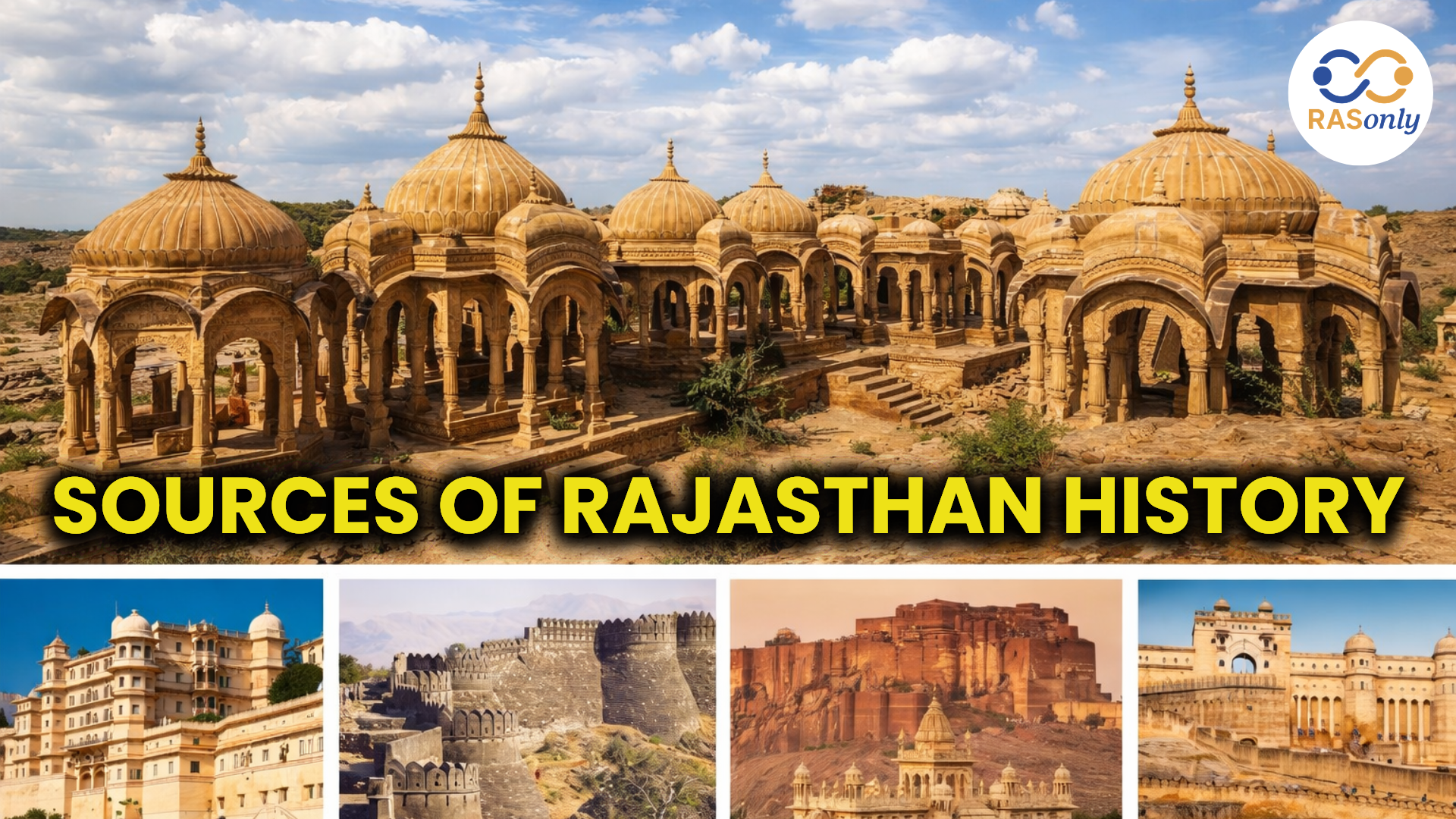
The Sources of Rajasthan History are the primary materials that help historians understand the political, social, economic, and cultural development of Rajasthan from ancient times to the modern period. These sources include archaeological evidence, inscriptions, coins, monuments, literary texts, and historical records, which provide valuable information about early civilizations, Rajput dynasties, administrative systems, and cultural traditions of the region. By studying these historical sources of Rajasthan, historians are able to reconstruct the past and trace the evolution of Rajasthan’s rich heritage.
Aspirants who are preparing to give RAS Exam 2026, RPSC examinations, and Rajasthan GK, it is very necessary to understand the Sources of Rajasthan History. Archaeological, epigraphic, literary, and valuable inscriptions of Rajasthan are the most commonly projected questions in competitive exams. As such, a clear understanding of the key sources of the Rajasthan history, such as archaeological finds, historical writings, and inscriptions, assists the candidates in reinforcing their study of the Rajasthan history in the RAS syllabus.
Classification of Sources of Rajasthan History
The Sources of Rajasthan History are generally categorized into two main types, depending upon the nature of historical evidence applied in studying the past. This classification assists historians and researchers in arranging various materials that give knowledge on the political, social, economic, and cultural aspects of Rajasthan.
Main Categories of Sources of Rajasthan History
- Archaeological Sources
- Literary Sources
Both of these sources help historians understand the historical development of Rajasthan from ancient times to the modern period.
1. Archaeological Sources of Rajasthan History
Archaeological sources have been regarded as the best sources to examine the early history of Rajasthan. These are inscriptions, coins, monumental, archaeological excavations, pottery, sculptures, and prehistoric rock paintings.
These sources provide information about:
- Ancient settlements
- Political history
- Economic activities
- Religious traditions
- Cultural development
Major Archaeological Sources
1. Inscriptions (Epigraphic Sources)
Inscriptions are carved texts that are written on stone pillars, wall of temples, copper plates, or monuments. They are very informative regarding rulers, dynasties, battles, donations, and administration systems.
Important inscriptions of Rajasthan include:
|
|
|
|
|
|
|
|
|
|
|
|
|
|
|
|
|
|
|
|
|
|
|
|
|
|
|
|
|
|
|
|
|
|
|
|
|
|
|
|
|
|
|
|
|
|
|
|
|
|
|
|
|
|
|
These inscriptions help historians reconstruct the political and cultural history of Rajasthan.
2. Coins (Numismatic Sources)
Another significant numismatic source of Rajasthan history is coins, which give good information regarding the political and economic situation of various historical eras. Coinage study enables historians to learn about the trade activities, economy, and the ruling dynasties that were present in Rajasthan.
Coins provide valuable information about:
- Economic systems
- Trade relations
- Political authority
- Religious symbols
Coins issued by dynasties such as Gurjara-Pratiharas, Chauhans, Mughals, and Rajput rulers help historians understand the economic and political conditions of Rajasthan.
3. Archaeological Excavations
The archaeological digs form a significant part of the Rajasthan history since they provide tangible records of the past settlements, cultures, and civilizations. Such excavations assist the historical thinkers in comprehending the life of early man, agriculture, the system of trade, and the advancement of technology in various parts of Rajasthan.
Excavations at several sites in Rajasthan have revealed important evidence of ancient civilizations.
Important archaeological sites include:
|
|
|
|
|
|
|
|
|
|
|
|
|
|
|
|
|
|
|
|
|
|
|
|
These excavations reveal information about ancient agriculture, trade, technology, and settlement patterns in Rajasthan.
4. Monuments and Architecture
The historical monuments, architectural buildings, also form valuable sources of Rajasthan history since they indicate the artistic, cultural, and political accomplishments of the various historical eras. These monuments offer good clues concerning the construction of the fort, structures of the temples, religious beliefs, and dominant forces of the ruling dynasties.
Historical monuments are also important sources of Rajasthan history. They reflect the art, architecture, and cultural traditions of different periods.
Important monuments include:
- Chittorgarh Fort
- Kumbhalgarh Fort
- Ranthambore Fort
- Jaisalmer Fort
- Dilwara Jain Temples
- Kirti Stambh and Vijay Stambh
These monuments help historians understand the architectural styles and political history of Rajasthan.
5. Painted Rock Shelters
Another source of the prehistoric history of Rajasthan that gives evidence about the lifestyle and culture of the ancient human communities is the painted rock shelters. These rock paintings illustrate hunting scenes, daily activities, animals, and religious signs, which assist historians in analyzing the prehistoric era in Rajasthan.
Prehistoric rock paintings found in Rajasthan provide evidence of early human life and culture.
Important rock painting sites include:
- Daidkar (Alwar)
- Viratnagar (Jaipur)
- Sohanpura (Sikar)
- Chhaja River area (Bundi)
- Chambal River region (Kota)
These paintings depict:
- Hunting scenes
- Human figures
- Animals
- Religious symbols
They provide valuable insights into prehistoric life in Rajasthan.
2. Literary Sources of Rajasthan History
Another significant source of Rajasthan history is literary sources comprising historical writings, chronicles, poems, and religious texts. These sources present valuable information concerning the political processes, social order, cultural practices, and performances of various rulers and dynasties.
Literary sources include historical texts, chronicles, poems, religious literature, and genealogical records. These sources provide information about political events, social structure, and cultural traditions.
Literary sources of Rajasthan history can be divided into several categories.
Sanskrit Literature
One great literary source of Rajasthan history is Sanskrit literature, since most of the literature regarding the Rajput rulers and states was composed in Sanskrit. Through these works, one gets to be informed about wars, administrative frameworks, and accomplishments of leaders.
Several historical texts written in Sanskrit provide information about Rajasthan.
Examples include:
- Prithviraj Vijay
- Hammira Mahakavya
- Rajvallabh
These texts describe the history of Rajput rulers and their achievements.
Persian and Urdu Sources
The historical works in Persian and Urdu took on significance in the medieval era, particularly in the time of the Delhi Sultanate and the Mughal reign. These sources give a lot of data on the Mughal administration, the Rajput kingdoms, and the political relations between the Rajput and the Mughal rulers.
During the medieval period, many Persian historians documented events related to Rajasthan.
Important works include:
- Akbarnama – Abul Fazl
- Ain-i-Akbari
- Tarikh-i-Firishta
These texts provide information about Mughal-Rajput relations and administrative systems.
Rajasthani Literature
Rajasthani literature is one of the most valuable sources of Rajasthan history, especially for understanding the history of Rajput rulers and local traditions. This literature includes Khyats (chronicles), Vanshavalis (genealogies), and heroic poetry describing the bravery and achievements of Rajput warriors.
Rajasthani historical literature includes Khyats, Vanshavalis, and heroic poetry.
Important works include:
- Nainsi Ri Khyat – Muhnot Nainsi
- Prithviraj Raso – Chand Bardai
- Kanhadade Prabandh – Padmanabha
- Hammir Raso
These texts provide detailed descriptions of Rajput rulers, wars, and social traditions.
Jain Literature
Jain scholars also contributed significantly to the literary sources of Rajasthan history by writing important historical and religious texts. These works provide information about religious traditions, cultural developments, and historical events in Rajasthan.
Jain scholars also wrote many important historical texts related to Rajasthan.
Examples include:
- Prabandha Chintamani
- Vividha Tirtha Kalpa
These works provide information about religious and cultural developments in Rajasthan.
Importance of Historical Time Systems
The concept of historical time is valuable when examining the sources of Rajasthan history since most of the inscriptions and historical sources refer to the dates by other calendars. These systems can be used by historians to establish the precise chronology of historical events.
While studying sources of Rajasthan history, historians use different time systems to determine historical chronology.
BC (Before Christ)
BC refers to the years before the birth of Jesus Christ. Time moves backward in BC chronology.
Example:
1000 BC means 1000 years before the birth of Christ.
AD (Anno Domini)
AD refers to the years after the birth of Christ. It is the standard calendar used worldwide today.
Example:
2026 AD means 2026 years after the birth of Christ.
Vikram Samvat (VS)
Vikram Samvat is an ancient Indian calendar that began in 57 BC after the victory of King Vikramaditya.
Key facts:
- Widely used in India and Nepal
- Used for religious and cultural purposes
- Runs 57 years ahead of the Gregorian calendar
Example:
2026 AD = 2083 Vikram Samvat
Importance of Sources of Rajasthan History for RAS Exam
The Sources of Rajasthan History are extremely important for candidates preparing for the RAS Exam, RPSC exams, and Rajasthan GK. Many questions in competitive exams are directly asked from archaeological sources, inscriptions, literary works, and historical monuments of Rajasthan.
Important areas for exam preparation include:
- Major inscriptions of Rajasthan
- Archaeological sites like Kalibangan and Ahar
- Literary works such as Prithviraj Raso and Nainsi Ri Khyat
- Painted rock shelters and prehistoric evidence
- Historical monuments and architecture
Understanding these sources helps candidates analyze the political, cultural, and social development of Rajasthan throughout history.
Conclusion
The Sources of Rajasthan History assists historians to comprehend the political, social, and cultural growth of the region in both the past and the modern times. These sources predominantly consist of archaeological findings like inscriptions and coins, monuments and excavations, as well as literary sources such as historical texts and chronicles.
Candidates who are going to take RAS Exam 2026 and the RPSC exams should read about the notable sources of Rajasthan history since a significant number of questions are posed in relation to such issues as significant inscriptions, archaeological sites, and literary works of Rajasthan.
Frequently Asked Questions (FAQs)
The main sources of Rajasthan history include archaeological sources such as inscriptions, coins, monuments, and excavations, and literary sources like historical texts and chronicles.
Archaeological sources include physical evidence such as inscriptions, coins, monuments, rock paintings, and archaeological excavations.
Important archaeological sites include Kalibangan, Ahar, Gilund, Bagor, and Ganeshwar.
Literary sources include historical texts such as Prithviraj Raso, Nainsi Ri Khyat, Kanhadade Prabandh, and Persian works like Akbarnama.
The Sources of Rajasthan History are important for the RAS exam because questions are frequently asked about inscriptions, archaeological discoveries, and historical texts of Rajasthan.

BEST SELLER
🏆 PRELIMS
RAS Pass
Prelims focused Hindi & English
₹399
✓
Prelims Topic-Wise Tests
✓
Subject-Wise Tests
✓
Full-Length Prelims Tests
✓
Daily Current Affairs Tests
✓
Prelims PYQs Tests
✓
Detailed Solutions & Analysis
✓
All Rajasthan Ranking
✓
Unlimited Reattempts
✓
Mains Tests
✓
Hindi & English Tests
✓
All Rajasthan Ranking
Trusted by 5,000+ Students
Post Category
- RAS Salary
- Result
- RAS Admit Card
- RAS Job
- RAS Cutoff
- Preparation Tips
- RAS Answer Key
- RAS Exam Analysis
- RAS Syllabus
- RAS Previous Year Papers
- RPSC RAS Exam Pattern
- RAS Interview
- RAS Exam Date
- RAS Vacancy
- RAS Test Series
- RAS Best Books
- RAS Preparation Resources
- RAS Coaching Centre
- History
- Polity
- Geography
- Economics
- Science
- Art and Culture
- RPSC RAS Application Form
- RPSC RAS Notification
- RAS Eligibility Criteria
- UPSC Exam
- RPSC RAS Mains
Visit Our RASonly Offline Center
Our Expert Faculty

Bhunesh Sir
Current Affairs · 13+ Yrs

Aamir Khan Sir
RAS-2017 · IIM Ahm.

Akash Sir
Polity · 8+ Yrs
Free Resources
Official Mobile App

RASOnly App
by OTSAdda · Free
Full Video Lectures
Mock Tests & PYQs
Daily Current Affairs
AI Mock Interview
Free Download · No subscription needed to install
RAS 2024 Toppers — RASonly
Rank 2
Virendra Charan
Rank 9
Bhoopinder Singh
Rank 26
Aanchal Nagpal
Rank 33
Lokendra Singh
Rank 45
Amar Rathore
Rank 46
Manasvini Verma

Join RASonly WhatsApp Community
Get daily current affairs, exam alerts, free study material and tips from expert faculty — right on WhatsApp.
Join for Free →RASonly Interview Guidance Program

Mr. Ashok Jain
Ex-Chief Secretary Govt of Rajasthan
- IAS officer of the 1981 batch, Rajasthan cadre.
- Passionate about mentoring the next generation of RAS officers with real-world insights.
- Got retired in Dec 2017 from the post of Chief Secretary of the state of Rajasthan.

Mr. Guru Charan Rai
Ex-ASP / SP in Jaisalmer
- Guru Charan Rai, IPS (Retd), retired as Inspector General of Police (Security), Rajasthan, Jaipur in 2017.
- Served as ASP and SP in Jaisalmer, Nagaur, Sri Ganganagar, Sawai Madhopur, Dausa, Sikar, and Karauli.
- He also held key positions as DIGP and IGP in the Law and Order division.

Mr. Rakesh Verma
Ex-IAS Officer, B.Tech, MBA, and M.A. (Economics)
- IAS officer of the 1981 batch and retired in Chief Secretary Rank.
- Civil servant of high repute and vast experience.
- Has been teaching UPSC CSE subjects for the last six years.
Related Post
Daily Current Affairs for RAS Exam Preparation 2026

Continuous Biomass Torrefaction Reactor
October 17, 2026
Shri Jaswant Exhibition and Cattle Fair
October 17, 2026
9th Rashtriya Poshan Maah 2026
October 16, 2026