Chola Dynasty: Capital, Founder, Kings, Time Period and History
How to Crack the RAS Exam in 6 Months: Complete Preparation Strategy

Get in Touch with RASonly!

Discover a practical 6-month RAS preparation strategy covering the latest syllabus, exam pattern, study plan, best books, answer writing, mock tests, revision techniques, and time management tips to maximize your chances of clearing the RPSC RAS exam.

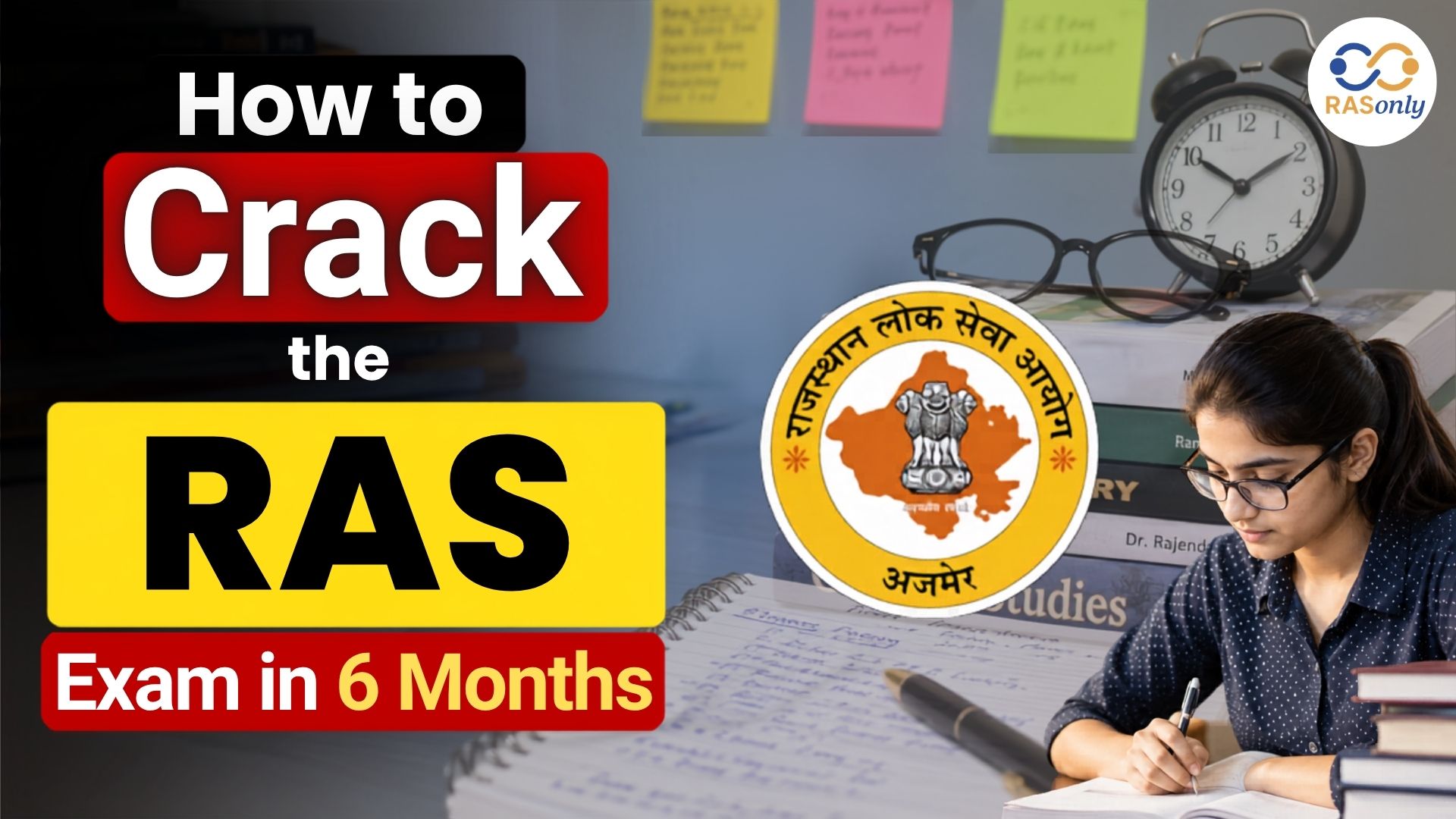
The preparation for the RAS exams for the period of six months may seem daunting but is certainly possible with a disciplined and syllabus-based approach. The Rajasthan Public Service Commission (RPSC) conducts the Rajasthan Administrative Service exam every year, and most experts suggest a year of preparation, but with a carefully structured 6-month regimen, graduates who can commit to a daily 8-10 hours of focused study can succeed.
This guide takes you through a comprehensive approach for preparing for the RAS exam pattern, preparation syllabus, realistic study plan, books to study and answer writing for the Main exam. If you are a working professional or a full-time student, the following tips will help you create an actionable and effective 6-month roadmap for the RAS.
Understanding the RAS Exam Pattern
Before you start preparing, it's essential to understand exactly how the exam is structured. The RAS exam pattern has been updated significantly during the 2026 cycle, so the candidates should prepare as per the updated pattern and not as per the old notes.
The selection process for RAS/RTS Combined Competitive Examination is conducted in three stages:
| Stage | Nature | Marks | Duration |
|---|---|---|---|
| Preliminary Exam | Objective (MCQ), screening only | 200 marks (150 questions) | 3 hours |
| Mains Exam | Descriptive, 4 compulsory papers | 800 marks (200 each) | 3 hours per paper |
| Interview | Personality Test | 100 marks | — |
Marks scored in the Prelims are not counted in the final result — it only acts as a screening stage to shortlist candidates for the Mains. The selection score is a combination of Mains (800) and Interview (100) marks and is prepared based on the final merit.
Key Changes in the RAS Exam Pattern 2026
RPSC has introduced significant reforms this year, and understanding the RAS exam pattern changes is critical to avoid studying outdated material.
- The Sports and Yoga section has been removed from the Prelims syllabus, and provisions of the Rajasthan Examination Act, 2022, have been added in its place
- Mains exam has dropped 2-mark questions and added more 5-mark and 10-mark questions, indicating a transition from analytical & application-based assessment.
- The General Hindi and English paper now comprises three sections — Hindi, English, and Essay — with only 5-mark and 10-mark questions asked
- Overall, around 25% of the syllabus has changed compared to the earlier pattern
RAS Syllabus 2026: What You Need to Cover
The RAS syllabus 2026 is quite large and if you can understand the syllabus on a subject to subject basis, you will be able to allocate your time effectively and not in a haphazard way.
The Prelims syllabus consists of General Knowledge and General Science, covering Rajasthan History, Geography, Polity, Economy, Science, Technology, Environment, Current Affairs, Ethics, Management, General Hindi, and General English. The core focus of the RAS preliminary exam remains unchanged — Rajasthan-specific history, culture, and heritage continue to dominate the question paper.
Mains Syllabus Breakdown
The RAS mains exam consists of four compulsory papers, and there are no optional subjects to choose from.
- Paper I (General Studies I): Tests understanding of History, Economics, Sociology, and related analytical topics
- Paper II (General Studies II): Covers Ethics, Science & Technology, and Geography (Earth Science) in descriptive format
- Paper III (General Studies III): Focuses on Polity, Governance, Public Administration, and Behavioural topics, along with the state economy
- Paper IV (General Hindi & English): Tests language proficiency, grammar, and includes an essay section
For instance, artificial intelligence is mentioned in the syllabus in the context of governance, cybersecurity, digital currency, and new laws such as BNS/BNSS replacing IPC/CrPC, indicating that RPSC is aligning the exam with the current happenings instead of traditional textbook material.
RAS Exam Eligibility and Notification Details
Before preparing, make sure you check the eligibility criteria for RAS exam and know the current notification timeline.
- Educational qualification: Graduation degree in any stream from a recognized University; final-year students should read the notification carefully.
- Age limit: Reservation-based relaxations up to 21 years and above to 40 years as on 01 Jan 2027
- Vacancies (2026 cycle): RPSC has notified 607 vacancies across Rajasthan State Services and Rajasthan Subordinate Services — 192 State Service posts and 415 Subordinate Service posts
- RAS notification 2026: RAS/RTS Combined Competitive Exam 2026 Notification released on 27 May 2026, Online Application Form Start from 4 June to 3 July 2026.
- Prelims Exam Date: Sunday, 29 November 2026.
Dates, vacancy details, and syllabus details can change, so always cross-check with the official RPSC Website (rpsc.rajasthan.gov.in) before finalizing the plan.
RAS Study Plan: 6-Month Roadmap
The foundation of your six-month study plan is a structured RAS study plan. Rather than preparing all at once, plan for your preparation in different stages so each stage builds on the next.
Month 1-2: Foundation Building
Take the first 2 months to develop a good conceptual foundation; skip mock tests.
- Go through NCERT textbooks (Class 6-12) for History, Geography, Polity, and Economy
- Begin Rajasthan GK notes of Rajasthan History, Culture, Geography and Government Schemes.
- Read a national newspaper daily and note down important current affairs
- Get familiar with the complete RAS syllabus and exam pattern in detail
Month 3-4: Syllabus Completion and Prelims Focus
This should be the time to complete the basic RAS programme and develop the exam temperament.
- Finish off the topics to the best of your ability for the section of Rajasthan. This is a section that is repeated throughout both Prelims and Mains.
- Solve the RAS previous year papers subject-wise to find the recurring topics.
- Take at least 2-3 full-length mock tests per week
- Start simple writing for Mains along with Prelims revision.
Month 5: Mains-Focused Preparation
After revision is done for Prelim level, focus on the Mains preparation for RAS.
- Practice daily answer writing for General Studies papers I, II, and III
- Practice essay writing for Paper IV, as the essay section has been increased to a greater scoring weightage.
- Deeply revise concepts of ethics, governance and public administration
- Compile a current affairs digest of the last 6-8 months for quick revision
Month 6: Revision, Mock Tests, and Interview Prep
The last month should be dedicated to consolidation, not learning new material.
- Take full-length RAS mock tests online under timed conditions
- Revise short notes and mind maps repeatedly instead of reading fresh material
- Start basic RAS interview preparation — practice mock interviews and current affairs discussions
- Review any errors made on past practice papers and correct them right away
Best Books for RAS Exam Preparation
Choosing the right resources is a time saver. These are the types of books used by the most competitive candidates:
- NCERT Books (Class 6-12) for foundational concepts
- Rajasthan GK books by reputed Rajasthan-focused publishers
- Standard reference books for Indian Polity, Economy, and Geography
- A reliable monthly current affairs magazine
- Previous year question paper compilations for Prelims and Mains
Daily Routine and Time Management for RAS Aspirants
As much as the study plan, a real schedule is important for RAS aspirants, particularly when they have to prepare in a span of six months.
- Dedicate 8-10 hours daily if preparing full-time; 4-5 focused hours if you are a working professional
- Structure your day into conceptual learning, current affairs and writing answers.
- Set aside one day a week to thoroughly review and evaluate the product.
- Avoid multitasking between too many books or sources for the same topic
How to Prepare for RAS Exam Without Coaching
This is a question that many aspirants ask — is it possible to prepare for the RAS exam without coaching? Yes, you can do RAS exam preparation without coaching if you are disciplined and use quality resources.
Self-study is best done with the help of the NCERTs, standard set books, previous year papers, and free or cheap mock test websites. The main difference between coaching and self-study is that in coaching, you have a structure that you follow, and self-study, you have to develop your own structure and stick to it. However, if consistency is possible and you can give a true estimate of your performance on a mock test then self-preparation can work equally well or more time efficiently.
Answer Writing Practice for RAS Mains
The actual merit weight is in the Mains, and so writing practice for the Mains should be practiced daily instead of at the last moment.
- Practice writing answers within the word limit for 5-mark and 10-mark questions, since 2-mark questions have been removed
- Use diagrams, flowcharts and examples, where appropriate, to make answers analytical rather than descriptive.
- Get your answers evaluated by mentors, peer groups, or online evaluation services
- Pay particular attention to the essay questions in Paper IV which now have a higher weighting
Conclusion
Cracking the RAS exam in 6 months is challenging, but it is achievable with a disciplined, well-planned, and consistent approach. Rather than preparing for all the topics at once, break up the preparation into different stages: Concept Building, Syllabus Completion, Answer Writing Practices, Attempting Mock Tests, and regular revisions. The main purpose of the Prelims is that it is a screening step and your aim should be to do objective practice as well as being strong in Mains. Focus on the latest RAS syllabus and exam pattern, Rajasthan-specific topics, current affairs, and regular revision. Although the choice is between self-study or coaching, your success will most likely depend on the consistent application of the following factors: consistency, smart time management, and continuous self-evaluation. Be disciplined with your daily routine, study what you can from every mock test and continue to refine your answer writing technique to increase your likelihood of being selected for the final merit list.
FAQs
Yes. A well-designed study plan, preparation of 8-10 hours a day or 4-5 focused hours for working professionals, frequent revision and mock tests can help you prepare well in a span of 6 months.
Full-time aspirants should study for 8-10 hours of good material daily whereas the working professionals should spend at least 4-5 hours of focused study daily.
No. Most candidates prepare themselves to pass the RAS exam by using official syllabus, NCERT books, standard reference books, previous year papers, and quality mock tests. It's the rules and the routine that carry more weight than the coaching.
Yes. Preparation for both stages is advisable as both the Mains and the Objective questions carry equal weightage.
Give special attention to Rajasthan History, Geography, Culture, Polity, Economy, Current Affairs, Ethics, Environment, Science & Technology, and General Hindi & English, as these form the core of the syllabus.
BEST SELLER
🏆 PRELIMS
RAS Pass
Prelims focused Hindi & English
₹399
✓
Prelims Topic-Wise Tests
✓
Subject-Wise Tests
✓
Full-Length Prelims Tests
✓
Daily Current Affairs Tests
✓
Prelims PYQs Tests
✓
Detailed Solutions & Analysis
✓
All Rajasthan Ranking
✓
Unlimited Reattempts
✓
Mains Tests
✓
Hindi & English Tests
✓
All Rajasthan Ranking
Trusted by 5,000+ Students
Post Category
- RAS Salary
- Result
- RAS Admit Card
- RAS Job
- RAS Cutoff
- Preparation Tips
- RAS Answer Key
- RAS Exam Analysis
- RAS Syllabus
- RAS Previous Year Papers
- RPSC RAS Exam Pattern
- RAS Interview
- RAS Exam Date
- RAS Vacancy
- RAS Test Series
- RAS Best Books
- RAS Preparation Resources
- RAS Coaching Centre
- History
- Polity
- Geography
- Economics
- Science
- Art and Culture
- RPSC RAS Application Form
- RPSC RAS Notification
- RAS Eligibility Criteria
- UPSC Exam
- RPSC RAS Mains
Visit Our RASonly Offline Center
Our Expert Faculty

Bhunesh Sir
Current Affairs · 13+ Yrs

Aamir Khan Sir
RAS-2017 · IIM Ahm.

Akash Sir
Polity · 8+ Yrs
Free Resources
Official Mobile App

RASOnly App
by OTSAdda · Free
Full Video Lectures
Mock Tests & PYQs
Daily Current Affairs
AI Mock Interview
Free Download · No subscription needed to install
RAS 2024 Toppers — RASonly
Rank 2
Virendra Charan
Rank 9
Bhoopinder Singh
Rank 26
Aanchal Nagpal
Rank 33
Lokendra Singh
Rank 45
Amar Rathore
Rank 46
Manasvini Verma

Join RASonly WhatsApp Community
Get daily current affairs, exam alerts, free study material and tips from expert faculty — right on WhatsApp.
Join for Free →RASonly Interview Guidance Program

Mr. Ashok Jain
Ex-Chief Secretary Govt of Rajasthan
- IAS officer of the 1981 batch, Rajasthan cadre.
- Passionate about mentoring the next generation of RAS officers with real-world insights.
- Got retired in Dec 2017 from the post of Chief Secretary of the state of Rajasthan.

Mr. Guru Charan Rai
Ex-ASP / SP in Jaisalmer
- Guru Charan Rai, IPS (Retd), retired as Inspector General of Police (Security), Rajasthan, Jaipur in 2017.
- Served as ASP and SP in Jaisalmer, Nagaur, Sri Ganganagar, Sawai Madhopur, Dausa, Sikar, and Karauli.
- He also held key positions as DIGP and IGP in the Law and Order division.

Mr. Rakesh Verma
Ex-IAS Officer, B.Tech, MBA, and M.A. (Economics)
- IAS officer of the 1981 batch and retired in Chief Secretary Rank.
- Civil servant of high repute and vast experience.
- Has been teaching UPSC CSE subjects for the last six years.
Related Post




Daily Current Affairs for RAS Exam Preparation 2026

Conclusion of Multinational Exercise Tarang Shakti 2.0
October 15, 2026
PM Dhan-Dhaanya Krishi Yojana 2026
October 15, 2026
Inauguration of the 133rd National Dussehra Fair 2026
October 14, 2026