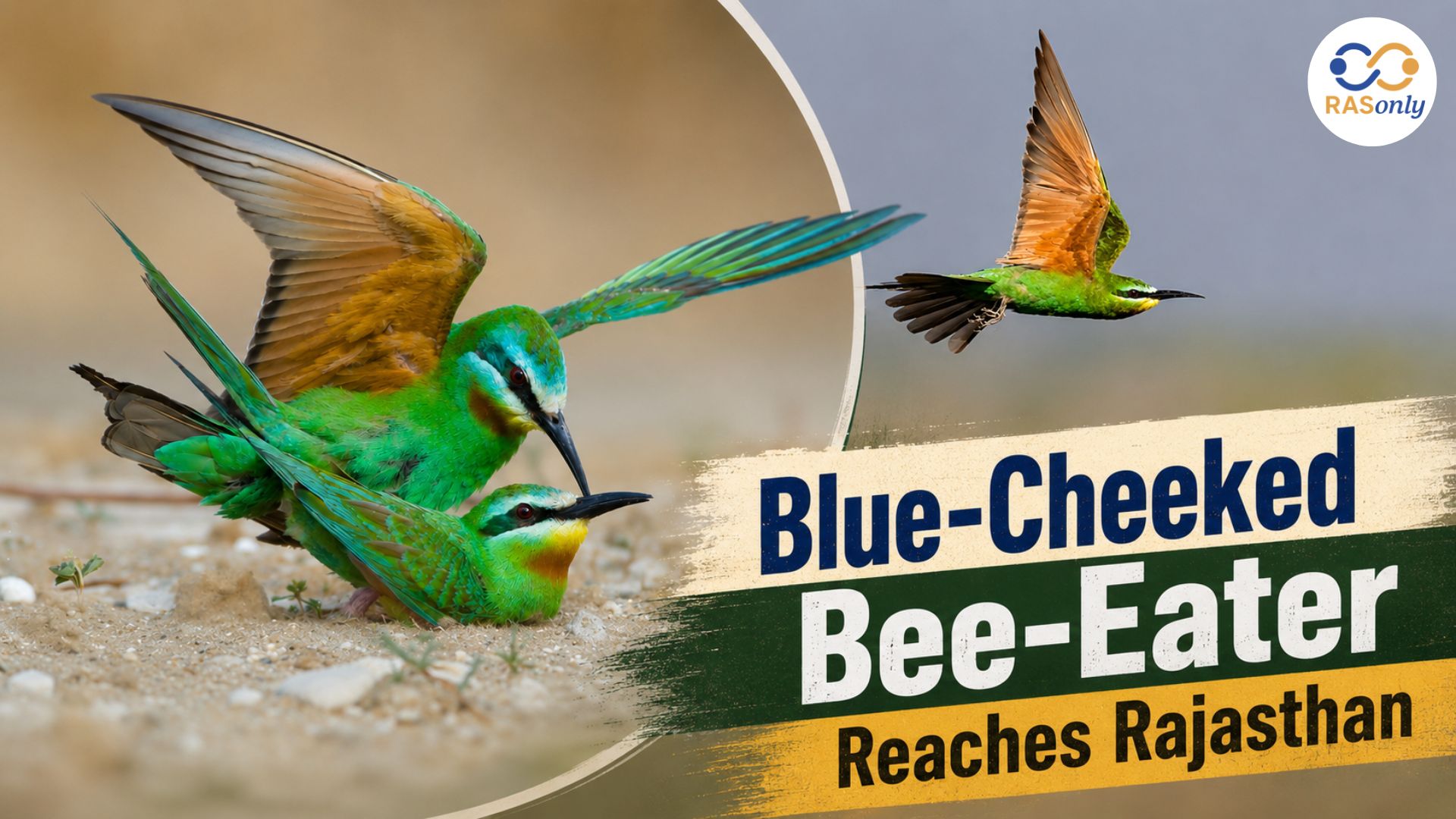
The arrival of the Blue-Cheeked Bee-Eater (Neela Pataringa) in the Thar Desert is considered a natural indicator of the onset of the Southwest Monsoon in Rajasthan. Every year, these colorful migratory birds travel thousands of kilometers from Central Asia to the desert landscapes of Jaisalmer, signaling the arrival of the rainy season.
Background
With the beginning of the monsoon season, migratory birds from Central Asia start arriving in Rajasthan's Thar Desert. Recently, large flocks of Blue-Cheeked Bee-Eaters have been spotted in the Lathi region of Jaisalmer and nearby desert areas. Their annual arrival has traditionally been associated with the approach of the Southwest Monsoon.
About Blue-Cheeked Bee-Eater
The Blue-Cheeked Bee-Eater (Merops persicus) is a migratory bird known for its vibrant appearance and exceptional aerial hunting abilities. It migrates from Central Asia to India during the summer and pre-monsoon months, covering thousands of kilometers.
Scientific Classification
|
|
|
|
|
|
|
|
|
|
|
|
|
|
|
Physical Characteristics
The Blue-Cheeked Bee-Eater is easily recognized due to its striking appearance.
Distinct Features
- Light green body
- Blue or whitish-blue cheeks and forehead
- Thin black line above the eyes
- Long, pointed tail
- Attractive and melodious calls during flight
These colorful birds flying in flocks add remarkable beauty to the Thar Desert.
Expert Aerial Hunter
The Blue-Cheeked Bee-Eater is highly skilled at catching insects while flying.
Favourite Food
- Bees
- Wasps
- Dragonflies
- Other flying insects
It catches prey with remarkable speed, precision, and agility.
Ecological Importance
The Blue-Cheeked Bee-Eater plays a significant role in maintaining ecological balance.
Environmental Benefits
- Controls harmful insect populations
- Protects crops by feeding on pest insects
- Maintains ecosystem balance
- Acts as a natural biological pest controller
Why Do These Birds Migrate to India?
India provides favorable environmental conditions for migratory birds during the summer season.
Reasons for Migration
- Abundant food availability
- Suitable climatic conditions
- Safe nesting and breeding habitats
- Diverse ecosystems including deserts, forests, wetlands, and mountains
During summer, these birds migrate from Central Asia to India's plains and deserts in search of favorable breeding conditions and food.
Blue-Cheeked Bee-Eater as an Indicator of Monsoon
The annual arrival of the Blue-Cheeked Bee-Eater in the Thar Desert is widely regarded by bird experts and environmentalists as a reliable sign of the approaching Southwest Monsoon in Rajasthan.
Its arrival has traditionally been linked with the beginning of the rainy season.
Significance for the Thar Desert
The presence of Blue-Cheeked Bee-Eaters reflects the ecological richness and biodiversity of the Thar Desert.
Importance
- Indicates a healthy desert ecosystem
- Reflects the rich biodiversity of Jaisalmer
- Attracts birdwatchers and wildlife enthusiasts
- Promotes eco-tourism in Rajasthan
- Highlights the ecological importance of the Thar Desert
Conclusion
The Blue-Cheeked Bee-Eater is much more than a seasonal migratory bird. Its annual arrival in Rajasthan's Thar Desert not only signals the onset of the Southwest Monsoon but also highlights the region's rich biodiversity, ecological health, and natural heritage. As an important insect predator and ecological indicator, the bird plays a valuable role in maintaining environmental balance while enhancing Rajasthan's reputation as a significant destination for wildlife and bird conservation.
MCQs
Q1. The arrival of the Blue-Cheeked Bee-Eater (Merops persicus) in Rajasthan is traditionally considered an indicator of:
A) Winter season
B) Southwest Monsoon
C) Desertification
D) Western Disturbances
Answer: B) Southwest Monsoon
Explanation: The annual arrival of the Blue-Cheeked Bee-Eater in the Thar Desert, particularly in Jaisalmer, is widely regarded as a natural sign of the onset of the Southwest Monsoon in Rajasthan.
Q2. The scientific name of the Blue-Cheeked Bee-Eater is:
A) Grus antigone
B) Merops persicus
C) Pavo cristatus
D) Ciconia episcopus
Answer: B) Merops persicus
Explanation: The Blue-Cheeked Bee-Eater belongs to the family Meropidae and is scientifically known as Merops persicus. It is a migratory bird that travels from Central Asia to India during the summer and pre-monsoon season.
Q3. Which of the following best describes the ecological importance of the Blue-Cheeked Bee-Eater?
A) It pollinates flowering plants.
B) It disperses seeds in desert regions.
C) It controls insect populations by feeding on bees, wasps, dragonflies, and other flying insects.
D) It enriches soil fertility through burrowing activity.
Answer: C) It controls insect populations by feeding on bees, wasps, dragonflies, and other flying insects.
Explanation: The Blue-Cheeked Bee-Eater is an expert aerial insect hunter. By feeding on bees, wasps, dragonflies, and other flying insects, it acts as a natural biological pest controller, helping maintain ecological balance and protecting crops from harmful insect pests.
राजस्थान पहुंचा नीला पतरिंगा: मानसून आगमन का प्राकृतिक संकेत
थार मरुस्थल में नीला पतरिंगा (ब्लू-चीक्ड बी-ईटर) का आगमन राजस्थान में दक्षिण-पश्चिम मानसून के आगमन का एक प्राकृतिक संकेत माना जाता है। प्रत्येक वर्ष ये रंग-बिरंगे प्रवासी पक्षी मध्य एशिया से हजारों किलोमीटर की यात्रा कर जैसलमेर के रेगिस्तानी क्षेत्रों में पहुंचते हैं और वर्षा ऋतु के आगमन का संकेत देते हैं।
पृष्ठभूमि
मानसून ऋतु की शुरुआत के साथ ही मध्य एशिया से प्रवासी पक्षियों का राजस्थान के थार मरुस्थल में आगमन शुरू हो जाता है। हाल ही में जैसलमेर के लाठी क्षेत्र तथा आसपास के रेगिस्तानी इलाकों में नीला पतरिंगा के बड़े झुंड देखे गए हैं। इनका वार्षिक आगमन पारंपरिक रूप से दक्षिण-पश्चिम मानसून के निकट आने से जोड़ा जाता है।
नीला पतरिंगा (ब्लू-चीक्ड बी-ईटर) के बारे में
नीला पतरिंगा (Merops persicus) एक प्रवासी पक्षी है, जो अपने आकर्षक रंग-रूप तथा उत्कृष्ट हवाई शिकार क्षमता के लिए प्रसिद्ध है। यह गर्मियों और मानसून-पूर्व अवधि में मध्य एशिया से भारत की ओर हजारों किलोमीटर की यात्रा करता है।
वैज्ञानिक वर्गीकरण
|
|
|
|
|
|
|
|
|
|
|
|
|
|
|
भौतिक विशेषताएँ
नीला पतरिंगा अपने आकर्षक स्वरूप के कारण आसानी से पहचाना जाता है।
विशिष्ट विशेषताएँ
- हल्के हरे रंग का शरीर
- नीले या हल्के नीले रंग के गाल एवं माथा
- आंखों के ऊपर पतली काली पट्टी
- लंबी एवं नुकीली पूंछ
- उड़ान के दौरान आकर्षक एवं मधुर आवाज
झुंड में उड़ते हुए ये रंग-बिरंगे पक्षी थार मरुस्थल की सुंदरता को और अधिक बढ़ा देते हैं।
विशेष हवाई शिकारी
नीला पतरिंगा उड़ते हुए कीटों का शिकार करने में अत्यंत दक्ष होता है।
प्रिय भोजन
- मधुमक्खियां
- ततैया
- व्याध पतंग (ड्रैगनफ्लाई)
- अन्य उड़ने वाले कीट
यह अत्यधिक गति, सटीकता और फुर्ती के साथ अपने शिकार को पकड़ता है।
पारिस्थितिक महत्व
नीला पतरिंगा पारिस्थितिक संतुलन बनाए रखने में महत्वपूर्ण भूमिका निभाता है।
पर्यावरणीय लाभ
- हानिकारक कीटों की संख्या नियंत्रित करता है।
- कीटभक्षी होने के कारण फसलों की सुरक्षा करता है।
- पारिस्थितिकी तंत्र का संतुलन बनाए रखता है।
- प्राकृतिक जैविक कीट नियंत्रक (Biological Pest Controller) के रूप में कार्य करता है।
ये पक्षी भारत क्यों आते हैं?
गर्मियों के दौरान भारत प्रवासी पक्षियों के लिए अनुकूल पर्यावरणीय परिस्थितियाँ उपलब्ध कराता है।
प्रवास के कारण
- पर्याप्त भोजन की उपलब्धता
- अनुकूल जलवायु
- सुरक्षित घोंसले बनाने एवं प्रजनन के स्थान
- मरुस्थल, वन, आर्द्रभूमि तथा पर्वतीय क्षेत्रों सहित विविध पारिस्थितिकी तंत्र
गर्मियों के दौरान ये पक्षी मध्य एशिया से भारत के मैदानी एवं रेगिस्तानी क्षेत्रों में अनुकूल प्रजनन परिस्थितियों तथा भोजन की तलाश में प्रवास करते हैं।
मानसून के संकेतक के रूप में नीला पतरिंगा
थार मरुस्थल में नीला पतरिंगा का वार्षिक आगमन पक्षी विशेषज्ञों एवं पर्यावरणविदों द्वारा राजस्थान में दक्षिण-पश्चिम मानसून के आगमन का एक विश्वसनीय प्राकृतिक संकेत माना जाता है।
पारंपरिक रूप से इसका आगमन वर्षा ऋतु की शुरुआत से जुड़ा हुआ है।
थार मरुस्थल के लिए महत्व
नीला पतरिंगा की उपस्थिति थार मरुस्थल की समृद्ध पारिस्थितिकी एवं जैव विविधता को दर्शाती है।
महत्व
- स्वस्थ मरुस्थलीय पारिस्थितिकी तंत्र का संकेत देता है।
- जैसलमेर की समृद्ध जैव विविधता को दर्शाता है।
- पक्षी प्रेमियों एवं वन्यजीव पर्यटकों को आकर्षित करता है।
- राजस्थान में इको-टूरिज्म को बढ़ावा देता है।
- थार मरुस्थल के पारिस्थितिक महत्व को रेखांकित करता है।
निष्कर्ष
नीला पतरिंगा केवल एक मौसमी प्रवासी पक्षी नहीं है। राजस्थान के थार मरुस्थल में इसका वार्षिक आगमन न केवल दक्षिण-पश्चिम मानसून की शुरुआत का संकेत देता है, बल्कि यह क्षेत्र की समृद्ध जैव विविधता, पारिस्थितिक स्वास्थ्य तथा प्राकृतिक विरासत को भी उजागर करता है। एक महत्वपूर्ण कीटभक्षी एवं पारिस्थितिक संकेतक के रूप में यह पक्षी पर्यावरणीय संतुलन बनाए रखने में महत्वपूर्ण भूमिका निभाता है तथा राजस्थान को वन्यजीव एवं पक्षी संरक्षण के प्रमुख गंतव्य के रूप में स्थापित करने में योगदान देता है।
बहुविकल्पीय प्रश्न (MCQs)
प्रश्न 1. राजस्थान में नीला पतरिंगा (Merops persicus) का आगमन परंपरागत रूप से किसका संकेत माना जाता है?
A) शीत ऋतु
B) दक्षिण-पश्चिम मानसून
C) मरुस्थलीकरण
D) पश्चिमी विक्षोभ
उत्तर: B) दक्षिण-पश्चिम मानसून
व्याख्या: थार मरुस्थल, विशेषकर जैसलमेर क्षेत्र में नीला पतरिंगा का वार्षिक आगमन राजस्थान में दक्षिण-पश्चिम मानसून के आगमन का प्राकृतिक संकेत माना जाता है।
प्रश्न 2. नीला पतरिंगा (Blue-Cheeked Bee-Eater) का वैज्ञानिक नाम क्या है?
A) Grus antigone
B) Merops persicus
C) Pavo cristatus
D) Ciconia episcopus
उत्तर: B) Merops persicus
व्याख्या: नीला पतरिंगा Meropidae कुल का एक प्रवासी पक्षी है, जिसका वैज्ञानिक नाम Merops persicus है। यह गर्मियों एवं मानसून-पूर्व अवधि में मध्य एशिया से भारत की ओर प्रवास करता है।
प्रश्न 3. निम्नलिखित में से कौन-सा कथन नीला पतरिंगा के पारिस्थितिक महत्व का सर्वोत्तम वर्णन करता है?
A) यह फूलों का परागण करता है।
B) यह मरुस्थलीय क्षेत्रों में बीजों का प्रसार करता है।
C) यह मधुमक्खियों, ततैयों, ड्रैगनफ्लाई तथा अन्य उड़ने वाले कीटों को खाकर उनकी संख्या नियंत्रित करता है।
D) यह बिल बनाकर मिट्टी की उर्वरता बढ़ाता है।
उत्तर: C) यह मधुमक्खियों, ततैयों, ड्रैगनफ्लाई तथा अन्य उड़ने वाले कीटों को खाकर उनकी संख्या नियंत्रित करता है।
व्याख्या: नीला पतरिंगा एक उत्कृष्ट हवाई कीट शिकारी है। यह मधुमक्खियों, ततैयों, ड्रैगनफ्लाई तथा अन्य उड़ने वाले कीटों का भोजन करता है, जिससे यह प्राकृतिक जैविक कीट नियंत्रक (Biological Pest Controller) के रूप में कार्य करते हुए पारिस्थितिक संतुलन बनाए रखने तथा फसलों को हानिकारक कीटों से बचाने में सहायता करता है
