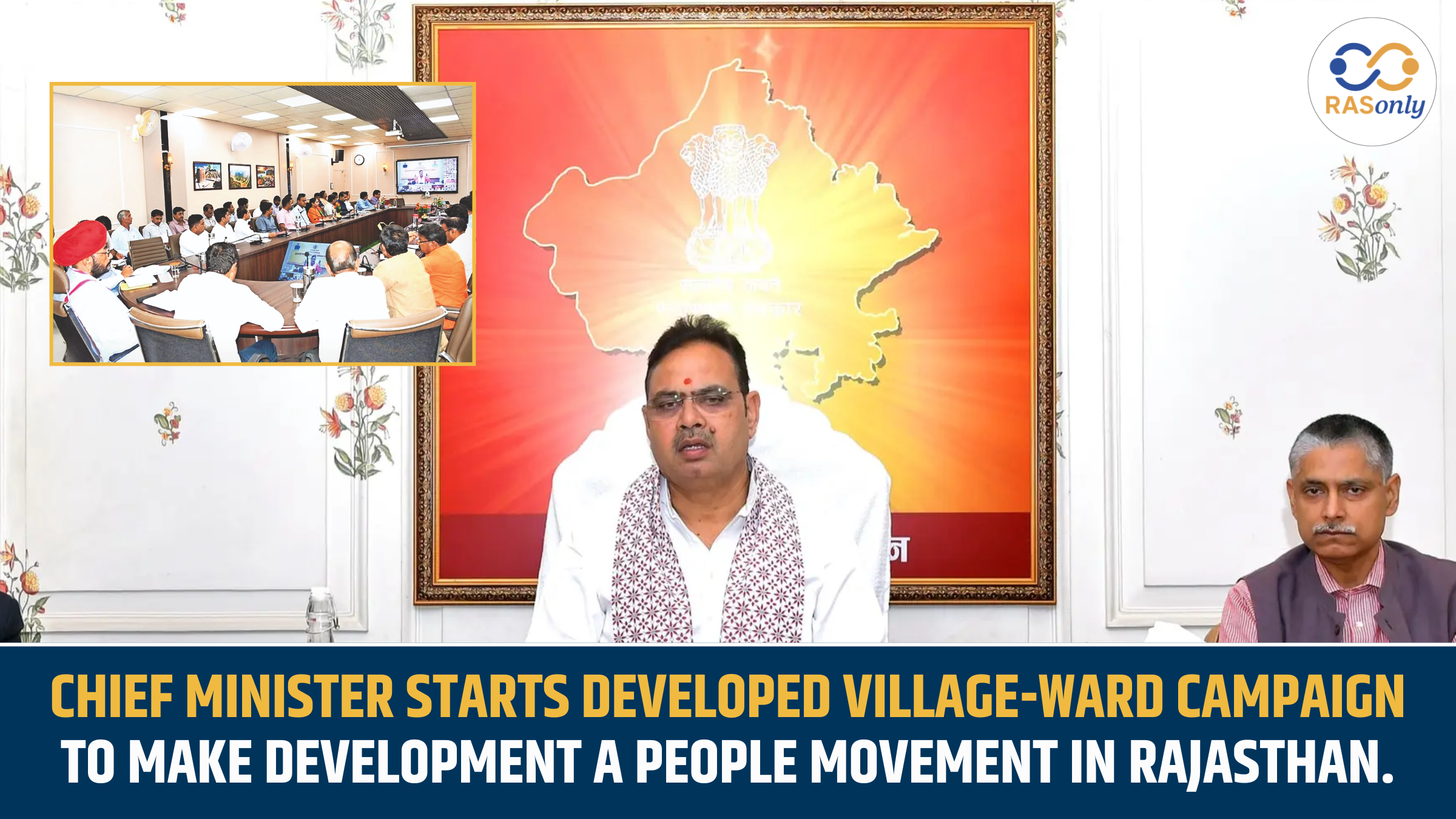
Village-Ward Campaign was initiated by Chief Minister Bhajanlal Sharma on 19 March in Jaipur during the Rajasthan Day. He also launched the site and video of the campaign and termed the move as a big stride towards making development a people-based movement. The campaign will prepare a development roadmap of all Gram Panchayats and urban wards of Rajasthan as per the local aspirations and requirements. It is meant to integrate development planning and participation of the people, such that village and ward planning can be directly used to enhance the living standards of the common individuals.
Objective of the Campaign
- The campaign aims at preparing a master plan of villages and wards by incorporating local needs, resources available, social conditions, economic realities and development priorities.
- Its widest application is in order to synchronize local planning with the vision of the Developed Rajasthan 2047 that is in turn connected with the national vision of Developed India 2047.
- According to the Chief Minister, development planning is not to be confined in government offices.
- Rather, it ought to be influenced by the people and consultation with the communities to ensure that the end product, the roadmap, would have the unbiased expectations of the locals.
Period and Process of Implementation.
The campaign will be on between 19 March and 15 May. Under this campaign:
The first Gram Panchayat Gram Sabha, and Ward Sabha in every urban ward will be on 20 March.
These meetings will enlighten people on the structure of the campaign.
Stage by stage additional Gram Sabhas and Ward Sabhas will be done.
At the panchayat level and ward level, a discussion with the people will be made and a database prepared.
The works that should be included in the master plan will be approved in gram sabhas and ward sabhas after consultation with the stakeholders and departments.
The process makes the campaign participatory and decentralised
Evidence-Based Planning and GIS-Based Planning.
One of the key aspects of the campaign is that it focuses on the evidence-based planning. To each village and city ward:
- A dynamic social, economic and cultural profile will be drawn.
- A base map will be created by use of GIS.
- The campaign will be implemented with the help of a digital portal.
This is significant in that it can enhance targeting and execution since planning will be done based on local data. The campaign targets to establish location-based development models instead of a uniform planning of all areas.
Local Economy and Employment.
The Chief Minister emphasized that master plans must not just be about physical infrastructure but they should also entail:
- local resources,
- traditional skills,
- employment opportunities,
- agriculture,
- vegetation,
- minerals,
- traditional arts, and
- local industries.
In agricultural based regions, he said that extra consideration should be done on the processing units, mandis, as well as value addition.
This is able to boost revenues and create jobs locally.
The planning can also be used in reducing the rate of people leaving villages in order to resettle in cities through providing them with better employment opportunities in the villages.
Social-Economic Profiles Preparation.
The Chief Minister instructed that every village should possess an elaborate level of social-economic profile that encompasses key sectors as:
- education,
- health,
- roads,
- electricity,
- water, and
- employment.
He further said that the District Collectors ought to mingle with the people of the village such as farmers, youth and women of every village and listen to their suggestions. This is to show that the campaign is not so much about physical planning rather about integrating the voice of important social groups in governance.
Community institutions and youth have a role to play in this.
- The campaign encourages the involvement of the local, too, in the form of groupings. The Chief Minister proposed to establish local organisations in the style of Rajivika and co-operative societies.
- He also stated that Gram Panchayat-related works should be organized into youth teams as the local suggestions would be gathered in a systematical manner.
- The aspect is important as it connects the development planning process to the social organisation, youth involvement, and community-level accountability.
Essentially the link with Developed Rajasthan 2047
- The campaign is linked directly with the long-term vision of the planning of the state. The Chief Minister has pointed out that the state government has already published the Vision Document of Developed Rajasthan 2047.
- The government had also declared in the state budget that it would prepare master plans of development in rural and urban local body areas at Gram Panchayat level. That budget announcement is made practical by the Developed Village-Ward Campaign.
According to the Chief Secretary, V. Srinivas, this campaign would be a significant move to Developed Rajasthan 2047 and that the master plans to be made in villages and urban wards would be dynamic. These plans will include:
- short-term aspirations up to 2030,
- and, lastly, the medium-term visions until 2035,
- long-term aspirations up to 2047.
The administrative coordination is the second part of the procurement plan.
The campaign will be executed via international departmental action:
- It will be practiced through the Panchayati Raj Department in the rural areas.
- In the cities, it will be done through the Autonomous Governance Department.
- This is an indication that the project is to include both the rural and urban local authorities within a single larger development project.
Wider Development Context
There were also the greater developmental activities of the government as pointed out by the Chief Minister.
According to him, the government has endeavored towards the overall development of youth, women, farmers, and the poor. He referred to steps such as:
- providing employment to over 1.25 lakh young people in the government,
- supporting close to 16 lakh women to become Lakhpati Didis, and
- raising the Samman Nidhi among the farmers.
He also indicated that thanks to such endeavors, the per capita income of Rajasthan has exceeded the 2 lakh mark in the first time in history;
The Day of Rajasthan has a background in terms of its history and culture.
The Chief Minister also attributed the incident to the historical identity of Rajasthan. He remembered how the state of Greater Rajasthan was set up on the Hindus New Year day, 30 March 1949, on the Chaitra Shukla Pratipada. He explained that the current government had resolved last year to commemorate the Rajasthan Day on that culturally important day and to extend wishes on the occasion of Chaitra Navratri and Hindu New Year and the Rajasthan Day.
Significant to the preparation of RAS
- decentralised planning,
- participatory governance,
- Gram Sabha and Ward Sabha,
- The rural-urban integrated development,
- GIS-based planning,
- evidence-based governance,
- local economy, value addition,
- Developed Rajasthan 2047 vision,
- the contribution of Panchayati Raj institutions and urban local bodies.
- It may be applicable in Rajasthan Current Affairs, Governance, Rural Development, Urban Administration and Essay/Descriptive answers.
Conclusion
Chief Minister Developed Village-Ward Campaign is a significant government program that focuses on making development participatory, localised, data-driven and long-term in its nature. The campaign aims at integrating community consultation, community resources, social-economic profiling, and futuristic planning by preparing master plans to all Gram Panchayats and urban wards. When applied efficiently, it can turn into a powerful tool of the even-handed development of the region and the higher quality of the life in the whole of Rajasthan.
MCQs
1. During which period will the Chief Minister Developed Village-Ward Campaign in Rajasthan be carried out?
a. 19 March to 15 April
b. 20 March to 30 June
c. 19 March to 15 May
d. 1 April to 31 May
Answer: c
Explanation : The campaign was initiated on 19 March, and will remain until 15 May. The phases of Gram Sabhas and Ward Sabhas will be conducted during this period, as well as the consultation of the population and the master plans of the villages and wards will be drawn up.
2. Select one of the following as a key planning aspect of the Chief Minister Developed Village-Ward Campaign?
a. Full attention of road construction.
b. Base maps and dynamic profiles in GIS.
c. Plans made centrally without consulting the local administrations.
d. Planning in rural areas alone.
Answer: b
Explanation: The campaign attaches significance to evidence planning. Dynamic social, economic and cultural profiles will be drawn up as to each village and urban ward, and GIS based base maps will also be made to facilitate better recognising planning which is more localised and accurate.
3. What are the time horizons of what should be the master plans prepared under the campaign?
a. 2028, 2032, and 2040
b. 2030, 2035, and 2047
c. 2027, 2037, and 2045
d. 2031, 2036, and 2050
Answer: b
Explanation: Chief Secretary V. Srinivas told that the master plans of villages and urban wards will be dynamic, and they will have short-term aspirations till 2030, medium-term aspirations till 2035 and long term aspirations till 2047.
मुख्यमंत्री ने राजस्थान में विकास को जन-आंदोलन बनाने हेतु विकसित ग्राम-वार्ड अभियान प्रारम्भ किया
मुख्यमंत्री भजनलाल शर्मा ने 19 मार्च को जयपुर में राजस्थान दिवस के अवसर पर विकसित ग्राम-वार्ड अभियान का शुभारम्भ किया। उन्होंने अभियान की वेबसाइट और वीडियो का भी लोकार्पण किया तथा इसे विकास को जन-आधारित आंदोलन बनाने की दिशा में एक बड़ा कदम बताया। इस अभियान के अंतर्गत राजस्थान की सभी ग्राम पंचायतों और शहरी वार्डों के लिए स्थानीय आकांक्षाओं और आवश्यकताओं के अनुसार विकास का रोडमैप तैयार किया जाएगा। इसका उद्देश्य विकास नियोजन को जनभागीदारी से जोड़ना है, ताकि ग्राम और वार्ड स्तर की योजना सीधे आम लोगों के जीवन स्तर में सुधार का माध्यम बन सके।
अभियान का उद्देश्य
- इस अभियान का उद्देश्य स्थानीय आवश्यकताओं, उपलब्ध संसाधनों, सामाजिक परिस्थितियों, आर्थिक वास्तविकताओं तथा विकास की प्राथमिकताओं को सम्मिलित करते हुए गांवों और वार्डों का मास्टर प्लान तैयार करना है।
- इसका व्यापक लक्ष्य स्थानीय नियोजन को विकसित राजस्थान 2047 के विजन से जोड़ना है, जो आगे चलकर विकसित भारत 2047 की राष्ट्रीय संकल्पना से जुड़ा हुआ है।
- मुख्यमंत्री के अनुसार विकास नियोजन केवल सरकारी कार्यालयों तक सीमित नहीं रहना चाहिए।
- इसके बजाय, इसे जनता और समुदायों के परामर्श से आकार दिया जाना चाहिए, ताकि विकास का अंतिम रोडमैप स्थानीय लोगों की वास्तविक अपेक्षाओं को प्रतिबिंबित करे।
क्रियान्वयन की अवधि और प्रक्रिया
अभियान 19 मार्च से 15 मई तक संचालित किया जाएगा। इस अभियान के अंतर्गत—
- ग्राम पंचायतों में पहली ग्राम सभा तथा प्रत्येक शहरी वार्ड में पहली वार्ड सभा 20 मार्च को आयोजित होगी।
- इन बैठकों के माध्यम से लोगों को अभियान की रूपरेखा से अवगत कराया जाएगा।
- इसके बाद चरणबद्ध तरीके से अन्य ग्राम सभाएं और वार्ड सभाएं आयोजित की जाएंगी।
- पंचायत स्तर और वार्ड स्तर पर लोगों से चर्चा करके एक डेटाबेस तैयार किया जाएगा।
- विभिन्न हितधारकों और विभागों से परामर्श के बाद मास्टर प्लान में शामिल किए जाने वाले कार्यों को ग्राम सभाओं और वार्ड सभाओं में अनुमोदित किया जाएगा।
यह पूरी प्रक्रिया अभियान को सहभागी और विकेन्द्रीकृत स्वरूप प्रदान करती है।
साक्ष्य-आधारित और भू-स्थानिक आधारित नियोजन
अभियान की एक प्रमुख विशेषता साक्ष्य-आधारित नियोजन पर जोर है। प्रत्येक गांव और शहरी वार्ड के लिए—
- एक गतिशील सामाजिक, आर्थिक और सांस्कृतिक प्रोफाइल तैयार की जाएगी।
- भू-स्थानिक सूचना प्रणाली के आधार पर एक आधार मानचित्र बनाया जाएगा।
- अभियान के क्रियान्वयन के लिए एक डिजिटल पोर्टल का उपयोग किया जाएगा।
यह महत्वपूर्ण है क्योंकि स्थानीय आंकड़ों के आधार पर नियोजन होने से लक्ष्य निर्धारण और क्रियान्वयन दोनों अधिक प्रभावी बन सकते हैं। अभियान का उद्देश्य सभी क्षेत्रों के लिए एक जैसी योजना बनाने के बजाय स्थान-विशिष्ट विकास मॉडल तैयार करना है।
स्थानीय अर्थव्यवस्था और रोजगार
मुख्यमंत्री ने स्पष्ट किया कि मास्टर प्लान केवल भौतिक आधारभूत संरचना तक सीमित नहीं होना चाहिए, बल्कि उसमें निम्न तत्व भी शामिल होने चाहिए—
- स्थानीय संसाधन,
- पारंपरिक कौशल,
- रोजगार के अवसर,
- कृषि,
- वनस्पति,
- खनिज,
- पारंपरिक कला, तथा
- स्थानीय उद्योग।
उन्होंने कहा कि कृषि-आधारित क्षेत्रों में प्रसंस्करण इकाइयों, मंडियों और मूल्य संवर्धन पर विशेष ध्यान दिया जाना चाहिए। इससे स्थानीय स्तर पर आय बढ़ सकती है और रोजगार के अवसर उत्पन्न हो सकते हैं। ऐसा नियोजन गांवों से शहरों की ओर हो रहे पलायन को भी कम कर सकता है, क्योंकि इससे ग्रामीण क्षेत्रों में ही बेहतर आजीविका के अवसर उपलब्ध होंगे।
सामाजिक-आर्थिक प्रोफाइल की तैयारी
मुख्यमंत्री ने निर्देश दिया कि प्रत्येक गांव की विस्तृत सामाजिक-आर्थिक प्रोफाइल तैयार की जाए, जिसमें प्रमुख क्षेत्रों को शामिल किया जाए, जैसे—
- शिक्षा,
- स्वास्थ्य,
- सड़कें,
- बिजली,
- पानी, और
- रोजगार।
उन्होंने यह भी कहा कि जिला कलेक्टर प्रत्येक गांव के किसानों, युवाओं और महिलाओं से संवाद करें और उनके सुझाव लें। इससे स्पष्ट होता है कि यह अभियान केवल भौतिक नियोजन तक सीमित नहीं है, बल्कि शासन प्रक्रिया में महत्वपूर्ण सामाजिक समूहों की आवाज को शामिल करने का प्रयास भी है।
सामुदायिक संस्थाओं और युवाओं की भूमिका
- यह अभियान स्थानीय भागीदारी को सामूहिक संस्थागत रूप में बढ़ावा देता है। मुख्यमंत्री ने राजीविका और सहकारी समितियों की तर्ज पर स्थानीय समूह बनाने का सुझाव दिया।
- उन्होंने यह भी कहा कि ग्राम पंचायत से जुड़े कार्यों के लिए युवाओं की टीम बनाई जानी चाहिए, ताकि स्थानीय सुझावों को व्यवस्थित ढंग से एकत्र किया जा सके।
- यह पहल विकास नियोजन को सामाजिक संगठन, युवा सहभागिता और सामुदायिक उत्तरदायित्व से जोड़ती है।
विकसित राजस्थान 2047 से संबंध
- यह अभियान राज्य की दीर्घकालिक नियोजन दृष्टि से सीधे जुड़ा हुआ है। मुख्यमंत्री ने कहा कि राज्य सरकार पहले ही विकसित राजस्थान 2047 का विजन दस्तावेज जारी कर चुकी है।
- राज्य बजट में भी ग्रामीण क्षेत्रों में ग्राम पंचायत स्तर पर तथा शहरी निकाय क्षेत्रों में विकास हेतु मास्टर प्लान बनाने की घोषणा की गई थी। विकसित ग्राम-वार्ड अभियान उसी बजटीय घोषणा को व्यावहारिक रूप देता है।
मुख्य सचिव वी. श्रीनिवास के अनुसार यह अभियान विकसित राजस्थान 2047 की दिशा में एक महत्वपूर्ण कदम होगा और गांवों तथा शहरी वार्डों के लिए तैयार किए जाने वाले मास्टर प्लान गतिशील होंगे। इन योजनाओं में शामिल होंगे—
- अल्पकालिक लक्ष्य वर्ष 2030 तक,
- मध्यकालिक लक्ष्य वर्ष 2035 तक,
- दीर्घकालिक लक्ष्य वर्ष 2047 तक।
प्रशासनिक समन्वय
अभियान का क्रियान्वयन विभागीय समन्वय के माध्यम से किया जाएगा—
- ग्रामीण क्षेत्रों में इसका संचालन पंचायती राज विभाग द्वारा किया जाएगा।
- शहरी क्षेत्रों में इसका संचालन स्वायत्त शासन विभाग द्वारा किया जाएगा।
- इससे स्पष्ट है कि यह परियोजना ग्रामीण और शहरी दोनों स्थानीय निकायों को एक व्यापक विकास ढांचे में सम्मिलित करती है।
व्यापक विकास परिप्रेक्ष्य
मुख्यमंत्री ने सरकार के व्यापक विकास प्रयासों का भी उल्लेख किया। उनके अनुसार सरकार ने युवाओं, महिलाओं, किसानों और गरीबों के समग्र विकास के लिए कार्य किया है। उन्होंने निम्न उपलब्धियों का उल्लेख किया—
- सवा लाख से अधिक युवाओं को सरकारी रोजगार देना,
- करीब 16 लाख महिलाओं को लखपति दीदी बनाने में सहयोग देना,
- किसानों के सम्मान निधि में वृद्धि करना।
उन्होंने यह भी कहा कि इन प्रयासों के कारण राजस्थान की प्रति व्यक्ति आय पहली बार 2 लाख रुपये से अधिक हो गई है।
राजस्थान दिवस की ऐतिहासिक और सांस्कृतिक पृष्ठभूमि
मुख्यमंत्री ने इस अवसर को राजस्थान की ऐतिहासिक पहचान से भी जोड़ा। उन्होंने स्मरण कराया कि 30 मार्च 1949 को चैत्र शुक्ल प्रतिपदा, अर्थात हिन्दू नववर्ष के दिन, वृहद राजस्थान की स्थापना हुई थी। उन्होंने बताया कि वर्तमान सरकार ने पिछले वर्ष यह निर्णय लिया था कि राजस्थान दिवस इसी सांस्कृतिक रूप से महत्वपूर्ण तिथि पर मनाया जाएगा। उन्होंने चैत्र नवरात्र, हिन्दू नववर्ष और राजस्थान दिवस की शुभकामनाएं भी दीं।
आरएएस तैयारी की दृष्टि से महत्व
यह समाचार निम्न विषयों की दृष्टि से महत्वपूर्ण है—
- विकेन्द्रीकृत नियोजन,
- सहभागी शासन,
- ग्राम सभा और वार्ड सभा,
- ग्रामीण-शहरी समेकित विकास,
- भू-स्थानिक आधारित नियोजन,
- साक्ष्य-आधारित शासन,
- स्थानीय अर्थव्यवस्था और मूल्य संवर्धन,
- विकसित राजस्थान 2047 का विजन,
- पंचायती राज संस्थाओं और शहरी स्थानीय निकायों की भूमिका।
यह राजस्थान समसामयिकी, शासन, ग्रामीण विकास, शहरी प्रशासन तथा वर्णनात्मक उत्तर लेखन में उपयोगी हो सकता है।
निष्कर्ष
मुख्यमंत्री विकसित ग्राम-वार्ड अभियान एक महत्वपूर्ण सरकारी पहल है, जिसका उद्देश्य विकास को सहभागी, स्थानीयकृत, आंकड़ा-आधारित और दीर्घकालिक बनाना है। यह अभियान सभी ग्राम पंचायतों और शहरी वार्डों के लिए मास्टर प्लान तैयार करके सामुदायिक परामर्श, स्थानीय संसाधनों, सामाजिक-आर्थिक प्रोफाइल तथा भविष्य-दृष्टि वाले नियोजन को एकीकृत करना चाहता है। यदि इसका प्रभावी क्रियान्वयन होता है, तो यह राजस्थान में संतुलित क्षेत्रीय विकास और बेहतर जीवन गुणवत्ता का एक सशक्त माध्यम बन सकता है।
बहुविकल्पीय प्रश्न
1. राजस्थान में मुख्यमंत्री विकसित ग्राम-वार्ड अभियान किस अवधि में संचालित किया जाएगा?
a. 19 मार्च से 15 अप्रैल
b. 20 मार्च से 30 जून
c. 19 मार्च से 15 मई
d. 1 अप्रैल से 31 मई
उत्तर: c
व्याख्या: यह अभियान 19 मार्च को प्रारम्भ किया गया और 15 मई तक संचालित होगा। इस अवधि में चरणबद्ध रूप से ग्राम सभाएं और वार्ड सभाएं आयोजित की जाएंगी, जनता से परामर्श लिया जाएगा तथा गांवों और वार्डों के मास्टर प्लान तैयार किए जाएंगे।
2. मुख्यमंत्री विकसित ग्राम-वार्ड अभियान की प्रमुख नियोजन विशेषताओं में से एक कौन-सी है?
a. केवल सड़क निर्माण पर पूरा ध्यान
b. भू-स्थानिक आधारित मानचित्र और गतिशील प्रोफाइल
c. स्थानीय परामर्श के बिना केन्द्रीय नियोजन
d. केवल ग्रामीण क्षेत्रों के लिए नियोजन
उत्तर: b
व्याख्या: यह अभियान साक्ष्य-आधारित नियोजन पर जोर देता है। प्रत्येक गांव और शहरी वार्ड के लिए सामाजिक, आर्थिक और सांस्कृतिक गतिशील प्रोफाइल तैयार की जाएगी तथा भू-स्थानिक आधारित आधार मानचित्र भी बनाए जाएंगे, जिससे अधिक स्थानीयकृत और सटीक नियोजन संभव होगा।
3. अभियान के अंतर्गत तैयार किए जाने वाले मास्टर प्लान किन समय-सीमाओं को ध्यान में रखकर बनाए जाएंगे?
a. 2028, 2032 और 2040
b. 2030, 2035 और 2047
c. 2027, 2037 और 2045
d. 2031, 2036 और 2050
उत्तर: b
व्याख्या: मुख्य सचिव वी. श्रीनिवास ने कहा कि गांवों और शहरी वार्डों के मास्टर प्लान गतिशील होंगे और उनमें 2030 तक के अल्पकालिक लक्ष्य, 2035 तक के मध्यकालिक लक्ष्य तथा 2047 तक के दीर्घकालिक लक्ष्य शामिल होंगे