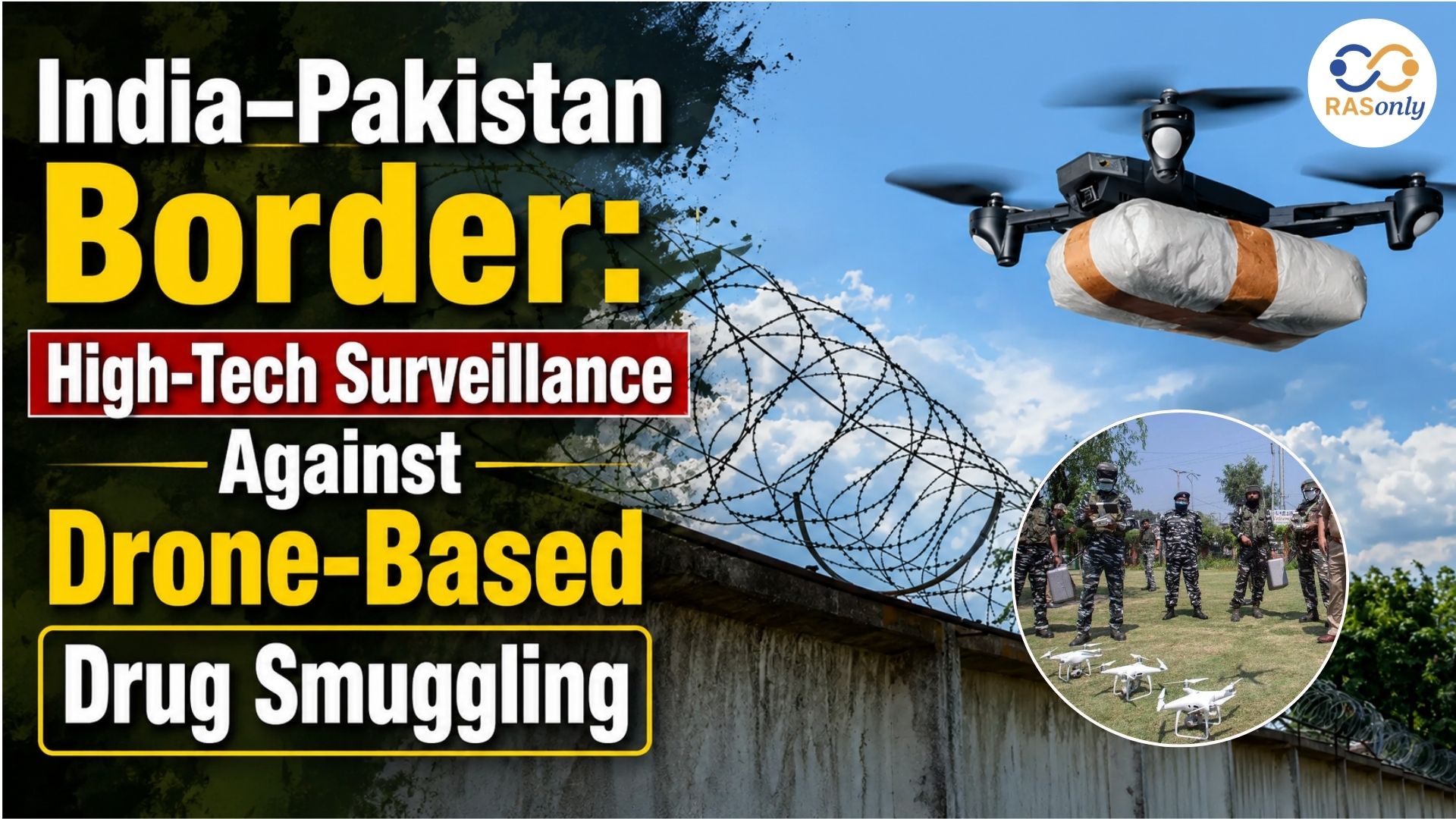
In view of the expanding utilization of drones by smugglers for cross-line drug bootlegging along the India–Pakistan border, particularly in Rajasthan and Punjab, security organizations are enhancing reconnaissance with enemy of drone frameworks, present day checking advances and interoffice insight coordination. Since the United Nations Office of Drugs and Crime World Drug Report 2025 indicates that the worldwide trade in illicit drugs is still growing, this matter has attracted additional urgency.
Background
Pakistan's international border with India is 3,323 km long, of which Rajasthan accounts for approximately 1,070 km and has the longest state-wise international border. The districts like Jaisalmer, Barmer, Bikaner and Sri Ganganagar that share borders with Pakistan are strategically significant.
Narcotics smuggling involved the use of human porters and cross-border supply lines. But they have ever more been using drones, GPS navigation, encrypted communication systems and night-time aerial deliveries for carting drugs, weapons and other contraband. This change in the technological paradigm has resulted in new security challenges, calls for the need of high-end counter-drone capability.
Why is Drone-Based Smuggling Increasing?
- Drones can cross over the border autonomously without human intervention.
- Built-in GPS for precise delivery at predetermined location.
- Encrypted communication decreases the possibility of interception.
- Visual detection is hard during night operations.
- Smugglers are thus able to use drones to make deliveries, which reduces risk while increasing efficiency.
Government Response and Security Measures
Deployment of Anti-Drone Systems
- Various anti-drone systems were developed over time to find, monitor and target the hostile drone.
- These systems utilize radar, radio-frequency sensors, electro-optical devices and jamming technologies.
Strengthening Border Surveillance
Increased monitoring through:
- Border Observation Posts (BOPs)
- Thermal imaging cameras
- Night vision devices
- Ground sensors
- Advanced surveillance equipment
Intelligence Coordination
Coordination has been strengthened among:
- Border Security Force (BSF)
- Indian Air Force (IAF)
- State Police
- Intelligence Agencies
- Narcotics Control Bureau (NCB)
The combined system allows efficient and effective access to data, along with synchronising operations.
Zero Tolerance Policy
The Zero Tolerance Policy of the government against narcotics trafficking is characterized by:
- Preventive intelligence
- Border security
- Youth awareness
- Strict legal action against traffickers
UNODC World Drug Report 2025
- Still, myriad new dangerous drugs are emerging with no checks or balance.
- In 2023 approximately 316 million people used illicit drugs around the globe.
- 244 million used cannabis.
- 61 million consumed opioids.
- The size of global illegal drug market continues to grow which is making life harder for law enforcement agencies, the report says.
About UNODC
- Established: 1997
- Headquarters: Vienna, Austria
- Parent Organization: United Nations
Mandate:
- Combat illicit drugs
- Prevent organized crime
- Counter corruption
- Support criminal justice reforms
- Address terrorism-related threats
Significance for Rajasthan
National Security
The Rajasthan border passes through vast desert terrain, making surveillance difficult. Drone-based smuggling poses risks not only for narcotics trafficking but also for the movement of weapons, explosives, and sensitive information.
Internal Security
Drug trafficking messages are organized by network crime and may also fund illegal anti-nationalities.
Technological Modernization
- Artificial Intelligence (AI)-based surveillance
- Anti-drone systems
- Smart border management
- Integrated command and control systems
Social Impact
The availability of narcotic is increasing drug use and addiction, causing social stability as well as a threat to public health and productivity among youth.
Conclusion
The increasing use of drones for cross-border narcotics trafficking marks a significant shift in the nature of border security challenges. Rajasthan's long international border has become a critical focus area for technology-driven surveillance and coordinated security operations. Strengthening anti-drone capabilities, intelligence sharing, and community participation, along with addressing the broader global drug trade highlighted by the UNODC World Drug Report 2025, is essential to safeguard national security and protect society from the growing menace of narcotics.
MCQs
Q1. According to the UNODC World Drug Report 2025, approximately how many people used illicit drugs worldwide in 2023?
A) 68million
B) 316 million
C) 61 million
D) 367.8 million
Answer: B) 316 million
Explanation:
According to the UNODC World Drug Report 2025, approximately 316 million people used illicit drugs globally in 2023. The report also states that 244 million used cannabis and 61 million consumed opioids.
Q2. Which of the following technologies is NOT as part of India's anti-drone border surveillance system?
A) Radar and radio-frequency sensors
B) Electro-optical devices and jamming technologies
C) Thermal imaging cameras and ground sensors
D) Quantum computing-based surveillance systems
Answer: D) Quantum computing-based surveillance systems
Explanation:
Radar, radio-frequency sensors, electro-optical devices, jamming technologies, thermal imaging cameras, night vision devices, and ground sensors as part of India's anti-drone surveillance. Quantum computing-based surveillance is not mentioned.
Q3. Which of the following districts shares the international border with Pakistan in Rajasthan?
A) Kota
B) Udaipur
C) Jaisalmer
D) Ajmer
Answer: C) Jaisalmer
Explanation:
Rajasthan shares an approximately 1,070 km international border with Pakistan. The major border districts are Sri Ganganagar, Bikaner, Jaisalmer, and Barmer. Jaisalmer is one of the most strategically important border districts.
भारत-पाकिस्तान सीमा: ड्रोन-आधारित मादक पदार्थों की तस्करी के खिलाफ उच्च-तकनीकी निगरानी
भारत-पाकिस्तान सीमा, विशेष रूप से राजस्थान और पंजाब के साथ, तस्करों द्वारा ड्रोन के बढ़ते उपयोग के मद्देनजर, सुरक्षा संगठन एंटी-ड्रोन सिस्टम, आधुनिक निगरानी प्रौद्योगिकियों और अंतर-एजेंसी खुफिया समन्वय के साथ टोही (reconnaissance) को बढ़ा रहे हैं। चूँकि संयुक्त राष्ट्र मादक पदार्थ एवं अपराध कार्यालय (UNODC) की 'विश्व ड्रग रिपोर्ट 2025' यह संकेत देती है कि अवैध मादक पदार्थों का वैश्विक व्यापार लगातार बढ़ रहा है, इसलिए इस मामले ने अतिरिक्त तात्कालिकता प्राप्त कर ली है।
पृष्ठभूमि
पाकिस्तान के साथ भारत की अंतरराष्ट्रीय सीमा 3,323 किमी लंबी है, जिसमें से राजस्थान लगभग 1,070 किमी का हिस्सा साझा करता है और राज्य-वार सबसे लंबी अंतरराष्ट्रीय सीमा है। जैसलमेर, बाड़मेर, बीकानेर और श्री गंगानगर जैसे जिले जो पाकिस्तान के साथ सीमा साझा करते हैं, रणनीतिक रूप से महत्वपूर्ण हैं।
मादक पदार्थों की तस्करी में पहले मानव वाहक और सीमा पार आपूर्ति लाइनों का उपयोग होता था। लेकिन अब ड्रोन, जीपीएस नेविगेशन, एन्क्रिप्टेड संचार प्रणालियों और रात में हवाई डिलीवरी का उपयोग नशीले पदार्थों, हथियारों और अन्य वर्जित वस्तुओं को लाने-ले जाने के लिए किया जा रहा है। तकनीकी प्रतिमान में इस बदलाव ने नई सुरक्षा चुनौतियां पैदा की हैं, जिससे उच्च-स्तरीय एंटी-ड्रोन क्षमता की आवश्यकता महसूस हो रही है।
ड्रोन-आधारित तस्करी क्यों बढ़ रही है?
- ड्रोन बिना मानवीय हस्तक्षेप के स्वायत्त रूप से सीमा पार कर सकते हैं।
- पूर्वनिर्धारित स्थान पर सटीक डिलीवरी के लिए इनमें इन-बिल्ट जीपीएस होता है।
- एन्क्रिप्टेड संचार अवरोधन (interception) की संभावना को कम करता है।
- रात के समय के संचालन के दौरान दृश्य पहचान (visual detection) मुश्किल होती है।
इस प्रकार तस्कर जोखिम को कम करते हुए और दक्षता बढ़ाते हुए डिलीवरी के लिए ड्रोन का उपयोग करने में सक्षम हैं।
सरकारी प्रतिक्रिया और सुरक्षा उपाय
एंटी-ड्रोन सिस्टम की तैनाती
- शत्रु ड्रोन का पता लगाने, निगरानी करने और उसे लक्षित करने के लिए समय के साथ विभिन्न एंटी-ड्रोन सिस्टम विकसित किए गए हैं।
- ये सिस्टम रडार, रेडियो-फ्रीक्वेंसी सेंसर, इलेक्ट्रो-ऑप्टिकल डिवाइस और जैमिंग तकनीकों का उपयोग करते हैं।
सीमा निगरानी को मजबूत करना
इसके माध्यम से निगरानी बढ़ाई गई है:
- बॉर्डर ऑब्जर्वेशन पोस्ट (BOPs)
- थर्मल इमेजिंग कैमरे
- नाइट विजन डिवाइस
- ग्राउंड सेंसर
- उन्नत निगरानी उपकरण
खुफिया समन्वय
इनके बीच समन्वय को मजबूत किया गया है:
- सीमा सुरक्षा बल (BSF)
- भारतीय वायु सेना (IAF)
- राज्य पुलिस
- खुफिया एजेंसियां
- नारकोटिक्स कंट्रोल ब्यूरो (NCB)
संयुक्त प्रणाली डेटा तक कुशल पहुंच और संचालन के समन्वय की अनुमति देती है।
जीरो टॉलरेंस नीति
मादक पदार्थों की तस्करी के खिलाफ सरकार की जीरो टॉलरेंस नीति की विशेषता है:
- निवारक खुफिया जानकारी
- सीमा सुरक्षा
- युवा जागरूकता
- तस्करों के खिलाफ सख्त कानूनी कार्रवाई
UNODC विश्व ड्रग रिपोर्ट 2025
- नई खतरनाक दवाएं बिना किसी जांच या संतुलन के उभर रही हैं।
- 2023 में दुनिया भर में लगभग 316 मिलियन लोगों ने अवैध दवाओं का उपयोग किया।
- 244 मिलियन लोगों ने कैनबिस का उपयोग किया।
- 61 मिलियन लोगों ने ओपिओइड का सेवन किया।
रिपोर्ट के अनुसार, अवैध नशीली दवाओं का वैश्विक बाजार लगातार बढ़ रहा है, जिससे कानून प्रवर्तन एजेंसियों के लिए काम करना कठिन होता जा रहा है।
UNODC के बारे में
- स्थापना: 1997
- मुख्यालय: वियना, ऑस्ट्रिया
- मूल संगठन: संयुक्त राष्ट्र
- अधिदेश (Mandate): मादक पदार्थों का मुकाबला करना, संगठित अपराध को रोकना, भ्रष्टाचार का सामना करना, आपराधिक न्याय सुधारों का समर्थन करना और आतंकवाद से संबंधित खतरों को संबोधित करना।
राजस्थान के लिए महत्व
- राष्ट्रीय सुरक्षा: राजस्थान की सीमा विस्तृत रेगिस्तानी भू-भाग से होकर गुजरती है, जिससे निगरानी करना चुनौतीपूर्ण हो जाता है। ड्रोन आधारित तस्करी न केवल मादक पदार्थों की तस्करी बल्कि हथियारों, विस्फोटकों तथा संवेदनशील सूचनाओं के आदान-प्रदान के लिए भी जोखिम उत्पन्न करती है।
- आंतरिक सुरक्षा: नशीली दवाओं की तस्करी का संचालन नेटवर्क अपराध द्वारा किया जाता है और यह अवैध राष्ट्र-विरोधी गतिविधियों को भी वित्तपोषित कर सकता है।
- तकनीकी आधुनिकीकरण: एआई-आधारित निगरानी, एंटी-ड्रोन सिस्टम, स्मार्ट बॉर्डर मैनेजमेंट और एकीकृत कमांड और कंट्रोल सिस्टम।
- सामाजिक प्रभाव: नशीले पदार्थों की उपलब्धता मादक पदार्थों के उपयोग और लत को बढ़ा रही है, जिससे सामाजिक स्थिरता प्रभावित हो रही है और युवाओं के सार्वजनिक स्वास्थ्य और उत्पादकता के लिए खतरा पैदा हो रहा है।
निष्कर्ष
सीमापार मादक पदार्थों की तस्करी में ड्रोन के बढ़ते उपयोग ने सीमा सुरक्षा की चुनौतियों को एक नया आयाम दिया है। पाकिस्तान से लगने वाली राजस्थान की लंबी अंतरराष्ट्रीय सीमा अब प्रौद्योगिकी आधारित निगरानी और समन्वित सुरक्षा अभियानों का प्रमुख केंद्र बन गई है। राष्ट्रीय सुरक्षा सुनिश्चित करने तथा समाज को नशीले पदार्थों के बढ़ते खतरे से सुरक्षित रखने के लिए एंटी-ड्रोन क्षमताओं को सुदृढ़ करना, खुफिया सूचनाओं के आदान-प्रदान को मजबूत बनाना, सीमावर्ती समुदायों की भागीदारी बढ़ाना तथा यूएनओडीसी की विश्व ड्रग रिपोर्ट 2025 में रेखांकित वैश्विक मादक पदार्थों के अवैध व्यापार से प्रभावी ढंग से निपटना अत्यंत आवश्यक है।
बहुविकल्पीय प्रश्न (MCQs)
Q1. UNODC विश्व ड्रग रिपोर्ट 2025 के अनुसार, 2023 में दुनिया भर में लगभग कितने लोगों ने अवैध दवाओं का उपयोग किया?
A) 68 मिलियन
B) 316 मिलियन
C) 61 मिलियन
D) 367.8 मिलियन
उत्तर: B) 316 मिलियन
व्याख्या: UNODC विश्व ड्रग रिपोर्ट 2025 के अनुसार, 2023 में वैश्विक स्तर पर लगभग 316 मिलियन लोगों ने अवैध दवाओं का उपयोग किया। रिपोर्ट में यह भी कहा गया है कि 244 मिलियन लोगों ने कैनबिस और 61 मिलियन लोगों ने ओपिओइड का सेवन किया।
Q2. निम्नलिखित में से कौन सी तकनीक भारत की एंटी-ड्रोन सीमा निगरानी प्रणाली का हिस्सा नहीं है?
A) रडार और रेडियो-फ्रीक्वेंसी सेंसर
B) इलेक्ट्रो-ऑप्टिकल डिवाइस और जैमिंग तकनीक
C) थर्मल इमेजिंग कैमरे और ग्राउंड सेंसर
D) क्वांटम कंप्यूटिंग-आधारित निगरानी प्रणाली
उत्तर: D) क्वांटम कंप्यूटिंग-आधारित निगरानी प्रणाली
व्याख्या: रडार, रेडियो-फ्रीक्वेंसी सेंसर, इलेक्ट्रो-ऑप्टिकल डिवाइस, जैमिंग तकनीक, थर्मल इमेजिंग कैमरे, नाइट विजन डिवाइस और ग्राउंड सेंसर भारत की एंटी-ड्रोन निगरानी प्रणाली का हिस्सा हैं। क्वांटम कंप्यूटिंग-आधारित निगरानी का उल्लेख नहीं है।
Q3. निम्नलिखित में से कौन सा जिला राजस्थान में पाकिस्तान के साथ अंतरराष्ट्रीय सीमा साझा करता है?
A) कोटा
B) उदयपुर
C) जैसलमेर
D) अजमेर
उत्तर: C) जैसलमेर
व्याख्या: राजस्थान पाकिस्तान के साथ लगभग 1,070 किमी लंबी अंतरराष्ट्रीय सीमा साझा करता है। प्रमुख सीमावर्ती जिले श्री गंगानगर, बीकानेर, जैसलमेर और बाड़मेर हैं। जैसलमेर सबसे रणनीतिक रूप से महत्वपूर्ण सीमावर्ती जिलों में से एक है
