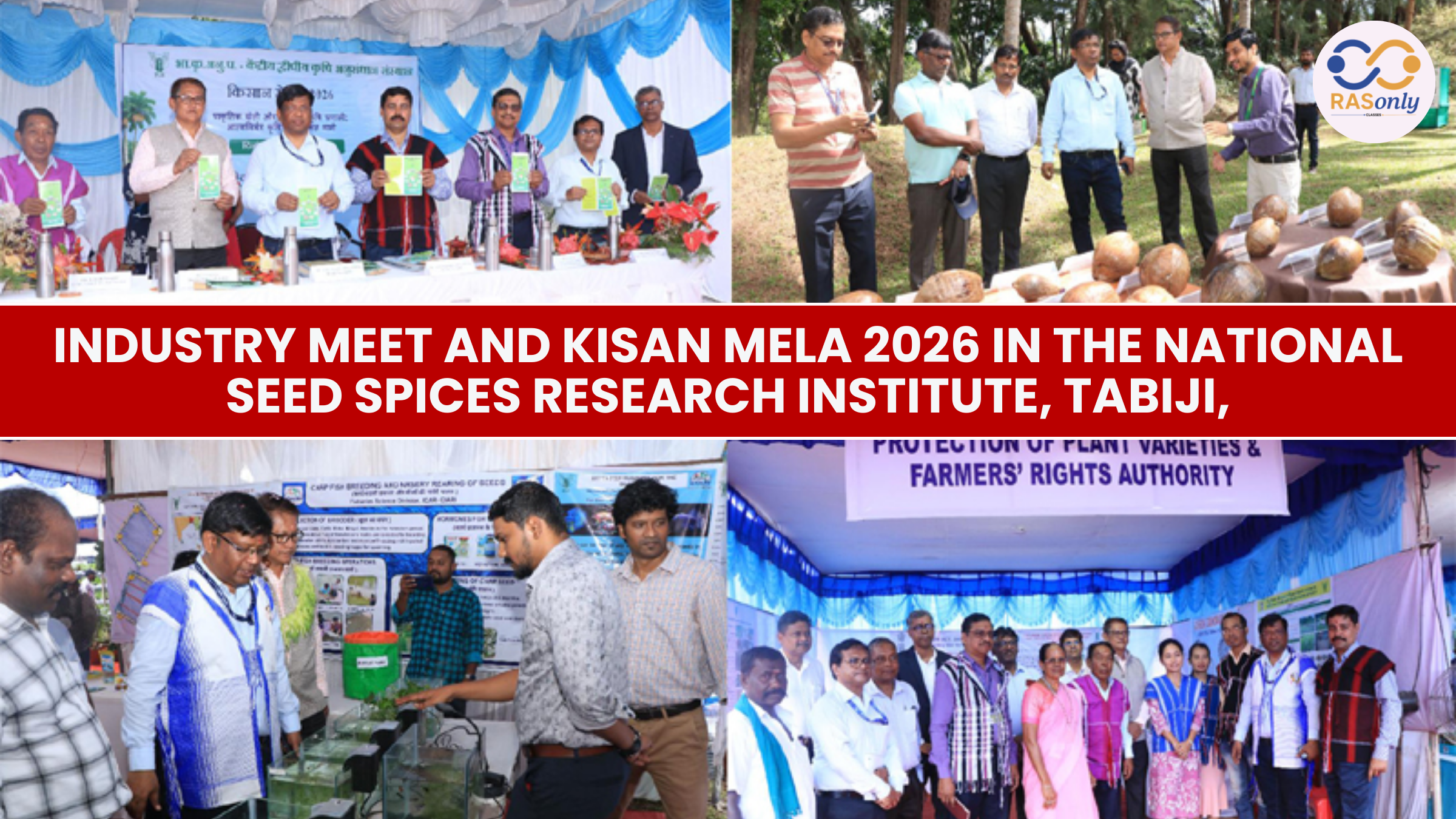
On 7 March, Union Minister of State for Agriculture and Farmers Welfare Bhagirath Choudhary met the farmers at the Industry Meet and Kisan Mela 2026 in the National Seed Spices Research Institute, Tabiji, Ajmer. The programme united the scientists, agricultural professional groups, industry, business people and farmers all over the nation. The event demonstrated the role of research and technology in seed spices which can help farmers earn more money by enhancing their incomes by means of better seeds, scientific cultivation, processing and value addition. It also emphasized the necessity of increased co-ordination among scientists, industry and farmers to ensure that new techniques are applied in field in a timely fashion and hence makes agriculture more productive profitable and export oriented.
Why Seed Spices Matter
Bhagirath Choudhary reported that since the ancient period India has been referred to as the land of spices and the Indian spices are known around the world due to their quality and aroma. He has observed seed spices like:
- Cumin
- Coriander
- Fennel
- Fenugreek
- Ajwain
are empowering the income of the farmers and the exports of the country. He further revealed that in Rajasthan and some areas of western India, seed spice farming has been a great income earner to farmers.
Research and Technology have a role to play.
The Union Minister claimed that a combination of industry and research and technology on seed spices can greatly enhance the farm income. He emphasized that enhanced collaboration among scientists, industry, and farmers is required in such a manner that the modern techniques soon find their way to the agricultural fields.
He also added that farmers were supposed to embrace:
- Improved seeds
- Cultivation practices in science.
- Better production methods
- Processing and value addition.
In his view, this strategy would help to make the agriculture sector more profitable and sustainable.
Government Assistance to Agriculturalists.
According to what Bhagirath Choudhary stated, the Central Government is actively striving to develop the sphere of agriculture and raise the level of income of farmers. He mentioned such big schemes as:
- Pradhan Mantri Kisan Samman Nidhi.
- Pradhan Mantri Fasal Bima Yojana.
- Pradhan Mantri Krishi Sinchai Yojana.
He claimed that these plans are assisting farmers in terms of economic security, modern technology as well as improved infrastructure support.
Research Priority Areas as revealed by ICAR.
ICAR Director General, Dr. Mangilal Jat, has indicated that agricultural research based on needs needs to be encouraged and farmers should communicate the research needs that arise in the field. He had a number of valuable observations:
- The list of local seed spice research centres will include Nagauri Pan Methi.
- The research will also be done on Rajasthani dry red chilli.
- It should develop processing facilities on cumin.
- There are some efforts in creating a centre of coriander seed production in the region of Kota such that the country will not be faced with the need to import coriander seed.
- Ajmer also has a potential of becoming a good centre in spice natural organic farming.
He also indicated that land is gradually turning neutral or either acidic and this leads to the need to come up with novel varieties that are:
- Alkali-resistant
- Heat-resistant
- Acid-resistant
Opinions of Agricultural and Industry Leaders
- Prof. P. S. Chauhan, the Vice-Chancellor of Swami Keshwanand Agriculture University, Jobner, stated that more money should be invested in research. He also added that industries were supposed to be directly connected to farmers and they should be encouraged to encourage crops as per the market and industrial requirements.
- Dhanuka Agritech President and CEO, Dr. R. G. Agrawal, indicated that the fruits of new research should not be limited to only small and marginal farmers. He focused on the need to diversify crops in the current situation.
- Director of ATARI Jodhpur, Dr. J. P. Mishra said that a cumin cluster would be established in Jodhpur and a new variety would also be displayed there.
Key Activities at the Event
In the programme, Union Minister of State, Agriculture, Minister, Bhagirath Choudhary:
- Opened seed processing plant.
- Publication of technical booklets.
- Distributed seed packets
- Blessed advanced farmers and scientists.
These were introduced by the welcoming of the guests by the Director of the National Seed Spices Research Centre, Dr. Vinay Bhardwaj and the vote of thanks was given by the Principal Scientist, Dr. S. S. Meena.
Conclusion
The Industry Meet and Kisan Mela 2026 held at Tabiji underscored the increased significance of research and technology on seed spices to enhance the farm incomes, advance production, further processing and export. As the event also demonstrated, the greater interconnection of scientists, industry, and farmers can enable Rajasthan and western India to become more powerful hubs of innovation, value addition, and profitable spice production.
MCQs (RAS Prelims)
1. What was the key objective of the Industry Meet and Kisan Mela 2026 that took place in Tabiji, Ajmer?
(a) Development of western Indian fisheries.
(b) Research, technology and coordination promotion in seed spices processing and industry.
(c) Substitution of the spice production with the cereal production.
(d) The Overview of a new national subsidy in fertilisers which is restricted to horticulture crops.
Answer: (b)
Explanation: The workshop at the National Seed Spices Research Institute, Tabiji was concerned with the significance of research, modern technology, industry support, processing and value addition in seed spices. It pointed out the role of closer coordination between scientists, industry, and farmers in enhancing the production and raising the income of farmers, particularly in Rajasthan and western India.
2. Based on what was discussed in the event, what agricultural purpose is Kota being developed?
(a) Import of fennel seed
(b) Export of wheat straw
(c) Growth of Coriander seeds and decreased reliance on imports.
(d) Cotton ginning and textile processing.
Answer: (c)
Explanation: According to the ICAR Director General Dr. Mangilal Jat, an attempt is underway to make Kota a coriander seed hub. The bigger picture is to build domestic production power such that in the future, the country will not rely on imported coriander seed.
3. What particular recommendation did the following make in the light of varying soil in spice-growing localities?
(a) Full substitution of spices with sugarcane.
(b) Production of new varieties that are alkalinity, heat and acid resistant.
(c) Ajmer organic farming prohibition.
(d) The ban on cumin farming at Jodhpur.
Answer: (b)
Explanation : It was indicated at the event that land is becoming more neutral or acidic in nature. In order to overcome this dilemma, the creation of better varieties that are resistant to alkalinity, heat, and acidity is required to ensure that the production of spice crops is still productive in the face of changing agro-climatic and soil conditions.
राष्ट्रीय बीजीय मसाला अनुसंधान संस्थान, तबीजी में आयोजित उद्योग संगोष्ठी एवं किसान मेला-2026 तथा किसानों की आय, अनुसंधान, प्रसंस्करण और मूल्य संवर्धन में उसका महत्व
7 मार्च को कृषि एवं किसान कल्याण राज्य मंत्री भागीरथ चौधरी ने अजमेर के तबीजी स्थित राष्ट्रीय बीजीय मसाला अनुसंधान संस्थान में आयोजित उद्योग संगोष्ठी एवं किसान मेला-2026 में किसानों से संवाद किया। इस कार्यक्रम में देशभर से वैज्ञानिक, कृषि विशेषज्ञ, उद्योग प्रतिनिधि, उद्यमी तथा किसान शामिल हुए। कार्यक्रम में यह रेखांकित किया गया कि बीजीय मसालों के क्षेत्र में अनुसंधान और प्रौद्योगिकी के माध्यम से उन्नत बीज, वैज्ञानिक खेती, प्रसंस्करण और मूल्य संवर्धन को बढ़ावा देकर किसानों की आय में वृद्धि की जा सकती है। साथ ही यह भी स्पष्ट किया गया कि वैज्ञानिकों, उद्योग जगत और किसानों के बीच अधिक समन्वय आवश्यक है, ताकि नई तकनीकें समय पर खेतों तक पहुँच सकें और कृषि को अधिक उत्पादक, लाभकारी तथा निर्यातोन्मुख बनाया जा सके।
बीजीय मसालों का महत्व
भागीरथ चौधरी ने कहा कि भारत प्राचीन काल से मसालों की भूमि के रूप में जाना जाता है और भारतीय मसाले अपनी गुणवत्ता तथा सुगंध के कारण विश्वभर में प्रसिद्ध हैं। उन्होंने कहा कि निम्न बीजीय मसाले—
- जीरा
- धनिया
- सौंफ
- मेथी
- अजवाइन
किसानों की आय बढ़ाने के साथ-साथ देश के निर्यात को भी सशक्त बना रहे हैं। उन्होंने यह भी बताया कि राजस्थान और पश्चिमी भारत के अनेक क्षेत्रों में बीजीय मसालों की खेती किसानों के लिए आय का एक महत्वपूर्ण स्रोत बन चुकी है।
अनुसंधान और प्रौद्योगिकी की भूमिका
केंद्रीय मंत्री ने कहा कि बीजीय मसालों के क्षेत्र में अनुसंधान, प्रौद्योगिकी और उद्योग के सहयोग से किसानों की आय में उल्लेखनीय वृद्धि की जा सकती है। उन्होंने बल दिया कि वैज्ञानिकों, उद्योग और किसानों के बीच बेहतर तालमेल स्थापित करना आवश्यक है, ताकि आधुनिक तकनीकें शीघ्रता से खेतों तक पहुँच सकें।
उन्होंने किसानों से आग्रह किया कि वे निम्न उपायों को अपनाएँ—
- उन्नत बीज
- वैज्ञानिक खेती की पद्धतियाँ
- बेहतर उत्पादन तकनीकें
- प्रसंस्करण और मूल्य संवर्धन
उनके अनुसार, इस प्रकार का दृष्टिकोण कृषि को अधिक लाभकारी और टिकाऊ बना सकता है।
किसानों के लिए सरकारी सहयोग
भागीरथ चौधरी ने कहा कि केंद्र सरकार कृषि क्षेत्र को सशक्त बनाने और किसानों की आय बढ़ाने के लिए निरंतर प्रयास कर रही है। उन्होंने निम्न प्रमुख योजनाओं का उल्लेख किया—
- प्रधानमंत्री किसान सम्मान निधि
- प्रधानमंत्री फसल बीमा योजना
- प्रधानमंत्री कृषि सिंचाई योजना
उन्होंने कहा कि इन योजनाओं के माध्यम से किसानों को आर्थिक सुरक्षा, आधुनिक तकनीक और बेहतर आधारभूत सहायता उपलब्ध कराई जा रही है।
भारतीय कृषि अनुसंधान परिषद द्वारा रेखांकित अनुसंधान प्राथमिकताएँ
भारतीय कृषि अनुसंधान परिषद के महानिदेशक डॉ. मांगीलाल जाट ने कहा कि किसानों को खेतों से जुड़ी अनुसंधान आवश्यकताओं की जानकारी सरकार तक पहुँचानी चाहिए, ताकि आवश्यकता-आधारित अनुसंधान को बढ़ावा मिल सके। उन्होंने कई महत्वपूर्ण बिंदु रखे—
- नागौरी पान मेथी को स्थानीय बीजीय मसाला अनुसंधान केंद्रों की सूची में शामिल किया जाएगा।
- राजस्थानी सूखी लाल मिर्च पर भी अनुसंधान किया जाएगा।
- जीरे के लिए प्रसंस्करण सुविधाओं का विकास किया जाना चाहिए।
- कोटा को धनिया बीज का केंद्र बनाने का प्रयास किया जा रहा है, ताकि धनिया बीज के आयात की आवश्यकता कम हो सके।
- अजमेर में मसालों की प्राकृतिक जैविक खेती का एक उत्कृष्ट केंद्र बनने की संभावना है।
उन्होंने यह भी कहा कि भूमि धीरे-धीरे सामान्य से क्षारीय अथवा अम्लीय प्रकृति की होती जा रही है। इस चुनौती से निपटने के लिए ऐसी नई किस्मों के विकास की आवश्यकता है, जो हों—
- क्षारीय प्रतिरोधी
- गर्मी प्रतिरोधी
- अम्लीय प्रतिरोधी
कृषि और उद्योग विशेषज्ञों के विचार
- स्वामी केशवानंद कृषि विश्वविद्यालय, जोबनेर के कुलपति प्रो. पी. एस. चौहान ने कहा कि अनुसंधान में निवेश बढ़ाया जाना चाहिए। उन्होंने यह भी कहा कि उद्योगों को किसानों से सीधे जोड़ा जाना चाहिए और बाजार तथा औद्योगिक आवश्यकताओं के अनुसार नई फसलों को प्रोत्साहित किया जाना चाहिए।
- धानुका एग्रीटेक के डॉ. आर. जी. अग्रवाल ने कहा कि नए अनुसंधान के लाभ छोटे और सीमांत किसानों तक भी पहुँचने चाहिए। उन्होंने वर्तमान परिस्थितियों में फसल विविधीकरण की आवश्यकता पर बल दिया।
- अटारी, जोधपुर के निदेशक डॉ. जे. पी. मिश्रा ने कहा कि जोधपुर में जीरा उत्पादन के लिए एक क्लस्टर विकसित किया जाएगा और वहाँ एक नई किस्म का प्रदर्शन भी किया जाएगा।
कार्यक्रम की प्रमुख गतिविधियाँ
कार्यक्रम के दौरान कृषि राज्य मंत्री भागीरथ चौधरी ने—
- बीज प्रसंस्करण सुविधा का उद्घाटन किया
- तकनीकी पुस्तिकाओं का विमोचन किया
- बीज पैकेटों का वितरण किया
- प्रगतिशील किसानों और वैज्ञानिकों का सम्मान किया
कार्यक्रम में अतिथियों का स्वागत राष्ट्रीय बीजीय मसाला अनुसंधान केंद्र के निदेशक डॉ. विनय भारद्वाज ने किया, जबकि धन्यवाद ज्ञापन प्रधान वैज्ञानिक डॉ. एस. एस. मीणा ने प्रस्तुत किया।
निष्कर्ष
तबीजी में आयोजित उद्योग संगोष्ठी एवं किसान मेला-2026 ने यह स्पष्ट किया कि बीजीय मसालों के क्षेत्र में अनुसंधान और प्रौद्योगिकी किसानों की आय बढ़ाने, उत्पादन सुधारने, प्रसंस्करण को बढ़ावा देने और निर्यात क्षमता मजबूत करने में अत्यंत महत्वपूर्ण भूमिका निभा सकते हैं। इस कार्यक्रम ने यह भी दर्शाया कि वैज्ञानिकों, उद्योग जगत और किसानों के बीच मजबूत समन्वय राजस्थान और पश्चिमी भारत को नवाचार, मूल्य संवर्धन और लाभकारी मसाला उत्पादन का सशक्त केंद्र बना सकता है।
बहुविकल्पीय प्रश्न (आरएएस प्रारम्भिक परीक्षा)
1. तबीजी, अजमेर में आयोजित उद्योग संगोष्ठी एवं किसान मेला-2026 का मुख्य उद्देश्य क्या था?
(a) पश्चिमी भारत में मत्स्य उत्पादन का विस्तार
(b) बीजीय मसालों में अनुसंधान, प्रौद्योगिकी, प्रसंस्करण और उद्योग समन्वय को बढ़ावा देना
(c) मसाला खेती के स्थान पर अनाज उत्पादन को बढ़ावा देना
(d) केवल बागवानी फसलों के लिए नई उर्वरक सब्सिडी शुरू करना
उत्तर: (b)
व्याख्या: तबीजी स्थित राष्ट्रीय बीजीय मसाला अनुसंधान संस्थान में आयोजित इस कार्यक्रम का मुख्य उद्देश्य बीजीय मसालों के क्षेत्र में अनुसंधान, आधुनिक प्रौद्योगिकी, उद्योग सहयोग, प्रसंस्करण और मूल्य संवर्धन को बढ़ावा देना था। कार्यक्रम में यह रेखांकित किया गया कि वैज्ञानिकों, उद्योग प्रतिनिधियों और किसानों के बीच बेहतर समन्वय से उत्पादन बढ़ाया जा सकता है और विशेष रूप से राजस्थान तथा पश्चिमी भारत में किसानों की आय में वृद्धि की जा सकती है।
2. कार्यक्रम में हुई चर्चा के अनुसार कोटा को किस कृषि उद्देश्य के लिए विकसित किया जा रहा है?
(a) सौंफ बीज के आयात के लिए
(b) गेहूँ के भूसे के निर्यात के लिए
(c) धनिया बीज उत्पादन के केंद्र के रूप में और आयात पर निर्भरता कम करने के लिए
(d) कपास जिन्निंग और वस्त्र प्रसंस्करण के लिए
उत्तर: (c)
व्याख्या: भारतीय कृषि अनुसंधान परिषद के महानिदेशक डॉ. मांगीलाल जाट ने कहा कि कोटा को धनिया बीज के एक प्रमुख केंद्र के रूप में विकसित करने का प्रयास किया जा रहा है। इसका उद्देश्य देश में धनिया बीज के उत्पादन को मजबूत करना है, ताकि भविष्य में इसके आयात की आवश्यकता कम हो सके और घरेलू कृषि क्षमता को बढ़ावा मिले।
3. बदलती मृदा परिस्थितियों के संदर्भ में कार्यक्रम में कौन-सी विशेष सिफारिश की गई?
(a) मसाला फसलों को पूरी तरह गन्ने से बदल देना
(b) क्षारीयता, गर्मी और अम्लीयता के प्रति प्रतिरोधी नई किस्मों का विकास करना
(c) अजमेर में जैविक खेती पर रोक लगाना
(d) जोधपुर में जीरा खेती पर प्रतिबंध लगाना
उत्तर: (b)
व्याख्या: कार्यक्रम में यह बताया गया कि कई क्षेत्रों की भूमि सामान्य से क्षारीय अथवा अम्लीय प्रकृति की होती जा रही है। इस समस्या से निपटने के लिए ऐसी नई किस्मों के विकास की आवश्यकता बताई गई, जो क्षारीयता, गर्मी और अम्लीयता को सहन कर सकें। इससे बदलती मृदा और जलवायु परिस्थितियों में भी मसाला उत्पादन को स्थिर और उत्पादक बनाए रखा जा सकेगा