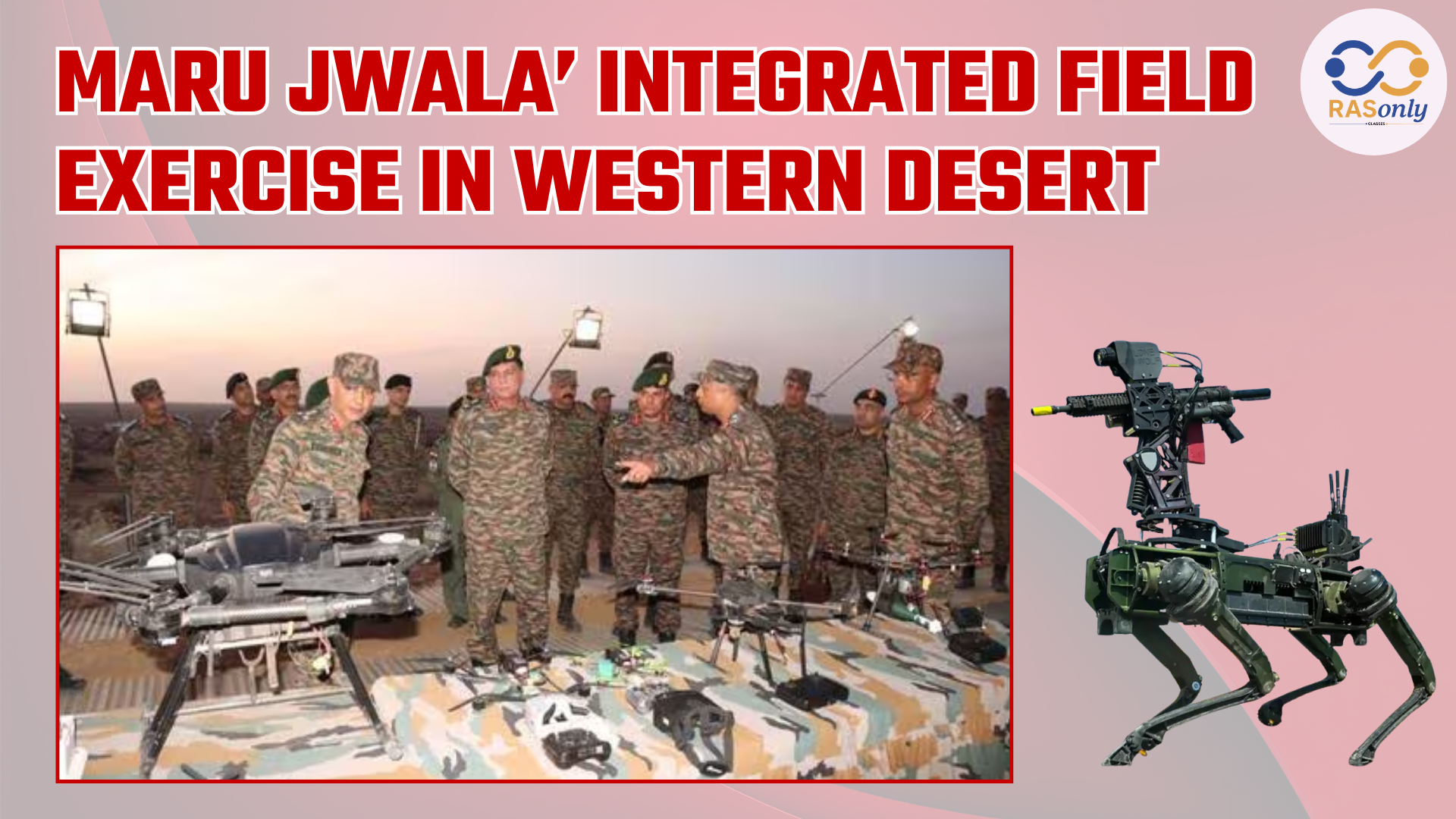
The Indian Army in liaison with the Indian Air Force executed the Indian Army field exercise, Maru Jwala, in the western desert sector on the India-Pakistan border in the broader operation construct Trishul. Armour columns, mechanised infantry and artillery carried out mobile offensive exercises and fighter aircraft and helicopters made precision attacks on simulated enemy targets. The drill tested the idea of networked and multi-domain operations through the application of drones in surveilling, providing evacuation and logistics support. One of the trials was a quadruped robotic dog that was carrying a first-aid box to forward squads, which decreased the risk of exposure of medics. Village evacuation was also practiced by troops by use of the public-address drones, night firing, quick bridging, and last mile resupply during dust-storm and high-heat environments that are characteristic of the Thar.
Key Features
- Precision land and air attack by the Joint Army-IAF.
- ISR in real-time with drones; acquisition of targets and evaluation of bomb-damage.
- Robot trial of dog delivering first aid to forward troops.
- Drone managed village evacuation messaging and reconstruction of routes.
- Logistics: drone deliveries of ammo/medical packs; quick turnaround and refuel.
- Tanks/IFVs night manoeuvres; counter-UAS exercises.
Objectives
- Authenticate multi-domain (land-air-UAS) combat in desert conditions.
- utility of stress-test command, control and jamming.
- Train faster civilian-safety measures on the border (evacuation and info-ops).
Significance
- Improves the deterrence and swift-strike capacity in the West.
- Minimizes casualties by unmanned logistics/medic support.
- Enhanced coordination of inter-service and time-critical targeting.
Technology Highlights
- Quad/hex-rotor ISR, EW awareness, and last-mile resupply UAS.
- Elastic robotic carrier is a quadruped medical payload carrier to forward segments.
- Networked fire-control FOOs, UAV feeds, artillery and air strikes.
RAS Exam Pointers
- Place/topic Western Desert sector (Rajasthan); combined Army-IAF exercise.
- Doctrinal lens Integrated battle groups, network-centric operations, multi-domain integration.
- Civil-mil activities exercises: messaging evacuations and casualty evacuation Using villages as a case study.
Conclusion
Maru Jwala evidences the increasing expertise of India in networked, high tempo desert war. Armour thrust, accuracy in air support and unmanned medical and logistics trials are just some of the exercises that prove quick-reaction, inter-service coordination and civilian-protection drills. The combination of the old platforms and the new-age robotics and drones enhances preparedness throughout the western theatre.
MCQs (English)
1. What was the main doctrine that was confirmed by Maru Jwala?
A. Mountain warfare only
B. Multi-domain desert operations Network-centric.
C. Blue-water maritime denial
D. Urban counter-insurgency
Answer: B
Explanation: The drill demonstrated combined Army-IAF maneuver, ISR drones, logistics robots and coordinated fires- the characteristics of network-centric, multi-domain operations in desert land.
2. What was the specific innovation that was trialed concerning frontline medical reach?
A. Exoskeleton stretcher suits.
B. Robotic quadruped with first-aid box.
C. Armed loitering munitions
D. Battlefield laser dazzlers.
Answer: B
Explanation: The four-legged robotic dog was employed to provide first-aid to those in front areas to minimize medics exposure to hostile areas or mined areas.
3. One of the civilian-protection exercises featured in the exercise was:
A. Seaborn evacuation
B. Cyber range takedown
C. Village evacuation messaging by drone.
D. Under-river bridging
Answer: C
Description: Public-address drones were employed to air evacuation instructions and organize safe passages- useful to habitats of the border.
पश्चिमी मरुस्थल में ‘मारु ज्वाला’ समेकित फील्ड अभ्यास
भारत–पाकिस्तान सीमा से लगे पश्चिमी मरु प्रदेश में भारतीय थलसेना ने वायुसेना के साथ ‘मरु ज्वाला’ फील्ड एक्सरसाइज संचालित की, जो ‘त्रिशूल’ ऑपरेशनल ढांचे का हिस्सा है। टैंकों, मैकेनाइज़्ड इन्फेंट्री और तोपखाने ने मोबाइल आक्रामक अभ्यास किए, जबकि लड़ाकू विमानों/हेलीकॉप्टरों ने सटीक वार कर काल्पनिक शत्रु लक्ष्यों को नष्ट किया। ड्रोन-आधारित निगरानी, रसद और निकासी सहायता के साथ बहु-क्षेत्रीय नेटवर्क-संचालित युद्धक क्षमता को परखा गया। उल्लेखनीय नवाचार के रूप में चौपाया “रोबोटिक डॉग” द्वारा फर्स्ट-एड बॉक्स अग्रिम दस्तों तक पहुँचाया गया। धूल-आंधी और तीव्र गर्मी जैसी थार परिस्थितियों में रात्रि फायरिंग, त्वरित पुल-स्थापना, ड्रोन से ग्राम-खालीकरण संदेश तथा अंतिम-मील आपूर्ति का भी अभ्यास हुआ।
प्रमुख विशेषताएँ
- थलसेना–वायुसेना द्वारा संयुक्त सटीक हमले।
- ड्रोन से वास्तविक-समय निगरानी, लक्ष्य-साधन और क्षति-आकलन।
- घायल सैनिकों तक फर्स्ट-एड पहुँचाने हेतु रोबोटिक डॉग का परीक्षण।
- ड्रोन-लाउडस्पीकर से ग्राम-खालीकरण संदेश और मार्ग-टोही।
- गोला-बारूद/चिकित्सा पैकेट की ड्रोन-आधारित आपूर्ति; त्वरित रिफ्यूल/टर्नअराउंड।
- रात्रि संचलन व काउंटर-UAS ड्रिल्स।
उद्देश्य
- रेगिस्तानी भूभाग में भूमि-वायु-UAS का एकीकृत संचालन सत्यापित करना।
- धूल, गर्मी और जैमिंग में कमान-नियंत्रण को परखना।
- सीमा-समीप नागरिक सुरक्षा (ग्राम-खालीकरण, casualty evacuation) की ड्रिल करना।
महत्व
- पश्चिमी मोर्चे पर त्वरित-प्रहार और प्रतिरोध क्षमता सुदृढ़।
- मानवरहित रसद/मेडिक सहायता से हताहत जोखिम कम।
- अंतर-सेवा समन्वय और समय-संवेदी लक्ष्यभेदन बेहतर।
प्रौद्योगिकी प्रमुख बिंदु
- ISR/ईडब्ल्यू अवेयरनेस और अंतिम-मील सप्लाई हेतु क्वाड/हेक्स-रोटर UAS।
- चिकित्सा पेलोड ले जाने वाला चौपाया रोबोट।
- पर्यवेक्षक अधिकारियों, UAV फीड, तोपखाने व वायु हमलों का नेटवर्क्ड फायर-कंट्रोल।
आरएएस परीक्षा संकेत
- स्थान/थीम: राजस्थान का पश्चिमी मरु क्षेत्र; संयुक्त थलसेना–वायुसेना अभ्यास।
- सिद्धांत: इंटीग्रेटेड बैटल ग्रुप, नेटवर्क-सेंट्रिक व बहु-क्षेत्रीय संचालन।
- नागरिक-सैन्य अभ्यास: ग्राम-खालीकरण संदेश, casualty evacuation।
निष्कर्ष
‘मरु ज्वाला’ भारत की नेटवर्क-आधारित, उच्च-गति मरु युद्धक क्षमता का सशक्त प्रदर्शन है। बख़्तरबंद thrust, सटीक वायु-समर्थन तथा ड्रोन/रोबोटिक नवाचारों के संग यह अभ्यास त्वरित-प्रतिक्रिया, अंतर-सेवा तालमेल और नागरिक-सुरक्षा उपायों को प्रमाणित करता है। पश्चिमी थिएटर में तत्परता और निवारक क्षमता इससे और मजबूत होती है।
बहुविकल्पीय प्रश्न
1. ‘मरु ज्वाला’ ने मुख्यतः किस सिद्धान्तिक दृष्टिकोण को प्रमाणित किया?
A. केवल पर्वतीय युद्धकला
B. नेटवर्क-सेंट्रिक, बहु-क्षेत्रीय मरु संचालन
C. ब्लू-वाटर समुद्री अवरोध
D. नगरीय उग्रवाद-रोधी
उत्तर: B
व्याख्या: अभ्यास में सेना-वायुसेना का एकीकृत संचालन, ISR ड्रोन, रोबोटिक रसद तथा समन्वित फायर दिखाई दिए—जो मरु क्षेत्र में नेटवर्क-संचालित बहु-क्षेत्रीय युद्ध के प्रमुख तत्व हैं।
2. अग्रिम मोर्चे तक चिकित्सकीय पहुँच के लिए कौन-सा नवोन्मेष परखा गया?
A. एक्ज़ो-स्केलेटन स्ट्रेचर सूट
B. फर्स्ट-एड बॉक्स ले जाने वाला चौपाया रोबोट
C. सशस्त्र लुटरिंग म्यूनिशन
D. बैटलफील्ड लेज़र डैज़लर
उत्तर: B
व्याख्या: चार टांगों वाला “रोबोटिक डॉग” फर्स्ट-एड बॉक्स लेकर अग्रिम दस्तों तक पहुँचा, जिससे मेडिक्स का जोखिम कम हुआ।
3. नागरिक-सुरक्षा से जुड़ा कौन-सा अभ्यास प्रमुख रहा?
A. समुद्री निकासी
B. साइबर रेंज निष्क्रियकरण
C. ड्रोन-आधारित ग्राम-खालीकरण संदेश
D. नदी के भीतर पुल निर्माण
उत्तर: C
व्याख्या: सार्वजनिक-घोषणा ड्रोन से सुरक्षित मार्ग और खालीकरण निर्देश प्रसारित किए गए, जो सीमा-समीप बस्तियों के लिए अत्यंत उपयोगी है।