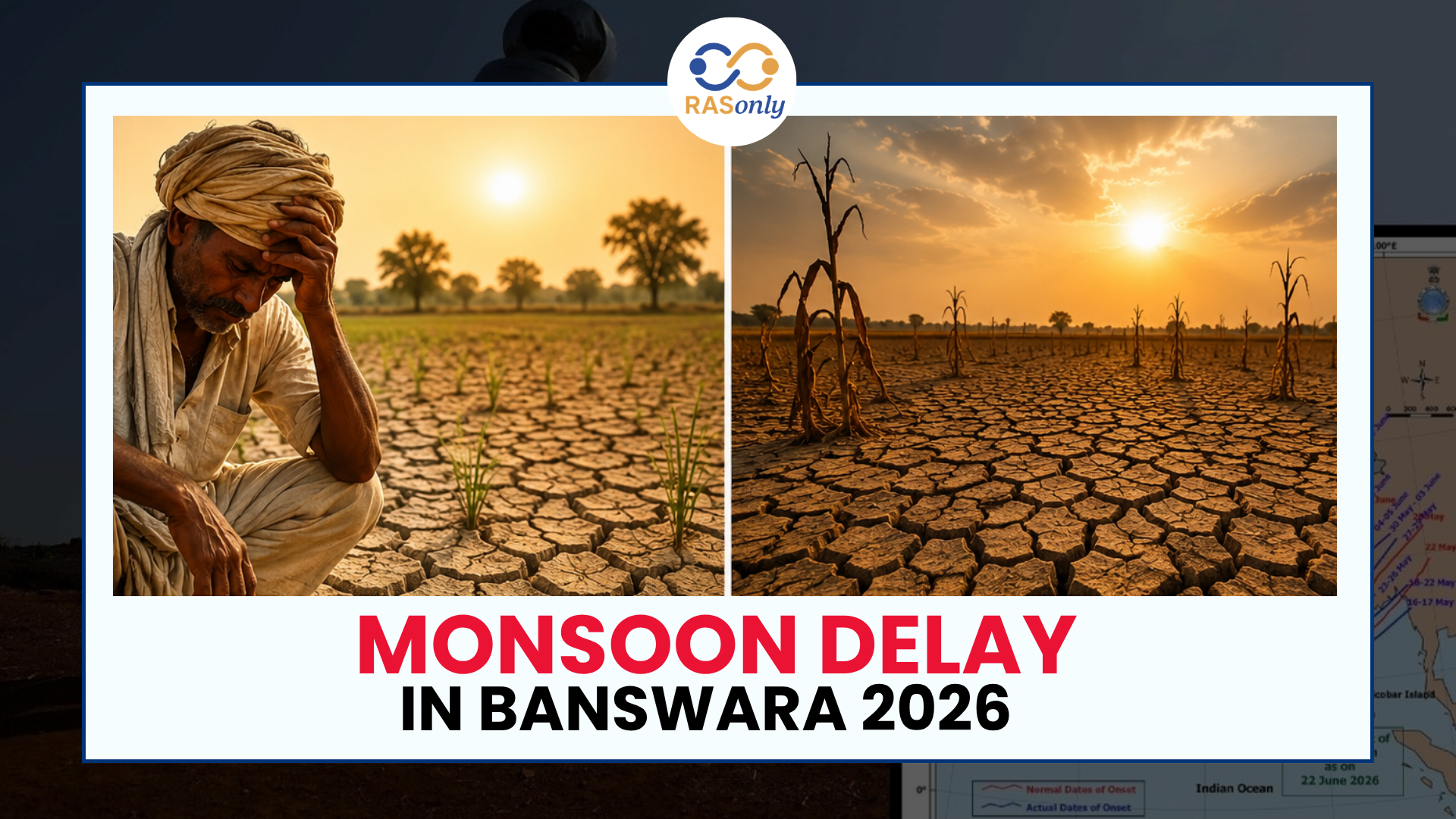
Banswara is also called as “Cherrapunji of Rajasthan” for its very high annual rainfall and this year it has faced an unusual lapse in receiving southwest monsoon. The first major monsoon showers are usually experienced in the district between 15 and 18 June, but the monsoon has not started properly so far, which has led to growing worries over the heat stress and farmers' concerns.
Background
Banswara is in the southern part of Rajasthan, in the Vagad region, which receives highest rainfall among all the regions of the state. It receives a significantly higher amount of rainfall than the rest of the state, and its climate is relatively humid, so for this reason it is called the "Cherrapunji of Rajasthan.
The district contributes significantly to the agriculture economy of Rajasthan, especially during the Kharif crop season where timely monsoon rains are essential for sowing operations. The southwest monsoon is traditionally considered to enter into the state of Rajasthan through Vagad-Mewar belt which makes Banswara one of the initial districts in the state receiving monsoon rainfall.
Current Situation
Delayed Arrival of Monsoon
Although the southwest monsoon has started to move on over Banswara, it has not yet fully established.
There have been only two spells of pre monsoon rain in the past few days.
The clouds are scattered with little coverage over the region.
The meteorologists forecast that monsoon activity will be observed in the near future in both the Arabian Sea branch and Bay of Bengal branch.
Rising Temperatures and Heat Stress
Due to the delay in monsoon rains, the following has been observed:
- Increasing daytime temperatures.
- Dry atmospheric conditions.
- Average July heat conditions for April/May.
- Inconvenience to the public and farm workers.
Weather experts predict that the temperature gap will persist in the next few days till monsoon activity gets stronger.
Impact on Agriculture
Farmers Waiting for Adequate Rainfall
After the pre-monsoon rains farmers had already started to plow fields for sowing. However, no rains have been received for prolonged periods and this has slowed down the sowing process.
Farmers are now holding out for adequate rains to come before they:
- Applying seeds and fertilizers.
- Beginning large-scale Kharif cultivation.
- Undertaking field-level agricultural operations
Kharif 2026 Cultivation Targets
The Agriculture Department has set a target of almost nearly 1.75 lakh hectares for Kharif cultivation in 2026.
Major Crops Planned
- Maize
- Soybean
- Paddy (Rice)
- Cotton
Insufficient rains may impact on sowing programmes and crop yields.
Rainfall Profile of Banswara
Rainfall Fact File
|
|
|
|
|
|
|
|
|
|
|
|
|
|
|
Key Highlights
- Banswara is one of the Rainfall Receiving Districts of Rajasthan in the Top 4 List.
- The district has a history of receiving amounts of rainfall well above the average for the state.
- In recent years rainfall has been above average.
Monsoon Progress Across India
Arabian Sea Branch
The Arabian Sea branch of the southwest monsoon enters into Rajasthan through Vagad-Mewar region in the month of June usually from 18-22 June.
However, this year:
- The passage of monsoon over the southern parts of Rajasthan has not commenced.
- As on 22nd June, the Arabian Sea branch was up to Mumbai.
Bay of Bengal Branch
The monsoon current in the Bay of Bengal has spread through:
- Chhattisgarh
- Eastern Madhya Pradesh
- Southern Madhya Pradesh
Meteorologists expect further advancement into southern Rajasthan during the current week.
Expected Monsoon Scenario
Weather experts say:
- There is a possibility of the monsoon becoming active over Banswara, Dungarpur, Pratapgarh, Mewar and Hadoti regions during the week.
- The initial rainfall may remain relatively weak.
- More widespread rainfall activity is expected as the monsoon system strengthens.
Importance of Banswara in Rajasthan’s Monsoon Geography
Gateway of Monsoon in Rajasthan
Banswara lies strategically in the monsoon system of Rajasthan as:
- It is one of the first districts to get monsoon rains.
- It is used as a cue for the advance of the monsoon over southern Rajasthan.
- Agricultural activities in the Vagad region are greatly affected by rainfall received in the district.
Contribution to Water Resources
Being well supported by good monsoon rainfall in Banswara helps:
- Recharge groundwater reserves.
- Enhance reservoir and river levels.
- Provide support for agriculture and drinking water.
- Maintain ecological balance in south Rajasthan.
Challenges Emerging from the Delay
Agricultural Concerns
- There was a delay in sowing operations.
- A rise in farmers' uncertainty.
- Potential effects on crop yields if rainfall continues to be below normal.
Climatic Stress
- Rising temperatures.
- Higher evaporation rates.
- Higher than usual water pressure.
Economic Impact
Agriculture is still very reliant on monsoon rains and a late start could impact:
- Farm incomes.
- Rural employment.
- The amount of food produced in the region.
Conclusion
The southwest monsoon has been late to reach the highest rainfall region of Rajasthan, Banswara, where it is known as the “Cherrapunji”, and it has raised concern among farmers and the policy makers. Kharif sowing is rain dependent, thus timely onset of monsoon in the upcoming days will be key in contributing to the agriculture, groundwater recharge and water security for the region. Meteorological conditions are favorable for the monsoon to enter into the southern part of Rajasthan in the coming days, however, its strength and spread will affect the success or failure of the Kharif 2026 farming season in the Vagad, Mewar and Hadoti areas.
MCQs
Question 1
Why is Banswara traditionally referred to as the “Cherrapunji of Rajasthan”?
A) It is the exact geographic center of the southwest monsoon system.
B) It has the highest target for Kharif cultivation in the state at 1.75 lakh hectares.
C) It receives a significantly higher amount of annual rainfall compared to other regions in the state.
D) It is the only district in Rajasthan that relies entirely on the Bay of Bengal branch of the monsoon.
- Correct Answer: C) It receives a significantly higher amount of annual rainfall compared to other regions in the state.
- Explanation: Banswara is located in the southern Vagad region, which receives the highest rainfall in Rajasthan. Because its climate is relatively humid and its annual rainfall is consistently well above the state average (with a 10-year average of 933.40 mm), it is nicknamed the "Cherrapunji of Rajasthan."
Question 2
Which of the following regional belts acts as the traditional geographic "gateway" through which the Southwest Monsoon enters the state of Rajasthan?
A) Hadoti region
B) Vagad-Mewar belt
C) Marwar-Shekhawati tract
D) Matsya region
- Correct Answer: B) Vagad-Mewar belt
- Explanation: The southwest monsoon currents traditionally enter Rajasthan through the Vagad-Mewar belt in the southern part of the state. Because Banswara is strategically located within this initial entry zone, it is one of the very first districts to receive monsoon rainfall and serves as a vital indicator for the advancement of the monsoon across southern Rajasthan.
Question 3
What major risk do farmers face in Banswara due to the prolonged delay between the pre-monsoon rains and the actual monsoon arrival?
A) They cannot determine which crops are part of the Kharif category.
B) They are delayed in applying seeds/fertilizers and starting large-scale cultivation despite already plowing fields.
C) The Agriculture Department will cancel the 1.75 lakh hectare cultivation target.
D) Groundwater reserves will permanently dry up before July.
- Correct Answer: B) They are delayed in applying seeds/fertilizers and starting large-scale cultivation despite already plowing fields.
- Explanation: Following the early pre-monsoon spells, many farmers eagerly plowed their fields to prepare for sowing. However, the subsequent lack of adequate rainfall has forced them to pause operations, delaying the application of seeds and fertilizers and slowing down the overall Kharif 2026 cultivation timeline.
बांसवाड़ा में मानसून की देरी 2026: राजस्थान में खरीफ फसलों और किसानों पर प्रभाव
बांसवाड़ा को अपने अत्यधिक उच्च वार्षिक वर्षा स्तर के कारण "राजस्थान का चेरापूंजी" भी कहा जाता है, और इस वर्ष इसे दक्षिण-पश्चिम मानसून के आगमन में एक असामान्य देरी का सामना करना पड़ा है। जिले में आमतौर पर मानसून की पहली मुख्य बारिश 15 से 18 जून के बीच देखने को मिलती है, लेकिन अब तक मानसून ठीक से शुरू नहीं हो पाया है, जिससे बढ़ते तापमान के तनाव और किसानों की चिंताएं बढ़ गई हैं।
पृष्ठभूमि
बांसवाड़ा राजस्थान के दक्षिणी भाग में, वागड़ क्षेत्र में स्थित है, जो राज्य के सभी क्षेत्रों में सबसे अधिक वर्षा प्राप्त करता है। यह राज्य के बाकी हिस्सों की तुलना में काफी अधिक मात्रा में वर्षा प्राप्त करता है, और इसकी जलवायु अपेक्षाकृत आर्द्र है, इसी कारण से इसे "राजस्थान का चेरापूंजी" कहा जाता है।
यह जिला राजस्थान की कृषि अर्थव्यवस्था में महत्वपूर्ण योगदान देता है, विशेष रूप से खरीफ फसल के मौसम के दौरान जहां बुआई कार्यों के लिए समय पर मानसूनी बारिश आवश्यक है। दक्षिण-पश्चिम मानसून को पारंपरिक रूप से वागड़-मेवाड़ पट्टी के माध्यम से राजस्थान राज्य में प्रवेश करने वाला माना जाता है, जो बांसवाड़ा को मानसून की बारिश प्राप्त करने वाले राज्य के शुरुआती जिलों में से एक बनाता है।
वर्तमान स्थिति
मानसून के आगमन में देरी
- हालांकि दक्षिण-पश्चिम मानसून बांसवाड़ा की ओर बढ़ने लगा है, लेकिन यह अभी तक पूरी तरह से स्थापित नहीं हुआ है।
- पिछले कुछ दिनों में प्री-मानसून (मानसून-पूर्व) बारिश के केवल दो दौर हुए हैं।
- क्षेत्र में बहुत कम कवरेज के साथ बादल बिखरे हुए हैं।
- मौसम वैज्ञानिकों का अनुमान है कि निकट भविष्य में अरब सागर शाखा और बंगाल की खाड़ी शाखा दोनों में मानसून की गतिविधि देखी जाएगी।
बढ़ता तापमान और हीट स्ट्रेस (गर्मी का तनाव)
मानसून की बारिश में देरी के कारण निम्नलिखित परिस्थितियां देखी गई हैं:
- दिन के तापमान में वृद्धि।
- शुष्क वायुमंडलीय स्थितियां।
- अप्रैल/मई में ही जुलाई जैसी औसत गर्मी की स्थिति।
- आम जनता और कृषि श्रमिकों को असुविधा।
नोट: मौसम विशेषज्ञों की भविष्यवाणी है कि जब तक मानसून की गतिविधि मजबूत नहीं हो जाती, तब तक अगले कुछ दिनों में तापमान का यह अंतर बना रहेगा।
कृषि पर प्रभाव
पर्याप्त वर्षा की प्रतीक्षा में किसान
- प्री-मानसून बारिश के बाद किसानों ने बुआई के लिए खेतों की जुताई शुरू कर दी थी। हालांकि, लंबे समय से बारिश नहीं हुई है और इसने बुआई की प्रक्रिया को धीमा कर दिया है।
- किसान अब निम्नलिखित कार्यों को शुरू करने से पहले पर्याप्त बारिश का इंतजार कर रहे हैं:
- बीज और उर्वरक डालना।
- बड़े पैमाने पर खरीफ की खेती शुरू करना।
- खेत-स्तरीय कृषि कार्यों को अंजाम देना।
खरीफ 2026 खेती के लक्ष्य
कृषि विभाग ने 2026 में खरीफ की खेती के लिए लगभग 1.75 लाख हेक्टेयर का लक्ष्य रखा है।
नियोजित मुख्य फसलें:
- मक्का
- सोयाबीन
- धान (चावल)
- कपास
अपर्याप्त बारिश से बुआई कार्यक्रमों और फसल की उपज पर असर पड़ सकता है।
बांसवाड़ा का वर्षा प्रोफाइल (Rainfall Profile)
वर्षा का फैक्ट फाइल (आंकड़े)
|
|
|
|
|
|
|
|
|
|
|
|
|
|
|
मुख्य विशेषताएं:
- बांसवाड़ा राजस्थान के शीर्ष 4 सबसे अधिक वर्षा प्राप्त करने वाले जिलों की सूची में शामिल है।
- जिले का इतिहास राज्य के औसत से काफी अधिक मात्रा में वर्षा प्राप्त करने का रहा है।
- हाल के वर्षों में वर्षा औसत से अधिक रही है।
पूरे भारत में मानसून की प्रगति
अरब सागर शाखा
- दक्षिण-पश्चिम मानसून की अरब सागर शाखा आमतौर पर जून के महीने में 18-22 जून तक वागड़-मेवाड़ क्षेत्र के माध्यम से राजस्थान में प्रवेश करती है।
- हालांकि, इस वर्ष:
- राजस्थान के दक्षिणी हिस्सों में मानसून का आगे बढ़ना शुरू नहीं हुआ है।
- 22 जून तक अरब सागर शाखा मुंबई तक ही पहुंची थी।
बंगाल की खाड़ी शाखा
बंगाल की खाड़ी में मानसून की धारा निम्नलिखित क्षेत्रों में फैल चुकी है:
- छत्तीसगढ़
- पूर्वी मध्य प्रदेश
- दक्षिणी मध्य प्रदेश
मौसम वैज्ञानिकों को चालू सप्ताह के दौरान दक्षिणी राजस्थान में इसके आगे बढ़ने की उम्मीद है।
अपेक्षित मानसून परिदृश्य
मौसम विशेषज्ञों का कहना है:
- सप्ताह के दौरान बांसवाड़ा, डूंगरपुर, प्रतापगढ़, मेवाड़ और हाड़ौती क्षेत्रों में मानसून के सक्रिय होने की संभावना है।
- शुरुआती बारिश अपेक्षाकृत कमजोर रह सकती है।
- जैसे-जैसे मानसून प्रणाली मजबूत होगी, अधिक व्यापक वर्षा गतिविधि की उम्मीद है।
राजस्थान के मानसून भूगोल में बांसवाड़ा का महत्व
राजस्थान में मानसून का प्रवेश द्वार (Gateway)
बांसवाड़ा राजस्थान की मानसून प्रणाली में रणनीतिक रूप से महत्वपूर्ण स्थान रखता है क्योंकि:
- यह मानसून की बारिश प्राप्त करने वाले पहले जिलों में से एक है।
- इसका उपयोग दक्षिणी राजस्थान में मानसून के आगे बढ़ने के संकेत (cue) के रूप में किया जाता है।
- वागड़ क्षेत्र में कृषि गतिविधियां जिले में प्राप्त होने वाली वर्षा से काफी प्रभावित होती हैं।
जल संसाधनों में योगदान
बांसवाड़ा में अच्छी मानसूनी बारिश से निम्नलिखित में मदद मिलती है:
- भूजल भंडारों (groundwater reserves) को रीचार्ज करना।
- जलाशयों और नदियों के जल स्तर को बढ़ाना।
- कृषि और पीने के पानी के लिए सहायता प्रदान करना।
- दक्षिण राजस्थान में पारिस्थितिक संतुलन बनाए रखना।
देरी से उभरती चुनौतियां
- कृषि संबंधी चिंताएं: बुआई कार्यों में देरी, किसानों में बढ़ती अनिश्चितता, और यदि बारिश सामान्य से कम रहती है तो फसल की उपज पर संभावित प्रभाव।
- जलवायु तनाव (Climatic Stress): बढ़ता तापमान, उच्च वाष्पीकरण दर, और सामान्य से अधिक जल संकट।
- आर्थिक प्रभाव: कृषि अभी भी मानसूनी बारिश पर बहुत अधिक निर्भर है और देर से शुरुआत होने से कृषि आय, ग्रामीण रोजगार और क्षेत्र में उत्पादित खाद्य सामग्री की मात्रा प्रभावित हो सकती है।
निष्कर्ष
दक्षिण-पश्चिम मानसून राजस्थान के सबसे अधिक वर्षा वाले क्षेत्र, बांसवाड़ा (जिसे "चेरापूंजी" के रूप में जाना जाता है) में पहुँचने में लेट हो गया है, और इसने किसानों तथा नीति निर्माताओं के बीच चिंता बढ़ा दी है। खरीफ की बुआई वर्षा पर निर्भर है, इसलिए आने वाले दिनों में मानसून का समय पर आना क्षेत्र के लिए कृषि, भूजल रीचार्ज और जल सुरक्षा में योगदान देने के लिए महत्वपूर्ण होगा। आने वाले दिनों में राजस्थान के दक्षिणी भाग में मानसून के प्रवेश करने के लिए मौसम संबंधी स्थितियां अनुकूल हैं, हालांकि, इसकी ताकत और प्रसार वागड़, मेवाड़ और हाड़ौती क्षेत्रों में खरीफ 2026 कृषि सीजन की सफलता या विफलता को तय करेगा।
बहुविकल्पीय प्रश्न (MCQs)
प्रश्न 1
बांसवाड़ा को पारंपरिक रूप से "राजस्थान का चेरापूंजी" क्यों कहा जाता है?
A) यह दक्षिण-पश्चिम मानसून प्रणाली का सटीक भौगोलिक केंद्र है।
B) राज्य में खरीफ की खेती के लिए इसका सबसे अधिक 1.75 लाख हेक्टेयर का लक्ष्य है।
C) यह राज्य के अन्य क्षेत्रों की तुलना में काफी अधिक मात्रा में वार्षिक वर्षा प्राप्त करता है।
D) यह राजस्थान का एकमात्र ऐसा जिला है जो पूरी तरह से मानसून की बंगाल की खाड़ी शाखा पर निर्भर है।
- सही उत्तर: C) यह राज्य के अन्य क्षेत्रों की तुलना में काफी अधिक मात्रा में वार्षिक वर्षा प्राप्त करता है।
- स्पष्टीकरण: बांसवाड़ा दक्षिणी वागड़ क्षेत्र में स्थित है, जो राजस्थान में सबसे अधिक वर्षा प्राप्त करता है। क्योंकि इसकी जलवायु अपेक्षाकृत आर्द्र है और इसकी वार्षिक वर्षा लगातार राज्य के औसत से काफी ऊपर (10-वर्षीय औसत 933.40 मिमी के साथ) रही है, इसलिए इसे "राजस्थान का चेरापूंजी" उपनाम दिया गया है।
प्रश्न 2
निम्नलिखित में से कौन सा क्षेत्रीय बेल्ट पारंपरिक भौगोलिक "प्रवेश द्वार" के रूप में कार्य करता है जिसके माध्यम से दक्षिण-पश्चिम मानसून राजस्थान राज्य में प्रवेश करता है?
A) हाड़ौती क्षेत्र
B) वागड़-मेवाड़ पट्टी
C) मारवाड़-शेखावाटी क्षेत्र
D) मत्स्य क्षेत्र
- सही उत्तर: B) वागड़-मेवाड़ पट्टी
- स्पष्टीकरण: दक्षिण-पश्चिम मानसून की धाराएं पारंपरिक रूप से राज्य के दक्षिणी भाग में वागड़-मेवाड़ पट्टी के माध्यम से राजस्थान में प्रवेश करती हैं। चूंकि बांसवाड़ा इस प्रारंभिक प्रवेश क्षेत्र के भीतर रणनीतिक रूप से स्थित है, इसलिए यह मानसून की बारिश प्राप्त करने वाले सबसे पहले जिलों में से एक है और दक्षिणी राजस्थान में मानसून के आगे बढ़ने के लिए एक महत्वपूर्ण संकेतक के रूप में कार्य करता lights।
प्रश्न 3
बांसवाड़ा में प्री-मानसून बारिश और वास्तविक मानसून के आगमन के बीच लंबे समय की देरी के कारण किसानों को किस बड़े जोखिम का सामना करना पड़ रहा है?
A) वे यह निर्धारित नहीं कर पा रहे हैं कि कौन सी फसलें खरीफ श्रेणी का हिस्सा हैं।
B) खेतों की जुताई पहले ही कर लेने के बावजूद वे बीज/उर्वरक डालने और बड़े पैमाने पर खेती शुरू करने में देरी का सामना कर रहे हैं।
C) कृषि विभाग 1.75 लाख हेक्टेयर खेती का लक्ष्य रद्द कर देगा।
D) जुलाई से पहले भूजल भंडार स्थायी रूप से सूख जाएंगे।
- सही उत्तर: B) खेतों की जुताई पहले ही कर लेने के बावजूद वे बीज/उर्वरक डालने और बड़े पैमाने पर खेती शुरू करने में देरी का सामना कर रहे हैं।
- स्पष्टीकरण: शुरुआती प्री-मानसून दौर के बाद, कई किसानों ने बुआई की तैयारी के लिए उत्सुकता से अपने खेतों की जुताई कर दी थी। हालांकि, उसके बाद पर्याप्त बारिश की कमी ने उन्हें कार्यों को रोकने के लिए मजबूर कर दिया है, जिससे बीज और उर्वरक डालने में देरी हो रही है और समग्र खरीफ 2026 खेती की समयसीमा धीमी हो गई है।
