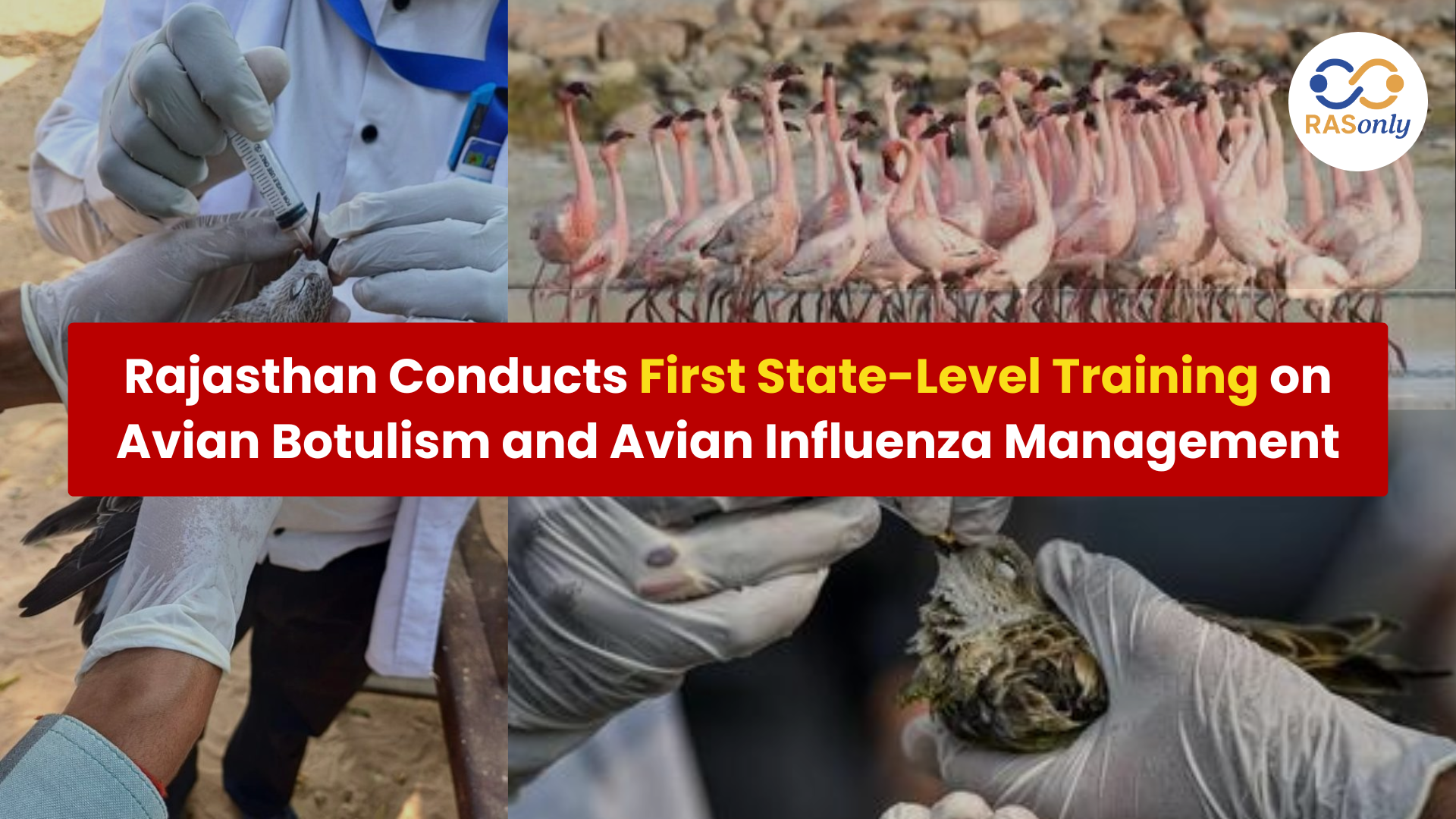
A two-day training programme on the identification, prevention, treatment, and disaster management of avian botulism and avian influenza concluded on Friday in Jaipur. Organised jointly by the Animal Husbandry Department, Forest Department, Sambhar Lake Management Agency, and Wildlife Trust of India, this was the first such State-level initiative. The programme was held under the leadership of Dr. Samit Sharma, Secretary, Animal Husbandry Department, and Biju Joy, CEO of Sambhar Lake Management Agency. Veterinary officers from Ramsar wetland regions participated. The aim was to strengthen practical expertise in early detection, timely disease management, scientific treatment, and field preparedness for these infectious avian diseases, which pose serious risks to the environment, livestock, and rural economy.
Key Highlights
Disease Identification, Prevention and Response
- Training organised at the Livestock Management and Training Institute, Jamdoli.
- Participants included veterinary officers from Rajasthan’s Ramsar wetland regions.
- Objective: Strengthening disease surveillance, rapid response capability, and scientific intervention in the field.
Address by Secretary Dr. Samit Sharma
- Livestock protection is among the highest priorities of the State Government.
- Rapidly changing biological risks and environmental conditions are increasing infectious disease threats.
- Early scientific diagnosis, vigilance, and integrated field response are essential.
- Diseases like avian botulism and avian influenza have significant economic and social impacts.
- Veterinary teams must effectively apply the training and guide farmers accurately.
- The department is strengthening livestock security through modern technology, digital reporting, laboratory networks, and rapid response teams.
Practical Field-Based Training
- Demonstrations conducted on field techniques to be adopted during disease outbreaks.
- Training will enhance livestock protection in rural areas and help prevent future disease incidents.
- Certificates were distributed to participants at the closing ceremony.
Officials Present
Director Dr. Sureshchand Meena, Additional Director Dr. Hemant Pant, Joint Director Dr. Tapesh Mathur, Dr. Sangeeta Mathur and other officials were present.
Conclusion
The State-level two-day training on avian botulism and avian influenza marks an important step in strengthening Rajasthan’s preparedness for managing infectious livestock diseases. By integrating scientific knowledge, field demonstrations, digital reporting, and rapid response systems, the initiative enhances animal health security, protects rural livelihoods, and ensures early containment of disease outbreaks in vulnerable wetland regions.
MCQs (English)
MCQ 1
What was the main aim of the two-day training on avian botulism and avian influenza?
a) To promote bird tourism in wetlands
b) To train veterinary officers on identification, prevention and field control of avian diseases
c) To introduce a new vaccine for livestock
d) To draft new wetland conservation policies
Answer: b)
Explanation:
The programme aimed to enhance hands-on skills of veterinary officers in identifying, preventing and treating avian botulism and avian influenza, along with improving their field-level disaster response capability.
MCQ 2
According to Dr. Samit Sharma, what factor is increasing the risk of infectious diseases in animals?
a) Overuse of technology in livestock farming
b) Rapidly changing biological risks and environmental conditions
c) Overpopulation of livestock in wetlands
d) Decline in veterinary education
Answer: b)
Explanation:
Dr. Sharma emphasised that fast-changing biological and environmental conditions are increasing the threat of infectious diseases, making scientific vigilance and rapid action essential.
MCQ 3
Which institutions collaborated to organise the two-day training programme?
a) Agriculture Department, NRLM and NDRF
b) Animal Husbandry Department, Forest Department, Sambhar Lake Management Agency and Wildlife Trust of India
c) Pollution Control Board and Ministry of Environment
d) FAO and Rural Development Department
Answer: b)
Explanation:
The training was a joint initiative conducted by the Animal Husbandry Department, Forest Department, Sambhar Lake Management Agency and Wildlife Trust of India—marking the first such collaborative training in Rajasthan on avian disease management.
राजस्थान में एवियन बोटूलिज़्म एवं एवियन इन्फ्लुएंजा प्रबंधन पर पहली राज्य स्तरीय प्रशिक्षण कार्यशाला आयोजित
एवियन बोटूलिज़्म और एवियन इन्फ्लुएंज़ा की पहचान, रोकथाम, उपचार एवं आपदा प्रबंधन पर आधारित दो दिवसीय प्रशिक्षण कार्यक्रम का समापन शुक्रवार को जयपुर में हुआ। यह राज्य में अपनी तरह का पहला कार्यक्रम था, जिसे पशुपालन विभाग, वन विभाग, सांभर लेक मैनेजमेंट एजेंसी और वाइल्डलाइफ ट्रस्ट ऑफ इंडिया द्वारा संयुक्त रूप से आयोजित किया गया। कार्यक्रम का नेतृत्व पशुपालन विभाग के शासन सचिव डॉ. समित शर्मा एवं सांभर लेक मैनेजमेंट एजेंसी के मुख्य कार्यकारी अधिकारी बिजु जॉय ने किया। रामसर वेटलैंड क्षेत्रों से आए पशु चिकित्सकों ने इसमें भाग लिया। इसका उद्देश्य इन संक्रामक पक्षी रोगों की प्रारम्भिक पहचान, त्वरित प्रबंधन, वैज्ञानिक उपचार तथा फील्ड-स्तर पर आपदा तैयारियों को मजबूत करना था, क्योंकि ये रोग पर्यावरण, पशुधन एवं ग्रामीण अर्थव्यवस्था पर गंभीर प्रभाव डालते हैं।
मुख्य बिंदु
रोग की पहचान, रोकथाम और त्वरित प्रतिक्रिया
- प्रशिक्षण जामडोली स्थित पशुधन प्रबंधन एवं प्रशिक्षण संस्थान में आयोजित हुआ।
- प्रतिभागी: प्रदेश के रामसर वेटलैंड क्षेत्रों के पशु चिकित्सक।
- उद्देश्य: रोग निगरानी क्षमता, त्वरित प्रतिक्रिया तंत्र और वैज्ञानिक फील्ड हस्तक्षेप को मजबूत करना।
शासन सचिव डॉ. समित शर्मा का संबोधन
- पशुधन सुरक्षा राज्य सरकार की सर्वोच्च प्राथमिकताओं में से एक है।
- लगातार बदलते जैविक जोखिमों और पर्यावरणीय परिस्थितियों से संक्रामक रोगों का खतरा बढ़ रहा है।
- समय पर वैज्ञानिक निदान, सतर्कता और फील्ड स्तर पर समन्वित प्रतिक्रिया अत्यंत आवश्यक है।
- एवियन बोटूलिज़्म व एवियन इन्फ्लुएंज़ा जैसे रोग गंभीर आर्थिक और सामाजिक प्रभाव उत्पन्न करते हैं।
- पशु चिकित्सकों को प्रशिक्षण से प्राप्त ज्ञान का प्रभावी उपयोग करते हुए किसानों को सही मार्गदर्शन देना चाहिए।
- विभाग आधुनिक तकनीक, डिजिटल रिपोर्टिंग, लैब नेटवर्क और त्वरित प्रतिक्रिया टीमों के माध्यम से पशुधन सुरक्षा को मजबूत कर रहा है।
फील्ड आधारित व्यावहारिक प्रशिक्षण
- रोग प्रकोप के समय अपनाई जाने वाली तकनीकों का现场 प्रदर्शन किया गया।
- प्रशिक्षण से ग्रामीण क्षेत्रों में पशुधन सुरक्षा सुदृढ़ होगी तथा भविष्य में रोग प्रसार को प्रारम्भिक स्तर पर नियंत्रित करने में सहायता मिलेगी।
- समापन समारोह में प्रतिभागियों को प्रमाण पत्र वितरित किए गए।
उपस्थित अधिकारी
कार्यक्रम के समापन पर निदेशक डॉ. सुरेशचंद मीना, अतिरिक्त निदेशक डॉ. हेमंत पंत, संयुक्त निदेशक डॉ. तपेश माथुर, डॉ. संगीता माथुर सहित विभागीय अधिकारी उपस्थित रहे।
निष्कर्ष
एवियन बोटूलिज़्म और एवियन इन्फ्लुएंज़ा पर राज्य स्तर का यह दो दिवसीय प्रशिक्षण राजस्थान की संक्रामक पशु रोग प्रबंधन क्षमता को मजबूत करने की दिशा में महत्वपूर्ण कदम है। वैज्ञानिक ज्ञान, फील्ड डेमोंस्ट्रेशन, डिजिटल रिपोर्टिंग और त्वरित प्रतिक्रिया प्रणालियों के एकीकरण से यह पहल पशुधन स्वास्थ्य सुरक्षा को बेहतर बनाएगी, ग्रामीण आजीविका की रक्षा करेगी और संवेदनशील वेटलैंड क्षेत्रों में रोग नियंत्रण को अधिक सशक्त करेगी।
बहुविकल्पीय प्रश्न (MCQs) — हिंदी
MCQ 1
दो दिवसीय प्रशिक्षण कार्यक्रम का मुख्य उद्देश्य क्या था?
a) वेटलैंड क्षेत्रों में पक्षी पर्यटन को बढ़ावा देना
b) पशु चिकित्सकों को एवियन रोगों की पहचान, रोकथाम और फील्ड प्रबंधन में दक्ष बनाना
c) पशुधन के लिए नई वैक्सीन योजना शुरू करना
d) वेटलैंड संरक्षण की नई नीतियाँ तैयार करना
उत्तर: b)
व्याख्या:
कार्यक्रम का उद्देश्य पशु चिकित्सकों की व्यावहारिक क्षमता को बढ़ाना था ताकि वे एवियन बोटूलिज़्म और एवियन इन्फ्लुएंज़ा जैसे रोगों की पहचान, रोकथाम, उपचार और फील्ड-स्तर की आपदा प्रतिक्रिया को प्रभावी रूप से अंजाम दे सकें।
MCQ 2
डॉ. समित शर्मा के अनुसार पशुओं में संक्रामक रोगों का खतरा क्यों बढ़ रहा है?
a) पशुपालन में तकनीक के अत्यधिक उपयोग के कारण
b) तेजी से बदलते जैविक जोखिमों और पर्यावरणीय परिस्थितियों के कारण
c) वेटलैंड क्षेत्रों में पशुधन की अधिकता के कारण
d) पशु चिकित्सा शिक्षा में कमी के कारण
उत्तर: b)
व्याख्या:
डॉ. शर्मा ने बताया कि बदलते जैविक जोखिम और पर्यावरणीय परिवर्तन पशुओं में संक्रामक रोगों के खतरे को बढ़ा रहे हैं। ऐसे में वैज्ञानिक सतर्कता और त्वरित कार्रवाई ही सबसे प्रभावी समाधान है।
MCQ 3
दो दिवसीय प्रशिक्षण कार्यक्रम किन संस्थाओं के संयुक्त तत्वावधान में आयोजित किया गया?
a) कृषि विभाग, NRLM और NDRF
b) पशुपालन विभाग, वन विभाग, सांभर लेक मैनेजमेंट एजेंसी और वाइल्डलाइफ ट्रस्ट ऑफ इंडिया
c) प्रदूषण नियंत्रण बोर्ड और पर्यावरण मंत्रालय
d) FAO और ग्रामीण विकास विभाग
उत्तर: b)
व्याख्या:
यह प्रशिक्षण पशुपालन विभाग, वन विभाग, सांभर लेक मैनेजमेंट एजेंसी और वाइल्डलाइफ ट्रस्ट ऑफ इंडिया द्वारा संयुक्त रूप से आयोजित किया गया था, जो राजस्थान में एवियन रोग प्रबंधन पर पहला राज्य स्तरीय सहयोगात्मक प्रयास है