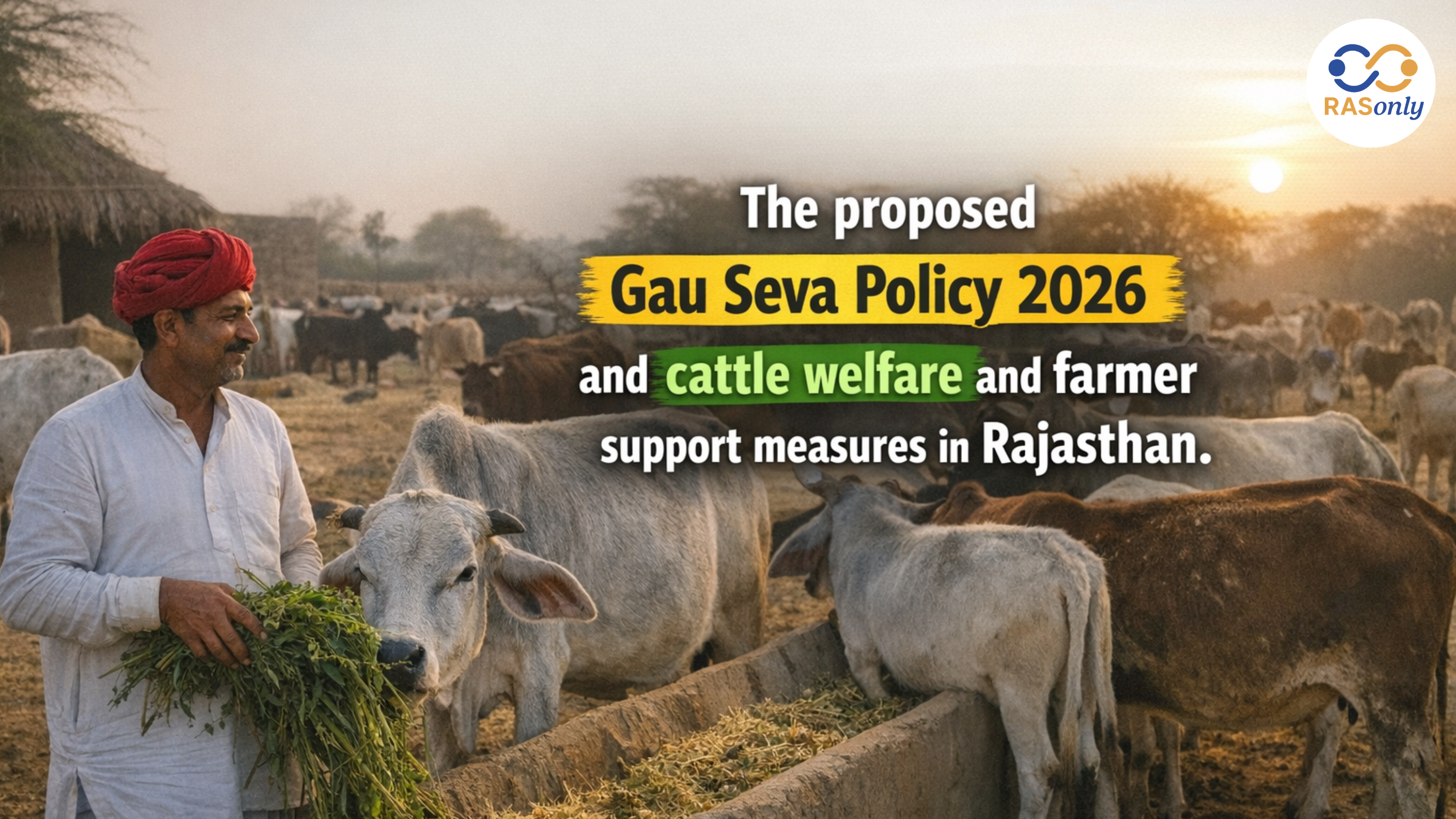
Rajasthan has declared that it will roll out the Gau Seva Policy 2026 to provide new impetus to cattle protection, promotion, and welfare in the state. The proposed policy will empower the rural livelihoods of the state, enhance the livelihoods that are cattle-based, and benefit both the farmers and the communities dominated by the population of pashu-paal under the leadership of the Chief Minister of the state, Bhajanlal Sharma. The project will play the role of enhancing livestock development, boosting the rural economy and the promotion of welfare based governance. The announcement is also in line with the larger dedication of welfare to farmers, women, youths and workers. In conjunction with this the state has emphasized that it is still in support of gaushalas, livestock schemes and direct assistance to cultivators.
The main characteristics of the intended policy are as follows:-
- A new Gau Seva Policy 2026 will be introduced in Rajasthan.
- Cattle welfare and cattle service activities in the state are the focus of the policy to speed up.
- It aims at the enhancement of Godhan and building up livestock resources.
- It should benefit the rural economy through the assistance of farmers and livestock rearers in the policy.
- It has been introduced within the broader welfare-oriented style of governance.
Current Cattle Welfare Measures.
The state has claimed that it has been over two years striving towards the direction of livestock protection, promotion and safety.
The schemes have been supported by schemes like:
- Mukhyamantri Mangala Pashu Bima Yojana.
- The Rajasthan Sahakari Gopal Credit Card Yojana is the second option.
- Mukhyamantri Dugdh Utpadak Sambal Yojana.
In registered gaushala the government makes available:
- Rs 50 per day for a large animal
- Rs 25 per day for a small animal
This financial help has been referred to as a good move towards conservation of cattle.
Farmer Support and Farming Dedication.
- Cattle welfare has also been associated with other welfare measures of farmers by the state.
- Farmers in the state are guaranteed under the Pradhan Mantri Kisan Samman Nidhi and Mukhyamantri Kisan Samman Nidhi Yojana as they are given Rs 9,000 per annum.
- Approximately, it has moved an amount of about RS 11,000 crore to the bank accounts of the farmers.
- Rajasthan has budgeted this amount as agriculture in the 2026-27 financial year: Rs 1,19,408 crore.
- The government has also declared an extra bonus of 150 per quintal on top of Minimum Support Price (MSP) of wheat next year.
- Farmers will get, with this, wheat at a rate of 2735 per quintal.
- The announcement has also been made as a promise fulfilment to buy wheat at Rs 2,700 per quintal in the framework of promises of the state.
Objectives
The development of the rural economy has been strengthened.
- To provide livestock-based assistance to rural economy by making it more resilient.
- To enhance the contribution of cattle welfare in the economic activity at village level.
Farmers and livestock rearers will also be assisted through the support program:-
- To offer institutional and financial assistance to animal rearers and farmers.
- To make animal welfare a part of agricultural security and income support.
Expanding Welfare Governance
- To incorporate animal welfare in general social welfare obligations.
- To assist vulnerable and productive components like farmers, women, youth and workers.
Conclusion
The Gau Seva Policy 2026 which is proposed is an initiative on the part of the State of Rajasthan to integrate cattle welfare, livestock development and economic empowerment of the rural population into one policy. The initiative, together with gaushala support, livestock-oriented scheme, farmer income scheme, and wheat buying incentives, is an indication of a larger program to transform animal husbandry into agricultural development and welfare-based government in the state.
MCQs(RAS Prelims)
MCQ 1: what is the principal intention of the proposed Rajasthan Gau Seva Policy 2026?
a) To substitute all the current agricultural subsidy schemes.
b) To enhance the livestock welfare, cattle growth and rural economy.
c) To privatise registered gaushalas throughout the state.
d) To cut down on the budgetary allocation on animal husbandry.
Answer : (b)
Explanation : to increase cattle welfare and service, godhan development, support farmers and livestock rearers, and boost the economy of rural areas, the proposed Gau Seva Policy 2026 has been announced.
MCQ 2: As per the announcement, what does the daily help in the registered gaushalas in Rajasthan look like?
a) 25 and 10 respectively on large and small animals.
b) big animals 40 Rs and small animals 20 Rs.
c) 50 as applied to large animals and 25 as applied to small animals.
d) large animals- Rs 60, small animals- Rs 30.
Answer: c) large animals 50, small animals 25.
Explanation: According to the claim of the state government, a large animal in registered gaushalas and a small animal attract assistance at a rate of 50 and 25 per day respectively in the conservation process of the cattle.
MCQ 3: At the new bonus rate of MSP plus, what is the price per quintal of wheat of farmers in Rajasthan?
a) Rs 2,585
b) Rs 2,700
c) Rs 2,735
d) Rs 2,850
Answer: c)
Explanation: Under the coming year, the Chief Minister stated that farmers will get an extra bonus of 150 per quintal over MSP of wheat. Through this, the cost-effective price of wheat will be 2,735/quintal.
राजस्थान में प्रस्तावित गौ सेवा नीति 2026 तथा गौ कल्याण और किसान सहायता संबंधी उपाय
राजस्थान ने घोषणा की है कि राज्य में गौ संरक्षण, संवर्धन और कल्याण को नई गति देने के लिए गौ सेवा नीति 2026 लागू की जाएगी। मुख्यमंत्री भजनलाल शर्मा के नेतृत्व में प्रस्तावित यह नीति ग्रामीण आजीविका को सशक्त करेगी, गौ-आधारित अर्थगत गतिविधियों को बढ़ावा देगी तथा किसानों और पशुपालक समुदायों को लाभ पहुंचाएगी। यह पहल पशुधन विकास को प्रोत्साहित करेगी, ग्रामीण अर्थव्यवस्था को मजबूत बनाएगी और कल्याणोन्मुख शासन को आगे बढ़ाएगी। यह घोषणा किसानों, महिलाओं, युवाओं और मजदूरों के कल्याण के व्यापक संकल्प के अनुरूप भी है। इसके साथ ही राज्य ने गौशालाओं, पशुधन योजनाओं और कृषकों को प्रत्यक्ष सहायता के प्रति अपनी निरंतर प्रतिबद्धता भी दोहराई है।
प्रस्तावित नीति की प्रमुख विशेषताएँ
- राजस्थान में नई गौ सेवा नीति 2026 लाई जाएगी।
- इस नीति का मुख्य उद्देश्य राज्य में गौ कल्याण और गौ सेवा गतिविधियों को तेज गति देना है।
- इसका लक्ष्य गोधन के विकास तथा पशुधन संसाधनों को सुदृढ़ करना है।
- यह नीति किसानों और पशुपालकों को सहयोग देकर ग्रामीण अर्थव्यवस्था को लाभ पहुंचाने का प्रयास करेगी।
- इसे व्यापक कल्याणोन्मुख शासन दृष्टिकोण के अंतर्गत प्रस्तुत किया गया है।
वर्तमान गौ कल्याण उपाय
- राज्य सरकार ने कहा है कि वह दो वर्ष से अधिक समय से पशुधन संरक्षण, संवर्धन और सुरक्षा की दिशा में कार्य कर रही है।
- इस दिशा में जिन योजनाओं के माध्यम से सहायता दी जा रही है, उनमें शामिल हैं:
- मुख्यमंत्री मंगला पशु बीमा योजना
- राजस्थान सहकारी गोपाल क्रेडिट कार्ड योजना
- मुख्यमंत्री दुग्ध उत्पादक संबल योजना
- पंजीकृत गौशालाओं में सरकार द्वारा उपलब्ध कराई जा रही सहायता:
- बड़े पशु के लिए प्रतिदिन 50 रुपये
- छोटे पशु के लिए प्रतिदिन 25 रुपये
- इस वित्तीय सहायता को गौ संरक्षण की दिशा में प्रभावी कदम बताया गया है।
किसान सहायता और कृषि प्रतिबद्धता
- राज्य ने गौ कल्याण को व्यापक किसान कल्याण उपायों से भी जोड़ा है।
- प्रधानमंत्री किसान सम्मान निधि तथा मुख्यमंत्री किसान सम्मान निधि योजना के अंतर्गत राज्य के किसानों को प्रतिवर्ष 9,000 रुपये सुनिश्चित किए गए हैं।
- किसानों के बैंक खातों में लगभग 11,000 करोड़ रुपये हस्तांतरित किए गए हैं।
- वित्त वर्ष 2026-27 में राजस्थान ने कृषि के लिए 1,19,408 करोड़ रुपये का प्रावधान किया है।
गेहूं खरीद की घोषणा
- सरकार ने आगामी वर्ष से गेहूं के न्यूनतम समर्थन मूल्य के अतिरिक्त प्रति क्विंटल 150 रुपये का बोनस देने की घोषणा की है।
- इसके बाद किसानों को गेहूं के लिए 2,735 रुपये प्रति क्विंटल प्राप्त होंगे।
- इस घोषणा को राज्य के वादों के अंतर्गत 2,700 रुपये प्रति क्विंटल पर गेहूं खरीद के संकल्प की पूर्ति के रूप में भी प्रस्तुत किया गया है।
उद्देश्य
ग्रामीण अर्थव्यवस्था को सशक्त बनाना
- पशुधन आधारित सहयोग के माध्यम से ग्रामीण अर्थव्यवस्था को अधिक सुदृढ़ और सक्षम बनाना।
- ग्राम स्तर की आर्थिक गतिविधियों में गौ कल्याण की भूमिका को बढ़ाना।
किसानों और पशुपालकों को सहायता देना
- किसानों और पशुपालकों को संस्थागत तथा वित्तीय सहायता उपलब्ध कराना।
- पशु कल्याण को कृषि सुरक्षा और आय सहायता से जोड़ना।
कल्याणोन्मुख शासन का विस्तार
- पशु कल्याण को व्यापक सामाजिक कल्याण दायित्वों में सम्मिलित करना।
- किसानों, महिलाओं, युवाओं और मजदूरों जैसे संवेदनशील तथा उत्पादक वर्गों को सहयोग देना।
निष्कर्ष
प्रस्तावित गौ सेवा नीति 2026 राजस्थान सरकार का ऐसा प्रयास है जिसके माध्यम से गौ कल्याण, पशुधन विकास और ग्रामीण आर्थिक सशक्तिकरण को एकीकृत नीति ढाँचे में जोड़ा जा रहा है। गौशाला सहायता, पशुधन उन्मुख योजनाएँ, किसान आय समर्थन तथा गेहूं खरीद प्रोत्साहन जैसे उपाय इस बात के संकेत हैं कि राज्य पशुपालन को कृषि विकास और कल्याण आधारित शासन से जोड़ने की व्यापक दिशा में आगे बढ़ रहा है
बहुविकल्पीय प्रश्न (आरएएस प्रारंभिक परीक्षा)
प्रश्न 1:राजस्थान की प्रस्तावित गौ सेवा नीति 2026 का मुख्य उद्देश्य क्या है?
a) सभी वर्तमान कृषि अनुदान योजनाओं को समाप्त करना
b) गौ कल्याण, पशुधन विकास और ग्रामीण अर्थव्यवस्था को सशक्त करना
c) राज्य की सभी पंजीकृत गौशालाओं का निजीकरण करना
d) पशुपालन पर बजटीय व्यय को कम करना
उत्तर: b) गौ कल्याण, पशुधन विकास और ग्रामीण अर्थव्यवस्था को सशक्त करना
व्याख्या: प्रस्तावित गौ सेवा नीति 2026 का उद्देश्य गौ कल्याण और गौ सेवा गतिविधियों को गति देना, गोधन के विकास को बढ़ावा देना, किसानों और पशुपालकों को सहयोग देना तथा ग्रामीण अर्थव्यवस्था को मजबूत बनाना है।
प्रश्न 2: घोषणा के अनुसार राजस्थान की पंजीकृत गौशालाओं में प्रतिदिन दी जाने वाली सहायता क्या है?
a) बड़े पशु के लिए 25 रुपये और छोटे पशु के लिए 10 रुपये
b) बड़े पशु के लिए 40 रुपये और छोटे पशु के लिए 20 रुपये
c) बड़े पशु के लिए 50 रुपये और छोटे पशु के लिए 25 रुपये
d) बड़े पशु के लिए 60 रुपये और छोटे पशु के लिए 30 रुपये
उत्तर: c) बड़े पशु के लिए 50 रुपये और छोटे पशु के लिए 25 रुपये
व्याख्या: राज्य सरकार के अनुसार पंजीकृत गौशालाओं में बड़े पशु के लिए प्रतिदिन 50 रुपये तथा छोटे पशु के लिए प्रतिदिन 25 रुपये की सहायता दी जा रही है। इसे गौ संरक्षण की दिशा में एक प्रभावी कदम माना गया है।
प्रश्न 3: नए बोनस सहित राजस्थान में किसानों को गेहूं के लिए प्रति क्विंटल कितना मूल्य मिलेगा?
a) 2,585 रुपये
b) 2,700 रुपये
c) 2,735 रुपये
d) 2,850 रुपये
उत्तर: c) 2,735 रुपये
व्याख्या: मुख्यमंत्री ने घोषणा की है कि आगामी वर्ष से गेहूं के न्यूनतम समर्थन मूल्य के अतिरिक्त 150 रुपये प्रति क्विंटल बोनस दिया जाएगा। इसके परिणामस्वरूप किसानों को गेहूं पर कुल 2,735 रुपये प्रति क्विंटल प्राप्त होंगे