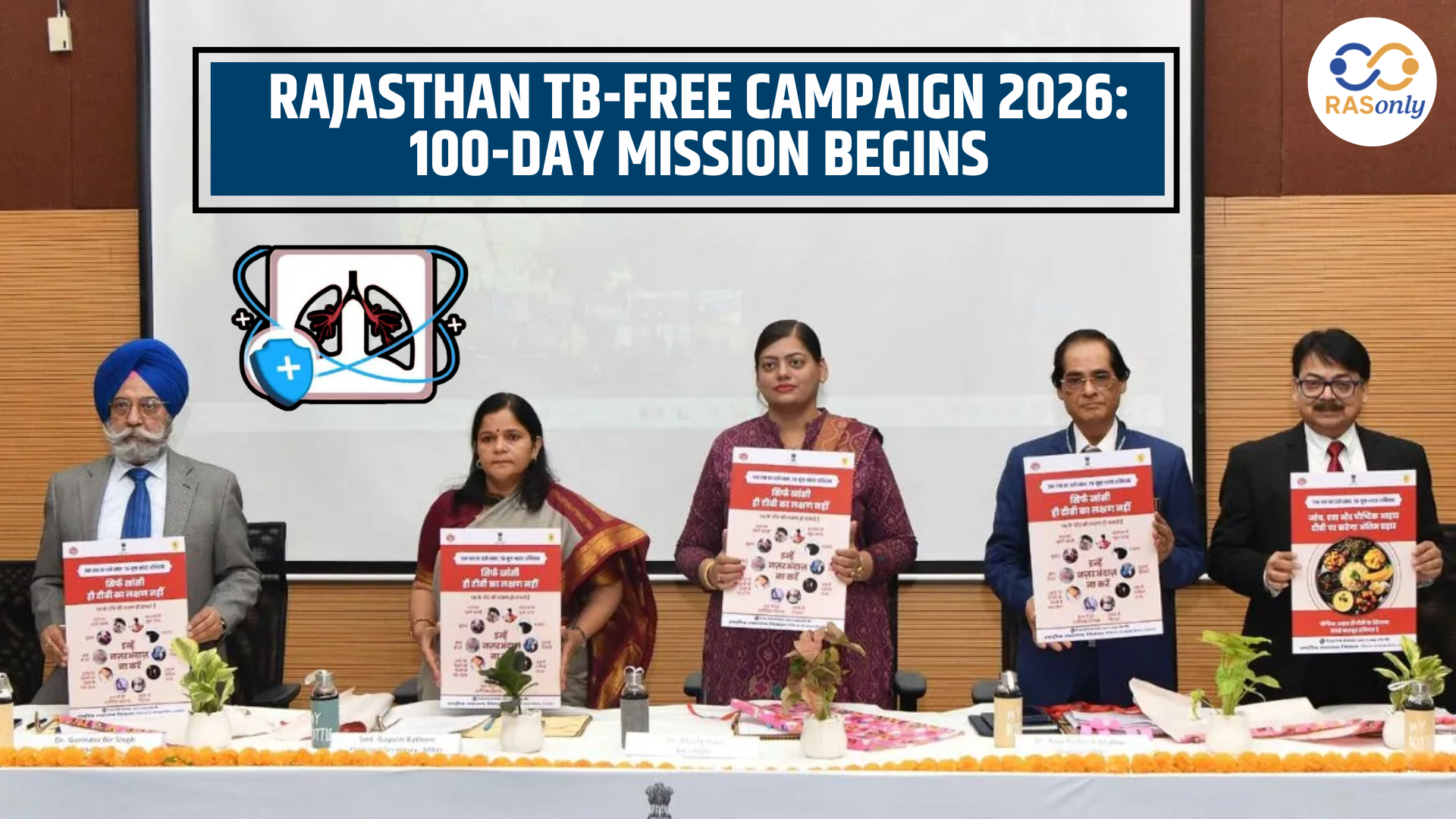
The event of World TB Day saw the introduction of the TB-Free India Campaign -100 Day in the auditorium of Sawai Man Singh Medical College, Jaipur, on 24 March, 2012 in Rajasthan. It was conducted under the presence of the Medical and Health Minister, Gajendra Singh Khimsar. The campaign will be used to ensure that the level of tuberculosis is eradicated by hastening the process with intense screening, diagnosis through technology, prompt treatment and enhanced involvement of the population. Rajasthan has put forward this campaign as one of the key public health missions particularly in the high-risk rural and urban areas. The initiative is significant as it comprises of disease detection, community outreach, nutrition support, and integrated health services with a mission-mode approach.
Reason as to why the Campaign is Important.
- Besides being a medical condition, Tuberculosis is also a grave social, economic, and psychological burden to individuals and families.
- The campaign is an expression of Rajasthan making investments in the national agenda of TB-Free India.
- It aims to make TB control a people movement by making sure that all patients are diagnosed and treated in time.
- The campaign has a symbolic, as well as public health meaning because the launch on World TB Day connects the awareness and action.
The key accomplishment of Rajasthan in TB Screening.
- One of the biggest highlights of the event was that in the year 2025, Rajasthan had screened over 1 crore 75 lakh probable TB patients.
- This was termed as the peak in the country. TB screening coverage has also been raised to 100 percent by the state.
- These results signify a massive increase in the active case finding and reveal the focus of the state on the early detection as the basis of TB eradication.
Focus on High-Risk Areas
Regions of Intensive Action identified
- Rajasthan has taken a data- and technology-oriented vision to determine the high-risk areas.
- Ayushman Arogya Camps will be conducted in 11,184 villages and urban areas which will be identified under the campaign.
- These camps will target the last individual and make sure that the cases of TB are detected early.
Population groups that are considered special focus groups are those whose needs are expected to be impacted by the program, yet these groups have not been included in the program.
The people who will be given special attention in the campaign include those who are residing in residential communal settings, including:
- Hostels
- Old age homes
- Orphanages
- Jails
- Juvenile detention centres
- Shelter homes
- Night shelters
- BPL housing clusters
- Industrial areas
These locations are believed to be significant as overcrowded living arranges may make people more susceptible and slow down early diagnosis in case of screening not being performed regularly.
Services to be provided at the camps in relation to health services.
The Ayushman Arogya Camps will offer not only TB screening but also the general health services. Screening will be done to all individuals who are over 14 years. The services include:
- TB screening
- Haemoglobin (HB) test
- Blood sugar test
- Measurement of blood pressure (BP).
- The Body Mass Index (BMI) measurement.
- Chest X-ray
In case there is an abnormal chest X-ray, a sputum sample will be taken and tested using NAAT. In a case where TB has been identified using NAAT, the patient will receive free and routine treatment.
Integrated Public Health Approach
- It is a holistic health intervention that has been developed into the campaign.
- The officials of National Health Mission stated that diabetes, hypertension, and other non-communicable diseases will also be screened in the camps.
- The significance of this is that the public health system can be in a position to offer an integrated healthcare as opposed to treating TB alone.
- It also enhances the accessibility among individuals, who might not otherwise attend health facilities to get preventive screening.
Technology and Mission-Mode Action: Role.
- The state government has focused on the use of mission-mode implementation whereby more technology is used in the screening and treatment process.
- The central pillars of the campaign are intensive screening in the high-risk areas, the use of the latest diagnostic methods, including NAAT, and time-limited treatment.
- This is an indication that passive care has changed to proactive action on the part of the population in terms of health.
These are the Nutritional and Social Support
- The campaign will also involve the Nikshay Mitra program whereby TB cases will be given nutritional and social support.
- At the launching, TB patients were given with Nikshay Poshan Kits.
- The reason why this dimension matters is due to the fact that TB recovery should be not just dependent on medicine but also nutrition, support systems, and continuity of treatment.
TB-Free Gram Panchayat Goal
Rajasthan is also in the process of trying to make more TB-Free Gram Panchayats. By 2025, 3350 Gram Panchayats were proclaimed TB-free. The state has projected that it should increase this figure to 2026. This objective underscores the importance of local government, community involvement and grassroots sensitization in the success of public health.
Conclusion
A popular TB-Free India Campaign 100-day campaign in Rajasthan is a large-scale public health project, which includes mass screening, early diagnosis, regular treatment, nutritional support, and community mobilisation. The state is currently attempting to accelerate the process of eliminating TB by targeting at-risk villages, urban areas, and collective living quarters via a data-driven and focused strategy. In the preparation of exams, it is significant under the public health, disease control programmes, health governance, community participation, and preventive healthcare delivery.
MCQs
1. What is the primary goal of the 100-day TB-Free India Campaign of Rajasthan?
a) To transform all district hospitals into mobile clinics.
b) To ensure the rapid eradication of TB by conducting screening, diagnosing, treating, and involving the people.
c) To offer urban industrial areas only the vaccination.
d) To restrict TB services to medical colleges only.
Answer: b
2. What is the diagnostic action, in case the chest X-ray of a person is established to be abnormal at the campaign camps?
a) Emergency operation will be advised.
b) Blood pressure will be rechecked only.
c) NAAT testing of the sample will be conducted on the sputum.
d) The individual will be released without extra testing.
Answer: c
3. What is the accurate reflection of TB-free local governance of Rajasthan?
a) Rajasthan announced all Gram Panchayats TB-free by 2025.
b) There is a declaration of 3,350 Gram Panchayats as TB-free in 2025 and the target in 2026 is to increase it to 2.
c) TB-free Gram panchayat can only be recognized in urban wards.
d) There is lack of community involvement of Panchayat level in the campaign.
Answer: b
राजस्थान ने उच्च जोखिम वाले क्षेत्रों पर विशेष ध्यान के साथ 100 दिवसीय टीबी मुक्त भारत अभियान प्रारम्भ किया
परिचय
विश्व क्षय रोग दिवस के अवसर पर 24 मार्च को जयपुर स्थित सवाई मानसिंह मेडिकल कॉलेज के सभागार में राजस्थान में “टीबी मुक्त भारत अभियान - 100 दिवसीय” का शुभारम्भ किया गया। यह कार्यक्रम चिकित्सा एवं स्वास्थ्य मंत्री गजेंद्र सिंह खींवसर की उपस्थिति में आयोजित हुआ। इस अभियान का उद्देश्य गहन जाँच, तकनीक आधारित निदान, त्वरित उपचार तथा जनसहभागिता को बढ़ाकर क्षयरोग उन्मूलन की प्रक्रिया को तेज करना है। राजस्थान ने इस अभियान को विशेष रूप से उच्च जोखिम वाले ग्रामीण और शहरी क्षेत्रों में एक महत्वपूर्ण जनस्वास्थ्य मिशन के रूप में प्रस्तुत किया है। यह पहल इसलिए महत्वपूर्ण है क्योंकि इसमें रोग की पहचान, सामुदायिक पहुँच, पोषण सहयोग और समेकित स्वास्थ्य सेवाओं को मिशन मोड में जोड़ा गया है।
अभियान का महत्व
- क्षयरोग केवल एक चिकित्सीय रोग नहीं है, बल्कि यह व्यक्ति और परिवारों पर गम्भीर सामाजिक, आर्थिक और मानसिक बोझ भी डालता है।
- यह अभियान टीबी मुक्त भारत के राष्ट्रीय लक्ष्य के प्रति राजस्थान की प्रतिबद्धता को दर्शाता है। इसका उद्देश्य यह सुनिश्चित करना है कि प्रत्येक रोगी की समय पर जाँच और उपचार हो तथा क्षयरोग नियंत्रण एक जनआन्दोलन का रूप ले।
- विश्व क्षय रोग दिवस पर इसका शुभारम्भ जागरूकता और कार्यवाही को एक साथ जोड़ता है, इसलिए इसका प्रतीकात्मक और जनस्वास्थ्य दोनों प्रकार का महत्व है।
क्षयरोग जाँच में राजस्थान की बड़ी उपलब्धि
- इस कार्यक्रम की एक प्रमुख उपलब्धि यह बताई गई कि वर्ष 2025 में राजस्थान ने 1 करोड़ 75 लाख से अधिक संभावित क्षयरोग रोगियों की स्क्रीनिंग की।
- इसे देश में सर्वाधिक बताया गया। राज्य ने क्षयरोग जाँच कवरेज को भी 100 प्रतिशत तक पहुँचाया है।
- ये उपलब्धियाँ सक्रिय रोगी खोज के बड़े विस्तार को दर्शाती हैं और बताती हैं कि राज्य ने शीघ्र पहचान को क्षयरोग उन्मूलन का आधार बनाया है।
उच्च जोखिम वाले क्षेत्रों पर विशेष ध्यान
गहन कार्यवाही के लिए चिन्हित क्षेत्र
- राजस्थान ने उच्च जोखिम वाले क्षेत्रों की पहचान के लिए आँकड़ा और तकनीक आधारित दृष्टिकोण अपनाया है। अभियान के अंतर्गत 11,184 चिन्हित ग्रामों और शहरी क्षेत्रों में आयुष्मान आरोग्य शिविर आयोजित किए जाएंगे।
- इन शिविरों का उद्देश्य अंतिम व्यक्ति तक पहुँचना और क्षयरोग के मामलों की शीघ्र पहचान सुनिश्चित करना है।
विशेष ध्यान वाले जनसमूह
अभियान में सामूहिक निवास स्थलों में रहने वाले व्यक्तियों पर विशेष ध्यान दिया जाएगा, जैसे:
- छात्रावास
- वृद्धाश्रम
- अनाथालय
- जेल
- किशोर निरोध केन्द्र
- आश्रय गृह
- रैन बसेरे
- बीपीएल आवास समूह
- औद्योगिक क्षेत्र
इन स्थानों को इसलिए महत्वपूर्ण माना गया है क्योंकि भीड़भाड़ वाले निवास प्रबंध लोगों को अधिक संवेदनशील बना सकते हैं और यदि नियमित जाँच न हो तो शीघ्र पहचान में विलम्ब हो सकता है।
शिविरों में उपलब्ध कराई जाने वाली स्वास्थ्य सेवाएँ
आयुष्मान आरोग्य शिविरों में केवल क्षयरोग जाँच ही नहीं, बल्कि सामान्य स्वास्थ्य सेवाएँ भी प्रदान की जाएंगी। 14 वर्ष से अधिक आयु के सभी व्यक्तियों की जाँच की जाएगी। इन सेवाओं में शामिल हैं:
- क्षयरोग जाँच
- हीमोग्लोबिन परीक्षण
- रक्त शर्करा परीक्षण
- रक्तचाप मापन
- शरीर द्रव्यमान सूचकांक का आकलन
- छाती का एक्स-रे
यदि किसी व्यक्ति का छाती का एक्स-रे असामान्य पाया जाता है, तो उसके बलगम का नमूना लेकर एनएएटी जाँच की जाएगी। यदि एनएएटी जाँच में क्षयरोग की पुष्टि होती है, तो रोगी को तत्काल निःशुल्क और मानक उपचार उपलब्ध कराया जाएगा।
समेकित जनस्वास्थ्य दृष्टिकोण
- यह अभियान एक समग्र स्वास्थ्य हस्तक्षेप के रूप में तैयार किया गया है। राष्ट्रीय स्वास्थ्य मिशन के अधिकारियों के अनुसार, शिविरों में मधुमेह, उच्च रक्तचाप और अन्य गैर-संचारी रोगों की भी जाँच की जाएगी।
- इसका महत्व इसलिए है क्योंकि इससे जनस्वास्थ्य प्रणाली केवल क्षयरोग तक सीमित न रहकर समेकित स्वास्थ्य सेवा दे सकेगी। इससे उन लोगों की पहुँच भी बढ़ेगी जो सामान्यतः निवारक जाँच के लिए स्वास्थ्य संस्थानों तक नहीं पहुँचते।
तकनीक और मिशन मोड में कार्यवाही की भूमिका
- राज्य सरकार ने मिशन मोड में क्रियान्वयन पर बल दिया है, जिसमें जाँच और उपचार में अधिकाधिक तकनीक का उपयोग किया जाएगा।
- उच्च जोखिम क्षेत्रों में गहन स्क्रीनिंग, एनएएटी जैसी उन्नत जाँच तकनीकों का उपयोग और समयबद्ध उपचार इस अभियान के प्रमुख स्तम्भ हैं।
- यह दर्शाता है कि जनस्वास्थ्य के क्षेत्र में निष्क्रिय देखभाल से आगे बढ़कर सक्रिय कार्यवाही की जा रही है।
पोषण और सामाजिक सहयोग
- अभियान में निक्षय मित्र पहल भी शामिल है, जिसके माध्यम से क्षयरोग रोगियों को पोषण और सामाजिक सहयोग प्रदान किया जाएगा।
- शुभारम्भ कार्यक्रम में टीबी रोगियों को निक्षय पोषण किट वितरित किए गए। यह आयाम इसलिए महत्वपूर्ण है क्योंकि क्षयरोग से उबरना केवल दवा पर निर्भर नहीं करता, बल्कि पोषण, सहयोग व्यवस्था और उपचार की निरंतरता पर भी निर्भर करता है।
टीबी मुक्त ग्राम पंचायत लक्ष्य
- राजस्थान अधिक टीबी मुक्त ग्राम पंचायतें बनाने की दिशा में भी कार्य कर रहा है। वर्ष 2025 में 3,350 ग्राम पंचायतों को टीबी मुक्त घोषित किया गया था।
- वर्ष 2026 के लिए राज्य ने इस संख्या को दोगुना करने का लक्ष्य रखा है। यह लक्ष्य जनस्वास्थ्य की सफलता में स्थानीय शासन, सामुदायिक भागीदारी और जमीनी स्तर की जागरूकता की भूमिका को रेखांकित करता है।
निष्कर्ष
राजस्थान का 100 दिवसीय टीबी मुक्त भारत अभियान एक व्यापक जनस्वास्थ्य पहल है, जिसमें सामूहिक जाँच, शीघ्र निदान, मानक उपचार, पोषण सहयोग और सामुदायिक भागीदारी को जोड़ा गया है। उच्च जोखिम वाले गाँवों, शहरी क्षेत्रों और सामूहिक निवास स्थलों पर ध्यान केंद्रित करके राज्य लक्षित और आँकड़ा आधारित रणनीति के माध्यम से क्षयरोग उन्मूलन की गति बढ़ाने का प्रयास कर रहा है। परीक्षा की दृष्टि से यह विकास जनस्वास्थ्य, रोग नियंत्रण कार्यक्रम, स्वास्थ्य प्रशासन, सामुदायिक भागीदारी और निवारक स्वास्थ्य सेवा जैसे विषयों के अंतर्गत महत्वपूर्ण है।
बहुविकल्पीय प्रश्न
1. राजस्थान के 100 दिवसीय टीबी मुक्त भारत अभियान का मुख्य उद्देश्य क्या है?
a) सभी जिला अस्पतालों को चलित चिकित्सालयों में बदलना
b) जाँच, निदान, उपचार और जनभागीदारी के माध्यम से क्षयरोग उन्मूलन की गति बढ़ाना
c) केवल शहरी औद्योगिक क्षेत्रों में टीकाकरण उपलब्ध कराना
d) क्षयरोग सेवाओं को केवल मेडिकल कॉलेजों तक सीमित रखना
उत्तर: b
2. यदि अभियान शिविरों में किसी व्यक्ति के छाती के एक्स-रे में असामान्यता पाई जाती है, तो अगला कदम क्या होगा?
a) तत्काल शल्य चिकित्सा की सलाह दी जाएगी
b) केवल रक्तचाप की पुनः जाँच की जाएगी
c) बलगम का नमूना लेकर एनएएटी जाँच की जाएगी
d) व्यक्ति को बिना किसी अतिरिक्त जाँच के भेज दिया जाएगा
उत्तर: c
3. राजस्थान की टीबी मुक्त स्थानीय शासन पहल का सही विवरण कौन-सा है?
a) राजस्थान ने 2025 तक सभी ग्राम पंचायतों को टीबी मुक्त घोषित कर दिया था
b) वर्ष 2025 में 3,350 ग्राम पंचायतों को टीबी मुक्त घोषित किया गया और 2026 में इस संख्या को दोगुना करने का लक्ष्य रखा गया
c) टीबी मुक्त ग्राम पंचायत की मान्यता केवल शहरी वार्डों तक सीमित है
d) इस अभियान में पंचायत स्तर पर सामुदायिक भागीदारी का अभाव है
उत्तर: b