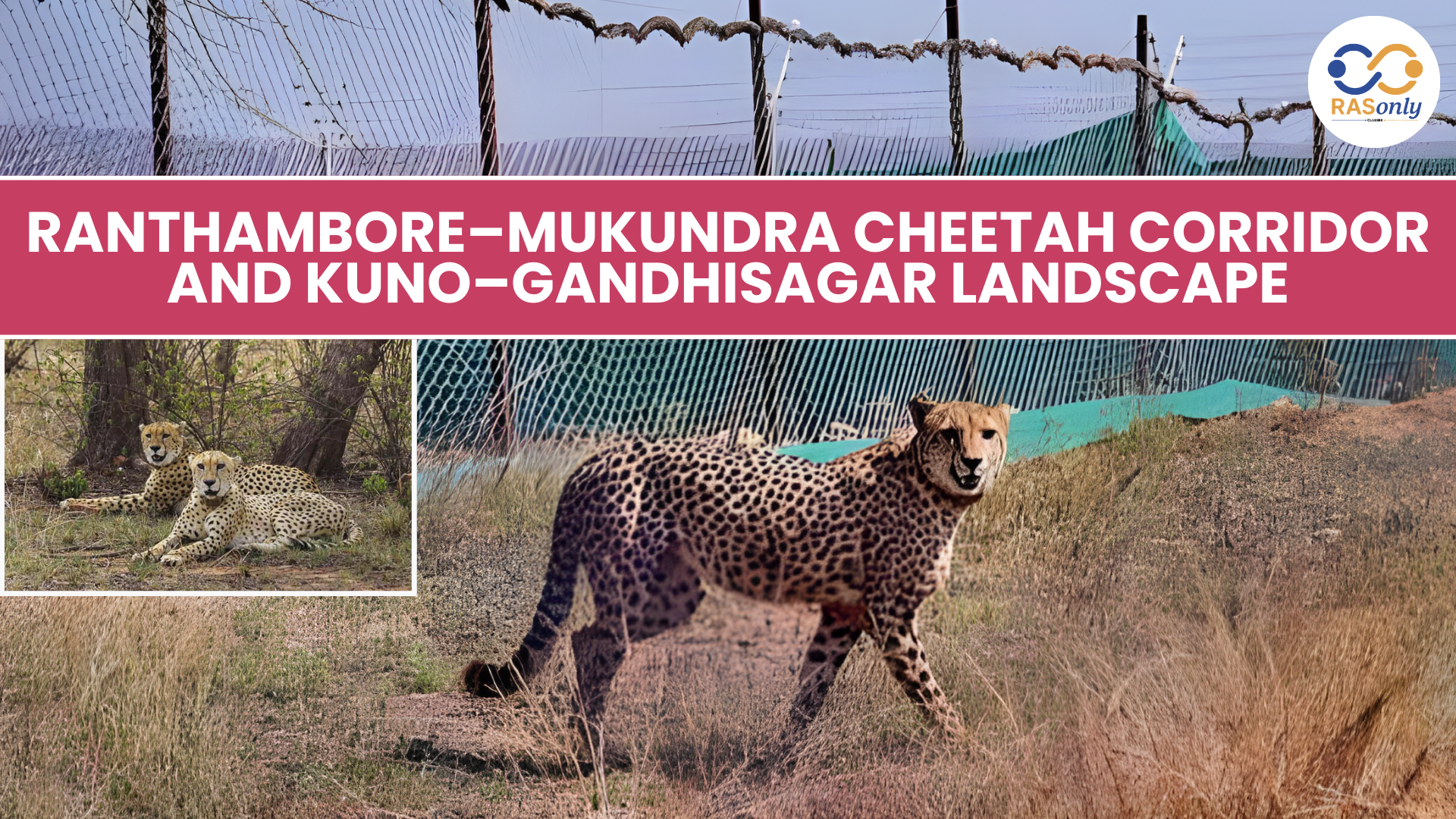
Rajasthan and Madhya Pradesh have jointly identified a large forest landscape to develop an inter-state cheetah corridor. The proposed corridor will run between Ranthambore and Mukundra Hills and will form part of the larger Kuno–Gandhisagar Cheetah Landscape. In total, around 17,000 sq km of area has been identified across the two states to ensure safe movement and habitat connectivity for cheetahs and other wildlife species.
Corridor Area and State-wise Share
- The combined area of the proposed cheetah corridor in Rajasthan and Madhya Pradesh is about 17,000 sq km.
- Of this, Rajasthan’s share is approximately 6,500 sq km, which is nearly 37% of the total landscape.
- Madhya Pradesh will contribute the remaining area (over 10,500 sq km), accounting for more than 61% of the corridor.
- Forest departments of both states have jointly demarcated suitable forest stretches that can be included in the cheetah landscape.
Sanctuaries and Tiger Reserves Included in the Corridor
The corridor, being developed as part of the Kuno–Gandhisagar Cheetah Landscape, will connect several important protected areas in Rajasthan, including:
- Bassi Wildlife Sanctuary and Bhainsrorgarh Sanctuary (Chittorgarh district)
- Ranthambore Tiger Reserve (Sawai Madhopur district)
- Mukundra Hills Tiger Reserve (Kota district)
- Ramgarh Vishdhari Tiger Reserve (Bundi district)
- Karauli–Dholpur Tiger Reserve
- National Chambal Sanctuary
- Shergarh Wildlife Sanctuary (Baran region)
These protected areas offer suitable habitat and an adequate prey base for cheetahs and other carnivores, making them crucial links in the proposed corridor.
Implementation Status and Administrative Coordination
- Forest officials in both Rajasthan and Madhya Pradesh have already carried out baseline demarcation of forest areas to be included in the cheetah landscape.
- One or more inter-state coordination meetings have been held to finalise corridor alignment and the list of protected areas.
- According to field officers, the states are currently awaiting formal written orders and notifications to operationalise the corridor plan.
- Once notified, the corridor will contribute to the long-term conservation of cheetahs and strengthen ecological connectivity among tiger reserves, sanctuaries and riverine ecosystems.
Significance for RAS Exam
- This corridor is an important example of inter-state cooperation (Rajasthan–Madhya Pradesh) in landscape-level wildlife conservation.
- Key factual points:
- Total corridor area: 17,000 sq km
- Rajasthan’s share: 6,500 sq km (about 37%)
- Major protected areas: Ranthambore, Mukundra Hills, Ramgarh Vishdhari, Karauli–Dholpur Tiger Reserve, National Chambal Sanctuary, Shergarh Wildlife Sanctuary, etc.
- It is relevant under topics such as Environment and Biodiversity, Protected Area Network, Wildlife Corridors and Cheetah Reintroduction.
Conclusion
The proposed cheetah corridor between Ranthambore and Mukundra, within the broader Kuno–Gandhisagar landscape, is a significant step towards landscape-based wildlife management in central India. With 37% of the corridor area lying in Rajasthan, the state will play a crucial role in ensuring secure habitat connectivity for cheetahs and other species. For civil services and RAS aspirants, this initiative serves as a contemporary case study of corridor planning, inter-state coordination and expansion of linkages among protected areas.
MCQs (RAS Prelims Oriented )
- The total area identified jointly by Rajasthan and Madhya Pradesh for the Kuno–Gandhisagar Cheetah Landscape is closest to:
a) 6,500 sq km
b) 10,500 sq km
c) 17,000 sq km
d) 37,000 sq km
Answer: c) 17,000 sq km
- Approximately what share of the proposed cheetah corridor area lies in Rajasthan?
a) About 25%
b) About 37%
c) About 50%
d) About 61%
Answer: b) About 37%
- Which of the following sets correctly represents protected areas in Rajasthan that are part of the proposed cheetah corridor between Ranthambore and Mukundra?
a) Kumbhalgarh Wildlife Sanctuary and Desert National Park
b) Ranthambore Tiger Reserve, Mukundra Hills Tiger Reserve and Ramgarh Vishdhari Tiger Reserve
c) Keoladeo National Park and Sariska Tiger Reserve only
d) Mount Abu Wildlife Sanctuary and Tal Chhapar Sanctuary
Answer: b) Ranthambore Tiger Reserve, Mukundra Hills Tiger Reserve and Ramgarh Vishdhari Tiger Reserve
रणथंभौर–मुकुंदरा चीता कॉरिडोर एवं कुनो–गांधीसागर लैंडस्केप
राजस्थान और मध्यप्रदेश ने मिलकर एक बड़े वन परिदृश्य को अंतर्राज्यीय चीता कॉरिडोर के रूप में चिन्हित किया है। प्रस्तावित कॉरिडोर रणथंभौर से मुकुंदरा हिल्स तक फैलेगा और बड़े कुनो–गांधीसागर चीता लैंडस्केप का हिस्सा होगा। दोनों राज्यों में मिलाकर लगभग 17,000 वर्ग किमी क्षेत्र की पहचान की गई है, ताकि चीता तथा अन्य वन्यजीवों की आवाजाही और आवासीय संपर्क (habitat connectivity) सुरक्षित रूप से बना रहे।
कॉरिडोर क्षेत्र एवं राज्यों की हिस्सेदारी
- प्रस्तावित चीता कॉरिडोर का कुल क्षेत्रफल राजस्थान और मध्यप्रदेश में मिलाकर लगभग 17,000 वर्ग किमी है।
- इसमें राजस्थान की हिस्सेदारी लगभग 6,500 वर्ग किमी है, जो कुल लैंडस्केप का लगभग 37% है।
- शेष क्षेत्र (लगभग 10,500 वर्ग किमी से अधिक, यानी 61% से अधिक) मध्यप्रदेश में होगा।
- दोनों राज्यों के वन विभागों ने संयुक्त रूप से ऐसे वन क्षेत्रों को चिह्नित किया है जिन्हें चीता लैंडस्केप में शामिल किया जा सकता है।
कॉरिडोर में शामिल अभयारण्य एवं टाइगर रिज़र्व
कुनो–गांधीसागर चीता लैंडस्केप के रूप में विकसित हो रहा यह कॉरिडोर राजस्थान के कई महत्वपूर्ण संरक्षित क्षेत्रों (Protected Areas) को जोड़ेगा, जिनमें प्रमुख हैं–
- बासी वन्यजीव अभयारण्य और भैंसरोगढ़ अभयारण्य (जिला चित्तौड़गढ़)
- रणथंभौर टाइगर रिज़र्व (जिला सवाई माधोपुर)
- मुकुंदरा हिल्स टाइगर रिज़र्व (जिला कोटा)
- रामगढ़ विषधारी टाइगर रिज़र्व (जिला बूंदी)
- करौली–धौलपुर टाइगर रिज़र्व
- राष्ट्रीय चंबल अभयारण्य
- शेरगढ़ वन्यजीव अभयारण्य (क्षेत्र बारां)
ये सभी संरक्षित क्षेत्र चीतों एवं अन्य मांसाहारी वन्यजीवों के लिए उपयुक्त आवास (habitat) और पर्याप्त शिकार आधार (prey base) उपलब्ध कराते हैं, इसलिए प्रस्तावित कॉरिडोर के महत्त्वपूर्ण लिंक माने जा रहे हैं।
क्रियान्वयन की स्थिति एवं प्रशासनिक समन्वय
- राजस्थान और मध्यप्रदेश, दोनों के वन अधिकारियों ने चीता लैंडस्केप में शामिल किए जाने वाले वन क्षेत्रों की प्राथमिक रेखांकन (baseline demarcation) कर ली है।
- कॉरिडोर की रूपरेखा (alignment) और शामिल संरक्षित क्षेत्रों की सूची को अंतिम रूप देने के लिए अंतर्राज्यीय समन्वय बैठकों का आयोजन किया जा चुका है।
- क्षेत्रीय अधिकारियों के अनुसार, अभी दोनों राज्य इस योजना को लागू करने के लिए औपचारिक लिखित आदेश एवं अधिसूचना का इंतज़ार कर रहे हैं।
- अधिसूचना जारी होने के बाद यह कॉरिडोर चीतों के दीर्घकालिक संरक्षण में मदद करेगा तथा टाइगर रिज़र्व, अभयारण्य और नदी तंत्र (riverine ecosystems) के बीच पारिस्थितिक संपर्क (ecological connectivity) को और मजबूत बनाएगा।
आरएएस परीक्षा के लिए महत्त्व
- यह उदाहरण राजस्थान–मध्यप्रदेश के बीच अंतर्राज्यीय सहयोग तथा लैंडस्केप स्तर पर वन्यजीव संरक्षण की दृष्टि से महत्त्वपूर्ण है।
- मुख्य तथ्य जिन्हें याद रखना चाहिए–
- कुल कॉरिडोर क्षेत्र: 17,000 वर्ग किमी
- राजस्थान की हिस्सेदारी: 6,500 वर्ग किमी (लगभग 37%)
- प्रमुख संरक्षित क्षेत्र: रणथंभौर, मुकुंदरा हिल्स, रामगढ़ विषधारी, करौली–धौलपुर टाइगर रिज़र्व, राष्ट्रीय चंबल अभयारण्य, शेरगढ़ वन्यजीव अभयारण्य आदि
- यह विषय पर्यावरण एवं जैव-विविधता, संरक्षित क्षेत्र नेटवर्क, वाइल्डलाइफ कॉरिडोर और चीता पुनर्वासन जैसे टॉपिक्स के अंतर्गत सीधे प्रासंगिक है।
निष्कर्ष
रणथंभौर से मुकुंदरा तक प्रस्तावित चीता कॉरिडोर, जो व्यापक कुनो–गांधीसागर लैंडस्केप का हिस्सा होगा, मध्य भारत में लैंडस्केप-आधारित वन्यजीव प्रबंधन की दिशा में एक बड़ा कदम है। कॉरिडोर के कुल क्षेत्रफल का 37% भाग राजस्थान में आने से राज्य चीतों और अन्य प्रजातियों के लिए सुरक्षित आवासीय संपर्क सुनिश्चित करने में महत्वपूर्ण भूमिका निभाएगा। सिविल सेवा एवं RAS अभ्यर्थियों के लिए यह पहल कॉरिडोर योजना, अंतर्राज्यीय समन्वय और संरक्षित क्षेत्रों के बीच लिंक बढ़ाने का समकालीन केस स्टडी है।
प्रश्न एवं उत्तर (हिंदी)
1. कुनो–गांधीसागर चीता लैंडस्केप के लिए राजस्थान और मध्यप्रदेश द्वारा संयुक्त रूप से चिन्हित कुल क्षेत्रफल लगभग कितना है?
a) 6,500 वर्ग किमी
b) 10,500 वर्ग किमी
c) 17,000 वर्ग किमी
d) 37,000 वर्ग किमी
उत्तर: c) 17,000 वर्ग किमी
2. प्रस्तावित चीता कॉरिडोर के कुल क्षेत्रफल का लगभग कितना भाग राजस्थान में आता है?
a) लगभग 25%
b) लगभग 37%
c) लगभग 50%
d) लगभग 61%
उत्तर: b) लगभग 37%
3. निम्न में से कौन-सा विकल्प उन संरक्षित क्षेत्रों (Protected Areas) का सही समूह है, जो रणथंभौर–मुकुंदरा प्रस्तावित चीता कॉरिडोर में शामिल हैं?
a) कुम्भलगढ़ वन्यजीव अभयारण्य और डेजर्ट नेशनल पार्क
b) रणथंभौर टाइगर रिज़र्व, मुकुंदरा हिल्स टाइगर रिज़र्व और रामगढ़ विषधारी टाइगर रिज़र्व
c) केवल केवलदेव राष्ट्रीय उद्यान और सरिस्का टाइगर रिज़र्व
d) माउंट आबू वन्यजीव अभयारण्य और ताल छापर अभयारण्य
उत्तर: b) रणथंभौर टाइगर रिज़र्व, मुकुंदरा हिल्स टाइगर रिज़र्व और रामगढ़ विषधारी टाइगर रिज़र्व