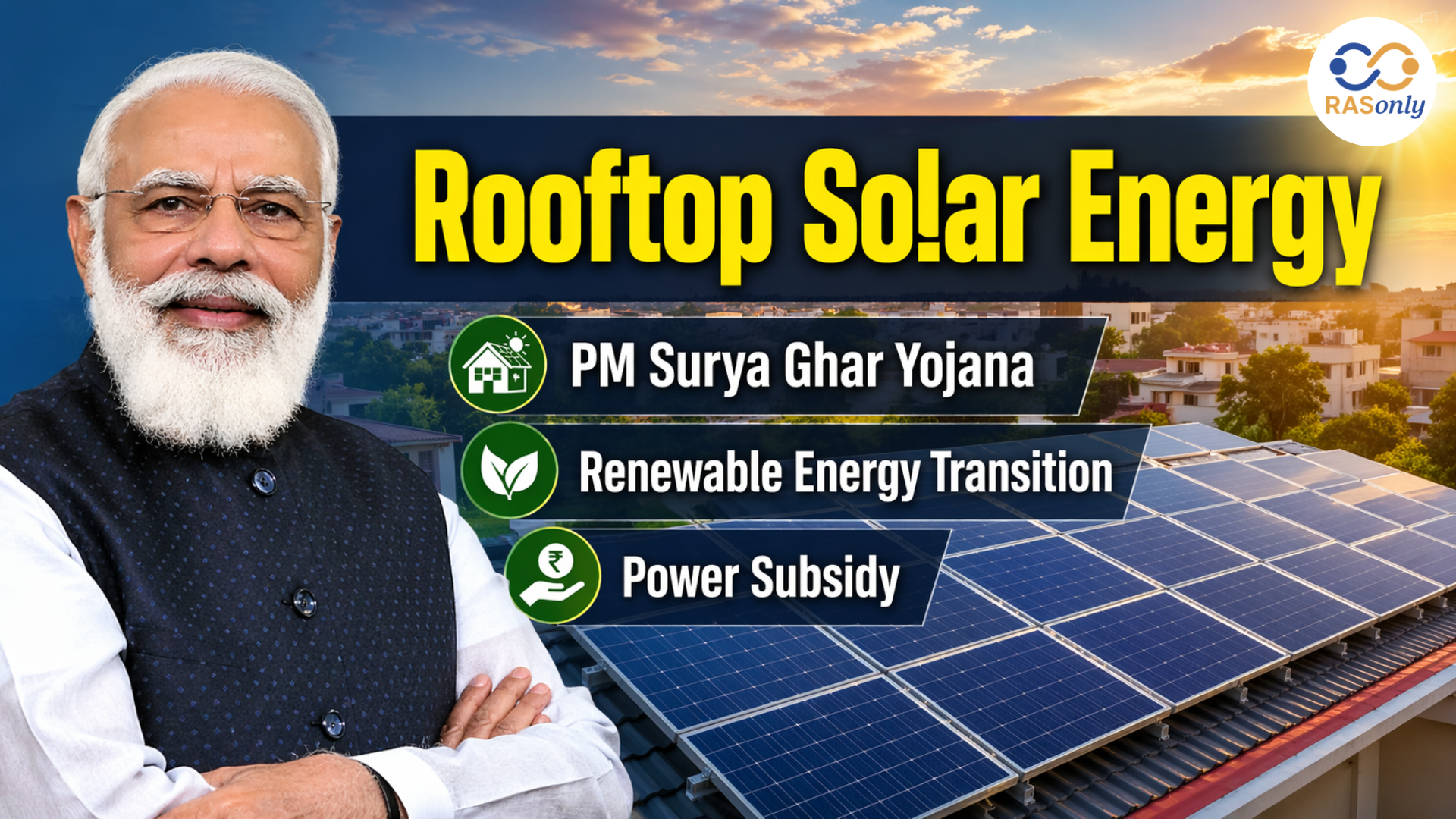
Rajasthan is fast becoming one of the leading states in terms of the use of rooftop solar energy in India. The state government is under the leadership of Chief Minister Bhajanlal Sharma and the guidance of the Energy Minister Hiralal Nagar to promote solar energy in domestic, non-domestic and industrial categories. There are already 2,45,317 rooftop solar plants installed in the state, which have developed a total capacity of 2,090 megawatts. This has made 1,43,965 consumers pay zero electricity bill. The significance of this development as per the RAS examination viewpoint is that it links renewable energy, subsidy assistance, energy security, consumer welfare, access to banking and reforms in administration in power sector.
The Position of Rooftop Solar Energy in Rajasthan
The state of Rajasthan is third in total rooftop solar installations whose capacity is 2,090 megawatts. Gujarat is the leader with 6,882 megawatts followed by Maharashtra with 5,442 megawatts. In Rajasthan, approximately 32,000 customers have installed rooftop solar systems with a capacity of 10 kilowatts and above, and there is a high growth in the adoption of solar of higher capacity.
Levels of development during PM Surya Ghar Yojana
Through PM Surya Ghar Yojana, a total of 1,77,468 solar plants are installed in rooftops in Rajasthan with a capacity of 686 megawatts. Approximately 675 to 700 new consumers are subscribing to the solar energy system every day. March saw the second-highest number of rooftop solar plants installed with 20,343. The highest number of solar plants installed in one day was recorded on 23 March, 910. Rajasthan ranks fifth in the country following Gujarat, Maharashtra, Uttar Pradesh and Kerala in this scheme.
Quick Installing Growth.
Consumers have installed rooftop solar systems two to two-and-a-half times in six months under PM Surya Ghar Yojana. The fraud started in February 2024. During the initial 6 months, there were only 7,694 consumers who installed the rooftop solar systems. Subsequently, they rose to 19,145, 39,311 and 68,450 in consecutive six months intervals. Over the first three months of this year, 58,153 consumers have installed solar plants. This trend indicates that in the first six months of the year the installations can hit one lakh.
Support of Subsidies to Consumers
The program offers serious financial incentive to promote the use of rooftop solar. Within a period of one to one-and-half months after the installation, subsidy of up to 78,000 is deposited to the bank account of the consumer. The Government of India has so far transferred ₹1,185 crore to the bank accounts of 1,52,350 consumers. It implies that approximately 85 percent of PM Surya Ghar beneficiaries in Rajasthan have already become beneficiaries of subsidies.
Extra Assistance in 150 Unit Free Electricity Programme
Consumers who install rooftop solar plants under the 150 Unit Free Electricity Scheme are also receiving a one-time subsidy of ₹17,000. This subsidy has been given so far to 13,141 consumers through Jaipur, Jodhpur and Ajmer power distribution companies. In this program, 23,273 consumers have installed solar plants and approximately ₹22.33 crore has been given as subsidy. Subsidy distribution under this scheme has been going on since December 2025. Therefore, a consumer in Rajasthan will get up to 78,000 under PM Surya Ghar Yojana and another 17,000 under the 150 Unit scheme.
Simple access to loans and support of vendors
Banks are also offering consumers easy loans at an interest rate of approximately 5.75 percent in the installation of rooftop solar. State Bank of India alone, has given loans to 62,236 consumers, Bank of Baroda to 9,292, Rajasthan Gramin Bank to 8,169, Canara Bank to 1,866, and other banks to 16,666 consumers. There is also an enhanced involvement of the vendors. Vendors registered on the PM Surya Ghar National Portal have increased to 1,896 compared to 762 vendors registered when the scheme was initiated.
Reforms in administration and facilitation of consumers
The Jaipur, Jodhpur, and Ajmer distribution companies have made the process of installation of rooftop solar easier. Staff are being encouraged by the introduction of a monthly Rooftop Solar Champion Award. Barriers to installation have been removed by issuing Standard Operating Procedures. The consumers have been relieved of application fee, higher security deposit, meter testing fee and the net metering agreement fee. Electricity bills are being used to collect charges following plant installation. Application of PM Surya Ghar connection is receiving separate priority and periodic coordination with banks is assisting the consumers to procure loans easily. Constant awareness camps are also being conducted, down to the sub-division level.
Conclusion
The high rate of rooftop solar energy development in Rajasthan is an indication of a significant change towards clean energy, consumer empowerment, and energy self-sufficiency. As installations increase, subsidies are timely, loans are easier to obtain and the processes are becoming easy, the state is establishing a robust renewable energy foundation. The development is notable in the process of comprehending how India is moving towards sustainable and secure energy systems.
MCQs
1.) What is the current stand of Rajasthan in India in terms of total rooftop solar installations?
A. First
B. Second
C. Third
D. Fifth
Answer: C
2. Rajasthan PM Surya Ghar Yojana: What is the maximum amount of subsidy that a consumer can get on the installation of rooftop solar?
A. ₹17,000
B. ₹50,000
C. ₹78,000
D. ₹1,00,000
Answer: C
3. Which among the following are true about rooftop solar development in Rajasthan?
A. Rajasthan has the highest number of rooftop solar capacity in India.
B. Approx 1,43,965 consumers have lowered their electricity bill to zero.
C. PM Surya Ghar Yojana began in December, 2025, in Rajasthan.
D. The maximum number of plants installed in one day was 510 in March.
Answer: B
छत आधारित सौर ऊर्जा, प्रधानमंत्री सूर्य घर योजना, नवीकरणीय ऊर्जा परिवर्तन, विद्युत सब्सिडी।
भारत में छत आधारित सौर ऊर्जा के उपयोग के क्षेत्र में राजस्थान तेजी से अग्रणी राज्यों में शामिल होता जा रहा है। मुख्यमंत्री भजनलाल शर्मा के नेतृत्व और ऊर्जा मंत्री हीरालाल नागर के मार्गदर्शन में राज्य सरकार घरेलू, अघरेलू तथा औद्योगिक श्रेणियों में सौर ऊर्जा को बढ़ावा दे रही है। राज्य में अब तक 2,45,317 छत आधारित सौर ऊर्जा संयंत्र स्थापित किए जा चुके हैं, जिनसे कुल 2,090 मेगावाट क्षमता विकसित हुई है। इससे 1,43,965 उपभोक्ताओं का बिजली बिल शून्य हो गया है। आरएएस परीक्षा की दृष्टि से यह विकास महत्वपूर्ण है, क्योंकि यह नवीकरणीय ऊर्जा, सब्सिडी सहायता, ऊर्जा सुरक्षा, उपभोक्ता कल्याण, बैंकिंग सुविधा और विद्युत क्षेत्र में प्रशासनिक सुधारों को एक साथ जोड़ता है।
राजस्थान में छत आधारित सौर ऊर्जा की स्थिति
राजस्थान कुल छत आधारित सौर ऊर्जा संयंत्रों के मामले में 2,090 मेगावाट क्षमता के साथ देश में तीसरे स्थान पर है। 6,882 मेगावाट क्षमता के साथ गुजरात प्रथम स्थान पर है, जबकि 5,442 मेगावाट क्षमता के साथ महाराष्ट्र दूसरे स्थान पर है। राजस्थान में लगभग 32,000 उपभोक्ताओं ने 10 किलोवाट या उससे अधिक क्षमता वाले छत आधारित सौर ऊर्जा तंत्र स्थापित किए हैं, जो उच्च क्षमता वाले सौर संयंत्रों की बढ़ती स्वीकृति को दर्शाता है।
प्रधानमंत्री सूर्य घर योजना के अंतर्गत प्रगति
प्रधानमंत्री सूर्य घर योजना के अंतर्गत राजस्थान में 686 मेगावाट क्षमता के 1,77,468 छत आधारित सौर ऊर्जा संयंत्र स्थापित किए जा चुके हैं। प्रतिदिन लगभग 675 से 700 नए उपभोक्ता सौर ऊर्जा व्यवस्था से जुड़ रहे हैं। मार्च माह में 20,343 छत आधारित सौर ऊर्जा संयंत्र स्थापित किए गए, जो किसी एक माह में दूसरी सबसे अधिक संख्या है। 23 मार्च को एक ही दिन में 910 सौर संयंत्र स्थापित किए गए, जो अब तक का सर्वाधिक दैनिक आँकड़ा है। इस योजना में गुजरात, महाराष्ट्र, उत्तर प्रदेश और केरल के बाद राजस्थान देश में पाँचवें स्थान पर है।
स्थापना में तीव्र वृद्धि
प्रधानमंत्री सूर्य घर योजना के अंतर्गत हर छह माह में छत आधारित सौर ऊर्जा संयंत्र स्थापित कराने वाले उपभोक्ताओं की संख्या दो से ढाई गुना तक बढ़ी है। यह योजना फरवरी 2024 में शुरू हुई थी। प्रारंभिक छह महीनों में केवल 7,694 उपभोक्ताओं ने ही ऐसे संयंत्र स्थापित किए थे। इसके बाद क्रमशः अगले छह-छह माह के अवधियों में यह संख्या 19,145, 39,311 और 68,450 तक पहुँच गई। इस वर्ष के पहले तीन महीनों में ही 58,153 उपभोक्ताओं ने सौर संयंत्र स्थापित कराए हैं। यह प्रवृत्ति संकेत देती है कि वर्ष के पहले छह महीनों में यह संख्या 1 लाख तक पहुँच सकती है।
उपभोक्ताओं को सब्सिडी सहायता
यह योजना छत आधारित सौर ऊर्जा अपनाने के लिए मजबूत वित्तीय सहायता प्रदान करती है। संयंत्र स्थापित होने के लगभग एक से डेढ़ माह के भीतर उपभोक्ता के बैंक खाते में ₹78,000 तक की सब्सिडी राशि स्थानांतरित कर दी जाती है। अब तक भारत सरकार द्वारा 1,52,350 उपभोक्ताओं के बैंक खातों में ₹1,185 करोड़ की राशि भेजी जा चुकी है। इसका अर्थ है कि राजस्थान में प्रधानमंत्री सूर्य घर योजना के लगभग 85 प्रतिशत लाभार्थियों को सब्सिडी मिल चुकी है।
150 यूनिट निःशुल्क बिजली योजना के अंतर्गत अतिरिक्त सहायता
150 यूनिट निःशुल्क बिजली योजना के अंतर्गत छत आधारित सौर ऊर्जा संयंत्र लगाने वाले उपभोक्ताओं को ₹17,000 की अतिरिक्त सब्सिडी भी दी जा रही है। जयपुर, जोधपुर और अजमेर विद्युत वितरण निगमों के माध्यम से अब तक 13,141 उपभोक्ताओं को यह सहायता दी जा चुकी है। इस योजना में 23,273 उपभोक्ताओं ने सौर संयंत्र स्थापित किए हैं और लगभग ₹22.33 करोड़ की सब्सिडी वितरित की जा चुकी है। इस योजना के अंतर्गत दिसंबर 2025 से सब्सिडी वितरण जारी है। इस प्रकार राजस्थान का एक उपभोक्ता प्रधानमंत्री सूर्य घर योजना के अंतर्गत अधिकतम ₹78,000 तथा 150 यूनिट योजना के अंतर्गत अतिरिक्त ₹17,000 प्राप्त कर सकता है।
सरल ऋण सुविधा और विक्रेता सहयोग
उपभोक्ताओं को छत आधारित सौर ऊर्जा संयंत्र लगाने के लिए लगभग 5.75 प्रतिशत ब्याज दर पर सरल ऋण भी उपलब्ध कराया जा रहा है। भारतीय स्टेट बैंक ने 62,236 उपभोक्ताओं को, बैंक ऑफ बड़ौदा ने 9,292 को, राजस्थान ग्रामीण बैंक ने 8,169 को, केनरा बैंक ने 1,866 को तथा अन्य बैंकों ने 16,666 उपभोक्ताओं को ऋण सुविधा प्रदान की है। विक्रेताओं की भागीदारी में भी उल्लेखनीय वृद्धि हुई है। प्रधानमंत्री सूर्य घर राष्ट्रीय पोर्टल पर पंजीकृत विक्रेताओं की संख्या योजना की शुरुआत के समय 762 से बढ़कर 1,896 हो गई है।
प्रशासनिक सुधार और उपभोक्ता सुविधा
जयपुर, जोधपुर और अजमेर विद्युत वितरण निगमों ने छत आधारित सौर ऊर्जा संयंत्रों की स्थापना प्रक्रिया को और सरल बनाया है। कार्मिकों को प्रोत्साहित करने के लिए प्रतिमाह छत आधारित सौर ऊर्जा चैंपियन पुरस्कार शुरू किया गया है। स्थापना में आने वाली बाधाओं को दूर करने के लिए मानक संचालन प्रक्रिया जारी की गई है। उपभोक्ताओं को आवेदन शुल्क, अतिरिक्त सुरक्षा राशि, मीटर परीक्षण शुल्क तथा नेट मीटरिंग समझौता शुल्क से राहत दी गई है। संयंत्र स्थापना के बाद शुल्कों की वसूली बिजली बिल के माध्यम से की जा रही है। प्रधानमंत्री सूर्य घर योजना के अंतर्गत कनेक्शन आवेदनों को अलग प्राथमिकता दी जा रही है तथा बैंकों के साथ नियमित समन्वय के माध्यम से उपभोक्ताओं को सरल ऋण उपलब्ध कराया जा रहा है। जागरूकता शिविर भी उपखंड स्तर तक लगातार आयोजित किए जा रहे हैं।
निष्कर्ष
राजस्थान में छत आधारित सौर ऊर्जा का तीव्र विस्तार स्वच्छ ऊर्जा, उपभोक्ता सशक्तिकरण और ऊर्जा आत्मनिर्भरता की दिशा में एक बड़े परिवर्तन का संकेत है। बढ़ती स्थापनाएँ, समय पर मिलने वाली सब्सिडी, सरल ऋण सुविधा और आसान प्रक्रियाएँ राज्य को नवीकरणीय ऊर्जा के मजबूत आधार की ओर ले जा रही हैं। यह विकास भारत के सतत और सुरक्षित ऊर्जा तंत्र की ओर बढ़ते कदमों को समझने की दृष्टि से अत्यंत महत्वपूर्ण है।
बहुविकल्पीय प्रश्न
1.) कुल छत आधारित सौर ऊर्जा संयंत्रों के मामले में राजस्थान वर्तमान में भारत में किस स्थान पर है?
A. प्रथम
B. द्वितीय
C. तृतीय
D. पंचम
उत्तर: C
2. राजस्थान में प्रधानमंत्री सूर्य घर योजना के अंतर्गत छत आधारित सौर ऊर्जा संयंत्र लगाने पर उपभोक्ता अधिकतम कितनी सब्सिडी प्राप्त कर सकता है?
A. ₹17,000
B. ₹50,000
C. ₹78,000
D. ₹1,00,000
उत्तर: C
3. राजस्थान में छत आधारित सौर ऊर्जा की प्रगति के संबंध में निम्नलिखित में से कौन-सा कथन सही है?
A. राजस्थान देश में छत आधारित सौर ऊर्जा क्षमता में प्रथम स्थान पर है।
B. लगभग 1,43,965 उपभोक्ताओं का बिजली बिल शून्य हो गया है।
C. प्रधानमंत्री सूर्य घर योजना राजस्थान में दिसंबर 2025 में शुरू हुई थी।
D. मार्च में एक दिन में अधिकतम 510 संयंत्र स्थापित किए गए थे।
उत्तर: B