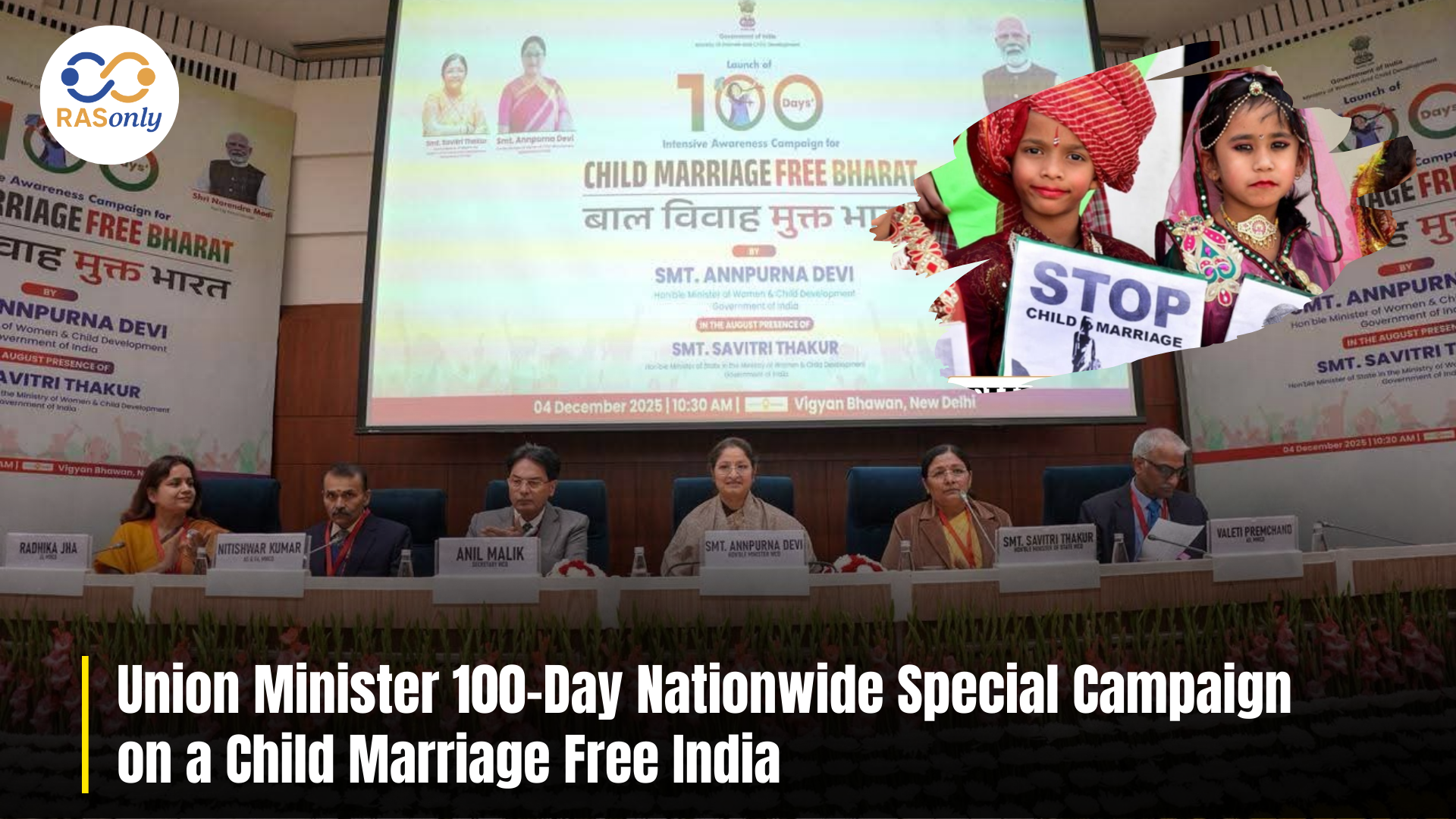
Union Minister of Women and Child Development, Annapurna Devi started a nationwide special campaign of 100 days on the occasion of Vigyan Bhawan, New Delhi, to achieve the dream of a Child Marriage Free India. This effort is meant to reinforce the idea of public participation, boosting awareness, action plans on the state level, and combining various departments, including education, health, rural development, and social welfare. Rajasthan was virtually part of the nationwide pledge which involved all officials such as DPOs, CMPOs, CDPOs, supervisors, Anganwadi workers, health workers, OSC teams, civil society groups, teachers and volunteers. The digital broadcasting guaranteed the real time interaction, and active involvement of the people in eradicating child marriage throughout India.
Major characteristics of the Campaign.
• Nationwide Awareness and action drive against child marriage 100 days.
• Virtual involvement of the central and state authorities, frontline employees, and civil society.
• Rajasthan executed the campaign at all district levels, blocks and community levels.
• Attend to education, health, social protection and community participation.
• Aired via Common Service Centres, Panchayats and local bodies.
• Child marriage free pledge by the masses.
Mission Strategy and the Development of Rajasthan.
Multi-Sectoral Strategy
• The focus on education, health, social security, and behavioural change.
• The participation of local leadership: Collectors, MLAs, Panchayati Raj institutions and activists.
• Capacity-building of schools, PRIs, Anganwadi centres and youth groups.
Rajasthan’s Achievements
• NFHS-4 to NFHS-5: The rate of child marriage dropped to 25.4% from 35.4%.
• More than 2.5 lakh community members were reached out to via awareness programs.
• Over 3 lakh students to be contacted through school outreach.
• New system of youth ambassadors and volunteers in the community.
Conclusion
The 100-day campaign is the national campaign that shows a concerted effort of eradicating child marriage by educating, empowering, and coordinating various departments. The proactive nature of Rajasthan, mobilisation of the communities and quantifiable development indicate a firm adherence to the Viksit Bharat @ 2047 vision. Empowering the grassroots leadership should greatly speed up the future of India to become child marriage free.
MCQ 1
Question: What then was the main aim of the 100-Day Special Campaign of the Union Minister?
A. Only increase school enrollment.
B. Encourage digital governance.
C. Nationwide awareness on a Child Marriage Free India.
D. Conduct a national census
Answer: C
Explanation:
The 100-day campaign is aimed at eradicating child marriage through enhancing awareness, community mobilisation, multi-sectoral intervention, and engagement of central and state departments. It is mainly aimed at behavioural change, greater protection schemes, empowerment of girls by education and health projects and a nation-building initiative. The involvement of Rajasthan indicates the mission idea to have coordinated activities at the grassroots level and to be in line with Viksit Bharat @ 2047 objectives.
MCQ 2
Question: Which is the decrease in child marriage prevalence in Rajasthan based on NFHS-4 and NFHS-5?
A. 50% to 40%
B. 40% to 30%
C. 35.4% to 25.4%
D. 20% to 10%
Answer: C
Explanation:
According to the NFHS data, child marriage in Rajasthan has reduced considerably, by 35.4 to 25.4 (NFHS-4 to NFHS-5). This has been enhanced through concerted efforts by government departments, civil society, front line workers, learning institutions, the youth and community influencers. This type of data-based evaluation emphasizes the significance of the policy intervention, awareness campaigns and support support system in diminishing the harmful practices.
केंद्रीय मंत्री ने बाल विवाह मुक्त भारत के लिए 100 दिवसीय राष्ट्रीय विशेष अभियान का शुभारंभ किया
केंद्रीय महिला एवं बाल विकास मंत्री श्रीमती अन्नपूर्णा देवी ने नई दिल्ली स्थित विज्ञान भवन से बाल विवाह मुक्त भारत के संकल्प को साकार करने हेतु “100 दिनों के विशेष अभियान” का शुभारंभ किया। यह अभियान जनभागीदारी को मजबूत करने, बाल विवाह उन्मूलन हेतु शिक्षा, स्वास्थ्य, सामाजिक सुरक्षा व व्यवहारिक परिवर्तन को बढ़ावा देने तथा विभिन्न विभागों के समन्वय को सुदृढ़ करने पर केंद्रित है। राजस्थान ने भी इस अभियान में वर्चुअली सहभागिता की, जिसमें डीपीओ, सीएमपीओ, सीडीपीओ, आंगनवाड़ी कार्यकर्ता, स्वास्थ्यकर्मी, शिक्षण संस्थान, सेवा प्रदाता और सिविल सोसायटी के सदस्यों ने भाग लिया। कार्यक्रम का प्रसारण कॉमन सर्विस सेंटर, पंचायतों व स्थानीय निकायों में किया गया।
अभियान की प्रमुख विशेषताएँ
• बाल विवाह उन्मूलन हेतु 100 दिवसीय राष्ट्रव्यापी अभियान।
• केंद्रीय व राज्य स्तरीय अधिकारियों, फ्रंटलाइन कार्यकर्ताओं व समाजसेवी संगठनों की व्यापक सहभागिता।
• राजस्थान में सभी जिलों व ब्लॉकों में वर्चुअल अपनाया गया मॉडल।
• शिक्षा, स्वास्थ्य, सामाजिक सुरक्षा व सामुदायिक भागीदारी पर विशेष बल।
• कॉमन सर्विस सेंटर व पंचायतों के माध्यम से लाइव प्रसारण।
• बाल विवाह मुक्त भारत की शपथ का आयोजन।
मिशन रणनीति एवं राजस्थान की प्रगति
बहु-क्षेत्रीय रणनीति
• शिक्षा, स्वास्थ्य, सामाजिक सुरक्षा एवं सामुदायिक जागरूकता को केंद्र में रखा गया।
• जिला कलेक्टर, विधायक, जनप्रतिनिधि एवं सामुदायिक नेताओं की सक्रिय भूमिका।
• विद्यालयों, पंचायतों एवं आंगनवाड़ी कार्यकर्ताओं का क्षमता-वर्धन।
राजस्थान की उपलब्धियाँ
• NFHS-4 से NFHS-5 में बाल विवाह दर 35.4% से घटकर 25.4%।
• 2.5 लाख से अधिक समुदाय सदस्यों से संवाद।
• 3 लाख से अधिक विद्यार्थियों तक जागरूकता गतिविधियाँ।
• युवा अग्रदूतों व सामुदायिक समर्थकों का मजबूत नेटवर्क विकसित।
निष्कर्ष
यह 100 दिवसीय अभियान बाल विवाह उन्मूलन के लिए राष्ट्रीय स्तर पर एक महत्वपूर्ण पहल है, जो शिक्षा, सामुदायिक सशक्तिकरण और विभागीय समन्वय को मजबूत करता है। राजस्थान की सक्रिय भागीदारी और सतत प्रगति विकसित भारत @ 2047 की दिशा में महत्वपूर्ण योगदान देती है। इससे बाल विवाह मुक्त समाज की दिशा में परिवर्तन की गति और अधिक तेज होगी।
MCQ 1
प्रश्न: 100 दिवसीय विशेष अभियान का मुख्य उद्देश्य क्या था?
A. केवल विद्यालय नामांकन बढ़ाना
B. डिजिटल गवर्नेंस को बढ़ावा देना
C. बाल विवाह मुक्त भारत के लिए राष्ट्रव्यापी जागरूकता फैलाना
D. राष्ट्रीय जनगणना आयोजित करना
उत्तर: C
व्याख्या:
यह अभियान बाल विवाह उन्मूलन हेतु जनजागरूकता, सामुदायिक सहभागिता, बहु-विभागीय समन्वय, तथा शिक्षा व स्वास्थ्य जैसे क्षेत्रों में सशक्तिकरण को बढ़ावा देता है। इसका लक्ष्य सामाजिक व्यवहार परिवर्तन लाना, लड़कियों की सुरक्षा सुनिश्चित करना और राज्य व केंद्र स्तर पर साझा प्रयासों को मजबूत करना है। राजस्थान की सहभागिता इस मिशन के जमीनी क्रियान्वयन की दिशा में महत्वपूर्ण है।
MCQ 2
प्रश्न: NFHS-4 और NFHS-5 के अनुसार राजस्थान में बाल विवाह प्रसार दर में कितनी कमी आई है?
A. 50% से 40%
B. 40% से 30%
C. 35.4% से 25.4%
D. 20% से 10%
उत्तर: C
व्याख्या:
NFHS आँकड़े दर्शाते हैं कि राजस्थान में बाल विवाह दर 35.4% से घटकर 25.4% हो गई है। यह कमी सरकारी विभागों, सिविल सोसायटी, विद्यालयों, आंगनवाड़ी कार्यकर्ताओं और समुदाय स्तर पर किए गए समन्वित प्रयासों का परिणाम है। ऐसी प्रगति इस बात को रेखांकित करती है कि लक्ष्य-निर्धारित योजनाएँ और जागरूकता अभियान सामाजिक कुप्रथाओं को कम करने में प्रभावी हैं