Chola Dynasty: Capital, Founder, Kings, Time Period and History
Climate Change Impact on Rajasthan – Detailed Guide for RAS 2026

Get in Touch with RASonly!

Climate Change Impact on Rajasthan 2026 is a crucial topic for RAS preparation as it directly affects water security, agriculture, public health, and rural livelihoods. Understanding climate risks, adaptation strategies, and SAPCC policies helps aspirants write analytical and Rajasthan-focused answers in Prelims, Mains, and Interview.

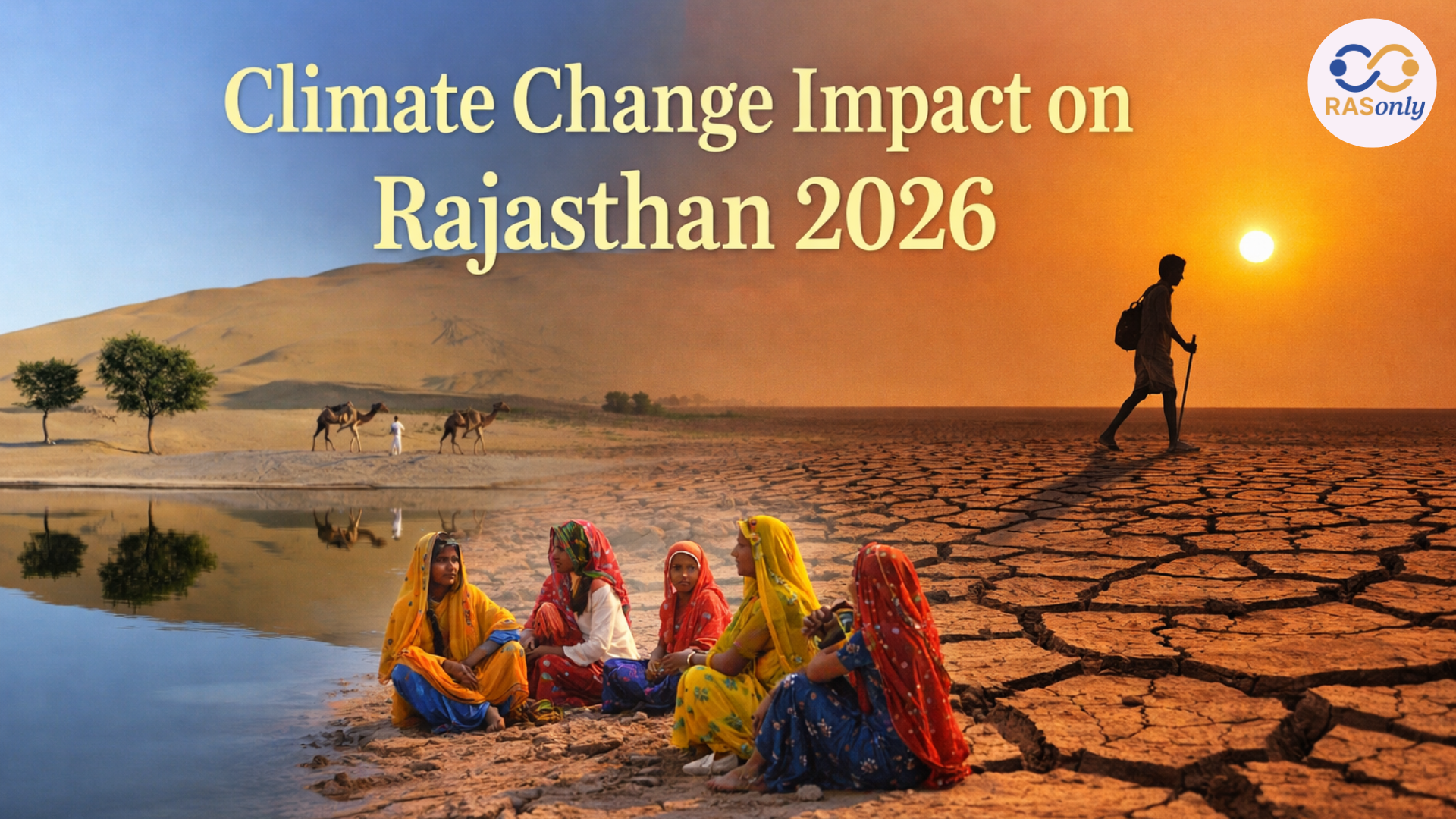
Climate change is one of the most pressing environmental and socio-economic challenges facing Rajasthan today. Located largely in arid and semi-arid zones, the state is highly vulnerable to rising temperatures, erratic monsoons, prolonged droughts, accelerated desertification, water scarcity, and climate-linked agricultural stress. These changes have direct implications for water security, food production, public health, livelihoods, natural ecosystems, and socio-economic development, all of which are important for RPSC RAS Prelims, Mains, and Interview preparation.
Rajasthan’s unique geography, including the Thar Desert, sparse rainfall, and high evapotranspiration rates, magnifies climate impacts compared to other regions. As the trend of warming is expected to persist and the rainfall patterns are ever more erratic, the state is exposed to compounded risks which impact its economy, environment, and society. The Rajasthan State Action Plan on Climate Change (SAPCC) is developed to deal with these susceptibilities by undertaking strategic mitigation and adaptation measures.
1. Rising Temperatures & Heatwaves
Rajasthan has been facing rising average temperatures and higher heat waves which have been far above the long term averages. Heatwaves do not only affect human health negatively due to heat stress and heatstroke, but also decrease labour productivity, enhance energy use in cooling, and disorient ecosystems. Recent statistics have indicated that temperatures in summer are often above 45°C in many districts.
Key Impacts:
- Higher risk of heat-related illnesses and deaths
- Reduced outdoor labour capacity (agriculture, construction)
- Increased energy consumption for cooling
- Stress on urban infrastructure and water demand
Evidence: Heatwave intensity in desert zones like Jaisalmer, Barmer, and Bikaner has risen, impacting human health and labour productivity.
2. Erratic Rainfall & Drought Conditions
Rajasthan has low rainfall and very erratic rainfall hence quite drought prone. Climate change exacerbates this change, creating erratic weather patterns of monsoons -droughts as well as torrential rains that enhance runoff over soil moisture. This variability has an impact on crop planning, recharge of ground water, and water storage facilities.
Seasonal Rainfall Trends
| Pattern | Effect |
|---|---|
| Variable monsoon | Drought susceptibility |
| Intense short rains | Flood risk & soil erosion |
| Long dry spells | Water scarcity & crop stress |
Mukhyamantri Jal Swavalamban Abhiyan (MJSA) and other adaptation measures are essential in enhancing water harvesting and storing surface water, as well as improving resilience to drought.
3. Water Scarcity & Groundwater Decline
The groundwater of Rajasthan is experiencing extreme stress due to over-extraction and recharge of the rainfall. Reports suggest that though certain areas of the state record small recharge, the number of districts record decreasing water tables, which endanger drinking water sources and irrigation.
Water Stress Indicators
- Depleted aquifers in northern and central districts
- Increasing dependence on surface water and tankers
- Low natural recharge due to heat and evaporation
Key Drivers:
- High irrigation demand
- Rapid groundwater extraction
- Climate-induced reduced recharge
Water augmentation programs and efficient management are key policy responses.
4. Agriculture & Food Security
Approximately 65 percent of the population in Rajasthan relies on agriculture, which is climate-sensitive. Late or erratic monsoons, heat stress, and alterations of soil moisture decrease crop production, compelling farmers to alter cropping or leave old crops.
Crop Risk Matrix
| Climate Factor | Agricultural Impact |
|---|---|
| Erratic rainfall | Crop failures & yield reduction |
| High temperature | Heat stress on crops |
| Soil moisture loss | Reduced water use efficiency |
| Drought events | Livelihood insecurity |
Climate change causes more water in arid areas such as Thar Desert to be used in agriculture and so the water stress intensifies and the sustainability of agriculture is diminished.
5. Desertification & Land Degradation
Rajasthan - especially around the Thar Desert area - is prone to desertification as fertile land becomes sterile up to wind erosion, loss of vegetation and extended dry spells. Climate change increases the rate of this process, which leads to loss of soil fertility and an increase in dust storms.
Impacts:
- Loss of arable land
- Soil erosion
- Reduced biomass and vegetation cover
- Increased wind and dust hazards
Efforts to conserve the Aravalli Range and expand tree plantations enhance land stability and climate resilience.
6. Public Health Risks Due to Climate Change in Rajasthan
The problem of climate change is posing an increased health risk to the population in Rajasthan because of temperature rise, excessive heat waves, water shortage, and erratic rain patterns. Rajasthan being a dry state is very susceptible to heat stress, lack of safe drinking water and shifting patterns of diseases. RAS under Environment, Disaster Management, and Public Health Governance is critical on this topic.
Major Health Challenges
Heat-Related Illnesses
- Heatstroke and dehydration
- Increased summer mortality
- High risk for outdoor workers
Water-Borne Diseases
- Diarrhea and cholera
- Poor water quality during droughts
Vector-Borne Diseases
- Dengue and malaria due to stagnant water
Pressure on Health Infrastructure
- Increased patient load during heatwaves
- Need for climate-resilient health systems
For RAS Mains, link this topic with climate adaptation policies, Heat Action Plans, water security, and strengthening rural healthcare systems.
7. Socio-Economic & Rural Livelihood Impacts
The rural economies especially those that rely on agriculture, livestock and their associated activities are climate stressed. Unpredictable weather patterns enhance the insecurity of income, drive communities to migration, and enhance rural poverty.
8. Rajasthan State Action Plan on Climate Change (SAPCC)
In response to climatic challenges, the Government of Rajasthan has devised the State Action Plan on Climate Change (SAPCC) - a broad-based mitigation and adaptation plan.
SAPCC Focus Areas
| Sector | Strategic Action |
|---|---|
| Water resources | Rainwater harvesting & recharge |
| Agriculture | Climate-resilient crops & practices |
| Forestry | Ecosystem restoration & afforestation |
| Health | Climate-ready healthcare systems |
| Energy | Renewable energy & efficiency |
| Sustainable habitats | Urban adaptation planning |
| Knowledge | Climate research & risk assessment |
The plan emphasizes cross-sectoral coordination and incorporates SDG goals (especially SDG 13 – Climate Action and SDG 15 – Life on Land).
Important Link
Conclusion
Climate change has come to the forefront of Rajasthan's development pattern. An increase in temperatures, water and food insecurity, ecosystem pressures, and health insecurity demand holistic, climate-responsible policies. To RAS aspirants, the connection between climate impacts and water governance, agricultural sustainability, rural economies, health systems, and environmental policies is essential in giving high marks in GS Papers and Interviews.
Understanding Rajasthan’s climate risks, adaptation strategies, and policy frameworks like SAPCC prepares candidates to answer policy and governance questions with depth, relevance, and analytical insight.
FAQs
Climate Change Impact on Rajasthan is important for RAS 2026 because it affects water scarcity, drought, desertification, agricultural productivity, and public health all major topics in the RAS Environment and Governance syllabus.
Climate change in Rajasthan causes erratic rainfall, heat stress, and groundwater depletion, leading to crop failure, reduced yield, and increased farmer vulnerability.
The Rajasthan State Action Plan on Climate Change (SAPCC) outlines mitigation and adaptation strategies in water resources, agriculture, energy, forestry, and health sectors.
Rising temperatures and extreme heatwaves in Rajasthan are linked to global warming, increasing heat-related illnesses, water demand, and stress on infrastructure.
Major environmental challenges include desertification in the Thar region, groundwater depletion, water scarcity, biodiversity loss, and climate-induced migration.

BEST SELLER
🏆 PRELIMS
RAS Pass
Prelims focused Hindi & English
₹399
✓
Prelims Topic-Wise Tests
✓
Subject-Wise Tests
✓
Full-Length Prelims Tests
✓
Daily Current Affairs Tests
✓
Prelims PYQs Tests
✓
Detailed Solutions & Analysis
✓
All Rajasthan Ranking
✓
Unlimited Reattempts
✓
Mains Tests
✓
Hindi & English Tests
✓
All Rajasthan Ranking
Trusted by 5,000+ Students

Post Category
- RAS Salary
- Result
- RAS Admit Card
- RAS Job
- RAS Cutoff
- Preparation Tips
- RAS Answer Key
- RAS Exam Analysis
- RAS Syllabus
- RAS Previous Year Papers
- RPSC RAS Exam Pattern
- RAS Interview
- RAS Exam Date
- RAS Vacancy
- RAS Test Series
- RAS Best Books
- RAS Preparation Resources
- RAS Coaching Centre
- History
- Polity
- Geography
- Economics
- Science
- Art and Culture
- RPSC RAS Application Form
- RPSC RAS Notification
- RAS Eligibility Criteria
- UPSC Exam
- RPSC RAS Mains
Visit Our RASonly Offline Center
Our Expert Faculty

Bhunesh Sir
Current Affairs · 13+ Yrs

Aamir Khan Sir
RAS-2017 · IIM Ahm.

Akash Sir
Polity · 8+ Yrs
Free Resources
Official Mobile App

RASOnly App
by OTSAdda · Free
Full Video Lectures
Mock Tests & PYQs
Daily Current Affairs
AI Mock Interview
Free Download · No subscription needed to install
RAS 2024 Toppers — RASonly
Rank 2
Virendra Charan
Rank 9
Bhoopinder Singh
Rank 26
Aanchal Nagpal
Rank 33
Lokendra Singh
Rank 45
Amar Rathore
Rank 46
Manasvini Verma

Join RASonly WhatsApp Community
Get daily current affairs, exam alerts, free study material and tips from expert faculty — right on WhatsApp.
Join for Free →RASonly Interview Guidance Program

Mr. Ashok Jain
Ex-Chief Secretary Govt of Rajasthan
- IAS officer of the 1981 batch, Rajasthan cadre.
- Passionate about mentoring the next generation of RAS officers with real-world insights.
- Got retired in Dec 2017 from the post of Chief Secretary of the state of Rajasthan.

Mr. Guru Charan Rai
Ex-ASP / SP in Jaisalmer
- Guru Charan Rai, IPS (Retd), retired as Inspector General of Police (Security), Rajasthan, Jaipur in 2017.
- Served as ASP and SP in Jaisalmer, Nagaur, Sri Ganganagar, Sawai Madhopur, Dausa, Sikar, and Karauli.
- He also held key positions as DIGP and IGP in the Law and Order division.

Mr. Rakesh Verma
Ex-IAS Officer, B.Tech, MBA, and M.A. (Economics)
- IAS officer of the 1981 batch and retired in Chief Secretary Rank.
- Civil servant of high repute and vast experience.
- Has been teaching UPSC CSE subjects for the last six years.
Related Post




Daily Current Affairs for RAS Exam Preparation 2026

Kundan Art Display in Hong Kong
October 23, 2026
Rajasthan International Folk Festival 2026
October 23, 2026
Inauguration of 100 New Kalika Patrolling Units in Rajasthan
October 21, 2026