Jainism: Founder, Symbol, Teachings, Beliefs, History & Principles
G7 Countries, Members, History
Get in Touch with RASonly!


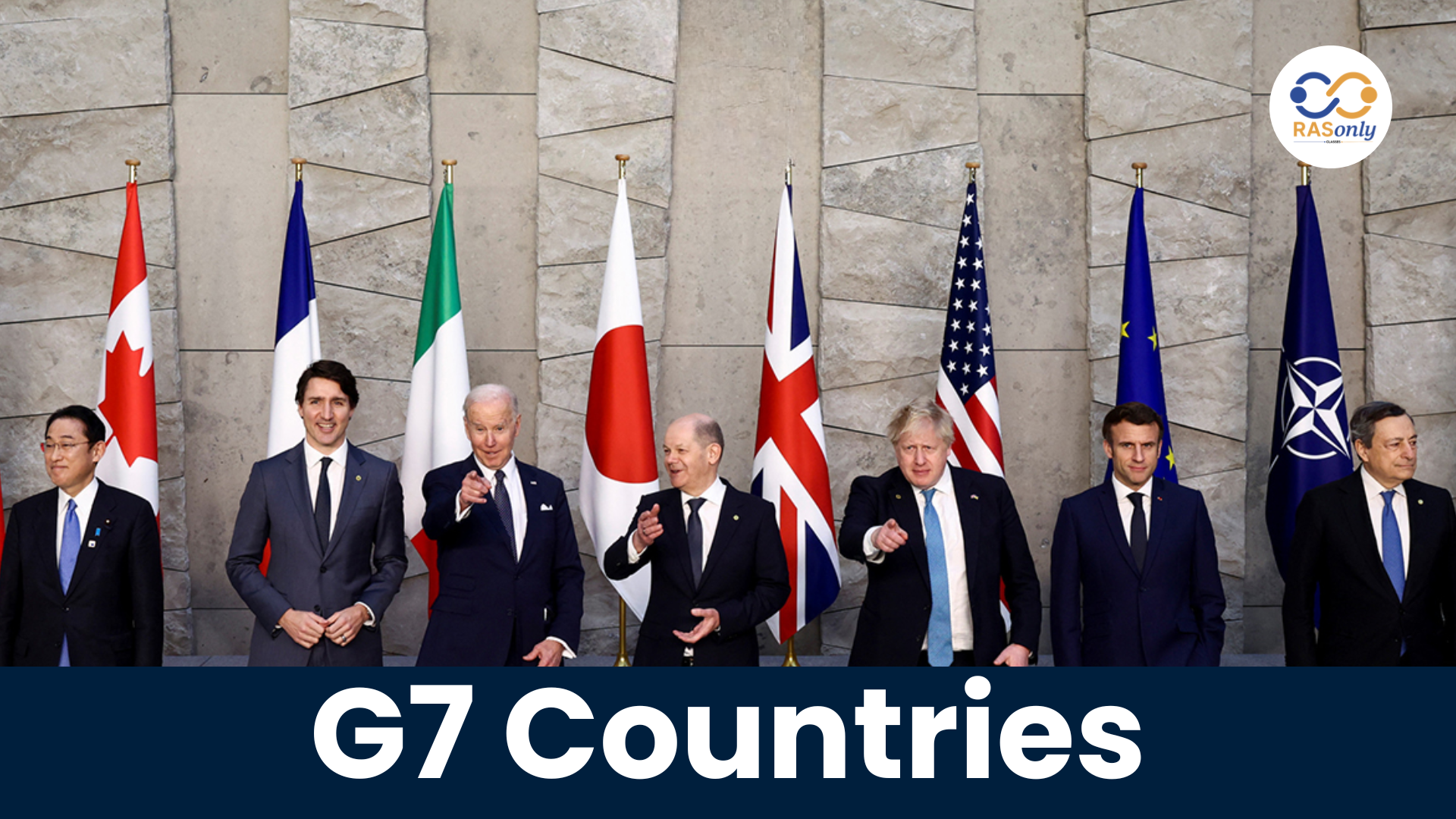
The G7 (Group of Seven) is an intergovernmental organisation of the seven most prospective economical powers of the entire planet, created in the 1970s as a forum by which global economic crises can be addressed. It comprises Canada, France, Germany, Italy, Japan, the UK and the USA, with the EU full member, but not partaking in all aspects of it. The G7 was initially concerned with macroeconomic policy but has since expanded its matters of interest to include such topics as climate change, world security and development. It was a member briefly when Russia was a part of it, and it was known as the G8 (199814), until Russia was ejected in the wake of the annexation of Crimea. The G7 wins it in all directions by having tremendous power in the financial, political and the social agenda-setting being global.
Key Points for RAS Mains
History and Development of G7
- Year Founded: 1975 as G6 France, Germany, Italy, Japan, UK, USA.
- In 1976, Canada entered the agreement and G7 was founded.
- Russia became a member in 1998 (G8 but suspended in 2014).
- It has been EU involved since the 1970s but not in membership formally.
- Purpose of formation: To organize reaction to oil crises, inflation, and currency fluctuation after the fall of Bretton Woods.
G7 Members
|
|
|
|
|
|
|
|
|
|
|
|
|
|
|
|
|
|
|
|
|
|
|
|
|
|
|
|
|
|
|
|
🔹 European Union (EU) – Participates but not a voting member.
Past Membership: G8
|
|
|
|
|
|
|
|
Aims and objectives of G7
- Standardize economic policies and administration of trade.
- Speak about the international issues of energy, environment, health, and terrorism.
- Foster democracy, human rights and rule of law.
- Counterbalance crises in finance and geopolitics.
Significance of G7 to the world
- Economic Power
- The combined GDP of the G7 countries is ~45 percent of the world economy.
- Key role in international trade, finance and development assistance.
- Political Influence
- They influence the decisions of UN policies, climate negotiations and global sanctions.
- Design geopolitical-stability agendas and democratic-rule agendas.
- Science Social Leadership
- Climate change, gender equity, world health, and education reforms can be discussed in G7 forums as well.
G7+ and Outreach Seven (O7) & Guests
What is g7+?
- An informal extension of G7.
- Invites countries or organizations at summits on particular topics (ex: India, South Africa Australia).
- Mission: Broaden discourse, particularly in areas of such global issues as climate, pandemic, or AI.
What is Outreach Seven (O7)?
- An ever-rotating club of 7 Non-G7 countries as special guests.
- Participants are different depending on the president and theme of the summit.
- Role: Advisory, not having the power to make decisions.
Conclusion for RAS
The G7 remains a major player towards influencing the world on issues involving economics and politics. In spite of the accusations of exclusivity like it was faced with before, its conglomerative outfits such as G7+ and O7 have made it more inclusive.
Also Read: SAARC
FAQs related to RPSC RAS
G7 is an informal group of the seven most advanced and industrialized economies in the world.
The members include Canada, France, Germany, Italy, Japan, the United Kingdom, and the United States of America.
No, the EU is not a formal member but has participated in G7 meetings since the 1970s.
The G7 was initially formed as the G6 in 1975. Canada joined in 1976, making it the G7.
Russia was removed in 2014 due to its annexation of Crimea, which was widely condemned as a violation of international law.
No, the G7 does not have a fixed headquarters. Its presidency rotates annually among the member countries.
India is not a member of the G7 but is regularly invited as a guest to participate in select sessions.
BEST SELLER
🏆 PRELIMS
RAS Pass
Prelims focused Hindi & English
₹399
✓
Prelims Topic-Wise Tests
✓
Subject-Wise Tests
✓
Full-Length Prelims Tests
✓
Daily Current Affairs Tests
✓
Prelims PYQs Tests
✓
Detailed Solutions & Analysis
✓
All Rajasthan Ranking
✓
Unlimited Reattempts
✓
Mains Tests
✓
Hindi & English Tests
✓
All Rajasthan Ranking
Trusted by 5,000+ Students
Post Category
- RAS Salary
- Result
- RAS Admit Card
- RAS Job
- RAS Cutoff
- Preparation Tips
- RAS Answer Key
- RAS Exam Analysis
- RAS Syllabus
- RAS Previous Year Papers
- RPSC RAS Exam Pattern
- RAS Interview
- RAS Exam Date
- RAS Vacancy
- RAS Test Series
- RAS Best Books
- RAS Preparation Resources
- RAS Coaching Centre
- History
- Polity
- Geography
- Economics
- Science
- Art and Culture
- RPSC RAS Application Form
- RPSC RAS Notification
- RAS Eligibility Criteria
- UPSC Exam
- RPSC RAS Mains
Visit Our RASonly Offline Center
Our Expert Faculty

Bhunesh Sir
Current Affairs · 13+ Yrs

Aamir Khan Sir
RAS-2017 · IIM Ahm.
Akash Sir
Polity · 8+ Yrs
Free Resources
Official Mobile App

RASOnly App
by OTSAdda · Free
Full Video Lectures
Mock Tests & PYQs
Daily Current Affairs
AI Mock Interview
Free Download · No subscription needed to install
RAS 2024 Toppers — RASonly
Rank 2
Virendra Charan
Rank 9
Bhoopinder Singh
Rank 26
Aanchal Nagpal
Rank 33
Lokendra Singh
Rank 45
Amar Rathore
Rank 46
Manasvini Verma

Join RASonly WhatsApp Community
Get daily current affairs, exam alerts, free study material and tips from expert faculty — right on WhatsApp.
Join for Free →RASonly Interview Guidance Program

Mr. Ashok Jain
Ex-Chief Secretary Govt of Rajasthan
- IAS officer of the 1981 batch, Rajasthan cadre.
- Passionate about mentoring the next generation of RAS officers with real-world insights.
- Got retired in Dec 2017 from the post of Chief Secretary of the state of Rajasthan.

Mr. Guru Charan Rai
Ex-ASP / SP in Jaisalmer
- Guru Charan Rai, IPS (Retd), retired as Inspector General of Police (Security), Rajasthan, Jaipur in 2017.
- Served as ASP and SP in Jaisalmer, Nagaur, Sri Ganganagar, Sawai Madhopur, Dausa, Sikar, and Karauli.
- He also held key positions as DIGP and IGP in the Law and Order division.

Mr. Rakesh Verma
Ex-IAS Officer, B.Tech, MBA, and M.A. (Economics)
- IAS officer of the 1981 batch and retired in Chief Secretary Rank.
- Civil servant of high repute and vast experience.
- Has been teaching UPSC CSE subjects for the last six years.
Daily Current Affairs for RAS Exam Preparation 2026
25th SCO Foreign Trade Ministers' Meeting
September 19, 2026
India’s flag bearer at the opening ceremony of the...
September 19, 2026
PM-YASASVI Scheme Update 2026
September 18, 2026