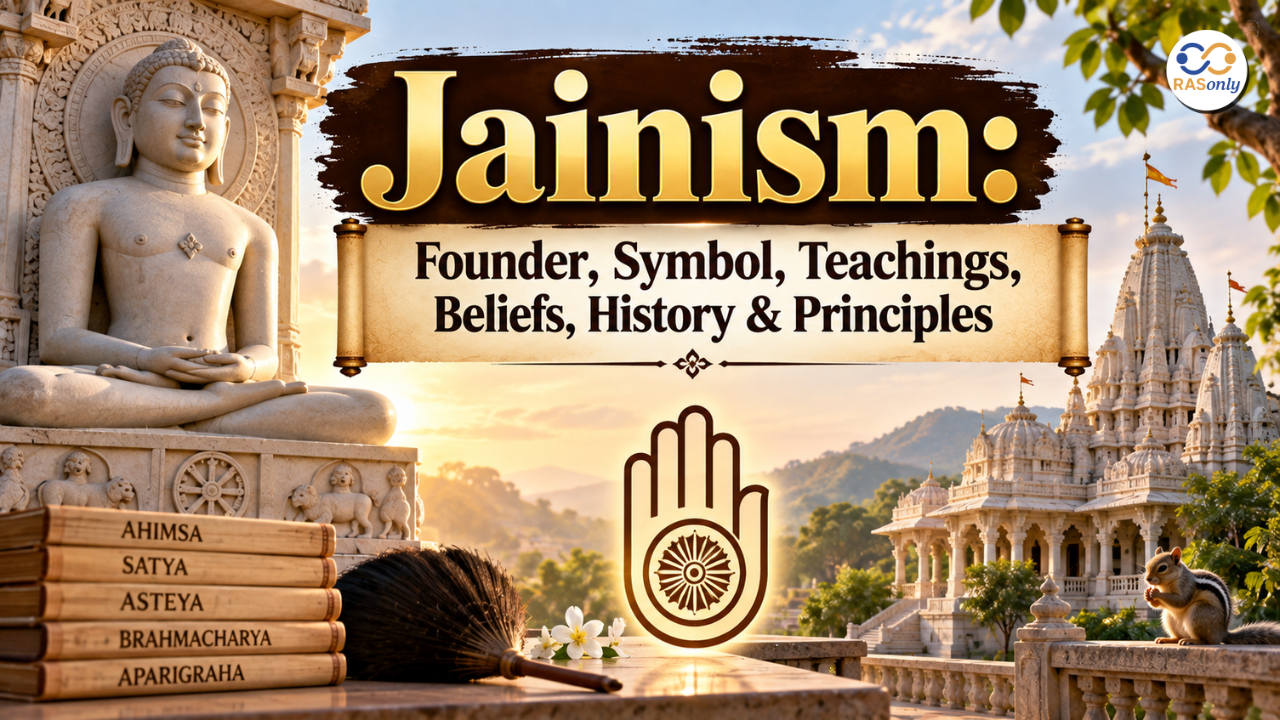
Jainism: Founder, Symbol, Teachings, Beliefs, History & Principles
Top Mistakes to Avoid in RAS Mains Paper 2: A Complete Preparation Guide for RPSC Aspirants

Get in Touch with RASonly!

Learn the most common mistakes candidates make in RAS Mains Paper 2 and discover practical strategies to improve answer writing, time management, presentation, and current affairs integration. This guide helps RPSC aspirants maximize their Mains score through smarter preparation.

RAS Mains Paper 2 mistakes are one of the biggest reasons why otherwise well-prepared candidates end up losing crucial marks in the RPSC RAS Mains examination. Every year, thousands of aspirants can clear the Prelims exams with confidence but fail to make it to the Mains exam due to silly mistakes in answer writing, time management, and presentation. The importance of RAS Mains Paper 2 cannot be undermined; if there are any minor mistakes in multiple questions of the paper, they can take away a huge margin from the overall merit list.
This guide takes a close look at the most common RAS Mains exam tips-related pitfalls candidates fall into, and explains a practical RAS Mains Paper 2 strategy to avoid them. If you are taking the exam for the first time or repeating it for some reason, it is important to know these mistakes from the outset so you can avoid all of them to ensure you get the score you want and go beyond it to a rank that leads to selection. Let's go through the syllabus, exam pattern, and then onto the specific errors that candidates need to be wary of.
Understanding RAS Mains Paper 2: Syllabus and Exam Pattern
Before identifying mistakes, it's important to have complete clarity on what RAS Paper 2 actually tests. The Paper 2 of RPSC RAS Mains is one of the more analytical and application-based papers in the RAS Mains syllabus as it covers Governance, Indian Constitution, Ethics and Science & Technology. A large number of errors happen simply because candidates misjudge the scope of this paper and prepare it like a factual, memory-based subject instead of an analytical one.
| Component | Details |
|---|---|
| Exam Type | Descriptive (Subjective) |
| Total Marks (per Paper) | 200 Marks |
| Duration | 3 Hours |
| Core Areas | Governance, Constitution, Ethics, Science & Technology |
| Negative Marking | Not Applicable in Mains (Only in Prelims) |
| Question Format | Mix of Short, Medium, and Long-Answer Questions |
The first mistake candidates make, and the last, is to not plan around the structure of the RAS Mains exam, which has a fixed time of 3 hours with a mix of question lengths.
Common Mistakes in RAS Mains Answer Writing
The typical errors people make in their RAS Mains answer writing are those in which the candidate provides answers to the questions that the examiner does not look for. Numerous candidates who know the content well may lose marks due to lack of structured writing, too general or not answering the question's requirements. Here are the most common problems painters are spotted in the RAS Mains Paper 2 answer paper.
Not Reading the Question Demand Carefully
One of the most common RAS Mains Paper 2 answer writing tips for beginners is to read the question twice before writing. Many candidates may notice a familiar word and begin to write about whatever they know about that word—whether it be “analyze”, “discuss” or “critically evaluate”. It is one of the most penalised errors from the perspective of the evaluation process because this does not involve using the word in the correct context.
Weak Introduction and Conclusion
Good candidates either failed to provide a proper introduction, or wrote a conclusion that was a restatement of the introduction in different words. A good answer should provide a clear statement of the main idea in the introduction and a conclusion that moves forward or provides a balanced conclusion, if applicable, that relates to governance or constitutional values.
Ignoring the Ethics and Governance Linkage
RAS Paper 2 is a combination of Governance, Constitution and Ethics, so students often address each section separately and not in relation to each other. An answer in response to a governance question that also considers constitutional content and ethical issues receives more marks than one that considers only one side of the question.
- Writing answers without linking constitutional articles to governance issues
- Failure to consider ethical issues in questions related to administration.
- Over-theorizing answers without using real-world/current examples
- Do not mention relevant committees, reports, or landmark judgments where appropriate
- Answering the same question repeatedly in various parts of the question.
How to Avoid Negative Marking and Scoring Errors in RAS Mains Paper 2
One must keep in mind that negative marking will be applicable to the RPSC RAS Prelims but not to the Mains examination as Mains is a purely descriptive paper. But this doesn't imply that the Mains stage is without risk of scoring; rather, it could be that the content is confusing, irrelevant, or factually incorrect, and that – without a formal negative marking – it would result in a loss of marks.
- Do not guess facts, data, or figures with which you are not familiar; a wrong answer to a statistic is worse than a thought-out answer that is not.
- Don't try to attempt questions on topics you don't know just to pad out the paper, as no questions are better than a poorly worded one that you didn't try.
- Cross-check factual claims (Articles, Acts, years) mentally before writing them down
- Examiners are looking for inconsistency, so make sure there aren't any in the same answer.
Time Management Mistakes in RPSC RAS Mains Exam
Time management errors are very common in RPSC RAS Mains exam, particularly for those candidates who scored good marks in the content but poor in the timing. Poor time allocation, especially when there is a timed window of three hours, and a combination of short, medium and long answers, can lead to the last few questions being rushed or not completed, and hence have an impact on the overall marks in spite of preparation.
| Time Management Issue | Impact on Score |
|---|---|
| Spending Too Long on the First Few Questions | Leaves rushed or incomplete answers for the remaining questions. |
| No Time Reserved for Revision | Silly mistakes and unclear handwriting remain uncorrected. |
| Writing Lengthy Answers for Low-Mark Questions | Consumes valuable time without proportionate marks. |
| Not Allocating Time Per Question in Advance | Creates panic and poor time management in the final 30 minutes. |
A disciplined approach — allocating time per question based on its marks weightage and sticking to it strictly — is one of the simplest yet most underused fixes for this problem.
RAS Mains Paper 2 Presentation and Word Limit Mistakes
One of the common mistakes committed by candidates in RAS Mains Paper 2 is that they practically overlook the aspects of presentation while focusing on the content. Every examiner who has marked hundreds of copies knows that it is easier to mark an answer that is presented in a visually organized, easy-to-scan way and written in the recommended word count guidance for each question type that is provided for the RAS Mains Paper 2.
- Answering very long answers on a short-mark question, wasting time unnecessarily
- Ignoring paragraph breaks, making answers look like a single dense block of text
- Not using headings or sub-points even in analytical or "discuss" type questions
- Illegible or rushed handwriting in the final section of the answer sheet
- Leaving no visual separation between introduction, body, and conclusion
RAS Mains Paper 2 Diagram and Flowchart Mistakes
RAS Mains Paper 2 diagram and flowchart errors are common in Science & Technology-related answers and Governance-related answers and a well-placed diagram can save time and enhance clarity, while a poorly created diagram can mar the answer. There is a lack of diagrams for some candidates, although diagrams may strengthen the answer, and some candidates use diagrams without labelling them.
- Using a diagram or flowchart when it isn't actually relevant to the question, just to "look different"
- Drawing diagrams without proper labels or explanatory notes
- Spending too much time perfecting a diagram at the cost of written content
- Missing an opportunity to use a simple flowchart for process-based governance answers (e.g., grievance redressal mechanisms)
RAS Mains Paper 2 Current Affairs Linking Mistakes
Weaker linkages to current examples in the current affairs part of the RAS Mains Paper 2 are caused either by candidates providing examples that are not relevant to the question or providing too much information about current affairs. A balanced and relevant current affairs reference can make a big difference between an average and a good answer to a Governance and Constitution-based question as these questions often relate to the latest developments in the policy.
- Forcing an unrelated current event into an answer just to appear updated
- Providing obsolete illustrations when newer ones are more relevant.
- Failing to briefly explain the relevance of the example cited
- Overusing current affairs at the cost of core conceptual explanation
Revision and Model Answer Mistakes in RAS Mains 2026 Preparation
There is a risk of a false sense of preparedness and revision errors in the RAS Mains 2026 exam by relying on RAS Mains model answer sources without analyzing them. Many candidates will only learn to memorize the model answers verbatim without grasping the structure and reasoning behind the answers, so when the question is put in a different form to the one they had been working on, they will struggle to respond accordingly.
- Copying off model answers rather than learning the framework for how to write answers.
- Skipping self-evaluation or RAS Mains copy checking by a mentor or peer before the actual exam
- Limiting changes to only static content and not recent changes in governance and policies.
- Not writing answers in timed exam-like conditions before test day.
RAS Mains Paper 2 Toppers' Copy Mistakes to Avoid
Studying RAS 2026 Mains Paper 2 toppers' copy mistakes to avoid is a useful exercise, but only when done the right way. Many students read the topper papers with an aim to copy the phrasing or structure without knowing why it is successful in catching the marks for a particular question for that particular question. This superficial mimicry can have the effect of backfiring when the same structure is used mechanically for a question that has a different demand.
- Answering a question by copying a topper's answer without considering whether it fits the direction of the question
- Ignoring the fact that topper answers are often tailored to their own strong areas of knowledge
- Didn't compare several copies of the same model to look for common features and variations to identify one-off stylistic decisions versus common features
- Failing to note how toppers balance factual content with analytical depth, rather than just listing facts
When used properly, topper copies serve as guides for structure and balance, and should not be copied verbatim. The aim should always be to internalise the approach and then apply it in one's own words, but with the key words in the question.
Building a Consistent Answer-Writing Practice Routine
While individual errors can be spotted, there is one common problem that plagues many RAS aspirants: lack of a well-defined and structured practice plan in the weeks before the exam. While reading standard reference books and taking notes is required, it is not enough; answer writing can only be developed with repeated and deliberate practice in the conditions that are conveyed in the exam itself.
The best practice is to write answers to old questions and discuss current topics every day or every other day with a subsequent honest self-review using a checklist of the structural, topical and word-counting requirements. When you practice, use a timer instead of writing at a relaxed pace, so you will develop the pacing habits required on test day. This habit becomes a noticeable improvement in faster, sharper and more disciplined answer writing over a period of months.
Conclusion
The majority of the errors mentioned above are not knowledge gaps, they are execution, structure and awareness errors under exam conditions. As long as candidates read the questions carefully, manage their time with discipline, present their answers with clarity and include current affairs and diagrams judiciously, they do well significantly better than their peers who prepare the same but do not perform as well on exam day. Identifying these trends in a timely fashion can provide aspirants with ample time to correct their course in a systematic way—before the exam date. A sound RAS Mains preparation strategy is ultimately about consistent, honest self-assessment. Regularly writing full-length answers under timed conditions, getting them reviewed, and consciously working on the specific gaps identified in this guide will help convert subject knowledge into a well-scoring answer sheet. By working hard on content and presentation, one can avoid these common mistakes in the RAS mains paper 2 easily.
FAQs
Common errors include poor answer structure, misreading questions, weak introductions and conclusions, poor time management, ignoring of ethics, and inappropriate linking of current affairs.
No. RAS Mains is a descriptive examination and does not have negative marking. However, incorrect or irrelevant content can reduce your score.
Allocate time according to the marks of each question, avoid spending too long on early questions, and keep the last few minutes for revision.
Yes. Where relevant, simple diagrams or flowcharts, drawn clearly and labelled, may be used in simple answers in Governance and Science & Technology to enhance clarity.
Your answer should include examples of current affairs that are relevant and recent, but should not be substituted for conceptual explanations.

BEST SELLER
🏆 PRELIMS
RAS Pass
Prelims focused Hindi & English
₹399
✓
Prelims Topic-Wise Tests
✓
Subject-Wise Tests
✓
Full-Length Prelims Tests
✓
Daily Current Affairs Tests
✓
Prelims PYQs Tests
✓
Detailed Solutions & Analysis
✓
All Rajasthan Ranking
✓
Unlimited Reattempts
✓
Mains Tests
✓
Hindi & English Tests
✓
All Rajasthan Ranking
Trusted by 5,000+ Students
Post Category
- RAS Salary
- Result
- RAS Admit Card
- RAS Job
- RAS Cutoff
- Preparation Tips
- RAS Answer Key
- RAS Exam Analysis
- RAS Syllabus
- RAS Previous Year Papers
- RPSC RAS Exam Pattern
- RAS Interview
- RAS Exam Date
- RAS Vacancy
- RAS Test Series
- RAS Best Books
- RAS Preparation Resources
- RAS Coaching Centre
- History
- Polity
- Geography
- Economics
- Science
- Art and Culture
- RPSC RAS Application Form
- RPSC RAS Notification
- RAS Eligibility Criteria
- UPSC Exam
- RPSC RAS Mains
Visit Our RASonly Offline Center
Our Expert Faculty

Bhunesh Sir
Current Affairs · 13+ Yrs

Aamir Khan Sir
RAS-2017 · IIM Ahm.

Akash Sir
Polity · 8+ Yrs
Free Resources
Official Mobile App

RASOnly App
by OTSAdda · Free
Full Video Lectures
Mock Tests & PYQs
Daily Current Affairs
AI Mock Interview
Free Download · No subscription needed to install
RAS 2024 Toppers — RASonly
Rank 2
Virendra Charan
Rank 9
Bhoopinder Singh
Rank 26
Aanchal Nagpal
Rank 33
Lokendra Singh
Rank 45
Amar Rathore
Rank 46
Manasvini Verma

Join RASonly WhatsApp Community
Get daily current affairs, exam alerts, free study material and tips from expert faculty — right on WhatsApp.
Join for Free →RASonly Interview Guidance Program

Mr. Ashok Jain
Ex-Chief Secretary Govt of Rajasthan
- IAS officer of the 1981 batch, Rajasthan cadre.
- Passionate about mentoring the next generation of RAS officers with real-world insights.
- Got retired in Dec 2017 from the post of Chief Secretary of the state of Rajasthan.

Mr. Guru Charan Rai
Ex-ASP / SP in Jaisalmer
- Guru Charan Rai, IPS (Retd), retired as Inspector General of Police (Security), Rajasthan, Jaipur in 2017.
- Served as ASP and SP in Jaisalmer, Nagaur, Sri Ganganagar, Sawai Madhopur, Dausa, Sikar, and Karauli.
- He also held key positions as DIGP and IGP in the Law and Order division.

Mr. Rakesh Verma
Ex-IAS Officer, B.Tech, MBA, and M.A. (Economics)
- IAS officer of the 1981 batch and retired in Chief Secretary Rank.
- Civil servant of high repute and vast experience.
- Has been teaching UPSC CSE subjects for the last six years.


Daily Current Affairs for RAS Exam Preparation 2026

25th SCO Foreign Trade Ministers' Meeting
September 19, 2026
India’s flag bearer at the opening ceremony of the...
September 19, 2026
PM-YASASVI Scheme Update 2026
September 18, 2026