How to Fill DAF for RAS Interview: A Step-by-Step Guide
Physiographic Divisions of Rajasthan - Complete RAS Notes

Get in Touch with RASonly!

Physiographic divisions of Rajasthan shape everything from climate to agriculture in India's largest state. This RAS-focused guide breaks down all four divisions, Marusthali, Aravalli Range, Eastern Plain, and Hadoti Plateau through their Structure, Features, map, and importance. Built for RAS Prelims and Mains aspirants, it pairs exam-ready facts with comparative tables and analytical insights examiners actually look for, making revision faster and answers sharper.

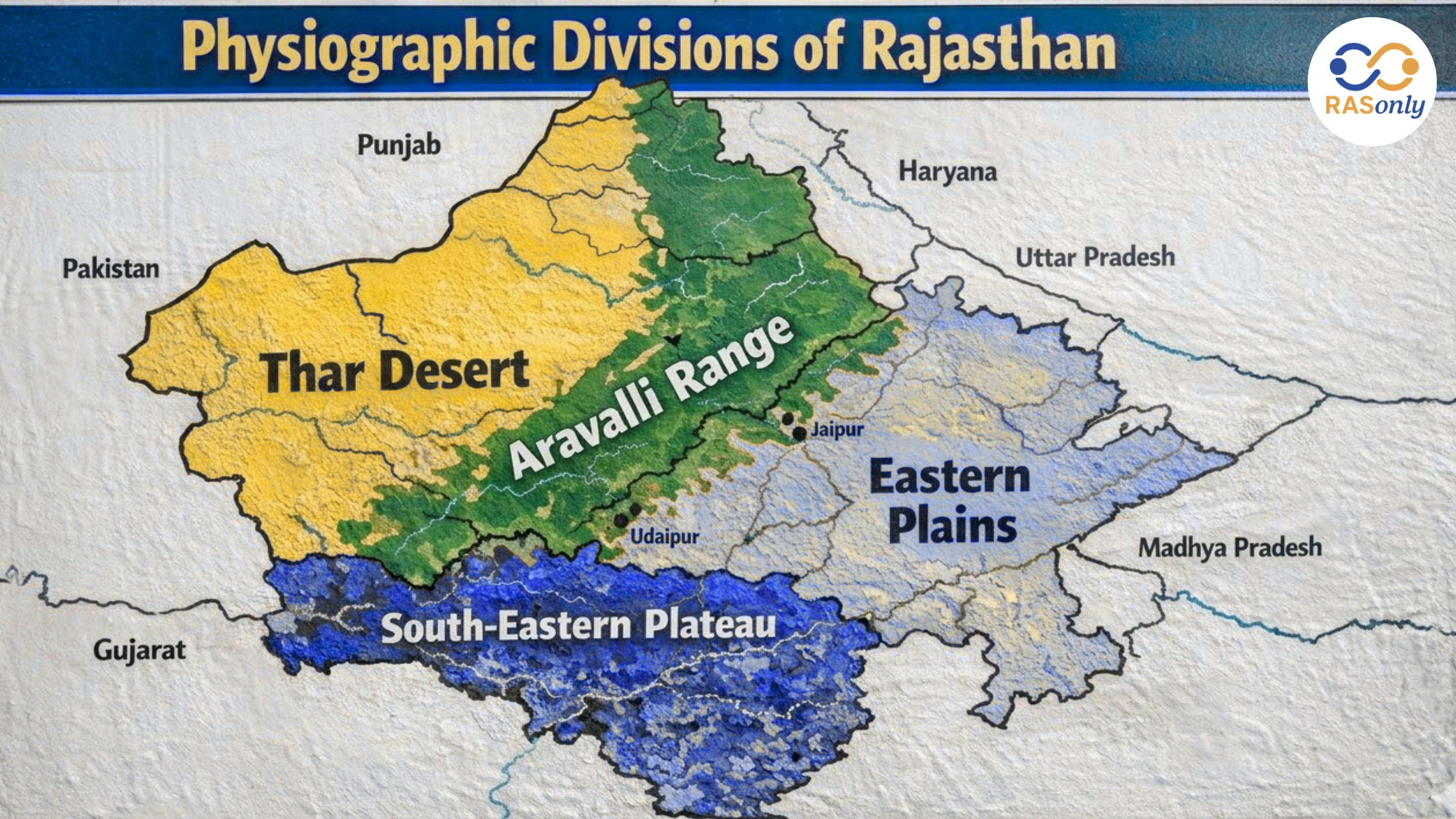
Rajasthan is the largest state of India by area, and its geography is one of the most scoring yet tricky sections for RAS Prelims and Mains. What makes this state unique is the sheer diversity packed into one region on one side, you have the shifting sand dunes of the Thar, and just a few hundred kilometres away, the black basaltic soil of the Hadoti plateau begins. This contrast exists mainly because of one geological feature: the Aravalli Range, which runs diagonally across the state from southwest to northeast and acts as a natural divider.
Based on relief, drainage, soil, and geological structure, geographers and the Rajasthan government's own revenue records divide the state into four broad physiographic divisions. This article covers each of them in detail, including their Structure, Features, map/location, and Importance, along with the kind of analytical points examiners expect in a Mains-level answer.
1. Marusthali - The Western Sandy Plain (Thar Desert Region)
The Marusthali, popularly known as the Thar Desert or the Great Indian Desert, covers roughly 60% of Rajasthan's total area, making it the largest physiographic division of the state. It lies to the west and northwest of the Aravalli Range and extends into Pakistan, where it merges with the Sindh desert.
Structure
Geologically, the Marusthali is a region of aggradation, built up over centuries by wind-blown (aeolian) sand deposits over an older rocky basement. The region is not uniformly flat, it has internal structural variations:
- Bagar region (north Ganganagar, Hanumangarh): relatively fertile due to canal irrigation.
- Sandy desert proper (Jaisalmer, Barmer, Bikaner): true desert conditions with active dunes.
- Nagaurland (Nagaur Uplands): a slightly elevated rocky tract acting as a transitional structural zone between the sandy plain and the Aravallis.
- Hamada zones: rocky, bare desert surfaces found in patches, structurally distinct from the loose sandy dunes.
Features
- Sand Dunes (Aeolian landforms): Barchan (crescent-shaped, most common), longitudinal (Seif dunes), transverse, and parabolic dunes.
- Playas: Seasonal salt lakes formed in depressions, Sambhar Lake (largest saline lake in India), Didwana, Pachpadra, and Lunkaransar.
- Internal/Inland Drainage: Most rivers here do not reach the sea; the Luni River is the principal river, draining into the Rann of Kutch and turning saline en route.
- Ghaggar Plain: Linked to the "lost river of Saraswati," this seasonal river enters from Punjab/Haryana and disappears into the sands near Hanumangarh, historically significant for Harappan sites like Kalibangan.
- Shekhawati Region: Semi-arid tract in the northeast of this division, historically a major trade hub.
- Climate: Average annual rainfall below 25 cm, extreme diurnal temperature variation.
Map (Location within Rajasthan)
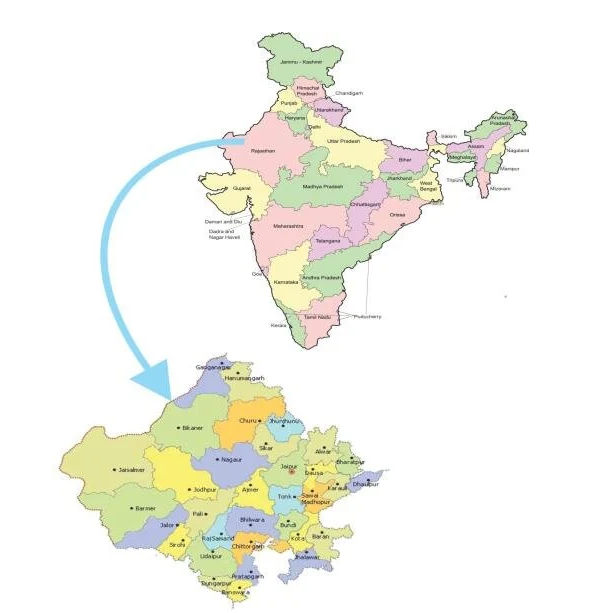
Occupies the entire western and north-western part of the state, lying west of the Aravalli Range. Major districts: Jaisalmer, Barmer, Bikaner, Jodhpur, Churu, Ganganagar, Hanumangarh, and Nagaur. It borders Pakistan on the west and the Aravalli foothills on the east.
Importance
- Home to the Indira Gandhi Canal, the lifeline irrigation project of western Rajasthan.
- Rich in wind and solar energy potential due to open flat terrain and high sunshine hours.
- Strategic importance due to the international border with Pakistan.
- A key example in discussions on desertification and land degradation in Mains answers.
2. Aravalli Hill Range - The Central Highland Region
The Aravalli Range is considered one of the oldest fold mountain ranges in the world, older even than the Himalayas, and formed of Precambrian rocks. It runs for about 550–700 km through Rajasthan, from Sirohi/Khedbrahma in the south to Delhi Ridge in the north, acting as a watershed between the eastward and westward-flowing rivers of the state.
Structure
Unlike young fold mountains, the Aravallis are heavily eroded, which is why they appear as a broken, discontinuous series of hills rather than one continuous range. The structure can be split into:
| Sub-Region | Key Feature |
|---|---|
| Sambhar-Sirohi Upland | Southern part includes Mount Abu and Gurushikhar (highest peak, 1722 m) |
| Central Aravalli (Merwara Hills) | Between Ajmer and Udaipur, moderate elevation |
| Alwar Hills | Northeastern extension, comparatively low and broken |
| Bhorat Plateau | High-altitude plateau near Kumbhalgarh, source of many rivers |
| Delhi Ridge | Extreme northern tail-end of the range |
Features
- Girwa and Kathar: Local basin regions within the Aravalli, known for fertile pockets amid the hills.
- Sapt Godawari basin: A seven-stream drainage basin near Udaipur.
- Nakki Lake: A natural lake at Mount Abu, formed in a hill depression.
- Passes: Desuri and Dewair passes historically connected Marwar and Mewar across the range.
- Rock type: Predominantly quartzite, schist, and granite very hard and resistant to erosion, yet heavily weathered due to age.
Map (Location within Rajasthan)
Runs diagonally across the state in a southwest-to-northeast direction, from Sirohi district through Udaipur, Rajsamand, Ajmer, and up to Alwar near the Delhi border. It effectively divides Rajasthan into the arid west and the relatively humid east.
Importance
- Acts as a climatic divide, largely responsible for the aridity of western Rajasthan since it runs parallel to monsoon winds.
- Major source of minerals - marble, zinc, and copper, especially around Udaipur and Rajsamand.
- Critical for groundwater recharge of the eastern plains.
- Frequently linked to environmental concerns like illegal mining and range depletion in current Mains questions.
3. Eastern Plain - The Fertile Alluvial Region
Lying to the east of the Aravalli Range, the Eastern Plain is Rajasthan's most agriculturally productive zone, formed by fertile alluvial soil deposited by rivers like the Banas, Chambal, Mahi, and Berach.
Structure
This is a region of aggradation formed by alluvial deposition, in contrast to the erosional structure of the Aravallis. It is further divided into local plains based on the dominant river basin:
- Banas Basin: Largest tributary river system entirely within Rajasthan.
- Chambal Basin: Fertile plain around Kota and Sawai Madhopur.
- Mahi Basin: Southeastern part, around Banswara and Dungarpur.
- Chappan Basin: Small fertile plain in Pratapgarh, named after 56 (Chappan) villages.
- Mewar Plain, Godwar Plain, Girwa Basin: Smaller fertile tracts named after historical regional divisions.
Features
- Dang Region: Badlands topography, deep ravines carved by the Chambal River around Dholpur and Karauli, historically infamous as dacoit terrain.
- Marginal Highlands: Bundi and Mukandwara Hills forming a transition zone toward the southeastern plateau.
- Soil: Deep, fertile alluvial soil, ideal for intensive agriculture.
- Drainage: Perennial rivers (Chambal) as well as seasonal tributaries, unlike the internal drainage of the west.
Map (Location within Rajasthan)
Covers the eastern and southeastern belt of the state, roughly stretching from Alwar and Bharatpur in the north down through Bhilwara, Tonk, Sawai Madhopur, and Dholpur.
Importance
- Known as the "granary of Rajasthan" major producer of wheat, sugarcane, and mustard.
- Site of major irrigation infrastructure Chambal Valley Project, Bisalpur Dam.
- High population density due to fertile land and water availability.
- Often used in Mains answers to contrast agricultural potential with the arid west.
4. South-Eastern Plateau - The Hadoti Plateau (Lava Region)
Also called the Vindhyan Scarpland or Deccan Lava Plateau region, this is the smallest of the four divisions but geologically the most distinct, since it is an extension of the Deccan Trap volcanic activity rather than being related to the Aravalli system.
Structure
Formed from successive lava flows during the Deccan Trap volcanic eruptions, this plateau has a horizontally layered basaltic structure, quite different from the folded/faulted structure of the Aravallis or the depositional structure of the eastern plain.
- Table Land Formation: Flat-topped structure typical of lava plateaus, seen clearly around Jhalawar and Baran.
- Mukandwara Range: Marks the natural structural boundary between the Eastern Plain and the Hadoti Plateau.
Features
- Black Soil (Regur Soil): Formed from weathered basalt, ideal for cotton and soybean cultivation a sharp contrast to sandy soils of the west.
- Chambal River Gorge: The Chambal cuts deep gorges through this plateau, historically ideal for dam construction.
- Major dams: Gandhi Sagar, Rana Pratap Sagar, and Jawahar Sagar, all built along this gorge stretch.
Map (Location within Rajasthan)
Located in the extreme southeast of the state, primarily covering Kota, Bundi, Jhalawar, and Baran districts, bordering Madhya Pradesh.
Importance
- Major hydroelectric power generation hub due to the Chambal dam chain.
- Distinct black soil supports a different agricultural profile (cotton, soybean) compared to the rest of Rajasthan.
- Frequently compared to the Deccan Plateau of peninsular India in Mains answers on geology and soil science.
Comparative Table: Physiographic Divisions of Rajasthan
| Division | Area Coverage | Major Rivers | Soil Type | Key Districts |
|---|---|---|---|---|
| Marusthali (Western Sandy Plain) | ~60% of state area | Luni, Ghaggar (seasonal) | Sandy, arid | Jaisalmer, Barmer, Bikaner, Jodhpur |
| Aravalli Range | ~9% of state area | Source region for Banas, Sabarmati, Luni | Rocky, thin soil cover | Sirohi, Udaipur, Ajmer, Alwar |
| Eastern Plain | ~23% of state area | Banas, Chambal, Mahi, Berach | Alluvial, fertile | Bhilwara, Tonk, Sawai Madhopur, Dholpur |
| South-Eastern Plateau (Hadoti) | ~7% of state area | Chambal, Parwan | Black (Regur) soil | Kota, Bundi, Jhalawar, Baran |
Significance of Physiographic Diversity for Rajasthan
Understanding why this division matters beyond memorization is what separates a good Mains answer from an average one:
- Climate control: The Aravallis run parallel to the monsoon winds in most stretches, which is a key reason western Rajasthan remains a desert despite being in the path of the southwest monsoon.
- Agricultural planning: Government schemes differ drastically, canal-based irrigation (Indira Gandhi Canal) in the west versus dam-based irrigation (Chambal projects) in the east and southeast.
- Mining and minerals: The Aravalli belt is rich in minerals (marble, zinc, and copper), while the Hadoti plateau's basalt is relevant to a different set of industries.
- Environmental concerns: Desertification in the west and Aravalli depletion due to mining are recurring current-affairs-linked topics in RAS Mains.
Conclusion
The physiographic divisions of Rajasthan are not just a static geography topic they explain almost every other subject about the state, from its climate and drainage patterns to its agriculture, mineral wealth, and even historical settlement patterns. For RAS preparation, the smartest approach is to study each division through its Structure, Features, Map/Location, and Importance rather than as scattered facts, this connected understanding is exactly what Mains examiners look for, and it also makes Prelims-level factual questions (highest peak, largest saline lake, largest tributary basin) much easier to recall.
FAQs
The four divisions are the Western Sandy Plain (Marusthali/Thar Desert), the Aravalli Hill Range, the Eastern Plain, and the South-Eastern Plateau (Hadoti Plateau).
The Marusthali or Western Sandy Plain is the largest, covering roughly 60% of the state's total area.
Gurushikhar, located near Mount Abu in Sirohi district, at an elevation of about 1722 metres, is the highest peak.
The Luni River is the main river of this region; it is unique because it becomes increasingly saline as it flows towards the Rann of Kutch.
Unlike the Aravalli-dominated regions, the Hadoti Plateau is an extension of the Deccan Trap volcanic formation, giving it distinctive black (regur) soil instead of sandy or alluvial soil.
Because the Aravalli Range runs parallel (rather than perpendicular) to the monsoon winds in most stretches, it fails to block or lift the moisture-laden clouds, resulting in very little rainfall in the western parts.
Sambhar Lake is the largest saline lake, not just in this region but in all of India.

BEST SELLER
🏆 PRELIMS
RAS Pass
Prelims focused Hindi & English
₹399
✓
Prelims Topic-Wise Tests
✓
Subject-Wise Tests
✓
Full-Length Prelims Tests
✓
Daily Current Affairs Tests
✓
Prelims PYQs Tests
✓
Detailed Solutions & Analysis
✓
All Rajasthan Ranking
✓
Unlimited Reattempts
✓
Mains Tests
✓
Hindi & English Tests
✓
All Rajasthan Ranking
Trusted by 5,000+ Students

Post Category
- RAS Salary
- Result
- RAS Admit Card
- RAS Job
- RAS Cutoff
- Preparation Tips
- RAS Answer Key
- RAS Exam Analysis
- RAS Syllabus
- RAS Previous Year Papers
- RPSC RAS Exam Pattern
- RAS Interview
- RAS Exam Date
- RAS Vacancy
- RAS Test Series
- RAS Best Books
- RAS Preparation Resources
- RAS Coaching Centre
- History
- Polity
- Geography
- Economics
- Science
- Art and Culture
- RPSC RAS Application Form
- RPSC RAS Notification
- RAS Eligibility Criteria
- UPSC Exam
- RPSC RAS Mains
Visit Our RASonly Offline Center
Our Expert Faculty

Bhunesh Sir
Current Affairs · 13+ Yrs

Aamir Khan Sir
RAS-2017 · IIM Ahm.

Akash Sir
Polity · 8+ Yrs
Free Resources
Official Mobile App

RASOnly App
by OTSAdda · Free
Full Video Lectures
Mock Tests & PYQs
Daily Current Affairs
AI Mock Interview
Free Download · No subscription needed to install
RAS 2024 Toppers — RASonly
Rank 2
Virendra Charan
Rank 9
Bhoopinder Singh
Rank 26
Aanchal Nagpal
Rank 33
Lokendra Singh
Rank 45
Amar Rathore
Rank 46
Manasvini Verma

Join RASonly WhatsApp Community
Get daily current affairs, exam alerts, free study material and tips from expert faculty — right on WhatsApp.
Join for Free →RASonly Interview Guidance Program

Mr. Ashok Jain
Ex-Chief Secretary Govt of Rajasthan
- IAS officer of the 1981 batch, Rajasthan cadre.
- Passionate about mentoring the next generation of RAS officers with real-world insights.
- Got retired in Dec 2017 from the post of Chief Secretary of the state of Rajasthan.

Mr. Guru Charan Rai
Ex-ASP / SP in Jaisalmer
- Guru Charan Rai, IPS (Retd), retired as Inspector General of Police (Security), Rajasthan, Jaipur in 2017.
- Served as ASP and SP in Jaisalmer, Nagaur, Sri Ganganagar, Sawai Madhopur, Dausa, Sikar, and Karauli.
- He also held key positions as DIGP and IGP in the Law and Order division.

Mr. Rakesh Verma
Ex-IAS Officer, B.Tech, MBA, and M.A. (Economics)
- IAS officer of the 1981 batch and retired in Chief Secretary Rank.
- Civil servant of high repute and vast experience.
- Has been teaching UPSC CSE subjects for the last six years.


Daily Current Affairs for RAS Exam Preparation 2026
Rajasthan Ranks First in Mission Karmayogi
September 16, 2026
CAR-T Cell Therapy
September 16, 2026
Swami Vivekananda Government Model Schools Rajasthan
September 15, 2026