Kushan Empire: History, Rulers, Administration, Economy, Art, Decline
Tourism Economy of Rajasthan 2026: Growth, Contribution, Policies, Impact, Challenges & Future Trends (RAS)

Get in Touch with RASonly!

The tourism economy of Rajasthan is a major driver of economic growth, contributing to GDP, employment, and cultural preservation. With strong government policies, infrastructure development, and increasing tourist inflow, the sector is expanding rapidly. Understanding tourism is essential for analyzing Rajasthan’s economy, urbanization, and sustainable development, especially for RPSC RAS 2026.

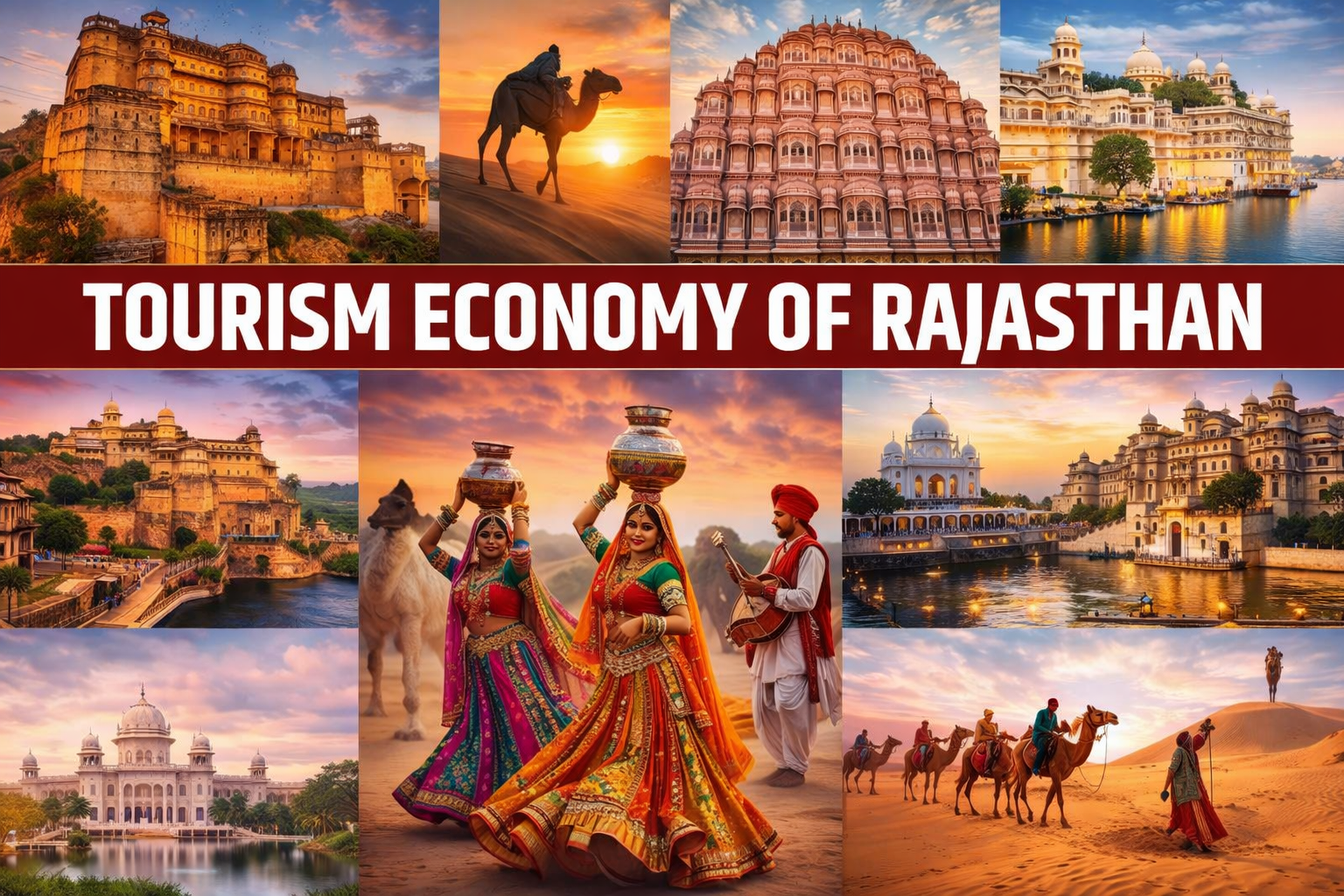
The tourism economy of Rajasthan is one of the most dynamic and high-potential sectors of the state, contributing significantly to economic growth, employment generation, cultural preservation, and regional development. Rajasthan is globally famous for its heritage tourism, desert tourism, royal palaces, forts, wildlife, fairs, and vibrant culture, making it one of India’s top tourist destinations.
According to the RPSC RAS 2026, Rajasthan GK, Economy and Geography, the topic of tourism is very significant because it is related to the GDP growth, urbanization, construction of infrastructures, jobs, sustainable development, and governance. Tourism is a major growth driver in the Rajasthan economy as the state government is vigorously boosting tourism by implementing policy changes, investments, digital activities, and the growth of rural tourism.
Overview of Tourism Economy in Rajasthan
Tourism in Rajasthan is a significant contribution to the state economy, the development of the service industry, and the creation of employment. It is one of the biggest service sectors in terms of its contribution to the GSDP of the state, as it contributes to the GSDP approximately 10-12 percent.
The sector is expanding rapidly due to increased domestic tourism, international arrivals, wedding tourism, and heritage tourism, along with improved connectivity and infrastructure. Rajasthan’s tourism economy is also important for foreign exchange earnings and cultural branding of India globally.
Growth Trends and Economic Contribution
Tourism in Rajasthan has been growing steadily in recent years with the support of governmental policies, individual investments, and tourism demand. The industry has experienced a high recovery following the COVID-19 period, and it continues to expand steadily.
Key Economic Indicators
| Indicator | Details |
|---|---|
| Contribution to GSDP | ~10–12% |
| Growth Rate | ~7–8% annually |
| Employment | Millions (direct + indirect) |
| Major Revenue Sources | Domestic + Foreign tourists |
Tourism acts as a multiplier sector, boosting industries like hospitality, transport, handicrafts, food services, and local markets, thereby strengthening the overall Rajasthan economy.
Types of Tourism in Rajasthan
The tourism structure of Rajasthan is very diversified, which is very important in attracting domestic and international tourists as well as boosting the tourism economy of Rajasthan. It is one of the most distinctive tourist destinations in India that features a combination of heritage, culture, nature, and modern tourism experiences.
This diversity is not only a boost in the inflow of tourists but also aiding in revenue-generation, generation of employment as well as branding Rajasthan tourism at the global levels which contributes to the major economic growth.
Major Tourism Segments
- Heritage Tourism → Forts, palaces, havelis (Jaipur, Udaipur, Jodhpur)
- Cultural Tourism → Fairs, festivals, folk dance, music
- Desert Tourism → Thar Desert, camel safari, dunes (Jaisalmer, Barmer)
- Wildlife Tourism → National parks and sanctuaries (Ranthambore, Sariska)
- Religious Tourism → Temples and pilgrimage sites (Ajmer, Pushkar)
- Wedding Tourism → Destination weddings in royal palaces
These tourism segments enhance tourist diversity, economic value, and international recognition, making Rajasthan a leading tourism hub.
Investment and Infrastructure Development
Large-scale investment and infrastructure development are found to heavily contribute to tourism development in Rajasthan because they contribute to better accessibility, comfort, and the experience of the visitor. The development of infrastructure has enabled Rajasthan to be competitive in the domestic and international tourism industry.
The PPP models, smart tourism development, and better connectivity (roads, railways, airports) are the areas the government is focusing on, which contribute to the essential increase in tourist inflow and investment opportunities.
Key Developments
- Tourism investment projects worth ₹1 lakh crore+
- Development of tourism circuits and heritage corridors
- Expansion of hotels, resorts, and luxury tourism infrastructure
- Improved road, rail, and air connectivity
Strong infrastructure ensures sustainable tourism growth, regional development, and economic expansion.
Tourism Policies and Government Initiatives (2026)
The government of Rajasthan has come up with various policies targeting sustainable, inclusive and technology-based tourism development. These policies are supposed to improve tourist experience as well as improve local economies.
Government initiatives focus on rural tourism, digital platforms, skill development, and investment promotion, making tourism more accessible and efficient.
Key Policies & Initiatives
- Rajasthan Tourism Policy → Promotes investment and ease of doing business
- Homestay/Paying Guest Scheme 2026 → Boosts rural tourism and local income
- Tourism Circuits Development → Heritage, desert, and tribal circuits
- Digital Tourism Platforms → Online booking and service tracking
- Skill Development Programs → Training in hospitality and tourism
These initiatives improve tourist inflow, employment generation, and balanced regional development.
Employment Generation and Livelihood Impact
Tourism is one of the most important sectors for employment generation in Rajasthan, providing livelihoods to millions of people across urban and rural areas. It supports both organized and unorganized sectors.
The tourism economy creates opportunities for youth, women, artisans, and small businesses, making it a key driver of inclusive growth.
Employment Impact
- Direct employment in hotels, travel agencies, guides, and transport
- Indirect employment in handicrafts, local markets, and food services
- Increased opportunities in rural and tribal areas
- Growth in women and youth employment
Tourism significantly contributes to income generation and poverty reduction.
Tourism and Urban Development
Cities such as Jaipur, Udaipur, Jodhpur and Jaisalmer have been transformed into world tourist locations due to tourism. It has boosted urbanization and infrastructural developments in these areas.
The industry enhances the creation of smart cities, enhanced transportation networks, and enhanced social amenities, yet poses such issues as overcrowding and strain on municipal services.
Tourism and Rural Economy
Rural Rajasthan is gradually opening up to tourism with the help of eco-tourism, village tourism, and homestay schemes as a source of income to the rural folk. Tourism can be used to promote inclusive and sustainable development as it aids in reducing rural migration, assisting in enhancing traditional culture and increasing the livelihoods of the rural area.
Cultural Heritage and Tourism
Tourism is a crucial factor that helps in saving the rich cultural heritage, monuments, traditions, handicrafts and folk art in Rajasthan. It offers grants for conservation and restoration.
The revenue generated from tourism ensures the protection of forts, palaces, temples, and historical sites, helping maintain Rajasthan’s global cultural identity.
Challenges in Tourism Economy
Despite strong growth, Rajasthan’s tourism sector faces several challenges that affect sustainability and long-term development. These challenges require proper planning and policy intervention.
Key Challenges
| Issue | Explanation |
|---|---|
| Over-tourism | Pressure on major cities like Jaipur |
| Environmental Damage | Desert and heritage degradation |
| Seasonal Dependency | Tourism peaks in winter only |
| Infrastructure Gaps | Weak rural connectivity |
| Climate Change | Impact on desert ecosystem |
Addressing these challenges is essential for sustainable tourism development.
Sustainable Tourism and Future Trends (2026)
Sustainable tourism models are now being considered by Rajasthan so as to find a balance between economic growth and environmental conservation, as well as preservation of culture. Digital transformation, eco-tourism, and experiential tourism are the future of tourism, likely to make the tourism experience more interactive and sustainable.
Future Trends
- Growth of eco-tourism and green tourism
- Expansion of digital tourism platforms
- Rise of experiential tourism (culture, desert life)
- Use of AI and smart tourism systems
- Focus on responsible and sustainable tourism
These trends will shape the future of the tourism economy in Rajasthan.
Importance for RPSC RAS 2026
Tourism economy is a highly important topic for RPSC RAS 2026, as it connects multiple subjects like economy, geography, and governance. It helps in understanding real-world development issues in Rajasthan.
Exam Relevance
Prelims:
- Tourism policies and schemes
- Economic contribution of tourism
- Types of tourism
Mains:
- Role in economic development
- Employment and urbanization
- Sustainable tourism and challenges
Rajasthan GK:
- Tourism circuits and regions
- Government initiatives
- Cultural and heritage tourism
Conclusion
Tourism economy of Rajasthan is a critical support structure to the state's development as it plays a key role in the economic growth, job creation, cultural maintenance, and region balancing. Having a wide range of tourism sectors, such as heritage, desert, wildlife, and cultural tourism, Rajasthan has been able to receive millions of domestic and international tourists annually.
The tourism sector will continue to expand in future years with good government policies, development of infrastructure and further growth in investment. Nonetheless, to make the tourism economy in Rajasthan sustainable, environment-friendly and balanced, it is critical to consider sustainable tourism, environmental preservation and balancing of the region to guarantee sustainable growth and stability in the sector.
BEST SELLER
🏆 PRELIMS
RAS Pass
Prelims focused Hindi & English
₹399
✓
Prelims Topic-Wise Tests
✓
Subject-Wise Tests
✓
Full-Length Prelims Tests
✓
Daily Current Affairs Tests
✓
Prelims PYQs Tests
✓
Detailed Solutions & Analysis
✓
All Rajasthan Ranking
✓
Unlimited Reattempts
✓
Mains Tests
✓
Hindi & English Tests
✓
All Rajasthan Ranking
Trusted by 5,000+ Students
Post Category
- RAS Salary
- Result
- RAS Admit Card
- RAS Job
- RAS Cutoff
- Preparation Tips
- RAS Answer Key
- RAS Exam Analysis
- RAS Syllabus
- RAS Previous Year Papers
- RPSC RAS Exam Pattern
- RAS Interview
- RAS Exam Date
- RAS Vacancy
- RAS Test Series
- RAS Best Books
- RAS Preparation Resources
- RAS Coaching Centre
- History
- Polity
- Geography
- Economics
- Science
- Art and Culture
- RPSC RAS Application Form
- RPSC RAS Notification
- RAS Eligibility Criteria
- UPSC Exam
- RPSC RAS Mains
Visit Our RASonly Offline Center
Our Expert Faculty

Bhunesh Sir
Current Affairs · 13+ Yrs

Aamir Khan Sir
RAS-2017 · IIM Ahm.
Akash Sir
Polity · 8+ Yrs
Free Resources
Official Mobile App

RASOnly App
by OTSAdda · Free
Full Video Lectures
Mock Tests & PYQs
Daily Current Affairs
AI Mock Interview
Free Download · No subscription needed to install
RAS 2024 Toppers — RASonly
Rank 2
Virendra Charan
Rank 9
Bhoopinder Singh
Rank 26
Aanchal Nagpal
Rank 33
Lokendra Singh
Rank 45
Amar Rathore
Rank 46
Manasvini Verma

Join RASonly WhatsApp Community
Get daily current affairs, exam alerts, free study material and tips from expert faculty — right on WhatsApp.
Join for Free →RASonly Interview Guidance Program

Mr. Ashok Jain
Ex-Chief Secretary Govt of Rajasthan
- IAS officer of the 1981 batch, Rajasthan cadre.
- Passionate about mentoring the next generation of RAS officers with real-world insights.
- Got retired in Dec 2017 from the post of Chief Secretary of the state of Rajasthan.

Mr. Guru Charan Rai
Ex-ASP / SP in Jaisalmer
- Guru Charan Rai, IPS (Retd), retired as Inspector General of Police (Security), Rajasthan, Jaipur in 2017.
- Served as ASP and SP in Jaisalmer, Nagaur, Sri Ganganagar, Sawai Madhopur, Dausa, Sikar, and Karauli.
- He also held key positions as DIGP and IGP in the Law and Order division.

Mr. Rakesh Verma
Ex-IAS Officer, B.Tech, MBA, and M.A. (Economics)
- IAS officer of the 1981 batch and retired in Chief Secretary Rank.
- Civil servant of high repute and vast experience.
- Has been teaching UPSC CSE subjects for the last six years.

Daily Current Affairs for RAS Exam Preparation 2026

Women’s Cricket Team Wins Gold Medal
September 23, 2026
9th India International Water Week 2026
September 23, 2026
United Nations General Assembly
September 22, 2026