Kushan Empire: History, Rulers, Administration, Economy, Art, Decline
Kushan Empire: History, Rulers, Administration, Economy, Art, Decline

Get in Touch with RASonly!

The Kushan Empire emerged from the Yuezhi tribes and became a major power across Central Asia and northern India. Under rulers such as Kujula Kadphises and Kanishka, it promoted long-distance trade, Buddhism, coinage, and cultural exchange. The Gandhara and Mathura schools of art flourished, while pressures contributed to its decline.

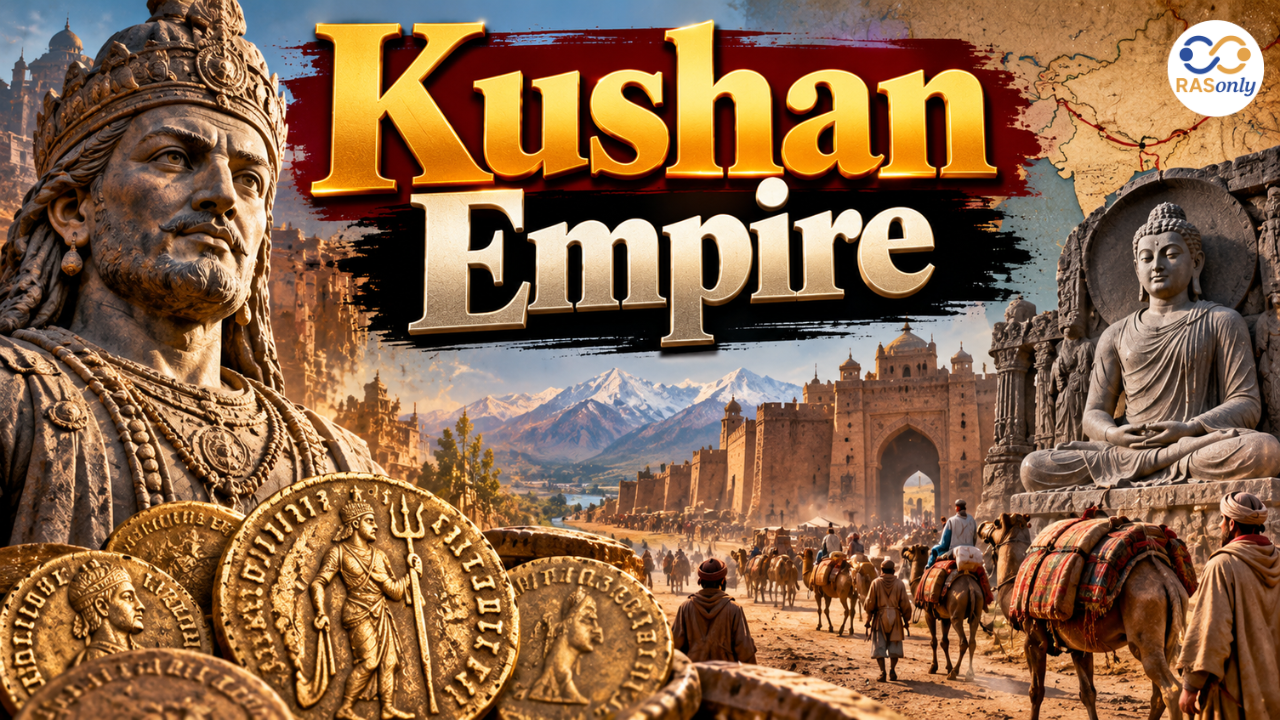
Kushan Empire is one of the most important empires of India and Central Asia. It arose from the Yuezhi tribes in Central Asia and grew into an influential political and commercial empire. The Kushan Empire once spanned across Central Asia, Afghanistan, Pakistan and northern India. The empire played an important role in the growth of long-distance trade, Buddhism, art, architecture and cultural exchange. The power of Kushan rulers Kujula Kadphises, Vima Kadphises, Kanishka and Huvishka was expanded and consolidated. The period of Kanishka is particularly remembered for the development of Buddhism, international trade and the famous Gandhara and Mathura schools of art.
About the Kushan Empire
Towards the beginning of the Common Era, the Kushan Empire emerged and became an important force between Central Asia and the Indian sub-continent. It was located in a strategic position which enabled the Kushans to regulate the major trading routes running from India to the Central Asian countries and the west.
Key Facts About the Kushan Empire
- The founder of the Kushan dynasty was Kujula Kadphises
- Greatest ruler of India: Kanishka I
- Important centre: Peshawar (Purushapura) and Mathura.
- Major regions: Bactria, Afghanistan, Gandhara, Punjab and northern India.
- Buddhism was the major religion, which Kanishka followed.
- Two major art traditions: Gandhara and Mathura.
- Significant economic activity: long-distance trade.
- Silk Road: A major trade route
- Important languages/scripts: Greek, Bactrian, Kharosthi and Brahmi in various areas
- Main period of dominance: 1st–3rd century CE.
Kushan Empire History
The Kushans' history is closely linked with that of the Yuezhi who migrated from Central Asia. One tribe of the Yuezhi eventually became so dominant that it was called the Kushans and started to settle in Bactria.
Origin of the Yuezhi
- The Yuezhi were nomadic tribesmen who were driven off their traditional homeland in the Central Terracotta alluvial plain and areas to its south as a result of conflict with the Xiongnu.
- They moved westwards and eventually settled in Bactria was part of present-day Afghanistan and Central Asia. The people of the Yuezhi had been weakened by being split into some chiefdoms. The Kushan branch was the strongest over the years.
Rise of Kujula Kadphises
- Kadphises is generally considered to be the dawn of the Kushan dynasty of emperors.
- He conquered various Yuezhi tribes and extended Kushan influence beyond Bactria. It was during his expansion that the political platform for the later Kushan Empire was developed.
- Over time, Kushan influence began to spread into the areas of Gandhara and northwestern India, and the Abbasids and Persians of the regions established new political alliances, trade relationships and culture with them.
Expansion into Northern India
The rulers after Kujula Kadphises gave the Kushan Empire a great extension.
They owned lands in and around the vicinity of the following places:
- Afghanistan
- Gandhara
- Punjab
- These are in the Sindh and Indus region.
- Mathura
- Northern parts of India.
This area provided the Kushans with control of a number of key trade routes and cities.
Major Kushan Rulers
The Kushan Empire had several rulers that aided in its development. The most famous of these were King Kujula Kadphises, Vima Kadphises, Kanishka and Huvishka.
Kujula Kadphises
The Kushan Empire began with the political seeds of the Kushan Empire being sown by the Kushan leader Kujula Kadphises.
He is noted for having worked on many key projects such as:
- The unification of the Yuezhi lands.
- The eastern expansion towards Afghanistan and the northwestern regions.
- The establishment of Kushan political control
- The introduction of the early Kushan coinage.
- The Golden Hind Navigation Academy at Lime Lane was started, with the intention of expanding to cover the north of India later.
Vima Takto
- Vima Takto is usually classified as being one of the earlier Kushan rulers, between the reign of Kujula Kadphises and Vima Kadphises.
- The expansion and consolidation of Kushan territories went on under his rule.
Vima Kadphises
Vima Kadphises consolidated and extended Kushan rule into northern India as far as India.
In particular, he is remembered for:
- Growth in the direction of India subcontinent
- Upscale use of gold coins.
- Increasing the strength of commercial activities
- Outside links to trade routes
- Use of religious imagery on coins
The gold coinage of the Kushans was an important component of the economy and includes significant information regarding Kushan politics and religion.
Kanishka I
The most important Kushan ruler was Kanishka I, who was very much involved in the development of the empire's political and cultural life.
These facts can be linked to his:
- Large territorial expansion
- Growth of Buddhism
- Buddhist art was developed.
- Expansion of trade
- Sponsorship of thinkers and philosophies
- Strengthening of connections between India and Central Asia
Historical dating of the accession of Kanishka is still under discussion, and the historical record in any given year must not necessarily be assumed to be entirely accurate.
Kanishka and Buddhism
- The Kanishkas are also believed to have contributed to the propagation and extension of Buddhism, especially in the North-West of the Indian subcontinent and Central Asia.
- He is also generally identified with the Fourth Buddhist Council, which it is claimed was held in Kashmir under his leadership during the rule of Vasumitra.
- The council sees itself in relation to the organisation and discussion of Buddhist teachings. The age has also been linked to the rise in significant Zen Buddhist traditions, however.
Huvishka
After Kanishka, Huvishka carried forward the tradition of Kushan rulers.
During his rule, the following took place:
- The settling of political rule by the Kushans in the region.
- Support of trade routes.
- Religious diversity
- Extensive coinage
- Adoration of various faiths
Vasudeva I
Vasudeva I was a later great Kushan ruler.
The empire began to be burdened by pressures from various parts of the empire during his rule. Eventually, it became more fractured politically, leading to Kushan power's waning.
Kushan Empire Administration
The Kushan rulers instituted a system which was appropriate for ruling over a vast stretch of land in Central Asia and northern India. They had to adhere to Central Asian political customs and practice those of the conquered area.
The King as the Supreme Authority
- The centre of political administration was the Kushan king.
- The occurrence of royal titles on Kushan inscriptions and coins indicated the high political ranking of the ruler. The title Devaputra, or 'Son of God ', is especially linked to the kingship of the Kushans.
Kshatrapas and Mahakshatrapas
- The Kushans also appointed officials, like kshatrapas and mahakshatrapas, who ruled over districts in some areas.
- They enabled political control of a vast, distant territory and a centralised government handling a large and varied empire.
Military Administration
Kushan Empire had a strong military system as it required it to protect its territory, which included the important frontier zones and trade routes.
The army helped the rulers:
- Expand their territory
- Protect commercial routes
- Control frontier regions
- Keep control over far-off provinces.
The Kushans also had the advantage of military customs from the Central Asian area, notably of horsemen.
Kushan Empire Economy
Agriculture, urbanisation, coinage and long-distance trade were vital facets of the economy of the Kushan Empire. Situated at the heart of the earth, its strategic location made it an important meeting point between India, Central Asia and the West.
Silk Road Trade
The Kushans were an important force in this trade network, which is normally linked with the Silk Road.
Their territories connected:
- China
- Central Asia
- Afghanistan
- India
- Western Asia
- Mediterranean markets
Silk and spices, precious stones, textiles and luxury goods passed via these networks.
Trading with the Roman world
- The Kushan lands were linked to the western trade routes and hence with the Roman Empire.
- By then, Roman coins had been found throughout parts of India, suggesting greater monetary and commercial connections.
Kushan Coinage
One of the relevant sources on Kushan history is coins.
The Kushans issued large quantities of gold and copper coins. Their coins often carried images of rulers and deities.
Useful for the study of Kushan coins are:
- Political authority
- Economic activity
- Religious diversity
- Royal titles
- Cultural contacts
Agriculture and Urban Economy
Agriculture continued to play a key role in the economy. In parallel, expansion of trade brought benefits to cities and commercial centres.
Important urban centres became the places where:
- Merchants operated
- Crafts were produced
- Religious institutions developed
- Long-distance trade was organised
- Registered merchants and trade organisations.
Kushan Empire Religion
Throughout the Kushan period, an element of religious variety is present. Rulers of Kushan, as well as their subjects, communicated with a number of religious systems rather than one.
Buddhism
Buddhism was well supported by the royal family and elites, particularly during Kanishka's rule.
During the Kushan period, the following Buddhist centres developed:
- Gandhara
- Mathura
- Kashmir
- Afghanistan
- Central Asia
Buddhism was transmitted beyond the Indian subcontinent by the Buddhist monks, scholars and merchants.
Religious Diversity
The coins of the Kushans were valuable sources of testimony to religious diversity.
Each of the various coins has associated with it:
- Buddhist traditions
- Indian deities
- Iranian religious traditions
- Greek traditions
Kushan Empire Art and Architecture
- During the Kushan Period, there were significant changes in the field of sculpture and religion-associated sculptures; two of these are of particular relevance: Gandharan Art and Mathura Art.
- The influence of these traditions gave rise to some very significant early depictions of Buddha and other religious figures of religion.
Gandhara Art
- Gandhara Art flourished primarily in the northwestern part of the subcontinent.
- It exhibits very strong Hellenistic and Roman artistic influences, particularly in aspects involving the depiction of clothing, hair, facial features, and realistic representations of the human form.
Important features include:
- Much grey schist was used
- Realistic human representation
- Expressive folds.Detailed folds in clothing.
- Rough, unrefined folds, waves and facial expressions
- The sense of classic artistic attribute or character.
- Exhaustion on the subject matter of Buddhism.
Mathura Art
Mathura Art was in the genesis of the Mathura region and closely intertwined with the traditional art of India.
Red sandstone was used abundantly, and used for images of Buddhist, Jain and Brahmanic traditions.
Important features include:
- Use of red sandstone
- Clear indigenous Art Quality
- Powerful and idealised human forms
- Buddha images, Jina images and Brahmanical images
- Development of important religious iconography
Kushan Empire and Literature
It is during the Kushan period that important intellectual and literary traditions of the Kushan era developed. Knowledge was advanced by the Buddhist thinkers, physicians and scholars in various disciplines.
Ashvaghosha
Ashvaghosha was an important Buddhist poet and thinker from the Kushan period.
He wrote:
- Buddhacharita
- Saundarananda
He was one of the early contributors to Sri Lankan Buddhist Sanskrit literature.
Nagarjuna
- Traditionally, Nagarjuna was related to the phase of the evolution of Madhyamaka philosophy in the Mahayana Buddhist tradition.
- Much of his philosophy is reflected in his writings, and his influence was significant to later Buddhist thought.
Charaka
The medical tradition of Charaka is related to the growth of Ayurvedic medicine.
The Charaka Samhita is an important work dealing with subjects such as:
- Diagnosis
- Diseases
- Medicines
- Diet
- Medical ethics
- Principles of treatment
Decline of the Kushan Empire
Political control of the Kushan Empire waned from about the 3rd century CE. It did not prolong decline through a single event; it was the result of multiple political and economic factors which gradually eroded Kushan control.
Rise of the Sasanian Power
- With the rise of the Sasanian Empire in Persia, there were some pressures on Kushan territories in the west of their sphere of influence.
- The Sasanians invaded regions which were under Kushan control.
Political Fragmentation
- Central power declined, and regional centres of power arose.
- The empire started to break apart, and it was hard to keep under control the large territories that were governed by earlier Kushan rulers.
Economic Pressures
- The economic power of the empire was influenced by altered long-distance trade routes and the political situation over commercial territories.
- Trade was a vital component in Kushan power, and alterations in the broader political and business landscape brought further pressure.
Rise of Regional Powers
- There were new political powers rising in northern parts of India and Central Asia.
- Kushan control was diminished by the rise of representatives who compromised by a series of regional states, but Kushan political traditions still lived on in certain regions after the empire's collapse.
Conclusion
The Kushan Empire played a significant role in the history of ancient India as a link between the Indian subcontinent and the rest of the Eurasian continent, including Central Asia. The Kushan rulers established political power in significant territories and facilitated trade, coinage, religious communication and cultural transfer. The most important aspect of the reign of Kanishka is that it fostered the development of Buddhism and the expansion of Gandhara and Mathura art. Even after the fall of the empire, the Buddhist tradition, art and architecture, trade, and cultural ties developed between India and Central Asia sustained his influence.
FAQs on Kushan Empire
Kujula Kadphises is generally regarded as the founder of the Kushan imperial dynasty.
Kanishka I is considered the most prominent Kushan ruler. He is associated with territorial expansion, Buddhism, trade and cultural development.
The Kushans emerged from the Yuezhi, a group of Central Asian tribes that settled in Bactria and gradually established political power.
Purushapura (Peshawar) and Mathura were among the important centres of Kushan power.
Long-distance trade, along with agriculture, urban commerce and coinage, was an important part of the Kushan economy.

BEST SELLER
🏆 PRELIMS
RAS Pass
Prelims focused Hindi & English
₹399
✓
Prelims Topic-Wise Tests
✓
Subject-Wise Tests
✓
Full-Length Prelims Tests
✓
Daily Current Affairs Tests
✓
Prelims PYQs Tests
✓
Detailed Solutions & Analysis
✓
All Rajasthan Ranking
✓
Unlimited Reattempts
✓
Mains Tests
✓
Hindi & English Tests
✓
All Rajasthan Ranking
Trusted by 5,000+ Students
Post Category
- RAS Salary
- Result
- RAS Admit Card
- RAS Job
- RAS Cutoff
- Preparation Tips
- RAS Answer Key
- RAS Exam Analysis
- RAS Syllabus
- RAS Previous Year Papers
- RPSC RAS Exam Pattern
- RAS Interview
- RAS Exam Date
- RAS Vacancy
- RAS Test Series
- RAS Best Books
- RAS Preparation Resources
- RAS Coaching Centre
- History
- Polity
- Geography
- Economics
- Science
- Art and Culture
- RPSC RAS Application Form
- RPSC RAS Notification
- RAS Eligibility Criteria
- UPSC Exam
- RPSC RAS Mains
Visit Our RASonly Offline Center
Our Expert Faculty

Bhunesh Sir
Current Affairs · 13+ Yrs

Aamir Khan Sir
RAS-2017 · IIM Ahm.

Akash Sir
Polity · 8+ Yrs
Free Resources
Official Mobile App

RASOnly App
by OTSAdda · Free
Full Video Lectures
Mock Tests & PYQs
Daily Current Affairs
AI Mock Interview
Free Download · No subscription needed to install
RAS 2024 Toppers — RASonly
Rank 2
Virendra Charan
Rank 9
Bhoopinder Singh
Rank 26
Aanchal Nagpal
Rank 33
Lokendra Singh
Rank 45
Amar Rathore
Rank 46
Manasvini Verma

Join RASonly WhatsApp Community
Get daily current affairs, exam alerts, free study material and tips from expert faculty — right on WhatsApp.
Join for Free →RASonly Interview Guidance Program

Mr. Ashok Jain
Ex-Chief Secretary Govt of Rajasthan
- IAS officer of the 1981 batch, Rajasthan cadre.
- Passionate about mentoring the next generation of RAS officers with real-world insights.
- Got retired in Dec 2017 from the post of Chief Secretary of the state of Rajasthan.

Mr. Guru Charan Rai
Ex-ASP / SP in Jaisalmer
- Guru Charan Rai, IPS (Retd), retired as Inspector General of Police (Security), Rajasthan, Jaipur in 2017.
- Served as ASP and SP in Jaisalmer, Nagaur, Sri Ganganagar, Sawai Madhopur, Dausa, Sikar, and Karauli.
- He also held key positions as DIGP and IGP in the Law and Order division.

Mr. Rakesh Verma
Ex-IAS Officer, B.Tech, MBA, and M.A. (Economics)
- IAS officer of the 1981 batch and retired in Chief Secretary Rank.
- Civil servant of high repute and vast experience.
- Has been teaching UPSC CSE subjects for the last six years.


Daily Current Affairs for RAS Exam Preparation 2026

Women’s Cricket Team Wins Gold Medal
September 23, 2026
9th India International Water Week 2026
September 23, 2026
United Nations General Assembly
September 22, 2026