Jainism: Founder, Symbol, Teachings, Beliefs, History & Principles
Jainism: Founder, Symbol, Teachings, Beliefs, History & Principles

Get in Touch with RASonly!

Jainism, an ancient Shramana tradition, emphasizes Ahimsa, truth, and non-possession as paths to liberation. Founded on the teachings of 24 Tirthankaras, with Mahavira as the last, it split into Digambara and Śvetāmbara sects. Rajasthan holds deep Jain heritage, home to Ranakpur, Dilwara, and other significant pilgrimage temples.

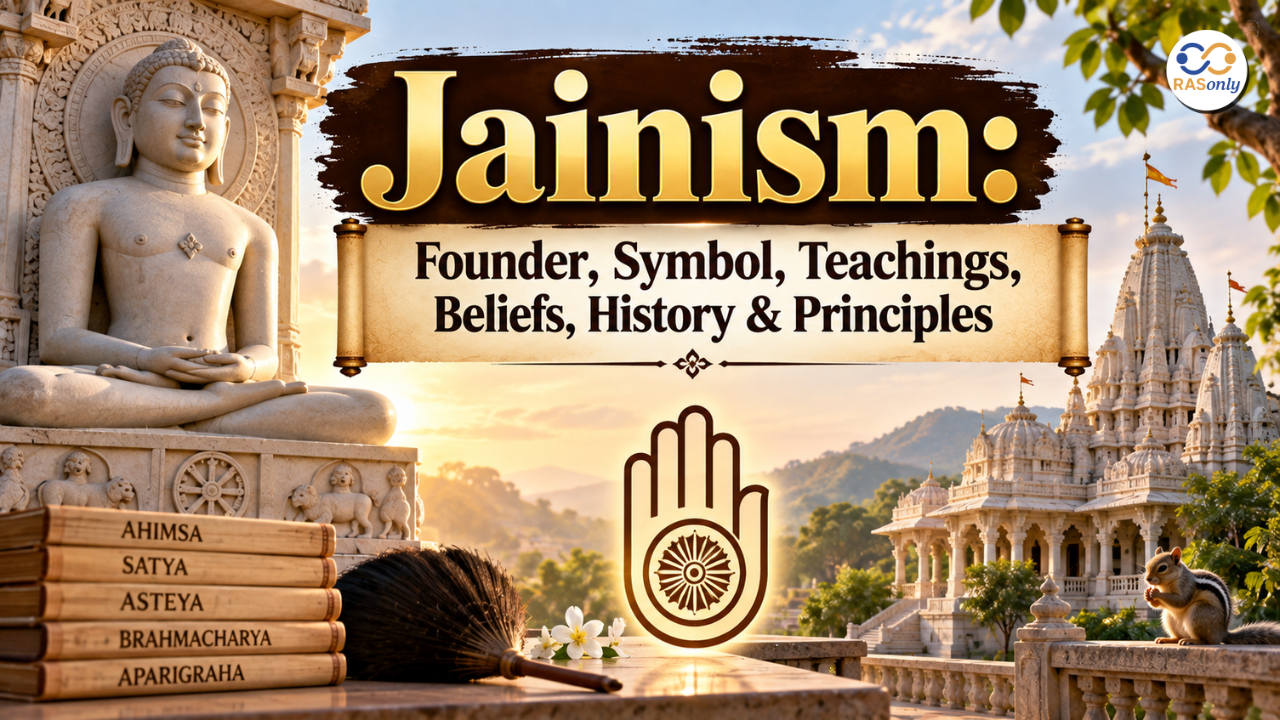
Jainism is one of the ancient Indian religions and philosophies. It is part of the Shramana tradition, which co-developed with other non-Vedic religions in ancient India. Jainism focuses heavily on non-violence (Ahimsa), self-discipline, truth, non-possession, karma and liberation of the soul. Unlike Buddhism, Jainism does not teach that a supreme creator God made the universe. In contrast, Jain cosmology describes the universe as eternal — subject to its own laws. The highest goal of Jain spirituality is Moksha, which occurs when the soul has been liberated from all karmas. The tradition identifies 24 Tirthankaras, with Rishabhanatha being the first and Mahavira the 24th. In the 6th century BCE, Mahavira developed Jain religious doctrine.
Jainism: Historical Background
- Jainism emerged in the broader intellectual context of early northern India, a period characterised by urbanisation, expansion of trade and agriculture, and new political centres.
- Amid radical change in the ritual tradition of the day, various Shramana movements centred in northern India began growing throughout the 6th century BCE, stressing personal effort, moral behaviour, and renunciation.
- The teachings of Jainism are attributed to a succession of Tirthankaras. Yet, historically speaking, there is far less evidence for the earlier Tirthankaras than later figures like Parshvanatha and Mahavira.
Why Did Jainism Gain Followers?
- Jainism developed due to various social and intellectual developments:
- Towns expanded, and new trade networks opened up, creating new classes of merchants and householders.
- Nevertheless, the increasing importance of elaborate ritual practices raised doubts with some.
- Ahimsa, the central ethical principle of Jainism, and self-control are central to its philosophy.
- The Shramana tradition emphasised self-effort over reliance on sacrificial ritual.
- Jain monks wandered from settlement to settlement, imparting their teachings.
- Later, merchant communities became an important source of support for Jain institutions.
- The widespread use of Prakrit languages allowed religious ideas to travel outside narrow academic circles.
The 24 Tirthankaras of Jainism
| No. | Tirthankara | Traditional Symbol | Principal Disciples / Associated Persons |
|---|---|---|---|
| 1 | Rishabhanatha (Adinatha) | Bull | Pundarika, Brahmi |
| 2 | Ajitanatha | Elephant | Singhasena, Phalgu |
| 3 | Sambhavanatha | Horse | Charu, Shyama |
| 4 | Abhinandananatha | Monkey | Vajranabha, Ajita |
| 5 | Sumatinatha | Curlew/Goose | Charama, Kasyapi |
| 6 | Padmaprabha | Red Lotus | Pradyotana, Rati |
| 7 | Suparshvanatha | Swastika | Vidirbha, Soma |
| 8 | Chandraprabha | Crescent Moon | Dinna, Sumana |
| 9 | Pushpadanta (Suvidhinatha) | Crocodile | Varahaka, Varuni |
| 10 | Shitalanatha | Shrivatsa | Nanda, Sujasa |
| 11 | Shreyansanatha | Rhinoceros | Kashyapa, Dharani |
| 12 | Vasupujya | Buffalo | Subhuma, Dharani |
| 13 | Vimalanatha | Boar | Mandara, Dhara |
| 14 | Anantanatha | Falcon | Jasa, Padma |
| 15 | Dharmanatha | Vajra | Arishta, Arthashiva |
| 16 | Shantinatha | Deer | Chakrayuddha, Suchi |
| 17 | Kunthunatha | Goat | Samba, Damini |
| 18 | Aranatha | Fish | Kumbha, Rakshita |
| 19 | Mallinatha | Kalasha | Abhikshaka, Bandhumati |
| 20 | Munisuvrata | Tortoise | Malli, Pushpavati |
| 21 | Naminatha | Blue Lotus | Shubha, Anila |
| 22 | Neminatha (Arishtanemi) | Conch | Varadatta, Yakshadinna |
| 23 | Parshvanatha | Snake | Aryadinna, Pushpachuda |
| 24 | Mahavira | Lion | Indrabhuti Gautama, Chandrabala |
Parshvanatha: The 23rd Tirthankara
Parshvanatha is generally regarded as the 23rd Tirthankara. Jain tradition places him several generations before Mahavira.
He is especially known for four major restraints,
- Ahimsa
- Satya
- Asteya
- Aparigraha
The five-vow pathway of Mahavira later made Brahmacharya into a separate vow.
Parshvanatha is significant for the relative historical memory retained by Jain tradition regarding him, and because these teachings appear as one of the Jains and the structured community with which Mahavira was associated.
Mahavira: The 24th Tirthankara
- Name: Vardhamana Mahavira
- Religious Tradition: Jainism
- Status: 24th and last Tirthankara of the present Jain tradition
- Birthplace: Kundagrama, near Vaishali, Bihar
- Father: Siddharth, Raja of Jnatrika/Naya clan
- Mother: Trishala (also called Priyakarini), by Jain tradition
- Wife: Yashoda, in the More traditional telling
- Daughter: Priyadarshana (Anojja)
- Renunciation: Mahavira is reputed to have renounced worldly life at the age of 30.
- Ascetic Life: He endured extreme austerities and meditation for around 12 years before achieving spiritual liberation (Dharma).
- Enlightenment: He achieved Kevala Jnana (perfect/omniscient knowledge).
- Place of Enlightenment: Historically connected with Jrimbhikagrama, near the Rijupalika river.
- Teaching: Mahavira preached Ahimsa (non-violence), Satya (truth), Asteya (non-stealing), Brahmacharya (celibacy) and Aparigraha (non-possession).
- Five Great Vows: The five vows formed the basis of Jain ethical teachings.
- Followers: His teachings formed a fourfold Jain community of monks, nuns, laymen and laywomen.
- Nirvana/Death: Mahavira's Nirvana at Pawapuri, Bihar.
- Traditional Dates: Śvetāmbara Jain tradition: 599–527 BCE.
- Fact: Jain tradition traces the lineage of Tirthankaras to a much earlier period than Mahavira, while historical evidence for the earliest Tirthankaras is limited.
- Predecessor: 23rd Tirthankara Parshvanatha, generally considered to have been before Mahavira.
- Symbol: The lion is the traditional symbol of Mahavira.
- Associated Tree: The Sāla tree is traditionally associated with Mahavira
- Significance: Pavapuri is associated with the place where Mahavira achieved salvation (Moksha/Nirvana).
Jain Councils
| First Jain Council | Second Jain Council |
|---|---|
| Time: 3rd century BCE | Time: 5th century CE |
| Venue: Pataliputra (present-day Patna, Bihar) | Venue: Vallabhi (Gujarat) |
| Presided by: Sthulabhadra | Presided by: Devardhigani Kshamashramana |
| Patronage: Mauryan period | Patronage: No specific ruler is securely established |
| Main Purpose: To collect and preserve the teachings of Mahavira | Main Purpose: To compile and preserve the Jain scriptures |
| Outcome: The Jain teachings were organised into 12 Angas according to the Śvetāmbara tradition | Outcome: The Śvetāmbara Jain canon was systematically compiled and put into written form |
| Important Point: This council is traditionally associated with the early compilation of the Jain canon | Important Point: Vallabhi became the major centre for the preservation of the Jain Agamas |
Teachings of Mahavira
Mahavira focused on self-control and asceticism as the path to liberation and encouraged non-violence, dispassion, ethics and soul-perfection. He preached that every jiva is capable of salvation by following right belief, right knowledge and right conduct.
Ahimsa: Non-Violence
The core of the teachings of Mahavira was Ahimsa. He pointed out that one must not hurt any being, in mind, word and deed.
Jainism carries the principle of Ahimsa to the minutiae of life. Thus compassion and carefulness of conduct became integral elements of Jain religious tradition.
Satya: Truth
- According to Mahavira, a man should never say anything but the truth. But we should remember that truth ought to be spoken judiciously and should not become a source of unnecessary destruction.
Asteya: Non-Stealing
- Asteya is not taking anything that has not been freely given. Mahavira associated an ethical life with truthfulness, self-control and respect for the property of others.
Aparigraha: Non-Possession
- Mahavira advocated against greed for material possessions. Accumulation and attachment naturally increase desires and create obstructions to liberation, as his teaching went.
Brahmacharya: Celibacy
- The word brahmacharya is roughly translated as celibacy or regulation of sexual urges. It was especially strictly prescribed for monks and nuns.
- Traditionally, Mahavira is said to have ordered Brahmacharya as the fifth great vow, while Parshvanatha's fourfold system traditionally has no mention of it as a separate vow.
Triratna – Three Jewels
Mahavira's path to liberation is expressed through the Three Jewels (Triratna):
| Three Jewels | Meaning |
|---|---|
| Samyak Darshana | Right Faith / Right Perception |
| Samyak Jnana | Right Knowledge |
| Samyak Charitra | Right Conduct |
Karma and Liberation
- Mahavira taught that doing and wanting bind the soul to karma. Someone can evolve spiritually through controlling desires, discipline and removing all the karmas stacked up.
- The final aim is Moksha (liberation from the cycle of birth-death).
Equality of Souls
- The teachings of Mahavira acknowledged the divine potential within all souls. Liberation is contingent on virtue and spiritual work, not birth or caste.
- Self-Control and Asceticism
- Renunciation, meditation, penance and control of the senses were most important to Mahavira. Jain monks adhered to ascetic practices, aiming to minimise attachment and thus prevent adding further karma.
Anekantavada
- The Jain tradition of philosophy associated with Mahavira holds to the doctrine that reality is complex. What we know as humans is only a fraction of what exists out there.
- This concept was then modified and evolved into Anekantavada, Syadvada and Nayavada.
8 Auspicious Symbols of Jainism (Ashtamangala)
Ashtamangala = eight auspicious symbols of Jainism. Symbols are prevalent in Jain arts, temples and rituals.
Swastika
- There are four types of beings: divine, human beings, aminals/plants and hell beings.
- Advises a person to tread the path of liberation (Moksha).
Shrivatsa
- An auspicious symbol usually seen by all Tirthankars.
- It represents purity, auspiciousness and spiritual perfection.
Nandyavarta
- A complex, many-lined auspicious symbol.
- Symbolises spiritual growth and effulgence.
Vardhamanaka
- Traditionally, a container or vessel which is seen as auspicious.
- It represents growth, prosperity and abundance.
Bhadrasana
- Signifies a sacred chair or throne.
- Indicates glory, dignity and religious significance.
Kalasha
- An auspicious water-filled vessel.
- Represents purity, prosperity and abundance.
Pair of Fish
- Two fish are represented as a propitious motif.
- Good fortune, good health, and well-being.
Darpana (Mirror)
- Represents a mirror.
- Represents self-examination, consciousness and clarity of soul.
Sects of Jainism
Due to differences in monasticism, clothing, scripture and belief over time, Jainism split into two major sects: Digambara and Śvetāmbara.
- Long Famine: A great famine in Magadha is traditionally held to have led Jain monks to emigrate from the region.
- Migration: The mystic Bhadrabahu, as well as a group of monks, are described in tradition to have migrated southwards to South India, with another group staying back in the north.
- Different Monastic Practices: Disputes regarding whether monks should be only naked or wear white clothes developed over time.
- Preservation of Scriptures: various traditions arose concerning preservation and authenticity of Jain Agamas.
- Religious Differences: Differing approaches to Women, possessions and asceticism
- Formation of Sects: These differences gradually became institutionalised into the two major traditions:
- Digambara – “Sky-clad”
- Śvetāmbara – “White-clad”
| Basis | Digambara | Śvetāmbara |
|---|---|---|
| Meaning | “Sky-clad” | “White-clad” |
| Associated Leaders | Traditionally associated with Bhadrabahu in the southern migration tradition | Sthulabhadra is traditionally associated with the northern tradition |
| Monastic Clothing | Male monks traditionally practise complete nudity as an ideal of non-possession | Monks and nuns traditionally wear white clothing |
| Women & Liberation | Traditional Digambara view holds that a woman must be reborn as a man before attaining liberation | Śvetāmbaras hold that women can attain liberation |
| Female Tirthankara | Malli/Mallinatha is regarded as male | Malli/Mallinatha is regarded as female |
| Five Vows | Follows the Five Mahavratas: Ahimsa, Satya, Asteya, Brahmacharya and Aparigraha | Also accepts the Five Mahavratas |
| Jain Scriptures | Does not accept the present Śvetāmbara canon as the complete original Jain canon; important texts include Ṣaṭkhaṇḍāgama and Kaṣāyapāhuda | Accepts the Jain Agamas, traditionally preserved and compiled at Vallabhi |
| Kevala Jnani & Food | A Kevali is traditionally believed not to need food | Śvetāmbara tradition accepts that a Kevali may continue to take food |
| Tirthankara Images | Usually depicted nude, unadorned and in a meditative posture | Usually depicted clothed and adorned with ornaments, especially in temple traditions |
| Major Regional Influence | Historically strong in Karnataka, Maharashtra, Madhya Pradesh and parts of Rajasthan | Historically strong in Gujarat, Rajasthan and parts of North India |
Jainism in Rajasthan
- Jainism has a long and important history in Rajasthan.
- Both Digambara and Śvetāmbara Jain communities have a long-standing presence in Rajasthan.
- Western Rajasthan emerged as an influential centre of Śvetāmbara Jainism.
- In Rajasthan, Jainism drew its patronage from merchant and trading communities.
- Ranakpur is one of the greatest pilgrimage sites in Jainism.
- The temple is dedicated to Tirthankara Adinatha (Rishabhanatha)
- Mount Abu has Dilwara Jain Temples in Sirohi district
- Dilwara Temples: These temples are known for their exquisite marble sculptures and detailed architecture.
- The Jain temples of Jaisalmer Fort
- Lodhurva at Jaisalmer is an important historic Jain pilgrimage centre of Parshwanath.
- Osian, near Jodhpur, is famous for its Jain temples and temple architecture.
- Narlai is a significant Jain pilgrimage centre in Pali.
- Karauli is an important Digambara Jain pilgrimage centre known for Shri Mahavirji.
- Keshorai Patan in Bundi district is also associated with Jain religious traditions.
- The temples, sculptures, manuscripts, pilgrimage centres, etc. in Rajasthan reflect the Jain heritage of the state.
FAQs on Jainism
Jainism is an ancient Shramana religious and philosophical tradition of India that emphasises Ahimsa, self-discipline, non-possession and liberation from the cycle of birth and death.
Jainism does not consider itself to have been founded by a single person. Jain tradition recognises 24 Tirthankaras, with Mahavira as the 24th Tirthankara who revived and organised the Jain tradition in the 6th century BCE.
Rishabhanatha (Adinatha) is regarded as the first Tirthankara of Jainism.
Mahavira, also known as Vardhamana, was the 24th and last Tirthankara of the present Jain tradition.
The major teachings include Ahimsa, Satya, Asteya, Brahmacharya, Aparigraha, self-discipline, non-attachment and liberation of the soul.

BEST SELLER
🏆 PRELIMS
RAS Pass
Prelims focused Hindi & English
₹399
✓
Prelims Topic-Wise Tests
✓
Subject-Wise Tests
✓
Full-Length Prelims Tests
✓
Daily Current Affairs Tests
✓
Prelims PYQs Tests
✓
Detailed Solutions & Analysis
✓
All Rajasthan Ranking
✓
Unlimited Reattempts
✓
Mains Tests
✓
Hindi & English Tests
✓
All Rajasthan Ranking
Trusted by 5,000+ Students
Post Category
- RAS Salary
- Result
- RAS Admit Card
- RAS Job
- RAS Cutoff
- Preparation Tips
- RAS Answer Key
- RAS Exam Analysis
- RAS Syllabus
- RAS Previous Year Papers
- RPSC RAS Exam Pattern
- RAS Interview
- RAS Exam Date
- RAS Vacancy
- RAS Test Series
- RAS Best Books
- RAS Preparation Resources
- RAS Coaching Centre
- History
- Polity
- Geography
- Economics
- Science
- Art and Culture
- RPSC RAS Application Form
- RPSC RAS Notification
- RAS Eligibility Criteria
- UPSC Exam
- RPSC RAS Mains
Visit Our RASonly Offline Center
Our Expert Faculty

Bhunesh Sir
Current Affairs · 13+ Yrs

Aamir Khan Sir
RAS-2017 · IIM Ahm.

Akash Sir
Polity · 8+ Yrs
Free Resources
Official Mobile App

RASOnly App
by OTSAdda · Free
Full Video Lectures
Mock Tests & PYQs
Daily Current Affairs
AI Mock Interview
Free Download · No subscription needed to install
RAS 2024 Toppers — RASonly
Rank 2
Virendra Charan
Rank 9
Bhoopinder Singh
Rank 26
Aanchal Nagpal
Rank 33
Lokendra Singh
Rank 45
Amar Rathore
Rank 46
Manasvini Verma

Join RASonly WhatsApp Community
Get daily current affairs, exam alerts, free study material and tips from expert faculty — right on WhatsApp.
Join for Free →RASonly Interview Guidance Program

Mr. Ashok Jain
Ex-Chief Secretary Govt of Rajasthan
- IAS officer of the 1981 batch, Rajasthan cadre.
- Passionate about mentoring the next generation of RAS officers with real-world insights.
- Got retired in Dec 2017 from the post of Chief Secretary of the state of Rajasthan.

Mr. Guru Charan Rai
Ex-ASP / SP in Jaisalmer
- Guru Charan Rai, IPS (Retd), retired as Inspector General of Police (Security), Rajasthan, Jaipur in 2017.
- Served as ASP and SP in Jaisalmer, Nagaur, Sri Ganganagar, Sawai Madhopur, Dausa, Sikar, and Karauli.
- He also held key positions as DIGP and IGP in the Law and Order division.

Mr. Rakesh Verma
Ex-IAS Officer, B.Tech, MBA, and M.A. (Economics)
- IAS officer of the 1981 batch and retired in Chief Secretary Rank.
- Civil servant of high repute and vast experience.
- Has been teaching UPSC CSE subjects for the last six years.

Daily Current Affairs for RAS Exam Preparation 2026

PM-YASASVI Scheme Update 2026
September 18, 2026
Launch of the Baran-Samruddh Didi Digital Campaign
September 18, 2026
India-US Yudh Abhyas 2026
September 17, 2026