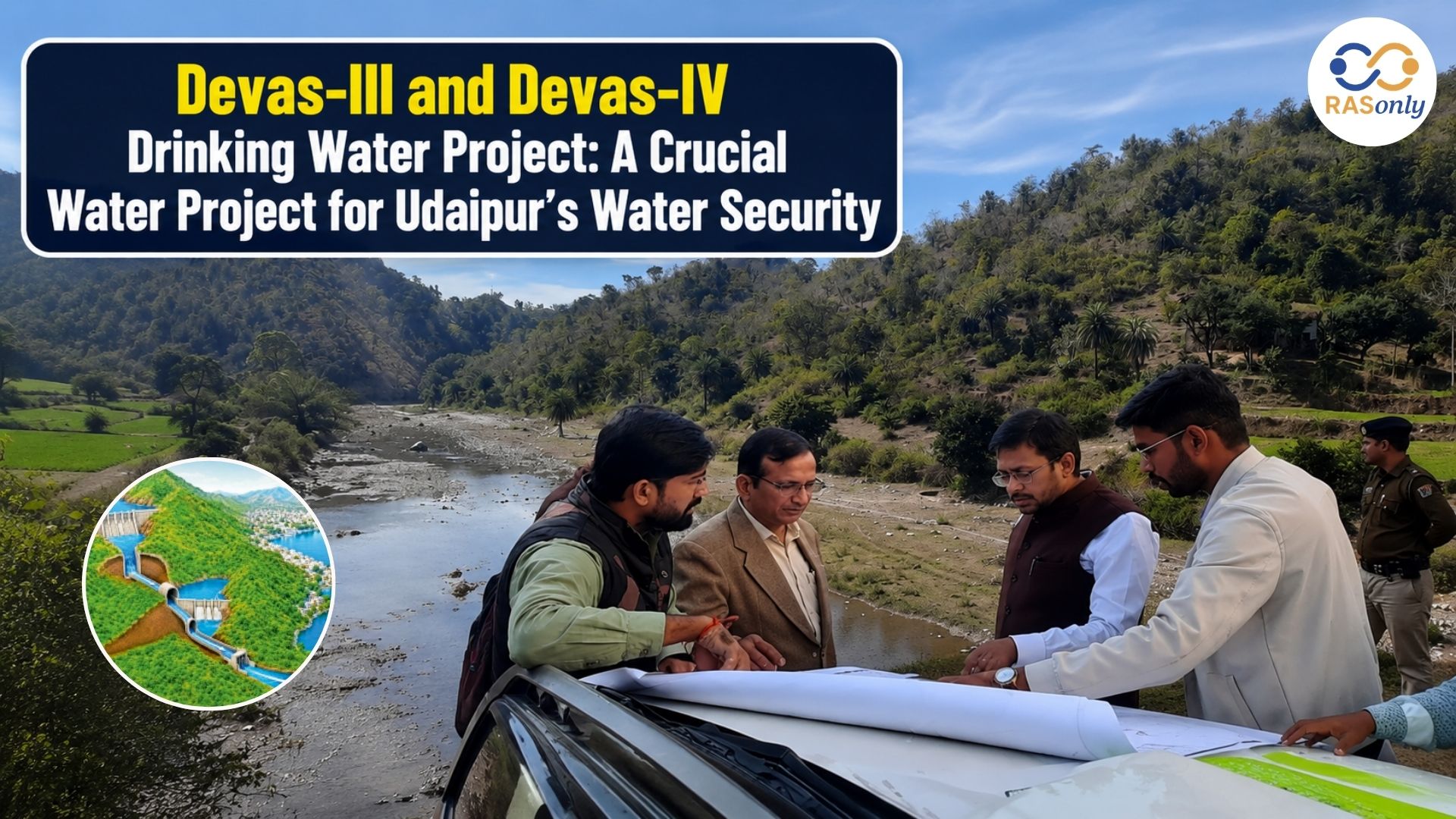
The Rajasthan Government has sped up work on the Devas-III and Devas-IV Drinking Water Project. This important water transfer plan aims to solve Udaipur’s ongoing drinking water shortages. The project should greatly improve water availability in the historic Pichola and Fateh Sagar Lakes, ensuring a sustainable drinking water supply for both urban and rural populations in the area.
Background
Udaipur, often called the "City of Lakes," relies heavily on its historic lakes, especially Lake Pichola and Fateh Sagar Lake, for drinking water. In the summer and during dry spells, water levels in these lakes often drop sharply, causing drinking water shortages throughout the city and nearby areas.
To tackle this issue, the Rajasthan Government proposed the Devas Project. It involves redirecting water from the Wakal River, a tributary of the Sabarmati Basin, to Udaipur using a network of dams and tunnels. The third and fourth phases of this ambitious project—Devas-III and Devas-IV—are now underway to support the city’s long-term water security.
About Devas-III Project
The Devas-III Dam is being built on the Wakal River near Nal (Nathiya Thal) village in the Gogunda Tehsil of Udaipur district.
Key Features
- River: Wakal River
- Location: Nal (Nathiya Thal), Gogunda, Udaipur
- Catchment Area: 86 sq. km.
- Storage Capacity: 500 Million Cubic Feet (MCFT)
- Main Tunnel Length: 10.38 km
- Purpose: To transfer water to the Devas-II (Akodara) Reservoir
This project includes a modern tunnel system that will allow for gravity-based water transfer with low energy use.
About Devas-IV Project
The Devas-IV Dam is being built near Ambava (Jhank) village, also in Gogunda Tehsil.
Key Features
- River: Wakal River
- Location: Ambava (Jhank), Gogunda, Udaipur
- Catchment Area: 90 sq. km.
- Storage Capacity: 500 Million Cubic Feet (MCFT)
- Link Tunnel Length: 3.88 km
- Purpose: To transfer water to the Devas-III Reservoir
This reservoir will act as the first collection point before water is sent to the existing Devas system.
How Will the Project Function?
The project relies on gravity flow and modern tunnel engineering to ensure effective water movement without relying heavily on pumps.
Flow of Water
Step 1: Water collected in the Devas-IV Dam will flow through a 3.88 km-long link tunnel to the Devas-III Reservoir.
Step 2: The combined water stored in Devas-III will then move through a 10.38 km-long main tunnel to the Devas-II (Akodara) Dam.
Step 3: From Akodara, the water will flow through the Bujhada and Amarjok river channels.
Step 4: Finally, the water will be released into Lake Pichola, replenishing Udaipur’s lake system and boosting the city’s drinking water supply.
Major Benefits of the Project
1. Additional Water Supply
The Devas-III and Devas-IV system will enable the diversion of around:
- 1,000 Million Cubic Feet (MCFT) of extra water every year.
- About 3.43 crore litres of drinking water daily for Udaipur and the surrounding areas.
This added supply will significantly improve water availability throughout the year.
2. Drinking Water Security for Udaipur
The project will provide:
- A dependable drinking water supply for Udaipur city.
- Less reliance on monsoon rains.
- Better water availability during dry years.
- Sustainable urban water solutions.
As Udaipur's population grows, this project will be vital in meeting future water needs.
3. Benefits for Rural and Tribal Areas
In addition to urban residents, the project will directly help about 186 tribal villages located in:
- Gogunda Sub-division
- Kotra Sub-division
These villages will gain better access to safe and clean drinking water, improving public health and quality of life.
4. Conservation of Udaipur’s Historic Lakes
Udaipur’s lakes are essential water sources and key parts of Rajasthan’s culture and ecology.
The project will help:
- Keep water levels in Lake Pichola and Fateh Sagar steady year-round.
- Enhance the ecological health of the lake system.
- Protect aquatic life.
- Keep Udaipur’s identity as the “City of Lakes.”
5. Groundwater Recharge
The continuous supply of surface water will boost groundwater recharge in the area.
This should:
- Raise groundwater levels.
- Ease the pressure on tube wells and bore wells.
- Support regional water sustainability.
Nearby areas like Rajsamand and Chittorgarh may also see benefits from improved water conditions.
6. Boost to Tourism and Economy
Tourism is a key part of Udaipur’s economy.
With lakes remaining full throughout the year:
- Tourist spots will be more attractive.
- Boating and lake activities will grow.
- The hospitality and service sectors will thrive.
- Job opportunities will rise across the Mewar region.
Thus, the project is expected to bring significant economic benefits beyond just providing drinking water.
Conclusion
The Devas-III and Devas-IV Drinking Water Project is one of Rajasthan’s largest water infrastructure efforts aimed at ensuring Udaipur's future water needs. By diverting water from the Wakal River through a system of reservoirs and tunnels, the project aims to provide a lasting solution to drinking water shortages while protecting the iconic lakes that define Udaipur’s character.
Beyond securing water supplies, the project will enhance groundwater resources, improve living conditions in tribal areas, support environmental preservation, and stimulate tourism-related economic growth in the Mewar region. As a result, the Devas Project is set to become a model for effective water management and development in Rajasthan.
MCQs
Question 1
Which river serves as the primary source of water for the Devas-III and Devas-IV Drinking Water Project?
A) Sabarmati River
B) Wakal River
C) Bujhada River
D) Banas River
Answer: B) Wakal River
Explanation: Both the Devas-III Dam (near Nal village) and the Devas-IV Dam (near Ambava village) are being built on the Wakal River, which is a tributary of the Sabarmati Basin. The project redirects water from this river to support Udaipur's lake system.
Question 2
How is water transported from the Devas-IV Reservoir down to the final lake system?
A) Through large electric pumping stations
B) Via tanker trucks and open canals
C) Through a system of gravity-based tunnels and river channels
D) By diverting it through groundwater aquifers
Answer: C) Through a system of gravity-based tunnels and river channels
Explanation: The project relies on modern tunnel engineering and gravity flow to ensure water movement without relying heavily on pumps. Water flows from Devas-IV to Devas-III via a link tunnel, then through a main tunnel to the Devas-II (Akodara) Dam, and finally through the Bujhada and Amarjok river channels into Lake Pichola.
Question 3
Which of the following is NOT as a direct benefit of the Devas-III and Devas-IV project?
A) Providing a dependable drinking water supply for about 186 tribal villages in Gogunda and Kotra.
B) Keeping water levels steady year-round in Lake Pichola and Fateh Sagar Lake.
C) Boosting tourism, boating activities, and the hospitality sector in the Mewar region.
D) Generating hydroelectric power to supply electricity to the city of Udaipur.
Answer: D) Generating hydroelectric power to supply electricity to the city of Udaipur.
Explanation: While the project provides significant benefits—such as supplying 3.43 crore litres of daily drinking water, helping rural/tribal villages, conserving historic lakes, recharging groundwater, and boosting tourism—the text does not mention anything about generating hydroelectric power or electricity.
देवास-III और देवास-IV पेयजल परियोजना: उदयपुर की जल सुरक्षा के लिए महत्वपूर्ण जल परियोजना
राजस्थान सरकार ने देवास-III और देवास-IV पेयजल परियोजना पर कार्य को तेज कर दिया है। यह महत्वपूर्ण जल स्थानांतरण योजना उदयपुर की लगातार बनी रहने वाली पेयजल कमी की समस्या का समाधान करने के लिए बनाई गई है। इस परियोजना से ऐतिहासिक पिछोला झील और फतेह सागर झील में जल उपलब्धता में उल्लेखनीय वृद्धि होने की उम्मीद है, जिससे क्षेत्र की शहरी और ग्रामीण आबादी के लिए टिकाऊ पेयजल आपूर्ति सुनिश्चित हो सकेगी।
पृष्ठभूमि
उदयपुर, जिसे अक्सर "झीलों की नगरी" कहा जाता है, अपनी ऐतिहासिक झीलों, विशेष रूप से पिछोला झील और फतेह सागर झील, पर पेयजल आपूर्ति के लिए काफी हद तक निर्भर है। गर्मियों और सूखे के समय इन झीलों का जल स्तर अक्सर काफी कम हो जाता है, जिससे पूरे शहर और आसपास के क्षेत्रों में पेयजल संकट उत्पन्न हो जाता है।
इस समस्या से निपटने के लिए राजस्थान सरकार ने देवास परियोजना का प्रस्ताव रखा। इस परियोजना में वाकल नदी, जो साबरमती बेसिन की एक सहायक नदी है, से जल को बांधों और सुरंगों के नेटवर्क के माध्यम से उदयपुर तक पहुंचाया जाएगा। इस महत्वाकांक्षी परियोजना के तीसरे और चौथे चरण—देवास-III और देवास-IV—अब उदयपुर की दीर्घकालिक जल सुरक्षा को मजबूत करने के लिए कार्यान्वित किए जा रहे हैं।
देवास-III परियोजना के बारे में
देवास-III बांध का निर्माण उदयपुर जिले की गोगुंदा तहसील के नाल (नाठिया थाल) गांव के पास वाकल नदी पर किया जा रहा है।
प्रमुख विशेषताएँ
- नदी: वाकल नदी
- स्थान: नाल (नाठिया थाल), गोगुंदा, उदयपुर
- कैचमेंट क्षेत्र: 86 वर्ग किमी
- भंडारण क्षमता: 500 मिलियन क्यूबिक फीट (MCFT)
- मुख्य सुरंग की लंबाई: 10.38 किमी
- उद्देश्य: जल को देवास-II (आकोदरा) जलाशय तक पहुंचाना
इस परियोजना में एक आधुनिक सुरंग प्रणाली शामिल है, जो कम ऊर्जा उपयोग के साथ गुरुत्वाकर्षण आधारित जल स्थानांतरण को संभव बनाएगी।
देवास-IV परियोजना के बारे में
देवास-IV बांध का निर्माण भी गोगुंदा तहसील के अम्बावा (झांक) गांव के निकट किया जा रहा है।
प्रमुख विशेषताएँ
- नदी: वाकल नदी
- स्थान: अम्बावा (झांक), गोगुंदा, उदयपुर
- कैचमेंट क्षेत्र: 90 वर्ग किमी
- भंडारण क्षमता: 500 मिलियन क्यूबिक फीट (MCFT)
- लिंक सुरंग की लंबाई: 3.88 किमी
- उद्देश्य: जल को देवास-III जलाशय तक पहुंचाना
यह जलाशय प्रारंभिक संग्रहण बिंदु के रूप में कार्य करेगा, जहां से जल को मौजूदा देवास प्रणाली में भेजा जाएगा।
परियोजना कैसे कार्य करेगी?
यह परियोजना गुरुत्वाकर्षण प्रवाह और आधुनिक सुरंग इंजीनियरिंग पर आधारित है, जिससे जल का प्रभावी परिवहन भारी पंपिंग व्यवस्था पर निर्भर हुए बिना किया जा सकेगा।
जल प्रवाह की प्रक्रिया
चरण 1: देवास-IV बांध में संचित जल 3.88 किमी लंबी लिंक सुरंग के माध्यम से देवास-III जलाशय तक पहुंचेगा।
चरण 2: देवास-III में संचित संयुक्त जल 10.38 किमी लंबी मुख्य सुरंग के माध्यम से देवास-II (आकोदरा) बांध तक जाएगा।
चरण 3: आकोदरा से जल बूझड़ा और अमरजोक नदी मार्गों के माध्यम से प्रवाहित होगा।
चरण 4: अंततः यह जल पिछोला झील में छोड़ा जाएगा, जिससे उदयपुर की झील प्रणाली पुनर्भरित होगी और शहर की पेयजल आपूर्ति में वृद्धि होगी।
परियोजना के प्रमुख लाभ
1. अतिरिक्त जल आपूर्ति
देवास-III और देवास-IV प्रणाली के माध्यम से प्रतिवर्ष लगभग:
- 1,000 मिलियन क्यूबिक फीट (MCFT) अतिरिक्त जल का स्थानांतरण संभव होगा।
- उदयपुर और आसपास के क्षेत्रों को प्रतिदिन लगभग 3.43 करोड़ लीटर पेयजल उपलब्ध कराया जाएगा।
यह अतिरिक्त जल आपूर्ति पूरे वर्ष जल उपलब्धता में महत्वपूर्ण सुधार लाएगी।
2. उदयपुर के लिए पेयजल सुरक्षा
यह परियोजना प्रदान करेगी:
- उदयपुर शहर के लिए विश्वसनीय पेयजल आपूर्ति।
- मानसून वर्षा पर निर्भरता में कमी।
- सूखे वर्षों में बेहतर जल उपलब्धता।
- टिकाऊ शहरी जल प्रबंधन समाधान।
उदयपुर की बढ़ती आबादी को देखते हुए यह परियोजना भविष्य की जल आवश्यकताओं को पूरा करने में महत्वपूर्ण भूमिका निभाएगी।
3. ग्रामीण एवं जनजातीय क्षेत्रों को लाभ
शहरी आबादी के अलावा, यह परियोजना सीधे तौर पर लगभग 186 जनजातीय गांवों को लाभान्वित करेगी, जो स्थित हैं:
- गोगुंदा उपखंड
- कोटड़ा उपखंड
इन गांवों को सुरक्षित एवं स्वच्छ पेयजल की बेहतर उपलब्धता मिलेगी, जिससे जनस्वास्थ्य और जीवन स्तर में सुधार होगा।
4. उदयपुर की ऐतिहासिक झीलों का संरक्षण
उदयपुर की झीलें न केवल जल स्रोत हैं बल्कि राजस्थान की सांस्कृतिक और पारिस्थितिक विरासत का भी महत्वपूर्ण हिस्सा हैं।
यह परियोजना:
- पिछोला झील और फतेह सागर झील के जल स्तर को वर्षभर स्थिर बनाए रखने में मदद करेगी।
- झील प्रणाली के पारिस्थितिक स्वास्थ्य को बेहतर बनाएगी।
- जलीय जीवों की सुरक्षा करेगी।
- उदयपुर की "झीलों की नगरी" की पहचान को बनाए रखेगी।
5. भूजल पुनर्भरण
सतही जल की निरंतर उपलब्धता से क्षेत्र में भूजल पुनर्भरण को बढ़ावा मिलेगा।
इससे:
- भूजल स्तर में वृद्धि होगी।
- ट्यूबवेल और बोरवेल पर दबाव कम होगा।
- क्षेत्रीय जल स्थिरता को समर्थन मिलेगा।
राजसमंद और चित्तौड़गढ़ जैसे निकटवर्ती क्षेत्रों को भी बेहतर जल परिस्थितियों का लाभ मिल सकता है।
6. पर्यटन और अर्थव्यवस्था को बढ़ावा
पर्यटन उदयपुर की अर्थव्यवस्था का एक प्रमुख आधार है।
झीलों में वर्षभर पर्याप्त जल उपलब्ध रहने से:
- पर्यटन स्थलों का आकर्षण बढ़ेगा।
- नौकायन और झील आधारित गतिविधियों का विस्तार होगा।
- आतिथ्य एवं सेवा क्षेत्र को लाभ मिलेगा।
- मेवाड़ क्षेत्र में रोजगार के अवसर बढ़ेंगे।
इस प्रकार यह परियोजना केवल पेयजल उपलब्ध कराने तक सीमित नहीं रहेगी, बल्कि व्यापक आर्थिक लाभ भी प्रदान करेगी।
निष्कर्ष
देवास-III और देवास-IV पेयजल परियोजना राजस्थान की सबसे बड़ी जल अवसंरचना परियोजनाओं में से एक है, जिसका उद्देश्य उदयपुर की भविष्य की जल आवश्यकताओं को सुरक्षित करना है। वाकल नदी से जल को जलाशयों और सुरंगों की एक सुव्यवस्थित प्रणाली के माध्यम से स्थानांतरित करके यह परियोजना पेयजल संकट का स्थायी समाधान प्रदान करने के साथ-साथ उदयपुर की पहचान बनी हुई ऐतिहासिक झीलों के संरक्षण में भी महत्वपूर्ण भूमिका निभाएगी।
जल सुरक्षा सुनिश्चित करने के अतिरिक्त, यह परियोजना भूजल संसाधनों को सुदृढ़ करेगी, जनजातीय क्षेत्रों में जीवन स्तर को बेहतर बनाएगी, पर्यावरण संरक्षण को बढ़ावा देगी तथा मेवाड़ क्षेत्र में पर्यटन आधारित आर्थिक विकास को गति देगी। परिणामस्वरूप, देवास परियोजना राजस्थान में प्रभावी जल प्रबंधन और सतत विकास का एक आदर्श मॉडल बनने की दिशा में अग्रसर है।
प्रश्न 1
देवास-III और देवास-IV पेयजल परियोजना के लिए जल का मुख्य स्रोत कौन-सी नदी है?
A) साबरमती नदी
B) वाकल नदी
C) बूझड़ा नदी
D) बनास नदी
उत्तर: B) वाकल नदी
व्याख्या: देवास-III बांध (नाल गांव के निकट) और देवास-IV बांध (अम्बावा गांव के निकट) दोनों का निर्माण वाकल नदी पर किया जा रहा है, जो साबरमती बेसिन की एक सहायक नदी है। यह परियोजना इसी नदी के जल को उदयपुर की झील प्रणाली तक पहुंचाती है।
प्रश्न 2
देवास-IV जलाशय से अंतिम झील प्रणाली तक जल का परिवहन किस प्रकार किया जाता है?
A) बड़े विद्युत चालित पंपिंग स्टेशनों के माध्यम से
B) टैंकरों और खुली नहरों के माध्यम से
C) गुरुत्वाकर्षण आधारित सुरंगों और नदी मार्गों की प्रणाली के माध्यम से
D) भूजल जलभृतों (Aquifers) के माध्यम से मोड़कर
उत्तर: C) गुरुत्वाकर्षण आधारित सुरंगों और नदी मार्गों की प्रणाली के माध्यम से
व्याख्या: यह परियोजना आधुनिक सुरंग इंजीनियरिंग और गुरुत्वाकर्षण प्रवाह पर आधारित है, जिससे भारी पंपिंग की आवश्यकता नहीं होती। जल देवास-IV से लिंक सुरंग द्वारा देवास-III तक, फिर मुख्य सुरंग द्वारा देवास-II (आकोदरा) बांध तक और उसके बाद बूझड़ा एवं अमरजोक नदी मार्गों के माध्यम से पिछोला झील तक पहुंचता है।
प्रश्न 3
निम्नलिखित में से कौन-सा लाभ देवास-III और देवास-IV परियोजना का प्रत्यक्ष लाभ नहीं है?
A) गोगुंदा और कोटड़ा के लगभग 186 जनजातीय गांवों को विश्वसनीय पेयजल उपलब्ध कराना।
B) पिछोला झील और फतेह सागर झील के जल स्तर को वर्षभर स्थिर बनाए रखना।
C) मेवाड़ क्षेत्र में पर्यटन, नौकायन गतिविधियों और आतिथ्य क्षेत्र को बढ़ावा देना।
D) उदयपुर शहर को बिजली उपलब्ध कराने के लिए जलविद्युत ऊर्जा का उत्पादन करना।
उत्तर: D) उदयपुर शहर को बिजली उपलब्ध कराने के लिए जलविद्युत ऊर्जा का उत्पादन करना।
व्याख्या: परियोजना के प्रमुख लाभों में प्रतिदिन 3.43 करोड़ लीटर पेयजल उपलब्ध कराना, ग्रामीण एवं जनजातीय क्षेत्रों को लाभ पहुंचाना, ऐतिहासिक झीलों का संरक्षण, भूजल पुनर्भरण तथा पर्यटन को बढ़ावा देना शामिल है। परियोजना के विवरण में कहीं भी जलविद्युत उत्पादन या बिजली आपूर्ति का उल्लेख नहीं किया गया है
