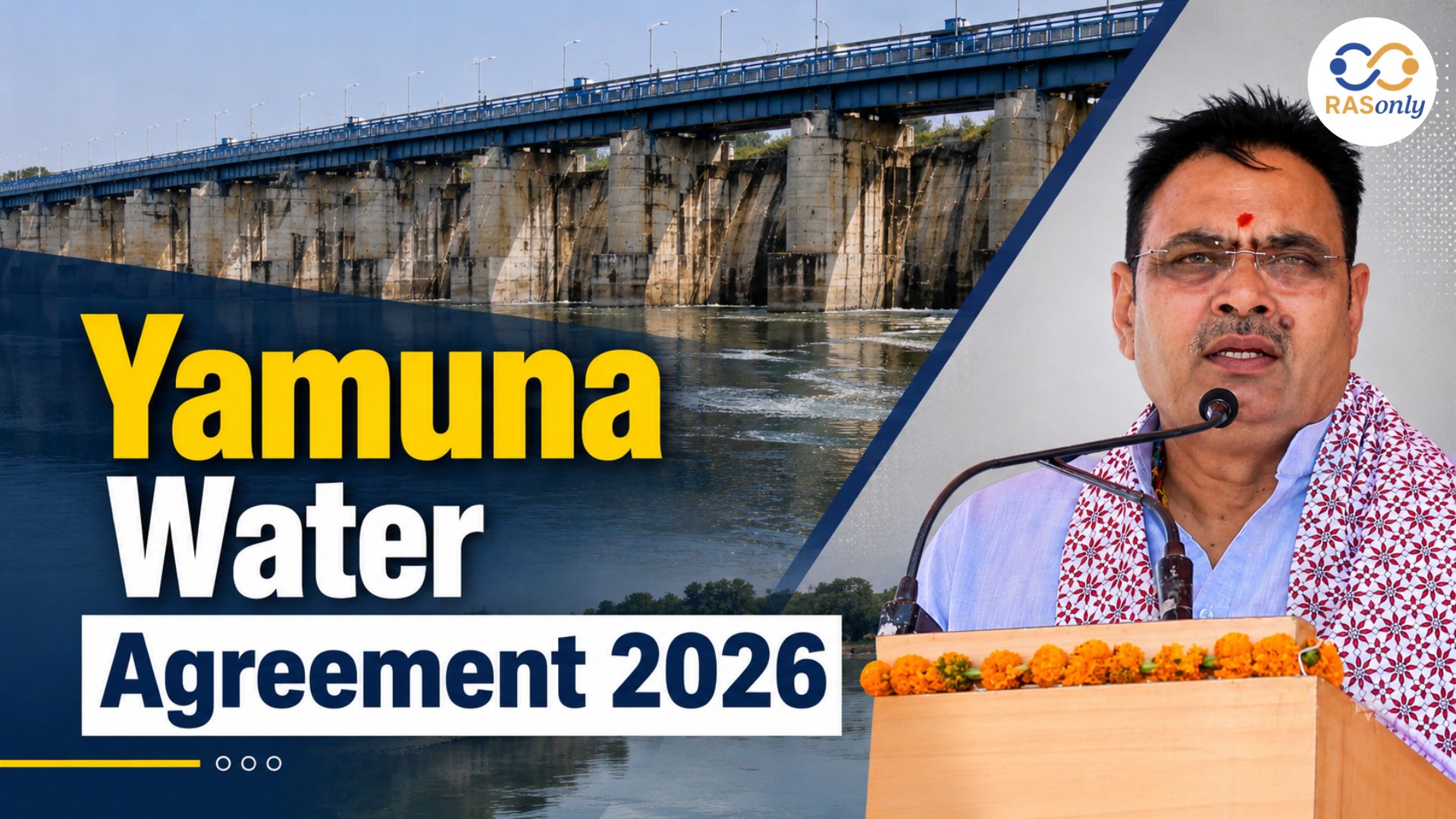
The Yamuna Water Agreement is an important step towards the water security of Shekhawati region of Rajasthan in India.A key meeting is taking place in New Delhi between Rajasthan Chief Minister Bhajan Lal Sharma, Union Jal Shakti Minister C.R. Patil and Haryana Chief Minister Nayab Singh Saini, to finalize the Memorandum of Agreement (MoA) for the Yamuna Water Project. Project is looking forward to solve the long-standing drinking water problem in the Rajasthan Shekhawati region.
Background
The Central Government has spearheaded the Yamuna Water Agreement in May 1994, which is signed among five states:
- Rajasthan
- Haryana
- Uttar Pradesh
- Himachal Pradesh
- Delhi
As per the agreement, the water of the river Yamuna was allotted to the state of Rajasthan at 1917 cusecs during four months of monsoon each year from the Tajewala Headworks (now Hathnikund Barrage). The implementation of the agreement was, however, delayed for almost 30 years.
In this context, the efforts under the present plan are aimed at securing the allocation of water from Rajasthan for operationalization in a dedicated pipeline based water supply system.
Key Features of the Project
1. Water Allocation
In Rajasthan, 577 Million Cubic Metres (MCM) of water will be available in excess of the requirements of the Yamuna every year.
Water will be available during the monsoon season, July to October.
The source of water will be from the Hathnikund Barrage in Haryana.
2. Infrastructure Development
Underground Pipeline Network
The project suggests for construction of four pipelines Undergrounds:
Three pipelines to provide water supply to Shekhawati region.
- One pipeline to cater to border areas of Haryana and Rajasthan.
Pipeline Length
Around 265 km of underground pipe will be laid in Haryana to Churu district.
3. Beneficiary Districts
The project is envisaged to have a positive impact on the water stressed districts of Rajasthan such as:
- Churu
- Sikar
- Jhunjhunu
The project could also benefit surrounding areas if the project expands.
4. DPR and Approval Status
Rajasthan and Haryana have prepared Joint Detailed Project Report (DPR).
The DPR has been submitted to the Central Government and the Central Water Commission (CWC).
Once technical assessment and approval, the project will then proceed to implementation.
Significance for Rajasthan
A. Drinking Water Security
The solution has been provided for the scarcity of water.Permanent Solution to Water Scarcity.
Shekhawati is one of the water-scarce areas of Rajasthan and is suffering from the following:
- Low rainfall
- Groundwater depletion
- The risk of dependence on tanker supply is high.
- Frequent drought-like conditions
The project will guarantee the urban and rural population a reliable drinking water supply.
B. Groundwater Conservation
At present, over extraction of groundwater has caused:
- Falling water tables
- Salinity problems
- Pollution of water quality
Water availability from the Yamuna can help decrease the reliance on groundwater and shift towards sustainable water use.
C. Enhance public health.E. Strengthen public health.
Safe drinking water can be helpful:
- Reduce water-borne diseases
- Improve sanitation standards
- Improve quality of life
This is especially critical to rural populations with water quality issues.
D. Agricultural Benefits
The project should indirectly benefit agriculture in the following ways:
- Improving water availability
- Avoiding the degradation of groundwater for irrigation
- Enhancing agricultural sustainability
Enhanced water availability can help to improve rural livelihood.
E. Regional Development
Better water facilities can:
- Support urban growth
- Encourage industrial investments
- Strengthen economic activities
- Improve living standards
The project has the potential to catalyse the socio-economic development of Shekhawati region.
Importance for Haryana
The project will not only help Rajasthan, but also Haryana.
Benefits to Haryana
Supplies of potable water to:
- Dadri
- Bhiwani
- Hisar
Enhanced water infrastructure at border areas.
Increased cooperation between states in water resource management.
Cooperative Federalism in Action
The project highlights the principle of Cooperative Federalism, where:
- The Central Government acts as a facilitator.
- Rajasthan and Haryana work jointly on planning and implementation.
- Water resources are managed through dialogue and mutual agreement.
This model can serve as an example for resolving other interstate water-sharing issues in India.
Financial Aspects
|
|
|
|
|
|
|
|
|
|
|
|
Challenges
Despite its importance, there are a number of challenges for the project:
1. Financial Burden
A significant investment of capital is needed.
2. Environmental Considerations
Evaluation of ecological impacts in Yamuna basin.
Water resources are sustainably extracted and utilised.
3. Interstate Coordination
Successful implementation requires the cooperation of states going hand in hand.
4. Timely Execution
Project timelines may be impacted by delay in approvals and/or construction.
Conclusion
Yamuna Water Project is one of the most important water infrastructure projects of the last few decades in Rajasthan. The project has the potential to change the landscape of water in the Shekhawati region, as operationalisation of the share of water to Rajasthan under the long pending Yamuna Water Agreement is under way. An important benefit of it is that it not only helps to alleviate the shortage of drinking water but also contributes to the overall conservation of groundwater resources, agriculture, public health, and regional development. The project also represents an example of ‘cooperative federalism', a form of federalism that involves states working together with the Centre to achieve sustainable solutions to significant resource-management problems..
MCQs
Question 1
With reference to the Yamuna Water Agreement 2026 and the Shekhawati Water Security Project, consider the following statements:
- The project aims to utilize 577 Million Cubic Metres (MCM) of water from the Hathnikund Barrage in Haryana.
- The water allocation will be available throughout the year to ensure a perennial supply to the desert districts.
- The infrastructure involves laying down an underground pipeline network stretching approximately 265 km into Rajasthan.
Which of the statements given above is/are correct?
A) 1 and 2 only
B) 1 and 3 only
C) 3 only
D) 1, 2, and 3
- Answer: B) 1 and 3 only
- Detailed Explanation:
- Statement 1 is correct: Under the updated 2026 framework, Rajasthan will receive an allocation of 577 Million Cubic Metres (MCM) of water, tapping into the excess waters of the Yamuna River. The primary source for this diversion is the Hathnikund Barrage located in Haryana (which replaced the old Tajewala Headworks).
- Statement 2 is incorrect: The water will not be available perennial (year-round). According to the project features, this water allocation is strictly seasonal, available only during the four months of the monsoon season, running from July to October.
- Statement 3 is correct: To minimize evaporation losses and avoid land acquisition conflicts, the project features a massive underground pipeline network. Around 265 km of underground pipelines will run through Haryana to reach Churu district in Rajasthan, distributing water further down the network.
Question 2
The Shekhawati Water Security Project primarily targets the mitigation of drinking water scarcity and groundwater depletion in which of the following groups of districts in Rajasthan?
A) Jaipur, Alwar, and Sikar
B) Churu, Sikar, and Jhunjhunu
C) Bikaner, Churu, and Sri Ganganagar
D) Jodhpur, Barmer, and Jaisalmer
- Answer: B) Churu, Sikar, and Jhunjhunu
- Detailed Explanation:
- The project is geographically dedicated to the Shekhawati region of Rajasthan, which historically comprises the core districts of Churu, Sikar, and Jhunjhunu.
- This region suffers from acute water distress characterized by low annual rainfall, rapidly falling water tables, and severe groundwater salinity.
- The pipeline infrastructure is specifically engineered with four underground pipelines—three of which are entirely dedicated to providing a permanent drinking water solution to these three core Shekhawati districts, while the fourth pipeline caters to the contiguous border areas of Haryana and Rajasthan.
Question 3
Consider the following statements regarding the historical background and financial aspects of the Yamuna Water Agreement:
- The original interstate Yamuna Water Agreement was signed in May 1994 among five basin states, including Himachal Pradesh and Delhi.
- The original 1994 allocation granted Rajasthan 1917 cusecs of water from the Tajewala Headworks during the monsoon period.
- The Rajasthan State Budget 2026–27 has made a revised provision of ₹32,000 crore for the execution of this project.
Which of the statements given above are correct?
A) 1 and 2 only
B) 2 and 3 only
C) 1 and 3 only
D) 1, 2, and 3
- Answer: D) 1, 2, and 3
- Detailed Explanation:
- Statement 1 is correct: The foundation of this project relies on the historic May 1994 Yamuna Water Agreement. It was a multilateral pact signed among five distinct states/UTs: Rajasthan, Haryana, Uttar Pradesh, Himachal Pradesh, and Delhi.
- Statement 2 is correct: Rajasthan was allotted 1917 cusecs of water during the four monsoon months. However, due to interstate disputes and the lack of dedicated carriage infrastructure, the implementation remained stalled for nearly three decades.
- Statement 3 is correct: The initial estimated cost of the project infrastructure was pegged at ₹31,000 crore, the Rajasthan Budget 2026–27 proactively enhanced this allocation by registering a provision of ₹32,000 crore to accommodate financial adjustments, emphasizing the state's commitment to cooperative federalism and regional water security.
यमुना जल समझौता 2026: शेखावाटी जल सुरक्षा परियोजना, लाभ, विशेषताएँ और राजस्थान के लिए महत्व
यमुना जल समझौता भारत में राजस्थान के शेखावाटी क्षेत्र की जल सुरक्षा की दिशा में एक महत्वपूर्ण कदम है। यमुना जल परियोजना के समझौता ज्ञापन (MoA) को अंतिम रूप देने के लिए नई दिल्ली में राजस्थान के मुख्यमंत्री भजन लाल शर्मा, केंद्रीय जल शक्ति मंत्री सी.आर. पाटिल और हरियाणा के मुख्यमंत्री नायब सिंह सैनी के बीच एक महत्वपूर्ण बैठक हो रही है। इस परियोजना का उद्देश्य राजस्थान के शेखावाटी क्षेत्र में लंबे समय से चली आ रही पेयजल समस्या का समाधान करना है।
पृष्ठभूमि (Background)
केंद्र सरकार ने मई 1994 में यमुना जल समझौते की पहल की थी, जिस पर पांच राज्यों ने हस्ताक्षर किए थे:
- राजस्थान
- हरियाणा
- उत्तर प्रदेश
- हिमाचल प्रदेश
- दिल्ली
समझौते के अनुसार, प्रत्येक वर्ष मानसून के चार महीनों के दौरान ताजेवाला हेडवर्क्स (अब हथिनीकुंड बैराज) से राजस्थान राज्य को 1917 क्यूसेक यमुना नदी का पानी आवंटित किया गया था। हालाँकि, इस समझौते का क्रियान्वयन लगभग 30 वर्षों तक लंबित रहा।
इस संदर्भ में, वर्तमान योजना के तहत प्रयास राजस्थान के पानी के आवंटन को सुरक्षित करने और इसे एक समर्पित पाइपलाइन-आधारित जल आपूर्ति प्रणाली के माध्यम से संचालित करने के उद्देश्य से किए जा रहे हैं।
परियोजना की मुख्य विशेषताएँ (Key Features of the Project)
1. जल आवंटन (Water Allocation)
- राजस्थान में हर साल यमुना की आवश्यकताओं के अतिरिक्त 577 मिलियन क्यूबिक मीटर (MCM) पानी उपलब्ध होगा।
- यह पानी मानसून के मौसम, यानी जुलाई से अक्टूबर के दौरान उपलब्ध होगा।
- पानी का स्रोत हरियाणा में स्थित हथिनीकुंड बैराज होगा।
2. बुनियादी ढांचे का विकास (Infrastructure Development)
- भूमिगत पाइपलाइन नेटवर्क: परियोजना के तहत भूमिगत चार पाइपलाइनों के निर्माण का प्रस्ताव है:
- शेखावाटी क्षेत्र में जलापूर्ति के लिए तीन पाइपलाइनें।
- हरियाणा और राजस्थान के सीमावर्ती क्षेत्रों की जरूरतों को पूरा करने के लिए एक पाइपलाइन।
- पाइपलाइन की लंबाई: हरियाणा से राजस्थान के चूरू जिले तक लगभग 265 किलोमीटर लंबी भूमिगत पाइपलाइन बिछाई जाएगी।
3. लाभार्थी जिले (Beneficiary Districts)
इस परियोजना से राजस्थान के अत्यधिक जल-तनाव वाले (Water Stressed) जिलों पर सकारात्मक प्रभाव पड़ने की उम्मीद है, जैसे:
- चूरू
- सीकर
- झुंझुनूं
यदि परियोजना का विस्तार होता है, तो इससे आसपास के क्षेत्रों को भी लाभ मिल सकता है।
4. डीपीआर और स्वीकृति की स्थिति (DPR and Approval Status)
- राजस्थान और हरियाणा ने एक संयुक्त विस्तृत परियोजना रिपोर्ट (DPR) तैयार की है।
- इस डीपीआर को केंद्र सरकार और केंद्रीय जल आयोग (CWC) के समक्ष प्रस्तुत कर दिया गया है।
- तकनीकी मूल्यांकन और स्वीकृति मिलने के बाद, परियोजना के क्रियान्वयन का काम आगे बढ़ेगा।
राजस्थान के लिए महत्व (Significance for Rajasthan)
A. पेयजल सुरक्षा (Drinking Water Security)
पानी की किल्लत का समाधान मिल गया है - जल संकट का स्थायी समाधान। शेखावाटी राजस्थान के सबसे कम पानी वाले क्षेत्रों में से एक है और निम्नलिखित समस्याओं से जूझ रहा है:
- कम वर्षा
- भूजल का गिरता स्तर
- टैंकर आपूर्ति पर निर्भरता का उच्च जोखिम
- बार-बार सूखे जैसी स्थिति
यह परियोजना शहरी और ग्रामीण आबादी को एक विश्वसनीय पेयजल आपूर्ति की गारंटी देगी।
B. भूजल संरक्षण (Groundwater Conservation)
वर्तमान में, भूजल के अत्यधिक दोहन के कारण ये समस्याएं उत्पन्न हुई हैं:
- जल स्तर का लगातार गिरना
- खारेपन (Salinity) की समस्या
- पानी की गुणवत्ता में प्रदूषण
यमुना से पानी की उपलब्धता भूजल पर निर्भरता को कम करने और टिकाऊ जल उपयोग की ओर बढ़ने में मदद कर सकती है।
C. सार्वजनिक स्वास्थ्य को सुदृढ़ करना (Strengthen public health)
सुरक्षित पेयजल निम्नलिखित में सहायक हो सकता है:
- जल-जनित बीमारियों को कम करना
- स्वच्छता के स्तर में सुधार करना
- जीवन स्तर को बेहतर बनाना
यह विशेष रूप से जल गुणवत्ता की समस्याओं से जूझ रही ग्रामीण आबादी के लिए अत्यंत महत्वपूर्ण है।
D. कृषि संबंधी लाभ (Agricultural Benefits)
यह परियोजना अप्रत्यक्ष रूप से कृषि को निम्नलिखित तरीकों से लाभ पहुंचाएगी:
- पानी की उपलब्धता में सुधार करके
- सिंचाई के लिए भूजल की गुणवत्ता को खराब होने से बचाकर
- कृषि की निरंतरता (Sustainability) को बढ़ाकर
पानी की बेहतर उपलब्धता से ग्रामीण आजीविका को सुधारने में मदद मिल सकती है।
E. क्षेत्रीय विकास (Regional Development)
जल की बेहतर सुविधाएं निम्नलिखित में मदद कर सकती हैं:
- शहरी विकास को गति देना
- औद्योगिक निवेश को प्रोत्साहित करना
- आर्थिक गतिविधियों को मजबूत करना
- जीवन स्तर में सुधार लाना
यह परियोजना शेखावाटी क्षेत्र के सामाजिक-आर्थिक विकास को उत्प्रेरित करने की क्षमता रखती है।
हरियाणा के लिए महत्व (Importance for Haryana)
यह परियोजना न केवल राजस्थान बल्कि हरियाणा की भी मदद करेगी।
हरियाणा को लाभ:
- निम्नलिखित क्षेत्रों को पीने योग्य पानी (Potable water) की आपूर्ति:
- दाद्री
- भिवानी
- हिसार
- सीमावर्ती क्षेत्रों में जल बुनियादी ढांचे (Water infrastructure) का सुदृढ़ीकरण।
- जल संसाधन प्रबंधन में राज्यों के बीच सहयोग में वृद्धि।
सहकारी संघवाद का उदाहरण (Cooperative Federalism in Action)
यह परियोजना 'सहकारी संघवाद' के सिद्धांत को रेखांकित करती है, जहाँ:
- केंद्र सरकार एक सूत्रधार (Facilitator) के रूप में कार्य करती है।
- राजस्थान और हरियाणा योजना तथा क्रियान्वयन पर मिलकर काम करते हैं।
- जल संसाधनों का प्रबंधन संवाद और आपसी सहमति के माध्यम से किया जाता है।
यह मॉडल भारत में अन्य अंतर-राज्यीय जल-बंटवारे के मुद्दों को सुलझाने के लिए एक उदाहरण के रूप में कार्य कर सकता है।
वित्तीय पहलू (Financial Aspects)
|
|
|
|
|
|
|
|
|
|
|
|
चुनौतियाँ (Challenges)
इसके महत्व के बावजूद, परियोजना के सामने कई चुनौतियाँ हैं:
- वित्तीय बोझ:
इसके लिए बड़े पैमाने पर पूंजी निवेश की आवश्यकता है।
- पर्यावरणीय चिंताएँ:
यमुना बेसिन में इसके पारिस्थितिक प्रभावों का मूल्यांकन करना और यह सुनिश्चित करना कि जल संसाधनों का निष्कर्षण और उपयोग स्थायी (Sustainable) रूप से हो।
- अंतर-राज्यीय समन्वय:
सफल क्रियान्वयन के लिए राज्यों का आपस में मिलकर और कदम से कदम मिलाकर सहयोग करना आवश्यक है।
- समय पर क्रियान्वयन:
मंजूरियों या निर्माण में देरी से परियोजना की समय-सीमा प्रभावित हो सकती है।
निष्कर्ष
यमुना जल परियोजना पिछले कुछ दशकों में राजस्थान की सबसे महत्वपूर्ण जल बुनियादी ढांचा परियोजनाओं में से एक है। यह परियोजना शेखावाटी क्षेत्र में पानी के परिदृश्य को बदलने की क्षमता रखती है, क्योंकि लंबे समय से लंबित यमुना जल समझौते के तहत राजस्थान के हिस्से के पानी को उपयोग में लाने की प्रक्रिया चल रही है। इसका एक महत्वपूर्ण लाभ यह है कि यह न केवल पीने के पानी की कमी को दूर करेगी बल्कि भूजल संसाधनों के समग्र संरक्षण, कृषि, सार्वजनिक स्वास्थ्य और क्षेत्रीय विकास में भी योगदान देगी। यह परियोजना 'सहकारी संघवाद' का भी एक बेहतरीन उदाहरण है, जिसमें महत्वपूर्ण संसाधन-प्रबंधन समस्याओं के स्थायी समाधान खोजने के लिए राज्य, केंद्र के साथ मिलकर काम करते हैं।
बहुविकल्पीय प्रश्न
प्रश्न 1
यमुना जल समझौता 2026 और शेखावाटी जल सुरक्षा परियोजना के संदर्भ में, निम्नलिखित कथनों पर विचार कीजिए:
- इस परियोजना का उद्देश्य हरियाणा के हथिनीकुंड बैराज से 577 मिलियन क्यूबिक मीटर (MCM) पानी का उपयोग करना है।
- मरुस्थलीय जिलों को बारहमासी (Perennial) आपूर्ति सुनिश्चित करने के लिए जल आवंटन पूरे वर्ष उपलब्ध रहेगा।
- इस बुनियादी ढांचे के तहत राजस्थान में लगभग 265 किलोमीटर तक फैला एक भूमिगत पाइपलाइन नेटवर्क बिछाना शामिल है।
उपर्युक्त कथनों में से कौन सा/से सही है/हैं?
A) केवल 1 और 2
B) केवल 1 and 3
C) केवल 3
D) 1, 2, और 3
उत्तर: B) केवल 1 और 3
विस्तृत व्याख्या :
- कथन 1 सही है: संशोधित 2026 ढांचे के तहत, राजस्थान को यमुना नदी के अतिरिक्त पानी का उपयोग करते हुए 577 मिलियन क्यूबिक मीटर (MCM) पानी का आवंटन प्राप्त होगा। इस डाइवर्जन का प्राथमिक स्रोत हरियाणा में स्थित हथिनीकुंड बैराज है (जिसने पुराने ताजेवाला हेडवर्क्स का स्थान लिया है)।
- कथन 2 गलत है: पानी बारहमासी (वर्ष भर) उपलब्ध नहीं होगा। परियोजना की विशेषताओं के अनुसार, यह जल आवंटन पूरी तरह से मौसमी है, जो केवल जुलाई से अक्टूबर तक चलने वाले मानसून के चार महीनों के दौरान ही उपलब्ध होगा।
- कथन 3 सही है: वाष्पीकरण के नुकसान को कम करने और भूमि अधिग्रहण के विवादों से बचने के लिए, इस परियोजना में एक विशाल भूमिगत पाइपलाइन नेटवर्क शामिल है। जल वितरण नेटवर्क को आगे बढ़ाने के लिए हरियाणा से राजस्थान के चूरू जिले तक लगभग 265 किलोमीटर लंबी भूमिगत पाइपलाइन बिछाई जाएगी।
प्रश्न 2
शेखावाटी जल सुरक्षा परियोजना मुख्य रूप से राजस्थान के किस जिला समूह में पेयजल की कमी और भूजल की कमी को दूर करने पर केंद्रित है?
A) जयपुर, अलवर, और सीकर
B) चूरू, सीकर, और झुंझुनूं
C) बीकानेर, चूरू, और श्रीगंगानगर
D) जोधपुर, बाड़मेर, और जैसलमेर
उत्तर: B) चूरू, सीकर, और झुंझुनूं
विस्तृत व्याख्या :
- यह परियोजना भौगोलिक रूप से राजस्थान के शेखावाटी क्षेत्र के लिए समर्पित है, जिसमें ऐतिहासिक रूप से चूरू, सीकर और झुंझुनूं के मुख्य जिले शामिल हैं।
- यह क्षेत्र अत्यधिक जल संकट से ग्रस्त है, जिसकी पहचान कम वार्षिक वर्षा, तेजी से गिरते भूजल स्तर और भूजल के अत्यधिक खारेपन से होती है।
- पाइपलाइन बुनियादी ढांचे को विशेष रूप से चार भूमिगत पाइपलाइनों के साथ तैयार किया गया है—जिनमें से तीन पूरी तरह से इन तीन मुख्य शेखावाटी जिलों को स्थायी पेयजल समाधान प्रदान करने के लिए समर्पित हैं, जबकि चौथी पाइपलाइन हरियाणा और राजस्थान के सटे हुए सीमावर्ती क्षेत्रों की जरूरतों को पूरा करती है।
प्रश्न 3
यमुना जल समझौते की ऐतिहासिक पृष्ठभूमि और वित्तीय पहलुओं के संबंध में निम्नलिखित कथनों पर विचार कीजिए:
- मूल अंतर-राज्यीय यमुना जल समझौता मई 1994 में हिमाचल प्रदेश और दिल्ली सहित पांच बेसिन राज्यों के बीच हस्ताक्षरित किया गया था।
- मूल 1994 के आवंटन में राजस्थान को मानसून अवधि के दौरान ताजेवाला हेडवर्क्स से 1917 क्यूसेक पानी दिया गया था।
- राजस्थान राज्य बजट 2026-27 ने इस परियोजना के क्रियान्वयन के लिए ₹32,000 करोड़ का संशोधित प्रावधान किया है।
उपर्युक्त कथनों में से कौन से सही हैं?
A) केवल 1 और 2
B) केवल 2 और 3
C) केवल 1 और 3
D) 1, 2, और 3
उत्तर: D) 1, 2, और 3
विस्तृत व्याख्या:
- कथन 1 सही है: इस परियोजना की नींव ऐतिहासिक मई 1994 के यमुना जल समझौते पर टिकी है। यह पांच अलग-अलग राज्यों/केंद्र शासित प्रदेशों: राजस्थान, हरियाणा, उत्तर प्रदेश, हिमाचल प्रदेश और दिल्ली के बीच हस्ताक्षरित एक बहुपक्षीय समझौता था।
- कथन 2 सही है: मानसून के चार महीनों के दौरान राजस्थान को 1917 क्यूसेक पानी आवंटित किया गया था। हालाँकि, अंतर-राज्यीय विवादों और समर्पित परिवहन बुनियादी ढांचे की कमी के कारण इसका क्रियान्वयन लगभग तीन दशकों तक रुका रहा।
- कथन 3 सही है: परियोजना के बुनियादी ढांचे की प्रारंभिक अनुमानित लागत ₹31,000 करोड़ तय की गई थी, लेकिन राजस्थान बजट 2026-27 ने वित्तीय समायोजन को समायोजित करने के लिए इस आवंटन को सक्रिय रूप से बढ़ाते हुए ₹32,000 करोड़ का प्रावधान किया है, जो सहकारी संघवाद और क्षेत्रीय जल सुरक्षा के प्रति राज्य की प्रतिबद्धता को दर्शाता है।
