Chola Dynasty: Capital, Founder, Kings, Time Period and History
Maurya Empire: History, Rulers, Administration, Economy, Art

Get in Touch with RASonly!


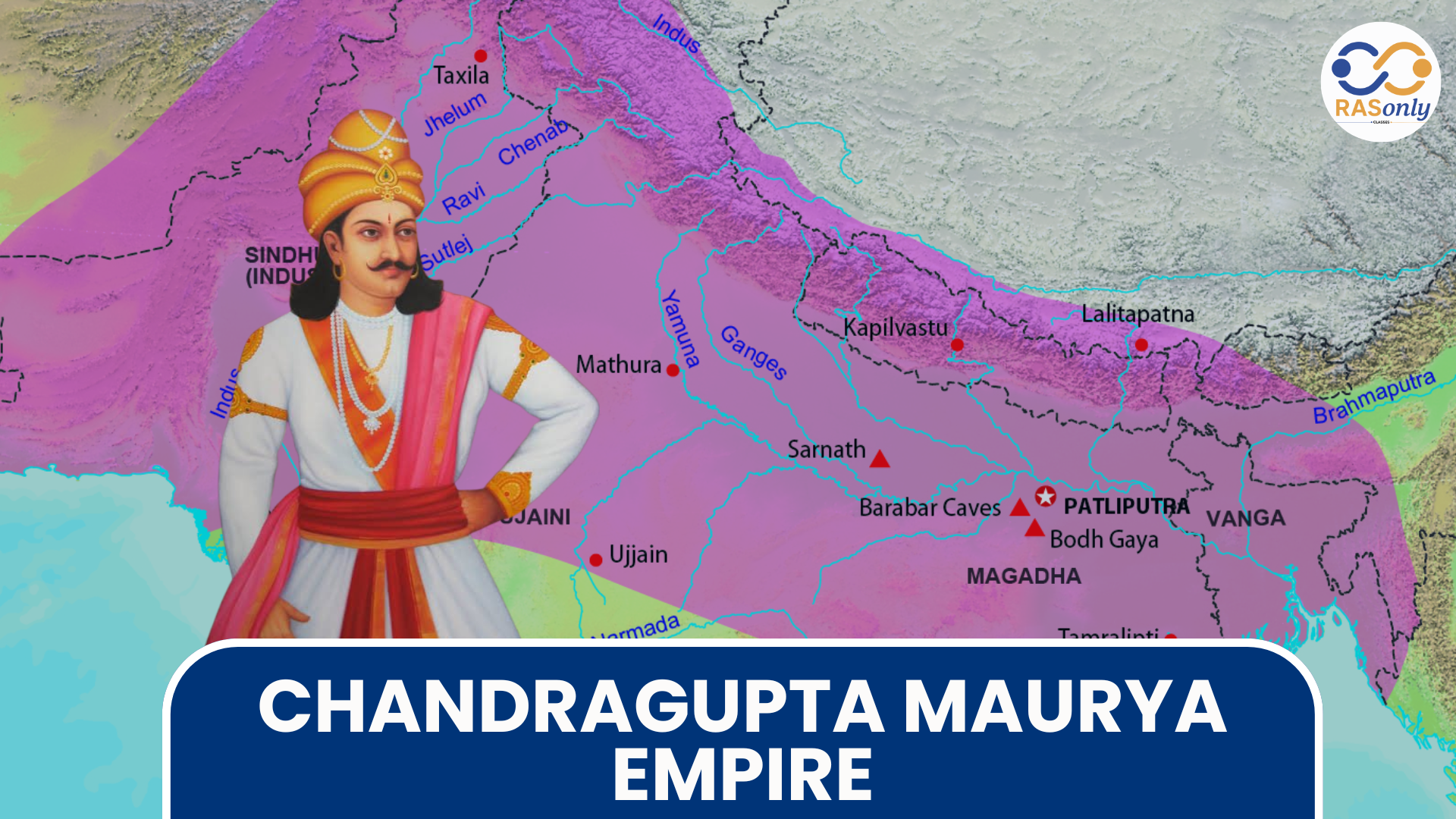
The Maurya empires one of the most powerful and influential empires in ancient Indian history. It was founded by Chandragupta Maurya around 322 BCE with Pataliputra as its political centre. The Mauryas consolidated a large part of the Indian subcontinent under a strong centralised administration and established an efficient system of government, taxation and military control. The most significant development in the dynasty was the reign of Emperor Ashoka, who is most notable for his Dhamma policy, Buddhist patronage and rock and pillar edicts, as well as the Kalinga war. During the Mauryan period, in addition to gradual advances in science and astrology, significant contributions were made in fields of art, architecture, trade and administration and diplomacy.
Foundation of the Maurya Empire
Magadha had political significance as well, which was closely associated with the rise of the Mauryas. After overthrowing the Nanda rulers, Chandragupta Maurya ruled the empire with a new imperial dynasty of his own.
Rise of Chandragupta Maurya
- The Maurya dynasty was started by Chandragupta Maurya in 322 BCE.
- He made himself master of Magadha.
- Pataliputra was the capital of the Mauryan kingdom.
- Mauryan rule spread in India little by little into the northern regions.
- Chanakya/Kautilya is usually credited with its emergence.
Role of Chanakya
Another name for Chanakya is Kautilya or Vishnugupta.
He is traditionally considered the political advisor of Chandragupta.
He has a nexus with the Arthashastra.
The text discusses:
- Administration
- Economy
- Diplomacy
- Military organisation
- Espionage
- Statecraft
Chandragupta Maurya
Chandragupta Maurya made Magadha the basis of a large empire. His reign is also significant with regard to the relationship between the Mauryans and the Hellenistic world.
Expansion of Chandragupta Maurya.
- Chandragupta ruled most of the northern parts of India.
- He added to the strength of Magadha's political power.
- He ruled the north-western area.
- Under the Mauryan state, strong administrative and army organisation was established.
Chandragupta and Seleucus
- Seleucus I Nicator was a successor of Alexander the Great.
- Chandragupta came into conflict with Seleucus over territories in the north-west.
- This ended in a compromise between the two rulers.
- Later, there was a diplomatic exchange between the Hellenistic and Mauryan worlds.
Chandragupta and Jainism
- Chandragupta has been associated with Jainism in his later life in the Jain Tradition.
- It is customary to associate him with Bhadrabahu, a Jain teacher.
- At the end of his life, he is associated with Shravanabelagola in Karnataka.
Bindusara
After Chandragupta, Bindusara followed the imperial tradition of the Mauryas. This reign is significant in terms of comprehending the consolidation of the empire before Ashoka.
Reign of Bindusara
- Bindusara was followed to the throne by Chandragupta Maurya.
- He expanded and consolidated the Empire.
- According to Greek sources, he's known simply as Amitrochates.
- He kept in contact with the Hellenistic world.
- Ashoka succeeded Bindusara.
Ashoka
Ashoka was the most popular Mauryan king. His reign is particularly relevant in view of his inscriptions, the Kalinga War as well as the evolution of his ‘Dhamma Policy'.
Reign of Ashoka
- Ashoka was emperor between 268 and 232 BCE.
- Under his rule, the Mauryan Empire was at its peak.
- The inscriptions are important sources for his reign.
- He preached Dhamma by means of inscriptions and administration.
Kalinga War
- The Kalinga War was in 261 BCE.
- The region that Kalinga was related to is all over Odisha and nearby areas in the present time.
- Many people died and were injured during the war.
- Ashoka expressed regret for the repercussions.
- There are some edicts of significant importance for this event, in particular Major Rock Edict XIII.
Ashoka's Dhamma
Ashoka's Dhamma was a moral code for harmonious and responsible social behaviour.
- Respect for parents and elders.
- Loving kindness towards animals
- Generosity
- Self-control
- Slavery was treated well, if practised at all
- Policymaking and understanding of religious diversity
- The fostering of harmony among all living things.
Mauryan Administration
Mauryan Empire was spread geographically and had to have a powerful administration. The king continued to be the most important authority and had a large group of ministers and others working with him.
Central Administration
The highest position of honour was held by the king.
The rulers were supported by ministers and advisers.
An official's duties included:
- Revenue
- Justice
- Military affairs
- Public works
- Trade
- Law and order
Provincial Administration
The empire was governed by 'sectors' or important administrative regions of its extensive territory.
- Taxila: north-western centre
- Ujjain: western centre
- Tosali: eastern centre
- Suvarnagiri: southern centre
Important Mauryan Officials
Mahamatras
- Senior administrative officials.
- They had different jobs depending on their work location.
Dhamma Mahamatras
- Carrying the values of Ashoka's policy of Dhamma.
- Built up: Welfare and ethical administration.
Rajukas
- Important administrative officials.
- They were in charge of government and law enforcement.
Yuktas
- Staff who were responsible for administration and documentation duties.
Mauryan Economy
The main economic activities of the Mauryans were agriculture, trade, craft and mining; there were also forests.
Agriculture and Revenue
- The main economic base was agriculture.
- Land revenue was a major source of the state's revenue.
- The people and the government were supported by irrigation and agricultural activities.
Trade and Commerce
Major centres included:
- Pataliputra
- Taxila
- Ujjain
- Internal and long-distance trade connected different parts of the empire.
- Important activities included:
- Textile production
- Metalworking
- Handicrafts
- Mining
- Trade
Mauryan Coinage
- Coins were very commonly punched.
- Typically, multiple symbols were used on a coin.
- They helped with trade.
Mauryan Military System
To conquer and maintain a vast empire, the Mauryans needed the services of a massive army.
Main Components of the Army
- Infantry
- Cavalry
- Chariots
- War elephants
Importance of the Military
- Expansion of the empire
- Defence of territories
- Strategic regions' command.
- To protect essential travel routes.Protection of key travel corridors.
- Ensuring political stability.
Mauryan Art and Architecture
Stonework, pillars, sculptures, stupas and rock-cut caves are the special features of Mauryan art.
Ashokan Pillars
- During the reign of Ashoka, large stone Pillars were erected.
- Numerous pillars included royal inscriptions.
- They are well-known for their fine-grained sandstones and are so dubbed.
- A few pillars were topped with animal capitals.
Lion Capital of Sarnath
- One of the most well-known works of Mauryan architecture is the lion's capital.
- Has four lions standing side by side.
- There are animal figures and a Dharmachakra shown on the abacus.
- This became the State Emblem of India.
Barabar Caves
- Located in Bihar.
- One of the earliest examples of rock-cut architecture found in India.
- There were several caves that were connected to the Ajivikas.
- The inside is well known for its polished surfaces.
Sanchi
- In Madhya Pradesh, India.
- The initial major period of the Great Stupa is related to the Mauryan era.
- There are additional periods of additions to the monument.
Ashokan Inscriptions
Ashoka's inscriptions are amongst the most important sources of primary information. They teach us "directly" about his policies, administration and Dhamma.
Major Rock Edicts
- Large rocks that are engraved.
- Talk about moral behaviour, government and Dhamma.
- The Kalinga War has been stressed in Major Rock Edict XIII.
Pillar Edicts
- Cut in stone posts.
- Discuss issues relating to Ashoka's administration and Ashoka's Dhamma.
- These help to understand the governance of the Mauryan rulers.
Scripts used by Ashoka.
- Brahmi: common in much of the empire.
- Kharosthi: mainly used in the north-west.
- Greek and Aramaic: some inscriptions in the north-western part.
Maski Inscription
- Fearing abolition, it was shifted to Karnataka in modern times.
- Ashoka's name appears here.
- Of significant value in the identification of Ashoka as the ruler known as Devanampiya Piyadasi by names in several inscriptions.
Buddhism During the Mauryan Period
World-renowned Buddhist art was fostered during Ashoka's reign and was especially patronised by the king himself. He implemented policies that have inspired the growth of Buddhist institutions and the dissemination of Buddhism generally.
Ashoka and Buddhism
- Ashoka joined the Buddhist fold and became an important patron.
- According to the Buddhist traditions, his reign was connected with the Third Buddhist Council.
- The council was the usual residence of the council at Pataliputra.
- Moggaliputta Tissa is connected with the council.
Spread of Buddhism
- Buddhist emissaries used to be dispatched to diverse parts of the country.
- There is a connection between Mahinda and the introduction of Buddhism into Sri Lanka.
- It is the tradition in Sri Lanka to tie Sanghamitta to the tradition of the Bodhi Tree.
- Buddhist monuments and institutions were sponsored by Ashoka.
Maurya Empire and Foreign Relations
Political and diplomatic relations existed between the Mauryan Empire and other kingdoms outside India, including Hellenistic kingdoms.
Relations with Hellenistic Kingdoms
Chandragupta made contact with Seleucus I Nicator.
Megasthenes went to the Court of the Mauryas.
Hellenistic kings are referred to in Ashoka's inscriptions.
List of those who appear to be Hellenistic rulers mentioned by Ashoka.
- Antiochus
- Ptolemy
- Antigonus
- Magas
- Alexander
Sources of Mauryan History
Historical facts about the Mauryans are obtained from literary, epigraphic and archaeological sources. There isn't a single source for the full history of the empire.
Arthashastra
Common at Kautilya's time.
Deals with:
- Statecraft
- Administration
- Economy
- Diplomacy
- Military affairs
Indica
Associated with Megasthenes.
Provides information about:
- Pataliputra
- Society
- Administration
- Economy
- Military organisation
Ashokan Inscriptions
Direct evidence from Ashoka's times.
Important for understanding:
- Dhamma
- Administration
- Welfare
- Kalinga War
- Religious policy
Archaeological Evidence
- Pillars
- Stupas
- Rock-cut caves
- Sculptures
- Coins
- Urban remains
- Inscriptions
Mauryan Empire in Rajasthan
The town of Nandivil, to the extent of its burials, is also important evidence in reference to Mauryan times. Bairat is an important site for the preparation of rasas.
Bairat and the Bhabru Edict
- Bairat is also called Viratnagar that is located in Rajasthan state.
- It can be found in the same Edict of Ashoka related to Bhabru.
- The inscription is significant due to its relationship with the Buddhist teachings.
- So the site ‘Bairat' is of significance in the arena of ‘Rajasthan Art, Culture & Ancient History'.
The fall or end of the Maurya Empire.
After the death of Ashoka, the Mauryan Empire started decaying. The decrease was a slow overall decrease, and not an abrupt, one-sided drop in consumption.
Causes of Decline
- Weakening of central authority
- Less powerful successors
- The inability to govern a vast empire fluidly.A challenge to manage the huge empire smoothly.
- Increasing autonomy of provincial regions
- Admin and political issues
- Failure of imperial governing authority in outlying areas
- End of the Maurya Dynasty
- Brihadratha is the last of the Mauryans.
- He was crowned by Pushyamitra Shunga in 185 BCE.
- Pushyamitra started the Shunga dynasty.
- This marked the end of the Mauryan Empire.
Maurya Empire - FAQs
Chandragupta Maurya founded the Maurya Empire around 322 BCE.
Pataliputra was the principal imperial capital.
Chanakya, also known as Kautilya or Vishnugupta, is traditionally associated with Chandragupta Maurya and the Arthashastra.
Megasthenes was a Greek ambassador associated with the Mauryan court.
He wrote Indica.
Ashoka fought the Kalinga War around 261 BCE.

BEST SELLER
🏆 PRELIMS
RAS Pass
Prelims focused Hindi & English
₹399
✓
Prelims Topic-Wise Tests
✓
Subject-Wise Tests
✓
Full-Length Prelims Tests
✓
Daily Current Affairs Tests
✓
Prelims PYQs Tests
✓
Detailed Solutions & Analysis
✓
All Rajasthan Ranking
✓
Unlimited Reattempts
✓
Mains Tests
✓
Hindi & English Tests
✓
All Rajasthan Ranking
Trusted by 5,000+ Students
Post Category
- RAS Salary
- Result
- RAS Admit Card
- RAS Job
- RAS Cutoff
- Preparation Tips
- RAS Answer Key
- RAS Exam Analysis
- RAS Syllabus
- RAS Previous Year Papers
- RPSC RAS Exam Pattern
- RAS Interview
- RAS Exam Date
- RAS Vacancy
- RAS Test Series
- RAS Best Books
- RAS Preparation Resources
- RAS Coaching Centre
- History
- Polity
- Geography
- Economics
- Science
- Art and Culture
- RPSC RAS Application Form
- RPSC RAS Notification
- RAS Eligibility Criteria
- UPSC Exam
- RPSC RAS Mains
Visit Our RASonly Offline Center
Our Expert Faculty

Bhunesh Sir
Current Affairs · 13+ Yrs

Aamir Khan Sir
RAS-2017 · IIM Ahm.

Akash Sir
Polity · 8+ Yrs
Free Resources
Official Mobile App

RASOnly App
by OTSAdda · Free
Full Video Lectures
Mock Tests & PYQs
Daily Current Affairs
AI Mock Interview
Free Download · No subscription needed to install
RAS 2024 Toppers — RASonly
Rank 2
Virendra Charan
Rank 9
Bhoopinder Singh
Rank 26
Aanchal Nagpal
Rank 33
Lokendra Singh
Rank 45
Amar Rathore
Rank 46
Manasvini Verma

Join RASonly WhatsApp Community
Get daily current affairs, exam alerts, free study material and tips from expert faculty — right on WhatsApp.
Join for Free →RASonly Interview Guidance Program

Mr. Ashok Jain
Ex-Chief Secretary Govt of Rajasthan
- IAS officer of the 1981 batch, Rajasthan cadre.
- Passionate about mentoring the next generation of RAS officers with real-world insights.
- Got retired in Dec 2017 from the post of Chief Secretary of the state of Rajasthan.

Mr. Guru Charan Rai
Ex-ASP / SP in Jaisalmer
- Guru Charan Rai, IPS (Retd), retired as Inspector General of Police (Security), Rajasthan, Jaipur in 2017.
- Served as ASP and SP in Jaisalmer, Nagaur, Sri Ganganagar, Sawai Madhopur, Dausa, Sikar, and Karauli.
- He also held key positions as DIGP and IGP in the Law and Order division.

Mr. Rakesh Verma
Ex-IAS Officer, B.Tech, MBA, and M.A. (Economics)
- IAS officer of the 1981 batch and retired in Chief Secretary Rank.
- Civil servant of high repute and vast experience.
- Has been teaching UPSC CSE subjects for the last six years.
Related Post
Daily Current Affairs for RAS Exam Preparation 2026
Kundan Art Display in Hong Kong
October 23, 2026
Rajasthan International Folk Festival 2026
October 23, 2026
Inauguration of 100 New Kalika Patrolling Units in Rajasthan
October 21, 2026