Chola Dynasty: Capital, Founder, Kings, Time Period and History
Wildlife Conservation in Rajasthan - RAS Exam Notes

Get in Touch with RASonly!

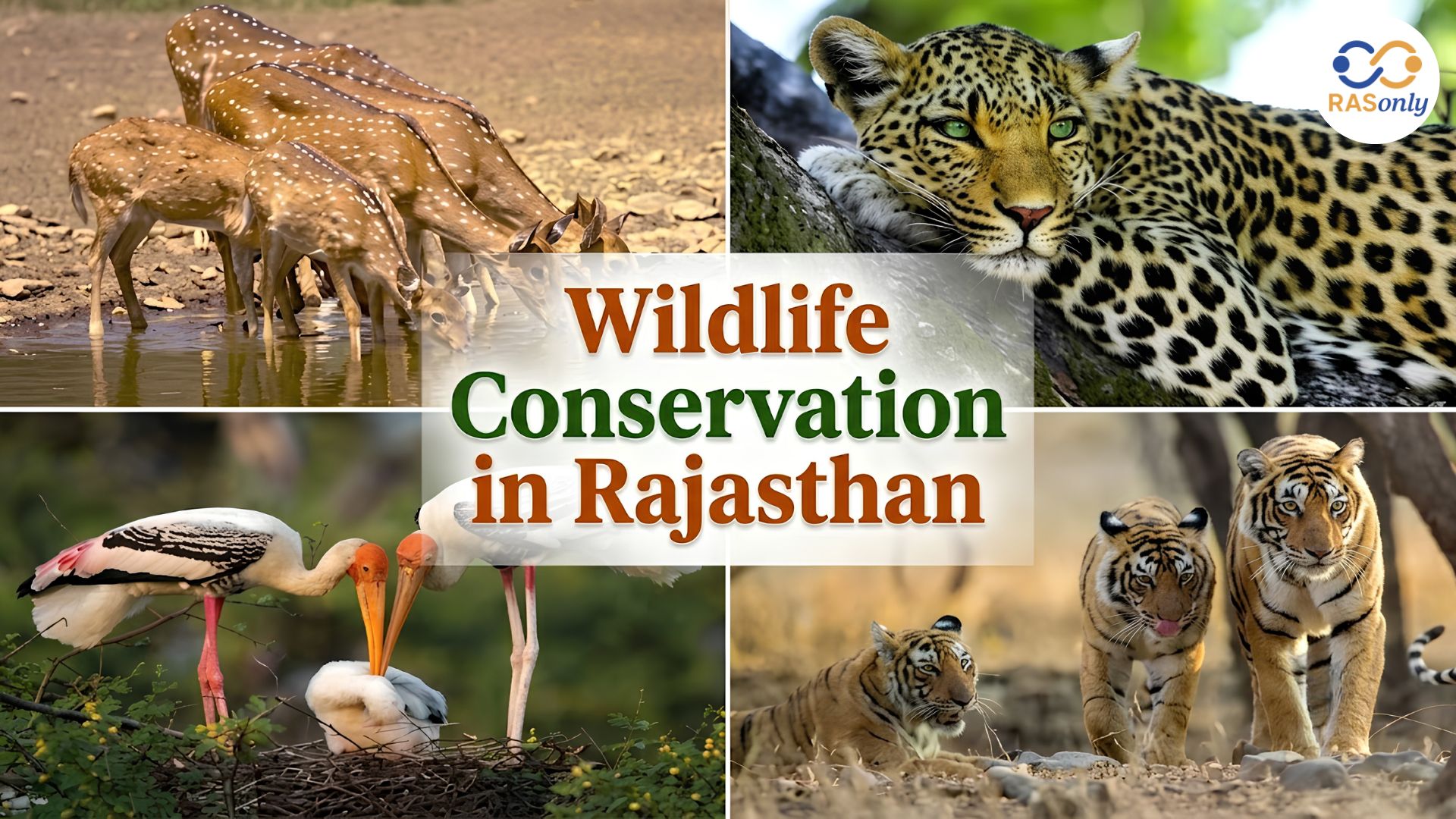
Wildlife conservation in Rajasthan stands at the intersection of ecology, policy, and administration, making it a crucial topic for RAS aspirants. From the tiger-rich forests of Ranthambore to the desert habitat of the Great Indian Bustard, the state's protected areas reflect decades of conservation planning. These detailed notes cover key facts, endangered species, government schemes, and analytical frameworks needed to write strong, exam-ready answers on this important environment and ecology topic.

Introduction
- Rajasthan is India's largest state by area (approx. 3.42 lakh sq. km), covering diverse ecological zones - Thar Desert, Aravalli hill range, and semi-arid plains.
- This geographical diversity gives Rajasthan a unique range of habitats, supporting species adapted to extreme heat, aridity, and rocky terrain.
- Wildlife conservation in Rajasthan is significant not just ecologically but also from an administrative and policy standpoint, since the state hosts several nationally and internationally important protected areas.
- Total protected area network: National Parks + Wildlife Sanctuaries + Tiger/Conservation Reserves - covering roughly 9-10% of the state's geographical area.
Possible exam angle: "Discuss the ecological significance of Rajasthan's geographical diversity for wildlife conservation." (This kind of question tests both geography + environment linkage.)
Protected Areas of Rajasthan (Key Facts Table)
| Protected Area | Category | District | Established | Key Species |
|---|---|---|---|---|
| Ranthambore National Park | National Park + Tiger Reserve | Sawai Madhopur | 1980 (NP); 1973 (Project Tiger) | Tiger, Leopard, Sloth Bear |
| Sariska Tiger Reserve | Tiger Reserve | Alwar | 1978 | Tiger, Chital, Sambar |
| Mukundra Hills Tiger Reserve | Tiger Reserve | Kota, Bundi & Chittorgarh | 2013 | Tiger, Panther, Hyena |
| Keoladeo National Park | National Park (Wetland, UNESCO Site) | Bharatpur | 1982 | Siberian Crane, Migratory Birds |
| Desert National Park | National Park | Jaisalmer & Barmer | 1980 | Great Indian Bustard, Desert Fox |
| Tal Chhapar Sanctuary | Wildlife Sanctuary | Churu | 1962 | Blackbuck |
| Mount Abu Wildlife Sanctuary | Wildlife Sanctuary | Sirohi | 1960 | Leopard, Sloth Bear |
| Kumbhalgarh Wildlife Sanctuary | Wildlife Sanctuary | Rajsamand & Udaipur | 1971 | Wolf, Leopard |
| Jaisamand Sanctuary | Wildlife Sanctuary | Udaipur | 1957 | Panther, Chital |
Note for exam: Ranthambore, Sariska, and Mukundra Hills are Rajasthan's three tiger reserves - this is a frequently asked fact.
Sub-points to remember:
- Sariska is historically important because it was the first reserve in the world to successfully relocate tigers after local extinction (tigers had gone locally extinct here in 2004, later reintroduced in 2008 from Ranthambore).
- Keoladeo National Park is a UNESCO World Heritage Site (declared in 1985) and internationally recognized under the Ramsar Convention as a wetland of international importance.
- Desert National Park is one of the largest national parks in India, spread across Jaisalmer and Barmer districts, and is critical habitat for the Great Indian Bustard.
Endangered Species of Rajasthan (Exam-Critical Section)
| Species | IUCN Status | Habitat in Rajasthan | Key Conservation Program |
|---|---|---|---|
| Great Indian Bustard | Critically Endangered | Desert National Park (Jaisalmer) | Project Great Indian Bustard / Bustard Recovery Programme |
| Bengal Tiger | Endangered | Ranthambore, Sariska, Mukundra Hills | Project Tiger |
| Indian Wolf | Near Threatened | Nagaur, Jodhpur, and Bikaner belt | Habitat Protection under State Wildlife Plans |
| Vulture (Multiple Species) | Critically Endangered | Various Districts | Vulture Conservation Breeding Centres |
| Chinkara | Least Concern (Locally Pressured) | Widespread in Desert Areas | State-level Protection under the Wildlife Protection Act |
| Sloth Bear | Vulnerable | Mount Abu, Kumbhalgarh | Habitat Corridors and Anti-poaching Patrols |
Great Indian Bustard - Important for Exam
- Also called "Godawan" in local language; declared the State Bird of Rajasthan.
- Population has declined drastically - fewer than 150 individuals estimated in the wild (majority in Rajasthan).
- Major threat: collision with overhead power transmission lines of solar/wind energy projects in the Thar region.
- Supreme Court has intervened on this issue, directing installation of bird diverters and consideration of underground cabling in bustard habitats.
- Conservation breeding facility established near Sam, Jaisalmer, in collaboration with the Wildlife Institute of India (WII).
Possible exam question: "Examine the conflict between renewable energy development and wildlife conservation in western Rajasthan, with reference to the Great Indian Bustard."
Major Conservation Programs and Government Initiatives
| Program/Scheme | Focus Area | Level |
|---|---|---|
| Project Tiger (1973) | Tiger Conservation | Central |
| Project Elephant | Not directly applicable to Rajasthan, but relevant for comparative questions | Central |
| Bustard Recovery Programme | Great Indian Bustard Conservation | State + Central (WII Collaboration) |
| Vulture Conservation Breeding Programme | Vulture Species Conservation | State + NGO Partnership |
| Eco-Development Committees (EDCs) | Community-based Forest Management | State |
| Joint Forest Management (JFM) | Community Participation in Forest Protection | State |
| Van Dhan Yojana | Livelihood Generation for Forest-dependent Communities | Central (Tribal-linked) |
Key Points:
- The Rajasthan Forest Department, under the Ministry of Environment, Forest and Climate Change (MoEFCC) guidelines, implements most of these schemes at the state level.
- Camera trapping and periodic wildlife census are standard monitoring tools used across tiger reserves.
- Compensation schemes exist for farmers/villagers facing crop damage or livestock loss due to wildlife, aimed at reducing retaliatory killing.
Threats to Wildlife Conservation (Analytical Section)
| Threat | Explanation | Affected Species/Areas |
|---|---|---|
| Habitat Fragmentation | Mining, agriculture, and infrastructure development disrupting forest corridors | Tiger corridors between Ranthambore, Kuno, and Mukundra |
| Poaching | Illegal hunting for skin, bones, and other wildlife products | Tigers, Chinkara |
| Human-Wildlife Conflict | Crop damage and livestock loss in villages near protected areas | Sariska and Ranthambore buffer zones |
| Water Scarcity | Limited natural water availability due to Rajasthan's arid climate | Desert species, especially during summer |
| Renewable Energy Infrastructure | Power transmission lines causing bird collisions and mortality | Great Indian Bustard and other avian species |
| Tourism Pressure | Unregulated tourist activities disturbing wildlife in core conservation zones | Ranthambore National Park |
Analytical Note for Answer-Writing:
When answering questions on threats, always structure your answer as:
- Anthropogenic threats (human-caused: poaching, habitat loss, conflict)
- Developmental threats (infrastructure, renewable energy, tourism)
- Environmental/climatic threats (water scarcity, climate change)
This three-part classification is useful for scoring well in analytical/GS-type questions.
Community Participation and Eco-Tourism
- Eco-tourism in reserves like Ranthambore generates significant revenue, part of which is channelled back into conservation and local employment.
- Joint Forest Management (JFM) committees involve local villagers directly in protecting forest resources, reducing dependency-based exploitation.
- Local communities are increasingly engaged as nature guides, safari drivers, and forest watchers, creating an economic stake in conservation success.
- Awareness programs in schools near protected areas help build long-term conservation consciousness among younger generations.
Legal and Institutional Framework (Quick Reference)
| Law/Body | Relevance |
|---|---|
| Wildlife Protection Act, 1972 | Primary legal framework for species and habitat protection in India |
| Forest (Conservation) Act, 1980 | Regulates diversion of forest land for non-forest use |
| Rajasthan Forest Department | State-level implementing authority for wildlife and forest conservation |
| National Tiger Conservation Authority (NTCA) | Oversees tiger reserves, including Ranthambore, Sariska, and Mukundra Hills |
| Wildlife Institute of India (WII) | Technical and research partner for wildlife conservation and species recovery programmes |
Way Forward - Key Points for Conclusion in Answers
- Strengthen wildlife corridors connecting fragmented habitats (e.g., Ranthambore-Kuno-Mukundra corridor).
- Balance renewable energy expansion with wildlife-sensitive planning (underground cabling, bird diverters).
- Expand community-based conservation models with stronger compensation and livelihood linkages.
- Increase funding and technology use (camera traps, GPS collaring) for real-time monitoring.
- Focus on species-specific recovery programs, especially for critically endangered species like the Great Indian Bustard and vultures.
Quick Revision Points (One-Liners)
- Rajasthan has 3 tiger reserves: Ranthambore, Sariska, Mukundra Hills.
- Keoladeo National Park - UNESCO World Heritage Site + Ramsar wetland.
- Desert National Park - critical habitat for Great Indian Bustard.
- State animal: Chinkara; State bird: Great Indian Bustard (Godawan).
- Sariska - first tiger reintroduction success story in India.
- Great Indian Bustard population - critically low, major threat from power lines.
- Key legal framework - Wildlife Protection Act, 1972.
- Key monitoring body for tigers - National Tiger Conservation Authority (NTCA).
Practice Questions for Self-Assessment
- Discuss the major wildlife conservation efforts undertaken in Rajasthan, highlighting their achievements and limitations. (250 words)
- "The expansion of renewable energy infrastructure in Rajasthan poses a direct threat to its wildlife." Critically examine this statement with reference to the Great Indian Bustard. (200 words)
- Explain the role of community participation in wildlife conservation, citing examples from Rajasthan. (150 words)
- Write short notes on: (a) Sariska Tiger Reserve (b) Desert National Park (c) Keoladeo National Park.
Important Links
Conclusion
Wildlife conservation in Rajasthan remains a dynamic and evolving subject, blending ecological urgency with administrative strategy. From flagship successes like tiger reintroduction in Sariska to ongoing struggles to save the Great Indian Bustard, the state offers a rich case study for understanding India's broader conservation challenges. For RAS aspirants, mastering the facts, schemes, and analytical frameworks covered in these notes will help build well-rounded, exam-ready answers on environment and ecology questions. Regular revision of key facts - protected areas, species status, and government initiatives - combined with practice answer-writing, will strengthen both conceptual clarity and exam performance on this consistently important topic.
FAQs
Rajasthan has three tiger reserves - Ranthambore Tiger Reserve, Sariska Tiger Reserve, and Mukundra Hills Tiger Reserve.
Keoladeo National Park in Bharatpur is a UNESCO World Heritage Site and is also recognized as a Ramsar wetland of international importance.
The Great Indian Bustard is critically endangered, with fewer than 150 individuals left in the wild, mostly found in the Desert National Park region of Jaisalmer.
The Wildlife Protection Act, 1972 serves as the primary legal framework governing species and habitat protection across Rajasthan and the rest of India.
Sariska is historically significant as it became the first reserve in the world to successfully relocate tigers after local extinction, with reintroduction completed in 2008.

BEST SELLER
🏆 PRELIMS
RAS Pass
Prelims focused Hindi & English
₹399
✓
Prelims Topic-Wise Tests
✓
Subject-Wise Tests
✓
Full-Length Prelims Tests
✓
Daily Current Affairs Tests
✓
Prelims PYQs Tests
✓
Detailed Solutions & Analysis
✓
All Rajasthan Ranking
✓
Unlimited Reattempts
✓
Mains Tests
✓
Hindi & English Tests
✓
All Rajasthan Ranking
Trusted by 5,000+ Students
Post Category
- RAS Salary
- Result
- RAS Admit Card
- RAS Job
- RAS Cutoff
- Preparation Tips
- RAS Answer Key
- RAS Exam Analysis
- RAS Syllabus
- RAS Previous Year Papers
- RPSC RAS Exam Pattern
- RAS Interview
- RAS Exam Date
- RAS Vacancy
- RAS Test Series
- RAS Best Books
- RAS Preparation Resources
- RAS Coaching Centre
- History
- Polity
- Geography
- Economics
- Science
- Art and Culture
- RPSC RAS Application Form
- RPSC RAS Notification
- RAS Eligibility Criteria
- UPSC Exam
- RPSC RAS Mains
Visit Our RASonly Offline Center
Our Expert Faculty

Bhunesh Sir
Current Affairs · 13+ Yrs

Aamir Khan Sir
RAS-2017 · IIM Ahm.

Akash Sir
Polity · 8+ Yrs
Free Resources
Official Mobile App

RASOnly App
by OTSAdda · Free
Full Video Lectures
Mock Tests & PYQs
Daily Current Affairs
AI Mock Interview
Free Download · No subscription needed to install
RAS 2024 Toppers — RASonly
Rank 2
Virendra Charan
Rank 9
Bhoopinder Singh
Rank 26
Aanchal Nagpal
Rank 33
Lokendra Singh
Rank 45
Amar Rathore
Rank 46
Manasvini Verma

Join RASonly WhatsApp Community
Get daily current affairs, exam alerts, free study material and tips from expert faculty — right on WhatsApp.
Join for Free →RASonly Interview Guidance Program

Mr. Ashok Jain
Ex-Chief Secretary Govt of Rajasthan
- IAS officer of the 1981 batch, Rajasthan cadre.
- Passionate about mentoring the next generation of RAS officers with real-world insights.
- Got retired in Dec 2017 from the post of Chief Secretary of the state of Rajasthan.

Mr. Guru Charan Rai
Ex-ASP / SP in Jaisalmer
- Guru Charan Rai, IPS (Retd), retired as Inspector General of Police (Security), Rajasthan, Jaipur in 2017.
- Served as ASP and SP in Jaisalmer, Nagaur, Sri Ganganagar, Sawai Madhopur, Dausa, Sikar, and Karauli.
- He also held key positions as DIGP and IGP in the Law and Order division.

Mr. Rakesh Verma
Ex-IAS Officer, B.Tech, MBA, and M.A. (Economics)
- IAS officer of the 1981 batch and retired in Chief Secretary Rank.
- Civil servant of high repute and vast experience.
- Has been teaching UPSC CSE subjects for the last six years.
Related Post




Daily Current Affairs for RAS Exam Preparation 2026

Ustad Bismillah Khan Yuva Puraskar
October 24, 2026
Marwar Festival 2026
October 24, 2026
Kundan Art Display in Hong Kong
October 23, 2026