UPSC Mains Result 2026 Out: Download PDF, Selection List, Cut Off & Interview Details
Best Optional Subject for RAS: Which One to Choose?

Get in Touch with RASonly!

Learn whether RAS 2026 has an optional subject and understand the latest RPSC RAS Mains exam pattern. Explore compulsory papers, Rajasthan-specific topics, answer writing, current affairs integration, and practical preparation strategies to improve your performance in the examination.

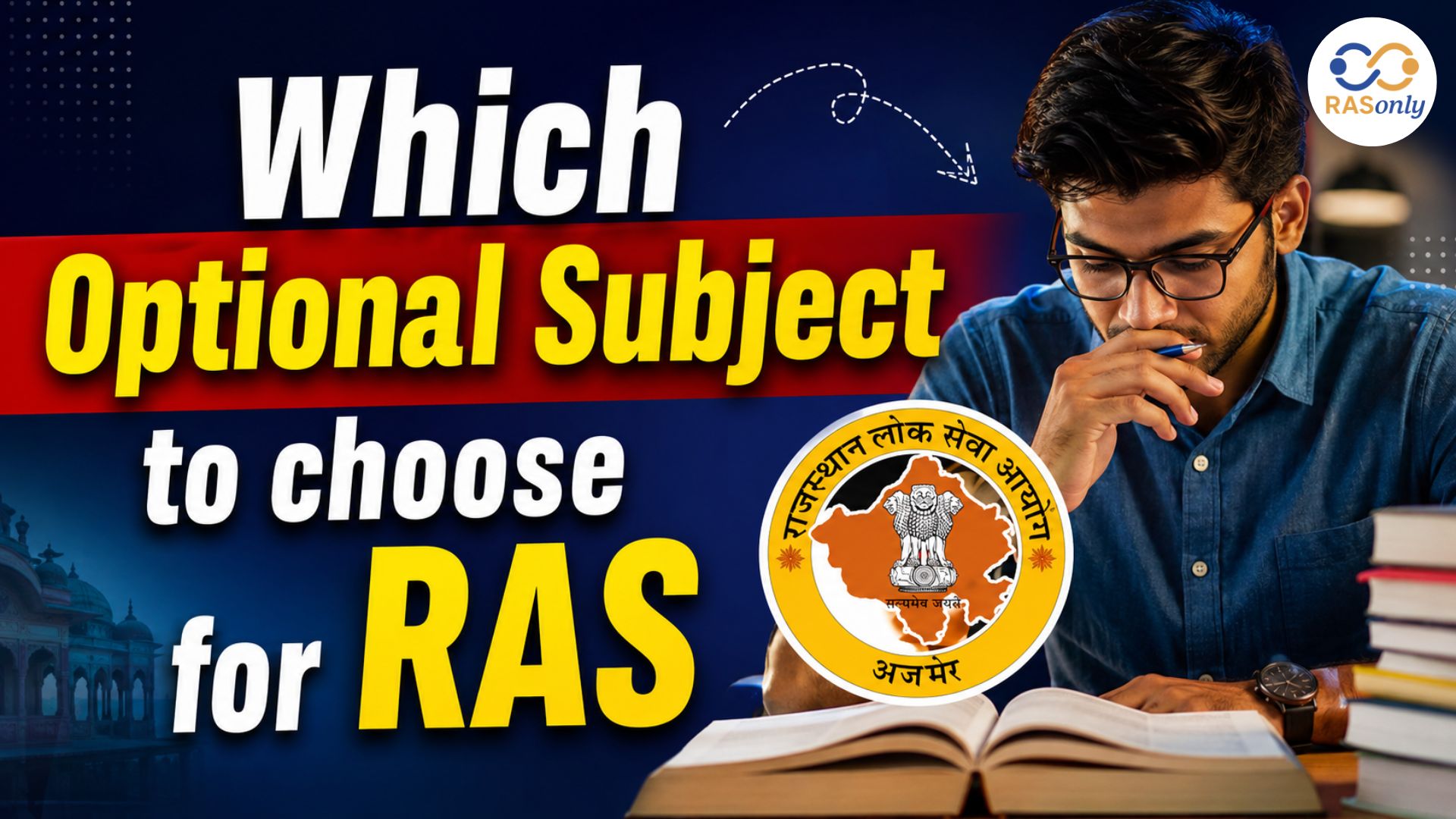
Among all the topics searched by Rajasthan Administrative Service aspirants, Best optional is one of the major queries that will save you months of misdirected effort, and the answer is honest. In the current RPSC scheme, there will be no optional paper in the RAS Mains as such, meaning that there is no subject to be selected. The exam is decided by depth in the General Studies and not by a subject chosen by the candidate; whether he is from Arts, Science, Commerce or Engineering, each candidate has to write four papers of descriptive type.
So there's the confusion that many older blogs, coaching pages, and videos still refer to candidates taking subjects like Public Administration, Sociology, or Geography. Those resources are outdated and can lead one to a wrong preparation plan. This guide covers the latest pattern, what it is, what the papers are really about, and how you should utilize your time if you were to have an optional subject in RAS 2026.
Does RAS Mains Have an Optional Subject?
No. RPSC conducts the RAS Mains as four compulsory papers, and there is no optional subject for RAS candidates to select. All four papers are marked in the final merit; none may be left out or treated lightly as a formality. Your selection depends on how well you cover the common syllabus and present your answers.
RAS Exam Pattern 2026 at a Glance
The RAS selection process has three stages: Prelims, Mains, and Interview. The marks of Prelims are only for screening purposes, and the final merit is created by the Mains and Interview marks. Knowing which stage counts toward your rank helps you divide your effort sensibly.
| Paper | Subject | Marks | Duration |
|---|---|---|---|
| Paper I | General Studies I | 200 | 3 Hours |
| Paper II | General Studies II | 200 | 3 Hours |
| Paper III | General Studies III | 200 | 3 Hours |
| Paper IV | General Hindi and General English | 200 | 3 Hours |
RAS Mains Paper Structure
The Mains has four papers of 200 marks each, and each paper is three hours long. Three papers are General Studies, and the fourth tests language skills. All papers are compulsory, and it is more important to be well prepared across papers than to be perfect in one.
| Stage | Nature | Marks | Counted in Final Merit? |
|---|---|---|---|
| Prelims | Objective, 150 questions, 3 hours, 1/3 negative marking | 200 | No (Screening Only) |
| Mains | 4 Compulsory Descriptive Papers | 800 | Yes |
| Interview | Personality Test | 100 | Yes |
| Final Merit | Mains + Interview | 900 |
Always cross-check the paper-wise syllabus on the official RPSC website, as the Commission’s notification overrides any third-party summary.
Why Aspirants Still Search for an Optional Subject for RAS
In previous exam patterns, there were papers to be chosen from, and the explanation for those papers was never taken off the Internet. After reading about the UPSC, aspirants who have an optional subject (which gets 500 marks) often think the state exam is similar. These patterns are combined, resulting in redundant preparation.
- Old blog posts and videos still list optional subjects and “highest scoring” choices.
- UPSC preparations are not tested and used for RAS.
- Some coaching pages are not updated after RPSC revises its scheme.
- The word of the year is seldom included in social media tips.
What to Focus on Instead of an Optional Subject for RAS
There is no paper for specialisation, and therefore, the result depends on three factors: up-to-date knowledge of the GS syllabus, quality of writing of answers, and a robust paper in Hindi and English. The sections below show where your time gives the best returns.
Rajasthan-Specific Preparation
Questions on the state’s history, art, culture, geography, economy, and administration are a defining feature of RAS. This content is rarely required in other examinations, and therefore, if you are well prepared, you really have an advantage over students preparing only on national topics.
- Rajasthan history, art, culture and heritage
- Geography and economy of the state
- Panchayati Raj and local administration
- Government schemes and current developments in Rajasthan
- Important personalities and literature of Rajasthan
Answer Writing Practice
RAS Mains is a Descriptive Test and may be evaluated differently between two candidates who know the same thing due to presentation. Daily answer-writing enhances speed, structure, and clarity. Pay attention to the question demand and match your depth to the marks and word count.
- Start with a short, relevant introduction.
- Cover every part of the question in a logical order.
- Use headings, points, and examples (particularly from Rajasthan).
- Close with a balanced conclusion.
Integrating Current Affairs with Static Topics
Current affairs should not be studied as a separate subject. When you refer to recent events, your answers will be more analytical and demonstrate the examiner's awareness of the practicality of concepts.
- Link economic news with the Indian and Rajasthan economy.
- Use environmental developments to support ecology answers.
- Connect new government schemes to governance questions.
- Note state-level developments for Rajasthan-based answers.
Governance and Constitutional Knowledge
In addition to being important in the Mains, polity, governance and public administration also have a role to play during the interview. The purpose of provisions is to grasp their function in practice, rather than to memorise articles.
- Fundamental Rights and Directive Principles
- Constitutional bodies and the State Government
- Local self-government and administrative reforms
- Social justice and public policy
General Hindi and General English Paper
Paper IV is the same 200-mark paper as the other General Studies papers, but is heavily overlooked. Those who develop and master grammar, comprehension, translation, and essay writing on a regular basis will receive a distinct edge in the final ranking.
Does Your Educational Background Matter?
The topics you may find familiar in your graduation stream do not mean that they will not be a part of your syllabus that you have to cover. Everyone is competing on the same papers, so the challenge is to add value to the areas in which your background is not strong.
| Background | Usual Strength | Area to Strengthen |
|---|---|---|
| Arts | History, Polity, Geography, Sociology | Science and Technology, Economy, Environment |
| Science | Analytical Thinking, Science and Technology | History, Culture, Governance, Rajasthan Topics |
| Commerce | Economics, Finance, Management | History, Geography, Polity, Rajasthan GK |
| Engineering | Problem Solving, Reasoning | Humanities, Governance, Current Affairs |
Myths vs Reality About Optional Subject for RAS
There are some misconceptions that continue to be prevalent among aspirants, which are largely due to the outdated content. If you clear them early, you will be in line with the exam that is actually given today.
| Myth | Reality |
|---|---|
| RAS Mains still has optional papers. | The Mains has four compulsory papers only. |
| The right optional guarantees success. | Success depends on GS preparation, writing, and revision. |
| Arts students have a built-in advantage. | All candidates prepare the same syllabus. |
| Science students need a technical optional. | There is no optional paper in the current pattern. |
| Interview questions depend on an optional. | The interview tests personality, awareness, and communication. |
Common Mistakes RAS Aspirants Should Avoid
Most marks are lost through avoidable preparation errors rather than lack of ability. Recognizing these habits early will allow you to steer clear of them in the exam.
- Taking a test following an old exam pattern or old syllabus.
- Ignoring Rajasthan-specific topics
- Rote learning facts, not understanding concepts.
- Avoiding regular writing of answers
- Not solving the previous year papers:
- Piling up books rather than revising only a few good books
Best Preparation Strategy for RAS 2026
Construct a program around the compulsory syllabus, rather than looking for an RAS elective. Progress is more important than any single resource: consistency, revision, and writing practice. Rather than a grand plan, a simple repeatable one is better.
- Read the most up-to-date official syllabus and divide it into smaller sections.
- Make a sensible time schedule and revision & writing time each week.
- Take short notes for rapid revision.
- Complete 1 – 2 answers each day.
- Make several adjustments to the syllabus.
- Do practice tests and review all errors.
- Read daily Current affairs and make connections with static affairs.
Also Read
| RAS Syllabus | RAS Exam Pattern |
| RAS Exam Date | RAS Preparation Tips |
| RAS Previous Year Papers | RAS Salary |
| RAS Exam Analysis | RAS Vacancy |
Conclusion
The search for the right optional subject for RAS ends with a simple fact: the current RAS Mains does not have one. RPSC scheme comprises of Prelims (200 marks) followed by 4 compulsory Mains papers (200 marks each) and 100 marks Interview which determines the merit. Therefore, covering the General Studies syllabus in detail, focusing on the topics of Rajasthan, and daily answer writing is the key to success. Ignore the Hindi and English paper as it will be marked the same as any other paper. Use only updated sources, check facts on the official RPSC website, edit regularly, and take regular mock tests to gain confidence and speed.
FAQs
No. The 2026 scheme has four compulsory Mains papers and no optional subject. Every candidate attempts the same papers, so there is nothing to choose.
There is no best optional subject for the RAS exam; the exam does not have any such question. Study General Studies, the paper(s) related to Rajasthan, answer writing, and the Hindi-English paper; you won't have enough time for the rest.
No. RAS Mains consists of General Studies I, II, and III, plus General Hindi and General English. Each paper carries 200 marks and lasts three hours.
There are still outdated blogs and videos about old exam patterns, which included optional subjects. Comparison with UPSC, which has an optional paper, adds to the confusion.
The previous patterns included Public Administration, Sociology, History, Political Science, Geography, Law, Economics, and Psychology. These are not part of the current scheme.
BEST SELLER
🏆 PRELIMS
RAS Pass
Prelims focused Hindi & English
₹399
✓
Prelims Topic-Wise Tests
✓
Subject-Wise Tests
✓
Full-Length Prelims Tests
✓
Daily Current Affairs Tests
✓
Prelims PYQs Tests
✓
Detailed Solutions & Analysis
✓
All Rajasthan Ranking
✓
Unlimited Reattempts
✓
Mains Tests
✓
Hindi & English Tests
✓
All Rajasthan Ranking
Trusted by 5,000+ Students
Post Category
- RAS Salary
- Result
- RAS Admit Card
- RAS Job
- RAS Cutoff
- Preparation Tips
- RAS Answer Key
- RAS Exam Analysis
- RAS Syllabus
- RAS Previous Year Papers
- RPSC RAS Exam Pattern
- RAS Interview
- RAS Exam Date
- RAS Vacancy
- RAS Test Series
- RAS Best Books
- RAS Preparation Resources
- RAS Coaching Centre
- History
- Polity
- Geography
- Economics
- Science
- Art and Culture
- RPSC RAS Application Form
- RPSC RAS Notification
- RAS Eligibility Criteria
- UPSC Exam
- RPSC RAS Mains
Visit Our RASonly Offline Center
Our Expert Faculty

Bhunesh Sir
Current Affairs · 13+ Yrs

Aamir Khan Sir
RAS-2017 · IIM Ahm.

Akash Sir
Polity · 8+ Yrs
Free Resources
Official Mobile App

RASOnly App
by OTSAdda · Free
Full Video Lectures
Mock Tests & PYQs
Daily Current Affairs
AI Mock Interview
Free Download · No subscription needed to install
RAS 2024 Toppers — RASonly
Rank 2
Virendra Charan
Rank 9
Bhoopinder Singh
Rank 26
Aanchal Nagpal
Rank 33
Lokendra Singh
Rank 45
Amar Rathore
Rank 46
Manasvini Verma

Join RASonly WhatsApp Community
Get daily current affairs, exam alerts, free study material and tips from expert faculty — right on WhatsApp.
Join for Free →RASonly Interview Guidance Program

Mr. Ashok Jain
Ex-Chief Secretary Govt of Rajasthan
- IAS officer of the 1981 batch, Rajasthan cadre.
- Passionate about mentoring the next generation of RAS officers with real-world insights.
- Got retired in Dec 2017 from the post of Chief Secretary of the state of Rajasthan.

Mr. Guru Charan Rai
Ex-ASP / SP in Jaisalmer
- Guru Charan Rai, IPS (Retd), retired as Inspector General of Police (Security), Rajasthan, Jaipur in 2017.
- Served as ASP and SP in Jaisalmer, Nagaur, Sri Ganganagar, Sawai Madhopur, Dausa, Sikar, and Karauli.
- He also held key positions as DIGP and IGP in the Law and Order division.

Mr. Rakesh Verma
Ex-IAS Officer, B.Tech, MBA, and M.A. (Economics)
- IAS officer of the 1981 batch and retired in Chief Secretary Rank.
- Civil servant of high repute and vast experience.
- Has been teaching UPSC CSE subjects for the last six years.
Related Post
Daily Current Affairs for RAS Exam Preparation 2026
Cow Dung-Based Innovation Initiative in Rajasthan
November 12, 2026
Rajasthan's Third Butterfly Park Proposed at Bandh Baretha Bharatpur
November 12, 2026
QS World University Rankings: Asia 2027
November 11, 2026