Pallava Dynasty: Major Rulers, Temple Architecture and Contributions to South India
Pallava Dynasty: Major Rulers, Temple Architecture and Contributions to South India

Get in Touch with RASonly!

The Pallava Dynasty shaped South Indian history through its political strength, culture and architecture. Ruling from Kanchipuram between the 6th and 9th centuries CE, rulers like Simhavishnu, Mahendravarman I and Narasimhavarman I advanced rock-cut caves, monolithic rathas and structural temples at Mahabalipuram, influencing later Dravidian temple architecture.

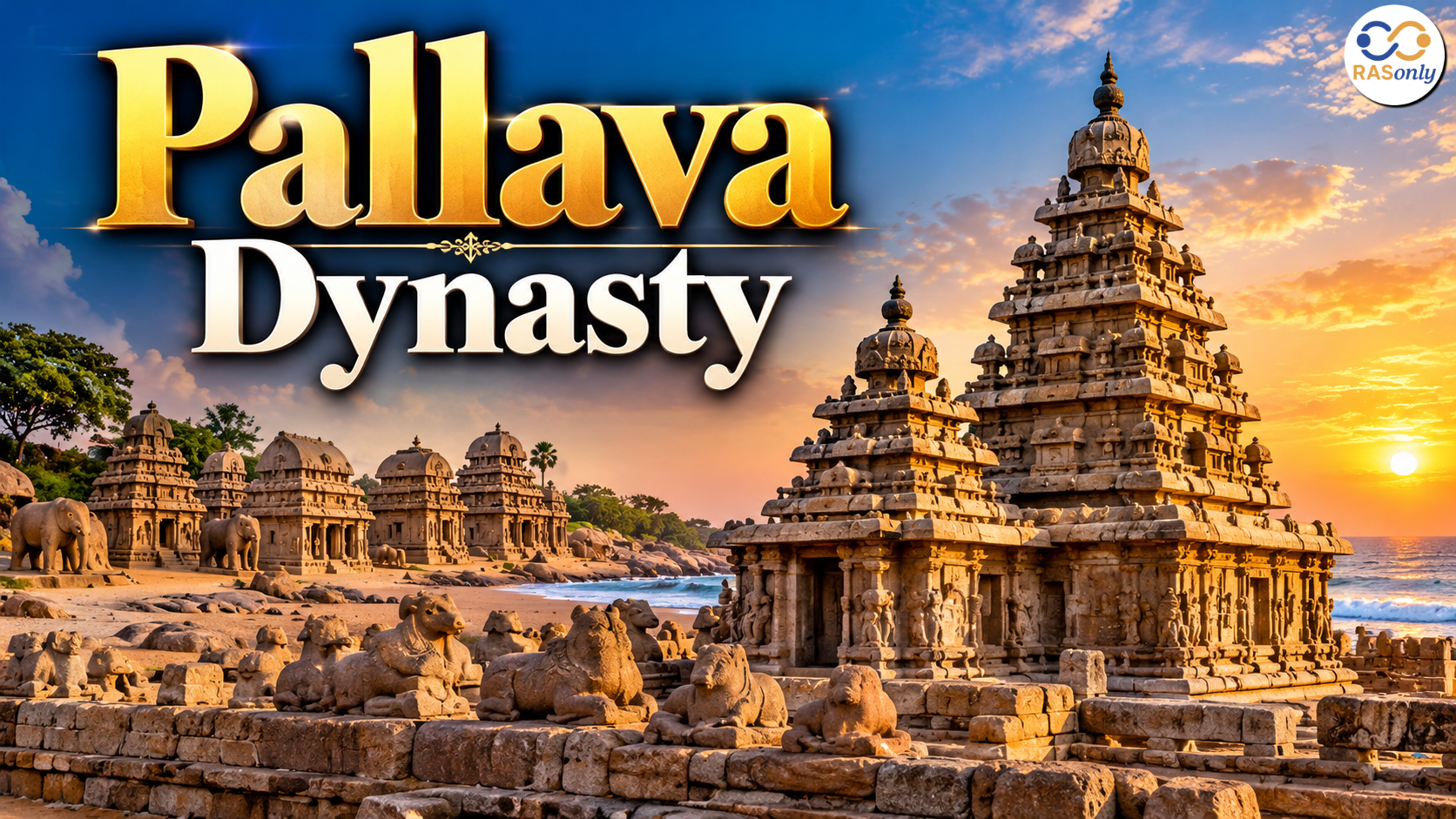
Pallava dynasty is one of the most influential dynasties in South Indian history. It played an important role in the political, cultural, religious and architectural development of the Deccan and Tamil region. During the Pallava period, Kanchipuram became a major centre of political power, Hindu learning, and Hindu religion. In identifying their rule, there is a special fervour of memory for their contribution to Dravidian temple architecture, rock-cut monuments and stone temples at Mahabalipuram. Other regions of India and Asia by the Pallavas. They played an important part in early medieval India as sculptors, Sanskrit scholars and contributors to temple building and Tamil culture.
Historical Background of the Pallava Dynasty
The Pallavas began to dominate the southern part of India during the early Common Era. They built up their political influence especially from the 6th to 9th century CE, when they rivalled their neighbouring kingdoms for control of vital lands.
Nowadays, this city called Kanchipuram in the state of Tamil Nadu has grown to be their main capital city with great significance for religion, learning and commerce.
Origin and Early History
Historians are uncertain about the origin of the Pallavas. Early inscriptions, in addition to the later records, give them information about their political evolution, religious patronage, and royal families.
Important points about their early history include:
- Region: mainly in the north of Tamil Nadu and bordering areas in southern India.
- Capital: Kanchipuram.
- Period of major political influence: The 6th to 9th centuries CE the most influential periods in the political history of the region.
- Major rivals: Chalukyas of Badami, Pandyas, others regional powers.
- Historical importance: The development of temple architecture, sculpture and royal administration.
Kings like Simhavishnu and Mahendravarman I, one of the dominant powers in southern India.
Important Rulers of the Pallava Dynasty
The political and cultural achievements of the Pallavas were closely associated with their major rulers. Some kings expanded the kingdom through military campaigns, while others encouraged architecture, literature and religious institutions.
| Ruler | Major Contribution |
|---|---|
| Simhavishnu | Expanded Pallava power and strengthened the kingdom |
| Mahendravarman I | Promoted rock-cut architecture and was associated with literary activity |
| Narasimhavarman I | Defeated the Chalukya ruler Pulakeshin II and captured Vatapi |
| Mahendravarman II | Continued the dynasty's rule after Narasimhavarman I |
| Paramesvaravarman I | Fought against the Chalukyas and defended Pallava interests |
| Narasimhavarman II (Rajasimha) | Supported major structural temple projects, including the Shore Temple tradition |
| Nandivarman II | Strengthened the dynasty during a period of political challenges |
| Dantivarman | Ruled during a period of increasing regional pressure |
Simhavishnu: Expansion of Pallava Power
Simhavishnu was an important early king who aided the foundations of the Pallavas as a powerful kingdom in southern India.
- Spread of Pallava influence in the Tamil area.
- Strengthened the political position of the dynasty.
- Contributed to the later Pallava military and cultural accomplishments.
- He was the first monarch in a dynasty that was unprecedented architectural and political advancement.
Mahendravarman I: Patron of Rock-Cut Architecture
Mahendravarman I was the first king in his lineage to be interested in the arts and sciences, including sculpture, architecture and literature and ruled during the early 7th century CE.
Promoted the building of cave temples made of rock.
- Was a link between the earlier Pallava architectural tradition.
- His rock-cut temple inscriptions are valuable evidence of history.
- He was also a writer and is associated with the Sanskrit satirical play, Mattavilasa Prahasana.
- He had to deal with Satta Vishnuchitta Pulakeshin II, a Chalukya king.
Narasimhavarman I: The Victorious King
Narasimhavarman I (d. c. 668 CE) ruled over the Pallava kingdom at a time when it was at its peak. He is also known as Mamalla, which means a great wrestler.
- Defeated the Chalukya ruler Pulakeshin II.
- In 642 CE they captured the capital of the Chalukyas, Vatapi.
- Was involved in the development of Mahabalipuram, known as Mamallapuram.
- Strengthened the military influence of the Pallava king in the south of India.
- His reign is of special significance in the monuments and Pallava sculpture.
Narasimhavarman II (Rajasimha): A Major Temple Builder
Narasimhavarman II (Rajasimha), popularly known as Rajasimha, was a ruler of the late 7th and early 8th century CE. A vital period in which his rule was important for the development of structural stone temples.
- Associated with the Shore Temple at Mahabalipuram.
- Supported the Kanchipuram Kailasanathar Temple, one of the earliest examples of Dravidian structural architecture.
- Believed in and sponsored religion and arts.
- Contributed to a more sophisticated form of stone temple-building.
Nandivarman II: A Ruler During Political Challenges
politics and competition between the various South Indian states, Nandivarman II or Pallavamalla, ascended to the throne.
- Ruled in the 8th century A.D.
- Fought wars against neighbouring powers, the Chalukyas and Pandyas.
- Involved in the building of the Vaikunthus Perumal Temple of Kanchipuram.
- Pallavas maintained their political and cultural significance even in the face of regional rivalries, as witnessed by their rule.
Pallava Administration
The Pallava Government amalgamated royal authority with local institutions. The king was the main figure in politics, war affairs, etc., and officials and local authorities assisted him in running the kingdom.
Main Features of Administration
- King: held authority in political, military and administrative affairs.
- Ministers & officials: helped the ruler govern & administer.
- Territorial divisions: The kingdom was divided regionally and into local settlements.
- Village administration: Local assemblies and village institutions village affairs, but in different ways from one place and time to another.
- Revenue: Land revenue was a significant source of state revenue.
- Military: They protected the kingdom and launched military campaigns against their rivals, competing kingdoms.
Administrative Structure
| Administrative Element | Main Role |
|---|---|
| King | Supreme political and military authority |
| Ministers and officials | Assisted in governance |
| Regional administrators | Managed territorial affairs |
| Village institutions | Participated in local administration |
| Revenue officials | Helped collect and manage taxes |
| Army | Protected the kingdom and supported military campaigns |
Pallava Art and Architecture
The Pallavas' Indian architecture. From rock-cut caves to freestanding structural temples of stone. Development is particularly important at Mahabalipuram and Kanchipuram.
Major Stages of Pallava Architecture
| Architectural Stage | Main Features | Important Examples |
|---|---|---|
| Rock-cut architecture | Shrines carved directly into rock | Mandagapattu and Mahabalipuram cave temples |
| Monolithic architecture | Entire monuments carved from single rock formations | Five Rathas at Mahabalipuram |
| Structural architecture | Temples built using stone blocks | Shore Temple and Kailasanathar Temple |
| Mature temple design | More developed temple plans, shrines and sculptural decoration | Kailasanathar Temple and Vaikuntha Perumal Temple |
Mahabalipuram: A Centre of Pallava Sculpture
Mahabalipuram or Mamallapuram rose to prominence as a hub of artistic patronage of the Pallava kings. So its monuments illustrate the intellectual creativity of the Pallava sculptors and builders.
Important monuments include:
- Five Rathas: The statues are not just those of functional temples of the Pandavas but are named after characters in the Mahabharata.
- Arjuna's Penance: A massive rock relief that shows a complex scene with divine, human and animal figures. There is a wide range of readings of its central story.
- Shore Temple: A structural stone temple complex overlooking the Bay of Bengal, which is related to the rule of Narasimhavarman II.
- Cave temple: Pillars, sculptures and religious imagery carved into rocks within a cave.
Kailasanathar Temple at Kanchipuram
Kailasanathar Temple is one of the significant examples of the Pallava type of structural temple. It seems to have been built under Narasimhavarman II, also called Rajasimha.
Key features include:
- Dedicated to Lord Shiva.
- Built mainly from sandstone.
- Contains a central shrine and a superstructure of a pyramid form.
- Sculptural panels and other small shrines are installed around the main temple.
- Exhibits understanding of how architectural forms developed and influenced later temple building in South India.
Religious Art and Sculpture
- Hindu religious traditions like Shaivism and Vaishnavism can be found at Pallava monuments. They have images of Shiva, Vishnu, gods, goddesses, guardians and mythological scenes in their temples.
- In addition, Pallava rulers every now and then patronised Jainism and Buddhism. Throughout the entire Pallava dynasty, they were patrons not only of one institution.
Religion During the Pallava Period
The Pallava architecture, literature, and royal patronage reflect the influence of religion. Hindu temples started being places of worship and eventful religious activity, and in the religious landscape of the south, Jainism and Buddhism also had a place.
Major developments included:
- Shaivism: Grew into patronage from royal circles, especially those of several large Pallava kings.
- Vaishnavism: Temples and Religious traditions under the Pallavas are of great importance.
- Bhakti movement: Shaiva Nayanars and Vaishnava Alvars popularised devotional worship in Tamil-speaking areas.
- Jainism and Buddhism still played a role within the wider landscape of religion.
- Temple patronage: Royal gifts and land grants supported temples and religious institutions.
Literature, Language and Education
The Pallavas nurtured literary and intellectual traditions. Sanskrit remained significant in royal inscriptions and upper-class literary culture, and Tamil grew independently of it following the literary and devotional traditions of the people.
- Sanskrit: Used in many royal inscriptions and literature.
- Tamil: Important in regional cultural life and devotional literature.
- Mahendravarman I: Sanskrit play Mattavilasa Prahasana.
- Religious literature: Nayanars, Alvars: development of devotional traditions.
- Kanchipuram: as an important centre of religious learning and intellectual activity.
Economy and Trade Under the Pallavas
The economy of the Pallavas was based on agriculture, with crafts, internal and external commerce and sea trade promoting prosperity in the region. The kingdom's location facilitated trade with other areas and coastal settlements.
Important features included:
- Agriculture: Farming was an important economic activity.
- Irrigation: Water management that affected agricultural production.
- Craft production: They were small-scale producers who traded with the artisans.
- Trade: coastal settlements and trading networks linked with other parts of India and with the markets of the outside world.
- Temples & land grants: a way of giving land and resources to the priests and to tie them to the local economy.
The figures of trade and economic activities varied from region to region and from time to time, and therefore were not uniform throughout the Pallava rule.
Decline of the Pallava Dynasty
The Pallava kingdom came to an end of political authority slowly by the 9th century CE. Its situation was made more precarious by numerous wars with neighbouring dynasties, and the Cholas grew more dominant in the Tamil Realm.
The major reasons for the decline included:
- Military conflicts: With wars against the neighbouring powers, namely the Pandyas and Chalukyas, kings of stress were readied upon the kingdom.
- Regional competition: The territories and influence of rival dynasties expanded.
- Rise of the Cholas: The Cholas became a big political power in southern India.
- Loss of political control: Pallava strength over significant territories declined over time.
Pallava Dynasty - FAQs
The exact founder of the Pallava Dynasty is uncertain. Simhavishnu is considered a key early ruler who strengthened the dynasty and expanded its political influence.
Kanchipuram, in present-day Tamil Nadu, was the principal capital of the Pallavas.
Narasimhavarman I was one of the most famous Pallava rulers because he defeated Pulakeshin II of the Chalukya dynasty and captured Vatapi.
The Shore Temple at Mahabalipuram is associated with Narasimhavarman II (Rajasimha).
The Pallavas helped develop rock-cut caves, monolithic monuments and structural stone temples. Their architectural achievements at Mahabalipuram and Kanchipuram influenced later South Indian temple architecture.

BEST SELLER
🏆 PRELIMS
RAS Pass
Prelims focused Hindi & English
₹399
✓
Prelims Topic-Wise Tests
✓
Subject-Wise Tests
✓
Full-Length Prelims Tests
✓
Daily Current Affairs Tests
✓
Prelims PYQs Tests
✓
Detailed Solutions & Analysis
✓
All Rajasthan Ranking
✓
Unlimited Reattempts
✓
Mains Tests
✓
Hindi & English Tests
✓
All Rajasthan Ranking
Trusted by 5,000+ Students
Post Category
- RAS Salary
- Result
- RAS Admit Card
- RAS Job
- RAS Cutoff
- Preparation Tips
- RAS Answer Key
- RAS Exam Analysis
- RAS Syllabus
- RAS Previous Year Papers
- RPSC RAS Exam Pattern
- RAS Interview
- RAS Exam Date
- RAS Vacancy
- RAS Test Series
- RAS Best Books
- RAS Preparation Resources
- RAS Coaching Centre
- History
- Polity
- Geography
- Economics
- Science
- Art and Culture
- RPSC RAS Application Form
- RPSC RAS Notification
- RAS Eligibility Criteria
- UPSC Exam
- RPSC RAS Mains
Visit Our RASonly Offline Center
Our Expert Faculty

Bhunesh Sir
Current Affairs · 13+ Yrs

Aamir Khan Sir
RAS-2017 · IIM Ahm.
Akash Sir
Polity · 8+ Yrs
Free Resources
Official Mobile App

RASOnly App
by OTSAdda · Free
Full Video Lectures
Mock Tests & PYQs
Daily Current Affairs
AI Mock Interview
Free Download · No subscription needed to install
RAS 2024 Toppers — RASonly
Rank 2
Virendra Charan
Rank 9
Bhoopinder Singh
Rank 26
Aanchal Nagpal
Rank 33
Lokendra Singh
Rank 45
Amar Rathore
Rank 46
Manasvini Verma

Join RASonly WhatsApp Community
Get daily current affairs, exam alerts, free study material and tips from expert faculty — right on WhatsApp.
Join for Free →RASonly Interview Guidance Program

Mr. Ashok Jain
Ex-Chief Secretary Govt of Rajasthan
- IAS officer of the 1981 batch, Rajasthan cadre.
- Passionate about mentoring the next generation of RAS officers with real-world insights.
- Got retired in Dec 2017 from the post of Chief Secretary of the state of Rajasthan.

Mr. Guru Charan Rai
Ex-ASP / SP in Jaisalmer
- Guru Charan Rai, IPS (Retd), retired as Inspector General of Police (Security), Rajasthan, Jaipur in 2017.
- Served as ASP and SP in Jaisalmer, Nagaur, Sri Ganganagar, Sawai Madhopur, Dausa, Sikar, and Karauli.
- He also held key positions as DIGP and IGP in the Law and Order division.

Mr. Rakesh Verma
Ex-IAS Officer, B.Tech, MBA, and M.A. (Economics)
- IAS officer of the 1981 batch and retired in Chief Secretary Rank.
- Civil servant of high repute and vast experience.
- Has been teaching UPSC CSE subjects for the last six years.
Related Post
Daily Current Affairs for RAS Exam Preparation 2026

Public Pledge Against Drug Abuse
October 10, 2026
Rajasthan CM Announces 100-Day Urban Development Roadmap
October 10, 2026
Khelo Rajasthan Campaign
October 09, 2026