Gupta Empire, Founder, Time Period, Rulers, Map, Capital City
Gupta Empire, Founder, Time Period, Rulers, Map, Capital City

Get in Touch with RASonly!

The Gupta Empire was a powerful ancient Indian dynasty that ruled northern India from around 320 CE to the mid-6th century CE. Founded by Sri Gupta and strengthened by Chandragupta I, it flourished under Samudragupta and Chandragupta II, and is widely celebrated as the Golden Age of ancient Indian culture.

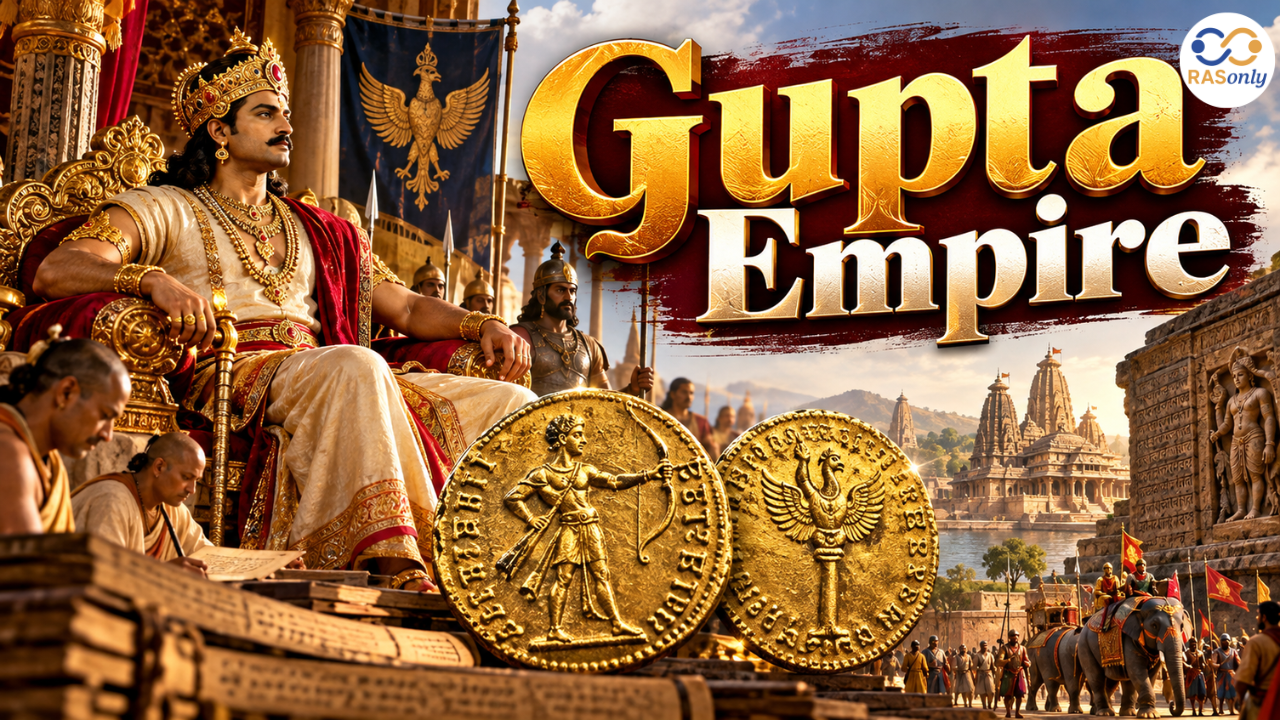
The Gupta Dynasty was a prominent dynasty that once ruled over the Indian subcontinent shortly after the fall of the Mauryan dynasty. It gained popularity in the north in the 4th century CE and eventually began to rule over extensive regions in the Gangetic plain and central India. The era was notable for the progress of its literature, science, mathematics, astronomy, art, architecture and education.
With the emergence of Gupta power, there was relative political stability in most parts of the northern regions of India. The empire was extended by strong kings like Chandragupta I, Samudragupta and Chandragupta II through military exploits, marriage, and policies. Subsequent emperors like Kumaragupta I and Skandagupta had to deal with more threats which ultimately undermined the influence of the empire.
The Gupta period has been referred to as the Golden Age of ancient Indian culture, though this more or less embraces the extraordinary intellectual and cultural achievements.
Rise of the Gupta Empire
- The early Gupta rulers ruled a relatively small area in the northern parts of India, especially present-day eastern parts of Uttar Pradesh and Bihar. The dynasty slowly gained political prominence and eventually became a great empire.
- The real impetus to the rise of Gupta power came with Chandragupta I. He bestowed upon himself the title of Maharajadhiraja showing the increasing importance of the dynasty. His marriage with Lichchhavi princess Kumaradevi also aided in forming the political situation of the Guptas.
- Chandragupta I was replaced by his son, Samudragupta whose military efforts led to the growth of the Gupta kingdom in terms of political power. He is credited with many achievements; they are chronicled in his court poet Harisena's Allahabad Pillar Inscription.
Who Was the Founder of the Gupta Empire?
The question of the Gupta Empire founder needs a small clarification because historians distinguish between the founder of the Gupta dynasty and the ruler who established its imperial power.
Sri Gupta was the founder of the Gupta Empire.
- Sri Gupta is considered as founder of Guptas. He was the first of the ruling family called the Gupta and was the founder of it which eventually emerged as a formidable empire.
- He was succeeded by Ghatotkacha, after whom Chandragupta I emerged as the first major Gupta monarch.
Chandragupta I: Founder of Imperial Gupta Power
- Chandragupta I is often described as the founder of the Gupta Empire in the imperial sense because he transformed the relatively small Gupta kingdom into a major political power.
- He assumed the title Maharajadhiraja and ruled from Pataliputra. His marriage with Kumaradevi of the Lichchhavi family further strengthened the Gupta position in northern India. also identifies Chandragupta I as the first important Gupta monarch.
- Sri Gupta: Founder of the Gupta Dynasty
- Chandragupta I: First major imperial Gupta ruler
Gupta Empire Time Period
- The Gupta dynasty existed during the time period 320–500 CE.
- The Gupta Empire era is said to have covered the early 4th century - the middle of the 6th century CE. The Gupta Age can be dated anywhere from 319-550 C.E. by, with historians disagreeing on the precise timing of the early dynasty and the subsequent period of Gupta rule.
- The emancipation time of the imperial gupta period is cognized with pursuance of Chandragupta I, around 319-320 CE.
Early Gupta Expansion
The dynasty started as a local power and became a significant kingdom under Chandragupta 1.
Imperial Expansion
Both Samudragupta and Chandragupta II extended Gupta power throughout northern and western and into central and other parts of India.
Later Gupta Period
The influence of central Gupta authority waned, and the Empire was subjected to a series of military, political and economic threats after Kumaragupta I and Skandagupta.
Gupta Empire Rulers
The rise and rule of able kings has been intimately linked to the history of the Gupta Empire. The empire was expanded, administered or developed culturally in various ways by each of the major rulers.
Chandragupta I
- Chandragupta I was the first emperor who gave an imperial character to the Gupta dynasty. Tradition attests to the start of the Gupta era around 319-320 CE under his reign.
- His marriage was to Kumaradevi, a Lichchhavi princess, which was a politically significant alliance. Coins in the name of Chandragupta I and Kumaradevi are in themselves an important source for this relationship.
- Known as his kingdom, it comprised Magadha, Saketa and Prayaga and Pataliputra as the capital.
Samudragupta
- Samudragupta was one of the most powerful rulers of Gupta dynasty. He pursued an active policy of conquest and greatly extended Gupta influence.
- He is mentioned in the Allahabad Pillar Inscription which was written by Harisena. The inscription talks about his campaigns in north, central and southern India.
- Samudragupta was not consistent in the policy. In the Ganga-Yamuna area, a few rulers fell and their land was annexed by the Gupta Empire. In southern India, many defeated rulers were allowed to continue ruling after accepting Gupta supremacy.
- This policy worked for him because he was able to rule a vast region, but he did not control all the states he conquered.
- Samudragupta wasn't just a military ruler. He was also associated with poetry, music and learning. He's also depicted in his coins playing the vina, indicating his love of music. He also conducted Ashvamedha sacrifice and minted Ashvamedha coins.
Chandragupta II
- Another great ruler of the Gupta dynasty was Chandragupta II. Vikramaditya is traditionally his title.
- His major accomplishments included the subjugation of the rulers to the west of India. This expanded influence from the Gupta side was towards western India and this opened up opportunities for the empire in important commercial centers.
- His ties with the Vakatakas were strengthened when his daughter Prabhavati Gupta was wed to Rudrasena II. This facilitated the acquisition of interests in the Deccan territory by the Guptas.
- Chandragupta II was also the time of significant periods of cultural and intellectual reform. During this period Chinese Buddhist erstwhile traveller Fa-Hien visited India and gave anecdotes over there.
Kumaragupta I
- Chandragupta II was succeeded by Kumaragupta I who ruled for a long time. With respect to his reign it could be considered that it was a relatively stable and prosperous time.
- He retained the political structure of the Guptas and inspired them to the same traditions. He is also known for having established Nalanda as a learning centre.
Skandagupta
- Skandagupta was one of the least powerful rulers of the Gupta dynasty.
- He is significant, as the threat from Hunas increased during his reign. He was able to ward off large scale invasions but all these battles brought increasing stresses on the Gupta regime.
- The political clout of the empire soon waned, and later rulers were unable to deal with its increasing troubles as a dynasty.
Gupta Empire Map and Territorial Expansion
- The Gupta Empire map shows the core of the empire in the Gangetic plains, with Gupta influence expanding towards central, western and eastern India.
- Samudragupta was the ruler who gave Gupta power a significant political expansion and conquest. Not all the region under the Gupta's control was, however, directly controlled.
- Direct control of the Gupta dynasty yielded a core of territory in the Ganga Valley, and several other kingdoms acknowledged Gupta hegemonies and either paid homage or were subordinate to the Guptas.
- As one looks at the size of the Gupta empire it is important to understand that political influence does not necessarily equal direct territorial control.
What Was the Capital of the Gupta Empire?
- The principal capital of the Gupta empire was Pataliputra. It was situated in modern day Patna, Bihar and it continued to be an important political hub in the Gupta era.
- Chandragupta I reigned over significant areas such as Magadha, Saketa and Prayaga, and had Pataliputra as his capital.
- Ujjain also became an equally significant center during the latter era of the Gupta expansion especially following the conquests of Chandragupta II in Western India.
- So, if you were to ask the question "What was the capital of the Gupta empire?", the most common response would be Pataliputra.
Gupta Empire Administration
- A Gupta Empire administration was implemented in different territorial/ administrative units. The lower and upper echelons of office, as well as sub-kings and local governors, were also significant.
- The empire was under the control of provinces that were termed as Bhuktis, which were then subdivided into smaller administrations that were called as Vishayas.
- High-ranking officials were part of the provincial administration, and local and district administration comprised various local representatives and officers.
- As a subordinate ruler system was also in use in several parts of the Gupta state, it became a source of instability. Many rulers remained loyal and were not ousted from power but were still subject to the Gupta kings.
Decentralisation of Administration
- An important aspect of the later Gupta administration was the growing emphasis placed on land grants. In some instances these grants even covered administrative rights, leading to a decentralisation of political power.
- This gradual change was important in the significance for the late period of the diminishment of the Gupta central control.
Gupta Empire Economy
- The economy was based primarily upon agriculture in the Gupta state. Land revenue was a key source of income and other economies included trade, crafts and commercial activities.
- Perhaps evident of the economic and political strength of the period, was the debating of gold coins of excellent grade made by the Gupta rulers.
- Chandragupta II extended his kingdom to western India, thus providing the Guptas with significant commercial sections.
- Meanwhile, there was growing reliance on land grants, and some evidence of the decline of long-range trading during the later Gupta phase. These changes played a role in the economic pressures in the state.
Gupta Empire Art and Architecture
- The Gupta Empire art and architecture represents one of the most important stages in the development of classical Indian art.
- In these times, the art of sculpture increased in refinement and the art of building temples reached a high degree of development. Art traditions continued with the Hindu, Buddhist and Jain.
Sculpture and Temple Architecture
- Gupta artists created very refined images, appealing proportions and serenity of expression. The art styles of Mathura and Sarnath got more relevant.
- During this time, the structural temples were also developed. The temples at Deogarh (Dashavatara) and Bhitargaon are among the important examples of Gupta period architecture.
- The Udayagiri Caves are also an important example of Gupta period religious art, especially theVaraha relief.
Gupta Empire Literature and Learning
- During the era of the Guptas, Sanskrit literature, poetry, and ideas significantly flourished.
- The most popular writer of this classical Sanskrit tradition is Kalidasa. He is the author of works such as Abhijnanashakuntalam, Raghuvamsha and Meghaduta.
- During this time, there was also the emergence of academic focuses in grammar, philosophy, astronomy, and other disciplines.
- There is also a navaratna association held in the court of Chandragupta II. The entire traditional list, however, should be handled with caution, however, since the historical evidence that the same court horizontally operated in the manner described in later traditions is not equally reliable for each of them.
Gupta Empire Science and Technology
Indian mathematics, astronomy and metallurgy has become a most sensitive period with respect to the Gupta period.
Aryabhata and Mathematics
- One of the greatest scholars of this era was Aryabhata. The Aryabhatiya, a work of mathematical calculations and astronomy written around 499 CE, is his work.
- He used to have other important mathematical ideas and astronomical concepts such as calculating planetary movements, eclipse and trigononometry.
Astronomy
- Indian agriculture got a boost from the Gupta period scholarship for Indian astronomy. The astronomers had been observing the motions of planets in the sky and had techniques for making mathematical predictions in astronomy.
Metallurgy
- The Mehrauli Iron Pillar stands as an Archaeological momentous example of the advanced level of metallurgical knowledge acquired during the Gupta Period. In the study of ancient Indian metallurgy it has proved an important subject because of its astonishing corrosion-resisting properties.
Gupta Empire Religion
- Brahmanical Hindu traditions were intertwined with the Gupta rulers, in addition to Buddhism and Jainism prevailing in the region.
- Hindu religious art and temple architecture flourished, especially Vaishnava art and Shaiva architecture, and was also supported by the patronage of the kings.
- Meanwhile, Buddhist institutions were also being supported on a different segment in various areas. It is, therefore, not only a religious atmosphere for Buddhism, as is often claimed, but several faiths.
Gupta Empire and Fa-Hien
- Fa-hien, a Chinese Buddhist traveller visited India during the period of reign of Chandra gupta-II.
- It is a significant source for the social and religious atmosphere of Gupta period for his travel account. His sketches offer glimpses into the lives of cities, Buddhist institutions, individuals and general conditions in portions of India.
- Foreign documents like those of Fa-Hien are of special interest, because what they offer is an external view from other angles besides inscriptions, coins, and literary sources.
Why is the Gupta period called the Golden Age?
The Gupta period has been referred to as an 'age of gold' for India because of its amazing development of various aspects of intellectual and cultural life.
The period witnessed:
- Major Sanskrit literary works
- Exceeding the development of mathematics and astronomy which were significant.
- Refinement in sculpture
- The small community structure temple commenced to expand.
- Advances in metallurgy
- Widespread spread of the educational culture.Spread of educational traditions.
- Extensive gold coinage
- Establishing the classic Indian cultural forms
But ‘Golden Age' has to be taken primarily within the cultural, intellectual and artistic dimension. It was not an era of uniformity of prosperity for all classes of society; there were social inequalities and hierarchy in the period.
Decline of the Gupta Empire
It was a gradual process that led to the fall of the Gupta Empire rather than one single event.
Huna Invasions
The Huna attack made a deep impression on the Gupta state. Skandagupta was victorious over the Hunas; however, there were further conflicts that depleted imperial forces.
Weakening Central Authority
In the absence of strong rulers, later Gupta rulers were not as effective in maintaining control in far away territories. Marginal chiefs and feudatories acquired increasing levels of strength.
Political and Economic Pressure
- Limited central authority was due to succession disputes, regional autonomy, land grants and the expense of maintaining military power.
- With the downfall of Gupta power a number of local powers rose. The Gupta Empire was not as significant in its former political role by the mid-6th century CE.
Historical Sources for the Gupta Empire
- Literary sources, inscriptions and coins, plus foreign accounts, provide sources of knowledge about the Gupta period.
- One of the best sources regarding the reign and military exploits of Samudragupta is the Allahabad pillar inscription. The information about the administration and repair of the Sudarshan Lake is given in inscriptions in the name of Silver coins by the Gupta period of which is found in Junagadh.
- Coins of the Gupta period are also of immense importance as they also portray the royal title, religious symbol, military success and royal events.
- From the account of Fa-Hien the perspective shifted to that of society and religious life during the reign of Chandragupta II.
- These sources help the historian to trace the political, economic and cultural history of the Gupta Empire in their entirety.
Gupta Empire: Historical Significance
- The Gupta Empire is a pivotal era in the history of ancient India due to its integration of political expansion and cultural development on a massive scale.
- It enhanced the political power in Northern India and academics, artists and writers left a lasting legacy in India's intellectual heritage. The period also saw significant advances in sculptures, mathematics, astronomy, and metallurgy; and temple structure.
- Indian tradition went on influencing the political and cultural way of living in the country even after the fall of the imperial system.
Frequently Asked Questions About Gupta Empire
Sri Gupta is generally regarded as the founder of the Gupta dynasty, while Chandragupta I is considered the first major ruler who established the Gupta Empire as an imperial power.
The Gupta Empire is generally associated with the period from around 320 CE to the middle of the 6th century CE. NIOS gives the Gupta Age as approximately 319–550 CE.
Pataliputra was the principal capital of the Gupta Empire. Ujjain was another important political and cultural centre.
Samudragupta is widely regarded as one of the greatest Gupta rulers because of his extensive military campaigns and expansion of Gupta influence.
Chandragupta II adopted the title Vikramaditya, traditionally associated with his power and victory, particularly after the defeat of the Shaka rulers of western India.

BEST SELLER
🏆 PRELIMS
RAS Pass
Prelims focused Hindi & English
₹399
✓
Prelims Topic-Wise Tests
✓
Subject-Wise Tests
✓
Full-Length Prelims Tests
✓
Daily Current Affairs Tests
✓
Prelims PYQs Tests
✓
Detailed Solutions & Analysis
✓
All Rajasthan Ranking
✓
Unlimited Reattempts
✓
Mains Tests
✓
Hindi & English Tests
✓
All Rajasthan Ranking
Trusted by 5,000+ Students
Post Category
- RAS Salary
- Result
- RAS Admit Card
- RAS Job
- RAS Cutoff
- Preparation Tips
- RAS Answer Key
- RAS Exam Analysis
- RAS Syllabus
- RAS Previous Year Papers
- RPSC RAS Exam Pattern
- RAS Interview
- RAS Exam Date
- RAS Vacancy
- RAS Test Series
- RAS Best Books
- RAS Preparation Resources
- RAS Coaching Centre
- History
- Polity
- Geography
- Economics
- Science
- Art and Culture
- RPSC RAS Application Form
- RPSC RAS Notification
- RAS Eligibility Criteria
- UPSC Exam
- RPSC RAS Mains
Visit Our RASonly Offline Center
Our Expert Faculty

Bhunesh Sir
Current Affairs · 13+ Yrs

Aamir Khan Sir
RAS-2017 · IIM Ahm.

Akash Sir
Polity · 8+ Yrs
Free Resources
Official Mobile App

RASOnly App
by OTSAdda · Free
Full Video Lectures
Mock Tests & PYQs
Daily Current Affairs
AI Mock Interview
Free Download · No subscription needed to install
RAS 2024 Toppers — RASonly
Rank 2
Virendra Charan
Rank 9
Bhoopinder Singh
Rank 26
Aanchal Nagpal
Rank 33
Lokendra Singh
Rank 45
Amar Rathore
Rank 46
Manasvini Verma

Join RASonly WhatsApp Community
Get daily current affairs, exam alerts, free study material and tips from expert faculty — right on WhatsApp.
Join for Free →RASonly Interview Guidance Program

Mr. Ashok Jain
Ex-Chief Secretary Govt of Rajasthan
- IAS officer of the 1981 batch, Rajasthan cadre.
- Passionate about mentoring the next generation of RAS officers with real-world insights.
- Got retired in Dec 2017 from the post of Chief Secretary of the state of Rajasthan.

Mr. Guru Charan Rai
Ex-ASP / SP in Jaisalmer
- Guru Charan Rai, IPS (Retd), retired as Inspector General of Police (Security), Rajasthan, Jaipur in 2017.
- Served as ASP and SP in Jaisalmer, Nagaur, Sri Ganganagar, Sawai Madhopur, Dausa, Sikar, and Karauli.
- He also held key positions as DIGP and IGP in the Law and Order division.

Mr. Rakesh Verma
Ex-IAS Officer, B.Tech, MBA, and M.A. (Economics)
- IAS officer of the 1981 batch and retired in Chief Secretary Rank.
- Civil servant of high repute and vast experience.
- Has been teaching UPSC CSE subjects for the last six years.
Related Post
Daily Current Affairs for RAS Exam Preparation 2026

CM Bhajan Lal Sharma Launches Rajasthan Portals
October 08, 2026
Rajasthani Film ‘Omlo’ Selected for Cannes Film Market
October 08, 2026
Rajasthan Initiative to Build India’s First UNESCO Global Geopark
October 07, 2026